API Testing with AI in 10 minutes
AI for API testing means a model reads your API definition, writes the test requests and assertions, runs them, and tells you which failures are real bugs. You give it an OpenAPI or Postman file and a sentence about what to check; it gives back runnable tests. The part that still needs you is deciding which tests to keep. This guide shows what AI does well in API testing, where it stops, and how to create your first AI-written API tests in Qodex in about ten minutes.
What AI does in API testing, and what it does not
| Job | What AI does | What you still decide |
|---|---|---|
| Test design | Reads the spec and proposes positive, negative and edge cases per endpoint | Which cases matter for your business rules |
| Test data | Fills request bodies with valid and invalid values | Which accounts and records are safe to use |
| Chaining | Links calls, such as create an order, then fetch it, then delete it | The flows your customers actually run |
| Auth and security | Tries requests with no token, the wrong token, and another user's token | Which roles exist and what each may see |
| Triage | Sorts a failure into a real bug, a stale test or an environment problem | Whether to fix the code or the test |
AI is weakest where the right answer is not in the spec. If a refund must never exceed the original charge, write that rule down in the prompt, or no model will test it.
Choosing an AI API testing tool
| What to check | Why it matters |
|---|---|
| What it imports | OpenAPI, Swagger and Postman imports save you from describing every endpoint by hand |
| Whether tests are code you keep | Tests locked in a vendor format are hard to move later |
| Whether reruns call a model | If every rerun is a model call, cost grows with your suite |
| Multiple users and roles | Authorization bugs only show up when two users are logged in |
| Where runs start | Pull requests, CI, schedules and webhooks keep tests running after day one |
Two common routes: an AI feature inside a request client, such as Postman's Agent Mode, which generates tests on Postman's AI credits (50 a month on Free, 400 on Solo and Team, read on Postman's pricing page on 11 November 2026), or an agent that writes and runs the whole suite, such as Qodex. If you mainly send requests by hand and want help writing assertions, Postman is the better fit. If nobody on the team has time to write the tests, an agent is.
How to create API tests with AI in Qodex
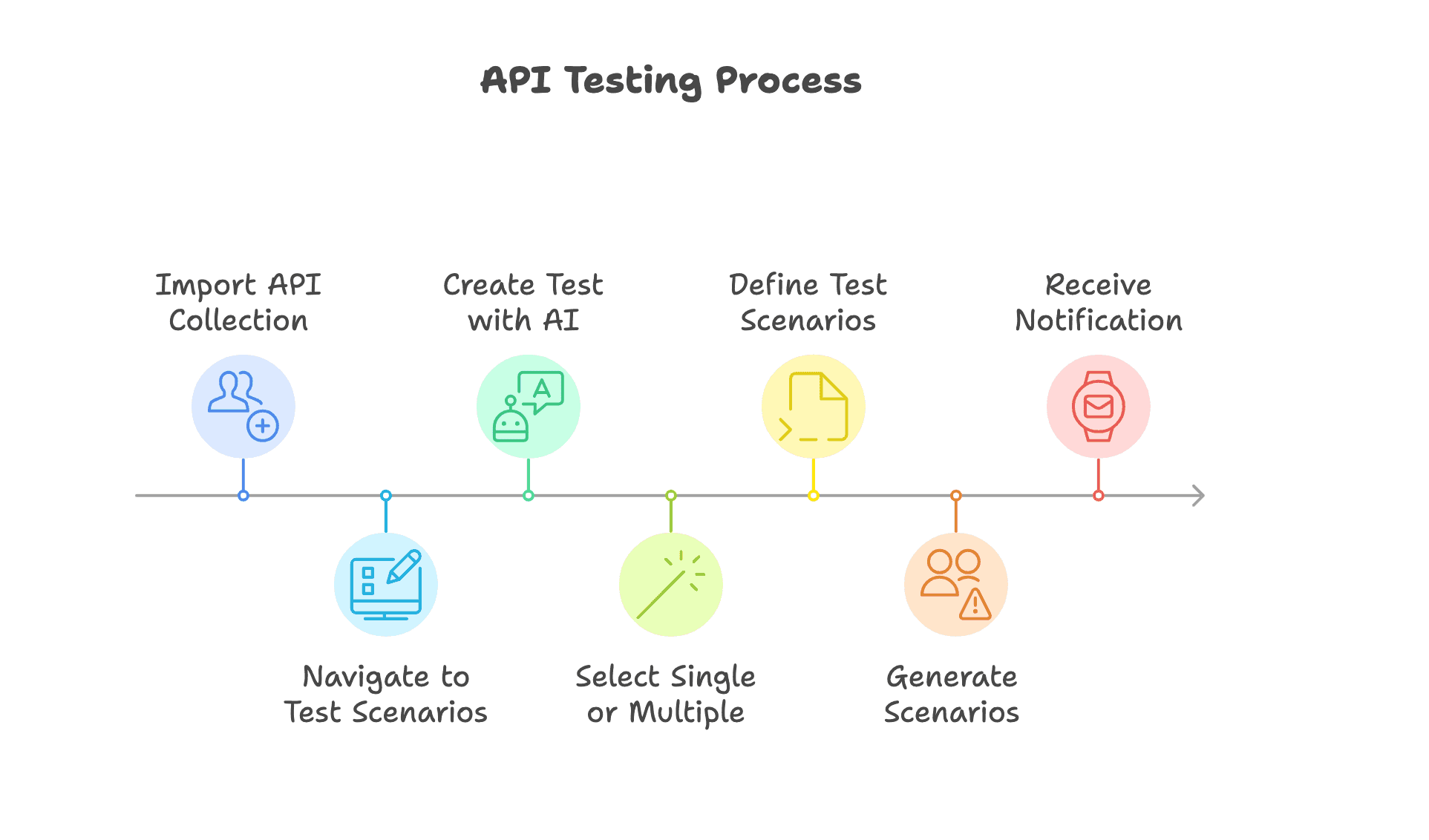
1. Import your API
Create a project and import your API definition: an OpenAPI 3.x or Swagger 2.0 file or URL, or a Postman collection. Qodex reads the auth scheme from the spec's security schemes or the collection's auth settings.
2. Point it at an environment
Add your staging base URL and test credentials. You can add several auth profiles, such as admin, regular user and viewer, so the tests can check what each role may and may not do. You can also mark an environment read-only, cap requests per second, or block destructive and security tests.
3. Describe what to test
In the chat, say what you want in plain English. For example: "Cover the orders API. Check that a viewer cannot cancel an order, and that a user cannot read another user's order." Or simply: "Find the endpoints with no tests and cover them."
4. Review the scenarios it writes
The agent writes scenarios, each with steps, assertions and a runnable script. API scenarios run against your environment as they are saved, so each arrives with a pass or fail result. New scenarios start as drafts. You read them and promote the ones you want to keep.
5. Run them on every change
Run one scenario, a tagged group or the whole suite. Schedule a nightly run, trigger runs from CI or a webhook, or run them on every pull request. Once a scenario is saved, a rerun replays the script without a model call.
Try it on your own API
Ready to try it on your own API? Start free with your OpenAPI or Postman file. The Individual plan is $0 with 25 scenarios and 100 runs a month.
AI in API testing: what the failures tell you
A failed API test means one of three things, and each needs a different person.
Real bug: the API broke. Qodex opens a finding with the failing request, the response and steps to reproduce it.
Stale test: the API changed on purpose and the test did not. The scenario is marked stale with a suggested fix.
Environment issue: staging was down or returned a 503. It is reported as an environment problem, not a bug.
Sorting failures this way is what keeps a growing suite trusted. Without it, a team learns to rerun red builds until they go green.
Frequently Asked Questions
What is AI for API testing?
It is a model that reads your API definition and writes, runs and triages API tests. You supply the spec and a plain-English goal; it returns runnable tests with assertions, and sorts failures into real bugs, stale tests and environment problems.
Can AI write API tests from a Swagger or OpenAPI file?
Yes. Qodex imports OpenAPI 3.x and Swagger 2.0 files or URLs, and Postman collections, then writes scenarios for the endpoints you ask about. It infers the auth scheme from the file.
Is AI API testing reliable?
The tests it writes are candidates. Each runs as it is saved so you see a result straight away, and new scenarios stay drafts until a person promotes them. Keep the ones that check a rule you care about.
Does AI API testing cost more as the suite grows?
It depends on the tool. In Qodex, a saved scenario reruns as a script with no model call. Tools that call a model on every run charge more as you add tests.
Can AI test API security?
It can run the common checks: requests with no token, an expired token, another user's token, and injection payloads. Qodex runs these from the same chat as functional tests, with several logged-in roles. See API security testing.
How much does Qodex cost for API testing?
Individual is $0 with 25 scenarios and 100 runs a month. Startup starts at $1,299 per project a month and Scale at $2,500 per project a month. See pricing.