10 Best End to End Testing Tools and Frameworks
End to end testing tools split into two buying models before they split into products. A framework is code your developers install, own and run: Playwright for web, Cypress for JavaScript browser workflows, Selenium for WebDriver reach, Maestro or Appium for mobile apps. A platform or commercial tool packages authoring, reporting, maintenance, hosted execution or service on top, which is where Qodex, Testsigma, Virtuoso and Ranorex sit. Decide that split first, then compare app coverage, authoring model, CI execution, debugging evidence, deployment and total cost.
Best end to end testing tools at a glance
| Tool | Type | Best for | Surfaces (web, native mobile, desktop, API) | Authoring and languages | Execution and CI | Published price |
|---|---|---|---|---|---|---|
| Qodex | Platform | Scenarios written as a sentence | Web, API | Natural language, output as Playwright and HTTP code | Hosted, runs on pull requests | $0 Individual; Startup from $1,299 per project per month |
| Playwright | Framework | Code-first web testing | Web | TypeScript, JavaScript, Python, .NET, Java | Local or CI, parallel, sharded | Free, open source |
| Cypress | Framework and cloud | JavaScript browser workflows | Web | JavaScript, TypeScript | Local runner, Cypress Cloud | App free; Cloud Starter free, Team $799 a year |
| Selenium WebDriver | Framework | Broad browser and language reach | Web | Java, Python, C#, Ruby, JavaScript | Local or Selenium Grid | Free, open source |
| Maestro | Framework | Mobile flows as YAML | Native mobile, web (in development) | YAML flows | Local devices, Maestro Cloud | CLI free, Apache-2.0 |
| Appium | Framework | iOS and Android apps | Native mobile, mobile web | JavaScript, Python, Java, Ruby, .NET | Local or remote, driver per platform | Free, Apache-2.0 |
| WebdriverIO | Framework | One Node runner, several surfaces | Web, native mobile, desktop | JavaScript, TypeScript | Local or CI, wdio runner | Free, open source |
| Testsigma | Platform | Low-code across app types | Web, native mobile, desktop | Low-code steps | Cloud, private cloud or on-premises | Custom quote |
| Virtuoso | Platform | Plain-language authoring | Web, API | Plain-language steps | Hosted, 5 to 100 parallel lanes | Custom quote |
| Ranorex | Platform | Windows desktop plus web and mobile | Web, native mobile, desktop, API | Recorder, codeless, or six coded languages | Local, remote, Grid and device clouds | Not published |
Ten tools, one fact pattern each. Every version, price, allowance, browser count and device count here is a vendor claim read on 15 September 2026, not an independent benchmark. Prices move, so open the vendor page before you sign anything.
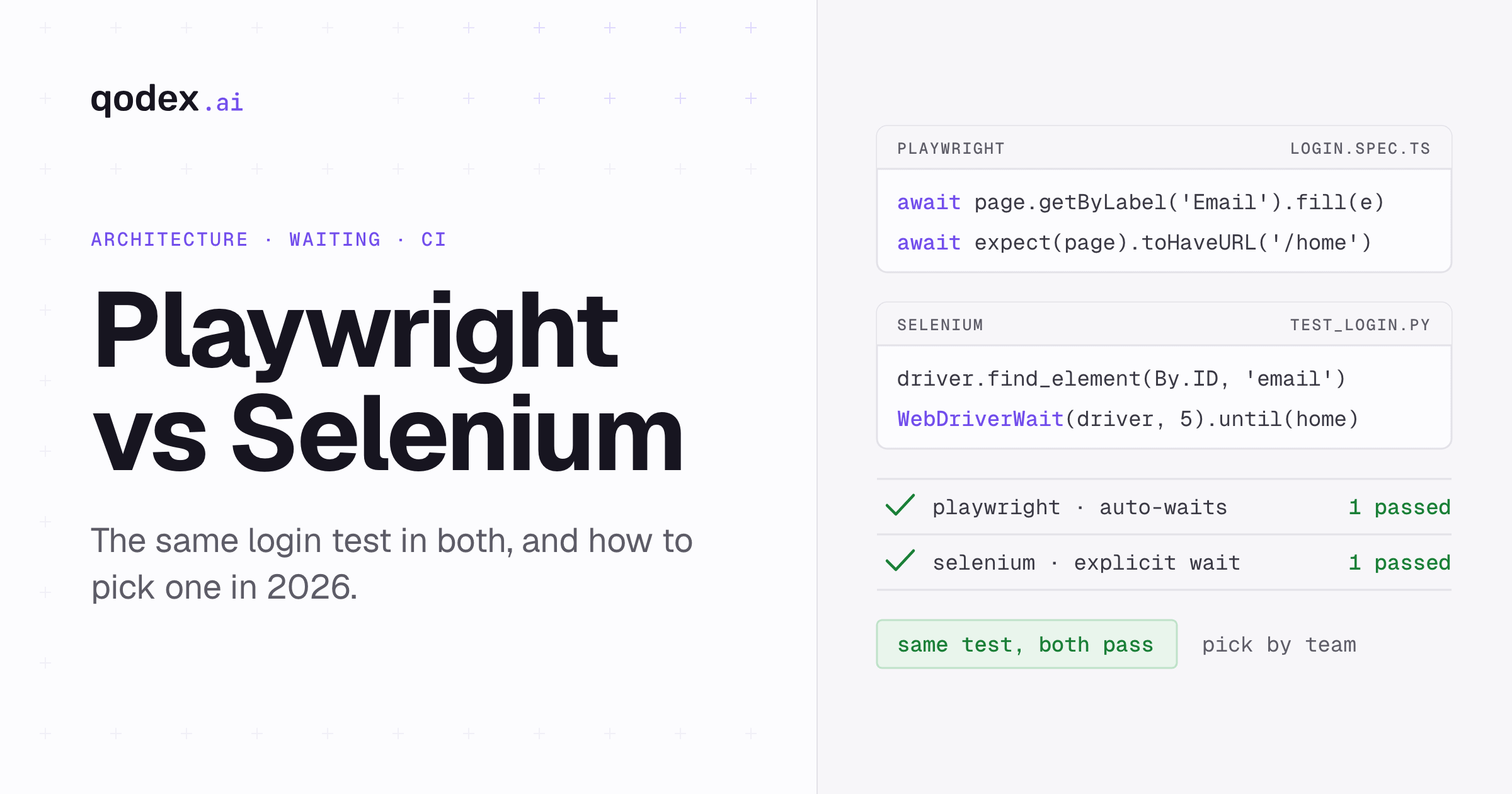
Two words in the Type column do most of the work. A framework is code your developers install and control. A platform adds hosted execution, authoring, reporting or maintenance on top, and normally a sales conversation. The split decides who owns the test code and who repairs it when a release breaks.
Where a cell reads custom quote or not published, the vendor exposes no dollar figure on its pricing page. Each entry below carries the limit the table cannot hold.
How to choose
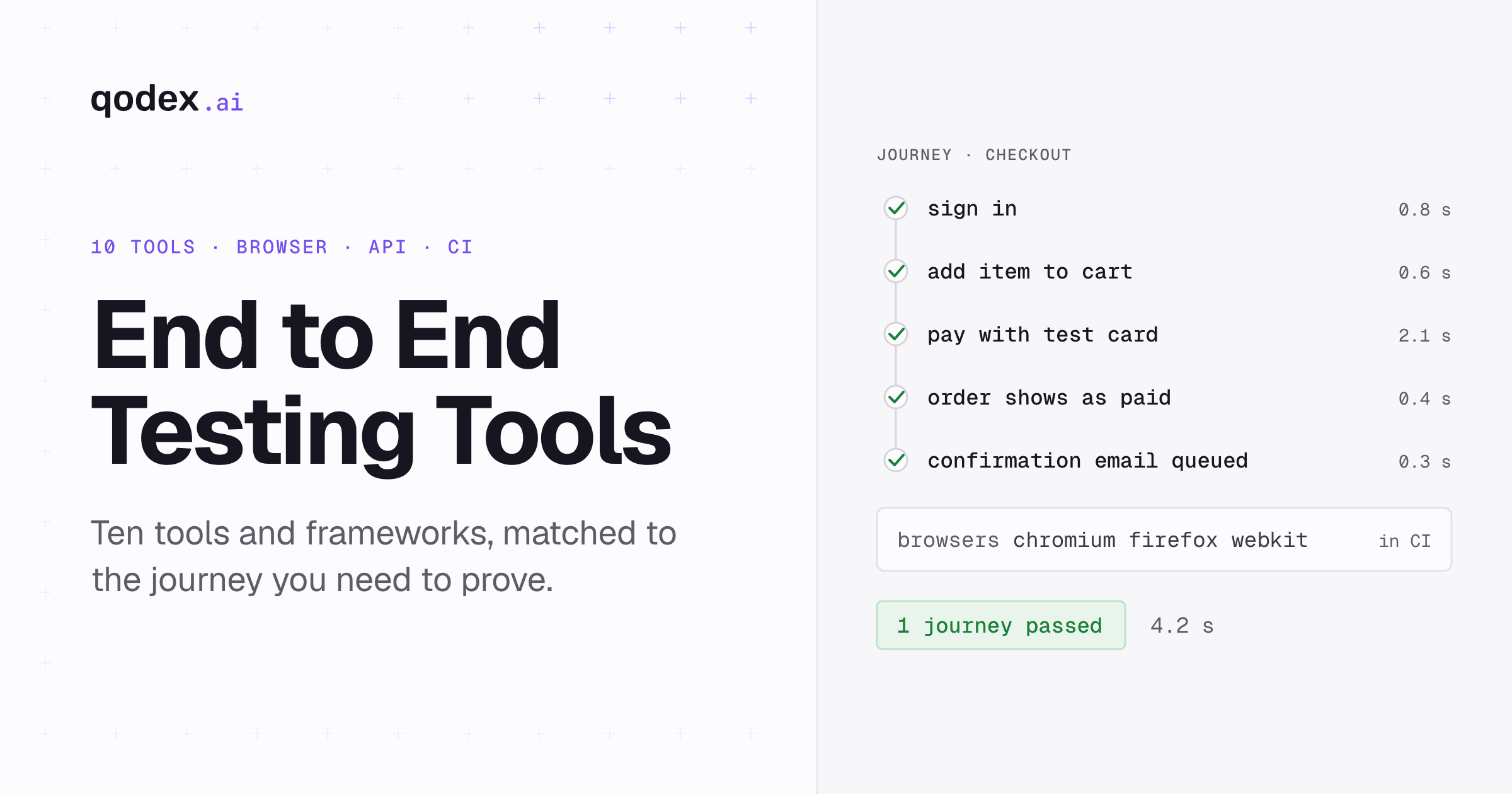
End to end testing checks a complete application workflow the way a user would walk it, across every connected component it touches. The full definition, benefits and challenges live in our guide to end to end testing; this page is about picking the software.
Start with the surface you ship. A web application narrows the list to Playwright, Cypress, Selenium and the hosted platforms. A native iOS or Android app rules most of them out and leaves Maestro, Appium, WebdriverIO and the platforms that buy real devices for you. A Windows desktop application leaves Ranorex, Testsigma and WebdriverIO, which documents desktop testing for Windows and macOS. Get this wrong and no other column matters.
Then match the authoring model to the people who will write the tests. Developers who live in a repository want code. A mixed team with manual testers wants low-code steps or plain language, and will accept a platform bill to get them. Ask who maintains the suite in six months, because that person lives with the answer.
Check how runs reach your pipeline. The useful question is what happens on a pull request: whether a run is triggered automatically, how many run at once, and whether a failure blocks the merge.
Look at what a failure hands you. A screenshot, a video, a network log or a full trace decides how long the diagnosis takes. Then price the whole thing: license, run minutes, device time and the hours spent repairing selectors. Once the tool is chosen, our test automation strategy guide covers what to automate first.
1. Qodex
Qodex is a hosted platform for API and UI scenarios. Describe the flow in a sentence. Qodex drives the real app, brings back a screenshot of what broke, and saves the run as Playwright you own.
You write a sentence instead of a selector, and the agent produces a runnable scenario. What comes out is ordinary code: generated tests are standard Playwright and HTTP code, parameterized per environment, synced to your git repository and exportable at any time. That matters for the exit case. If you stop paying, the specs stay in your repository and keep running wherever Playwright runs.
Execution is hosted, and the plans list real test runs on your pull requests along with API and UI scenario runs against your app. The Individual plan is quoted at $0, described as per project, per month, free for every developer, with up to 25 test scenarios and 100 test runs per month. Startup is quoted from $1,299, per project, per month, a starting price scoped to your team and usage, with up to 200 test scenarios and 10,000 test runs per month. Both are vendor claims read on 15 September 2026.
Main limit: native mobile and desktop coverage is not published, so treat Qodex as a web and API tool until the vendor says otherwise. Details on the UI testing product page.
2. Playwright
Playwright is the reference answer for code-first web testing. In the project's own words, Playwright Test is an end-to-end test framework for modern web apps. Release 1.63.0 was published on 4 September 2026.
It drives Chromium, WebKit and Firefox on Windows, Linux and macOS, headless or headed, with native mobile emulation for Chrome on Android and Mobile Safari. The documentation is published for Node.js, Python, Java and .NET, so JavaScript and TypeScript teams are not the only ones served.
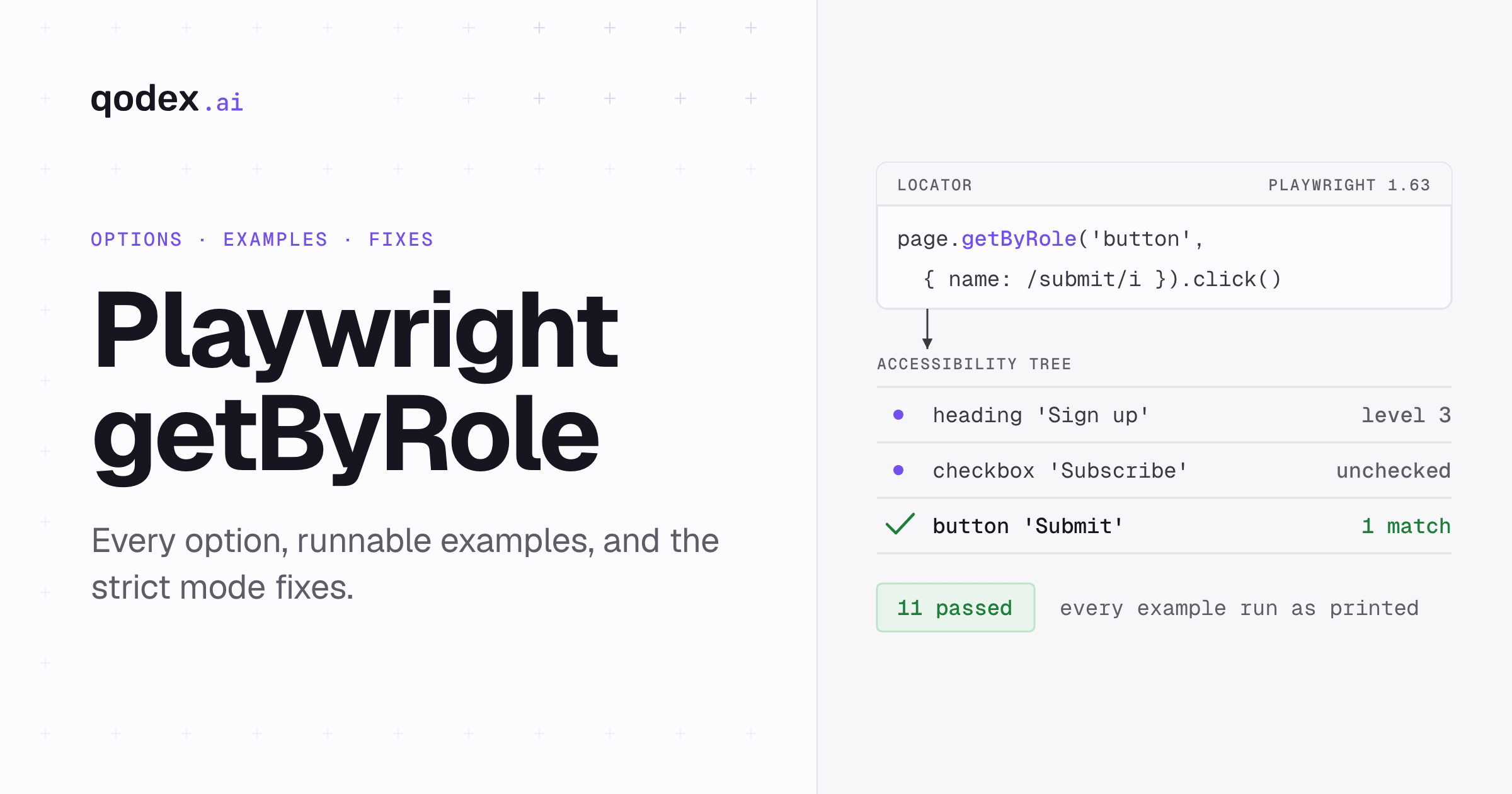
Three features carry the day-to-day experience. Auto-waiting holds an action until the element is actionable and retries assertions until they pass, which removes most of the sleep calls that make suites flaky. Each test gets a fresh browser context, so state does not leak between tests. Tests run in parallel by default and shard across machines in CI. When something fails, the Trace Viewer replays the run with DOM snapshots, network requests and console logs at every step.
Main limit: no native mobile apps. Playwright emulates mobile browsers; it does not drive an iOS or Android binary.
3. Cypress
Cypress is a JavaScript-first framework for browser workflows, and release 16.0.0 was published on 1 September 2026. The runner sits in the browser alongside your application, which is what gives it the time-travel debugging people remember it for: hover a step in the command log and see the page as it looked then.
Tests are JavaScript or TypeScript, and the setup is short. The trade is scope. Cypress is a web tool, so it covers browsers and stops there. For where browser testing sits inside the wider picture, see our UI testing guide.
The app is free and open source. Cypress Cloud is the paid layer for parallelization, analytics and test replay. The Starter tier is free and lists 10 users, 500 test results per month and 100 prompt executions per month. Team starts at $67 per month, billed annually at $799, and lists 50 users, 120,000 test results per year and 9,000 prompt executions per year. Both read on 15 September 2026 and both are vendor claims.
Main limit: test results are metered on the Cloud tiers, so a large suite running on every commit is the line item to model before you buy.
4. Selenium WebDriver
In the project's own words, WebDriver drives a browser natively, as a user would, either locally or on a remote machine using the Selenium server. Selenium WebDriver is a W3C Recommendation. The downloads page lists 4.49.0 as the stable release of 9 September 2026 for the Java, Python, C#, Ruby and JavaScript bindings and for the Selenium Server used by Grid.
Two things keep Selenium in service. Language reach is the first: a Java shop and a Python shop can use the same tool without either rewriting. Grid is the second, since it distributes tests across machines and browsers.
The cost is ergonomics. The API is low-level by design, so waits, retries, reporting and parallel execution are yours to assemble. Teams wrap it in a runner and a page object layer before the suite is comfortable to own. Our Playwright versus Selenium comparison walks through that gap.
Main limit: no batteries included. Budget for the framework you will build around it, not just the library you install.
5. Maestro
Maestro is a mobile-first framework where a test is a YAML file rather than a program. CLI 2.10.0 was published on 31 August 2026, and the repository is Apache-2.0, so the CLI is free to run.
The installation guide covers Android and iOS, with the Android path running on an emulator from Android Studio and the iOS path on a simulator from Xcode. Maestro Studio ships as a desktop installer for Windows, macOS and Linux.
The flow format keeps tests readable by people who do not write Swift or Kotlin, which is the practical reason mobile teams adopt it. For the wider mobile picture, see our roundup of iOS testing tools and frameworks.
Main limit: iOS support is documented for simulators. Web support is described as functional with ongoing development, so treat it as early rather than settled.
6. Appium
Appium is one automation approach across iOS and Android. The project describes itself as an ecosystem for UI automation of many app platforms, including mobile on iOS and Android, browsers, and desktop on macOS and Windows. Version 3.7.0 is current on npm under Apache-2.0.
The architecture is worth understanding before you install it, because it explains most of the setup complaints. Appium itself is a server. Real automation needs two more pieces: a driver for the platform, such as UiAutomator2 for Android, and a client library in your language. The official quickstart walks through exactly that sequence, and the clients cover JavaScript, Python, Java, Ruby and .NET. The npm record requires Node 20.19 or later on the 20 line, 22.12 or later on the 22 line, or 24 and above.
Main limit: setup and maintenance. Drivers, simulators, signing and device state are all yours to manage, and that work does not stop after the first green run.
7. WebdriverIO
WebdriverIO is the Node automation framework that wraps WebDriver and WebDriver BiDi into a full test runner. Release 9.31.9 was published on 13 September 2026.
The setup is a wizard. Running the starter toolkit prompts through reporters, services and framework choice, and a default answer set gives you Mocha with Chrome and the page object pattern. From there the documented surfaces go well past the browser: desktop testing, component testing, visual testing, accessibility checks and Flutter all have their own guides. That breadth is the reason a team picks it over Playwright, which is deeper on web and narrower elsewhere.
The ecosystem is the other argument. WebdriverIO publishes services for device clouds, reporters and application frameworks.
Main limit: every WebdriverIO command is asynchronous and must be handled with async and await.
8. Testsigma
Testsigma is a low-code platform aimed at teams where testers outnumber automation engineers. Tests are authored as steps with AI assistance rather than as code, which is the whole reason it gets shortlisted.
Coverage is the broadest claim on the page. The vendor lists web, mobile app, desktop and Salesforce testing as separate products, plus test management. The pricing page claims more than 3,000 browsers and devices in the cloud, broken down as over 800 browser and operating system combinations and over 2,000 real mobile devices. It also claims unlimited applications and projects, unlimited automated testing minutes, parallel execution, auto-healing scripts and more than 30 integrations on the Pro tier. Every one of those is a vendor claim read on 15 September 2026.
Deployment is the enterprise argument. The Enterprise tier lists public, private or on-premises cloud deployment, single sign-on, a private grid and IP allowlisting, which is what a regulated buyer asks for first.
Main limit: no published price. Both tiers say get custom pricing, so budgeting means a sales call. Note also that Testsigma is a commercial product, not an open-source project, whatever older roundups say.
9. Virtuoso
Virtuoso is a hosted platform built around natural-language authoring. You write a test step the way you would write it in a manual test script, and the engine turns it into an executable journey with self-healing applied when the interface moves.
The scope covers web and API in one journey, which is the useful part for workflows that cross a browser and a service. Execution is hosted and the pricing page describes two models. The consumption model is aimed at agile teams, modern apps and organizations adopting AI-native testing for the first time. The capacity model lists 5 to 100 parallel cloud execution lanes and 5 to unlimited authoring users, aimed at teams running large regression suites on a fixed cadence. Both read on 15 September 2026 and both are vendor claims.
If plain-language authoring is the requirement, compare it against the other agentic options in our roundup of AI QA tools before committing, because that is a crowded category and the products differ more than the marketing does.
Main limit: no dollar figure is published on either model. The page collects your details and returns a custom quote.
10. Ranorex
Ranorex earns its place on surface coverage rather than on modern authoring. It is the option for teams whose product includes a Windows desktop application, which most of this list cannot touch at all.
The plan comparison lists automated testing for web, for desktop including WinForms and WPF, and for mobile on iOS and Android. It also lists SaaS tools such as Salesforce and SAP, API testing and robotic process automation. Authoring runs both ways: a visual recorder, a shared object repository and codeless steps for testers, and coded automation in C#, Java, Python, Ruby, JavaScript and VB.NET for engineers. Object recognition is layered, falling back from object-based to image-based to coordinate-based matching, with self-healing on top.
Execution covers remote runs, cross-browser testing, scheduling and parallel testing, with documented integrations for Selenium Grid, BrowserStack and Sauce Labs. Licenses are floating and can be shared between physical and virtual machines.
Main limit: pricing is not published. The licensing page is a quote request, and authoring happens in a desktop IDE, which suits some teams and rules it out for others.
Framework, platform, or managed service
Three buying models sit behind those ten entries, and picking the wrong model costs more than picking the wrong product inside it.
Take a framework when developers write the tests and the tests live next to the application code. Playwright, Cypress, Selenium, Maestro, Appium and WebdriverIO are all free, so the cost is engineer time: writing the suite, keeping the runners alive, and repairing selectors after every redesign. That bill is recurring, but it buys full control.
Take a platform when the people who understand the workflows cannot write code, or when you need hosted browsers and devices you are not going to buy. Testsigma, Virtuoso, Ranorex and Qodex fit here. You trade some control for authoring that a business analyst can use and for infrastructure that arrives ready. Several lean on models to write or repair tests, which our roundup of generative AI testing tools covers. Check the exit before you sign: ask whether the tests export to something that runs without the vendor, because that answer varies sharply across this group.
Take a managed service when the constraint is headcount rather than tooling. QA Wolf describes itself as a hybrid platform and service. Its Coverage-as-a-Service offer claims embedded full-time QA engineers, guaranteed test coverage, unlimited maintenance and unlimited runs. Tests are written as Playwright and Appium code, which the vendor says is exportable and yours to keep. No public price is exposed. Read 15 September 2026, and all of it is a vendor claim.
Frequently Asked Questions
What are the best end to end testing tools in 2026?
There is no single answer, because the surface you ship decides most of it. For web applications, Playwright, Cypress and Selenium cover the code-first case and Qodex, Testsigma and Virtuoso cover the low-code case. For native mobile, Maestro and Appium are the working choices. For Windows desktop, Ranorex. Shortlist by surface first, then by who writes and maintains the tests, then by price.
What is the difference between an E2E testing framework and a platform?
A framework is a library your developers install, control and run themselves, usually free and open source. Playwright and Selenium are frameworks. A platform adds hosted execution, an authoring interface, reporting and maintenance on top, and charges for it. Testsigma and Virtuoso are platforms. The practical difference is ownership: with a framework the test code is yours and the operating work is yours too. With a platform, check whether the tests export to code that runs without the vendor.
Is Playwright or Cypress better for E2E testing?
Playwright covers Chromium, WebKit and Firefox from one API, supports five languages, and runs tests in parallel by default, so it suits teams that need cross-engine coverage and speed in CI. Cypress runs in the browser next to your app, which makes writing and debugging a test unusually quick, and it is JavaScript and TypeScript only. Our Playwright versus Cypress comparison works through the differences in detail.
Is Selenium still a good E2E testing tool?
Yes, for the cases it wins. It is a W3C Recommendation with bindings in Java, Python, C#, Ruby and JavaScript, the downloads page lists 4.49.0 as the stable release of 9 September 2026 for all five bindings, and Grid distributes runs across machines and browsers. What it does not give you is a runner, waits, reporting or parallel execution out of the box. If your team is happy to build that layer, or already has, Selenium remains a reasonable choice.
Which E2E tool is best for native mobile apps?
Maestro and Appium. Maestro uses YAML flows and documents Android emulator and iOS simulator paths. Appium supports multiple platforms and five client languages. QA Wolf and Testsigma both claim mobile coverage as part of a paid platform.
Which end to end testing tools are free?
Playwright, Selenium WebDriver, Appium and WebdriverIO are free and open source. The Maestro CLI is Apache-2.0. The Cypress app is free and open source, with the paid Cypress Cloud sitting on top for orchestration and analytics; its Starter tier is free with 500 test results a month. The Qodex Individual plan is quoted at $0 per project per month with up to 25 test scenarios and 100 test runs a month. Testsigma, Virtuoso, Ranorex and QA Wolf publish no public dollar price for these offerings.
What is the best no-code or low-code E2E tool?
It depends on which surfaces you need. Virtuoso authors in plain language and covers web and API journeys. Testsigma uses low-code steps and claims web, mobile, desktop and Salesforce. Ranorex offers a visual recorder and codeless steps and is the only one on this list with real Windows desktop depth. Qodex takes a sentence and returns a Playwright spec, which is the no-code entry point with a code-based exit. None of the four publishes a price, except the Qodex plans.
Should you buy a tool or hire an E2E testing service?
Buy a tool when you have engineers who will own the suite and the problem is coverage or speed. Hire a service when the problem is people: nobody has time to write the tests, and nobody will keep them green. Managed offers such as QA Wolf's coverage-as-a-service put engineers on the work and claim unlimited maintenance, which is the line item you are really buying. Settle one question first: who fixes a broken test at the end of a release week. That work decides whether a suite survives.
Final shortlist
Shipping a web app with developers who write tests: Playwright, or Cypress if the team is JavaScript-only and values the debugging loop. Shipping native mobile: Maestro to start fast, Appium if you need WebDriver and device clouds. Shipping a Windows desktop app: Ranorex. Testers rather than engineers writing the tests: Testsigma or Virtuoso. Want scenarios authored from a sentence that come back as Playwright code running on your pull requests: Qodex.