NeoLoad vs JMeter: A Detailed Comparison
The difference between NeoLoad and JMeter is who does the work around the load test. Apache JMeter is free, open-source software that you script, scale and report on yourself. Tricentis NeoLoad is a commercial platform that sells that work done for you: recording with automatic correlation, packaged-app protocols such as SAP and Citrix, cloud load generators, and pass or fail gates for CI. Pick JMeter when the budget is zero and your team can script and run its own infrastructure. Pick NeoLoad when you test SAP, Citrix or Oracle applications, or need vendor support. Both tools' facts below were read on their own sites on 11 November 2026.
NeoLoad vs JMeter at a glance
Six differences decide most choices. Each row is from the vendor's own page: jmeter.apache.org for JMeter, and the Tricentis NeoLoad product page and documentation for NeoLoad.
| Criterion | Apache JMeter | Tricentis NeoLoad |
|---|---|---|
| 1. License and price | Open source under the Apache License 2.0. Free at any number of virtual users. | Commercial. Tricentis publishes no list price; you start from a free trial or a demo. |
| 2. Test design | A test IDE with recording from browsers or native applications. Dynamic values are extracted with extractors you add. Scripting through JSR223 languages such as Groovy. | Codeless drag-and-drop design and record and playback, with automatic handling of dynamic parameters. Also YAML as-code and a CLI. |
| 3. Protocols and enterprise apps | HTTP and HTTPS, SOAP and REST, FTP, JDBC, LDAP, JMS, mail (SMTP, POP3, IMAP), TCP, native commands and Java objects. More through plugins. | HTTP/S, REST, SOAP and WebSocket, plus SAP, Oracle, Salesforce, ServiceNow, Workday and Citrix, and JMS, MQTT, AMQP and Kafka. |
| 4. Browser-level testing | None. JMeter works at protocol level: it does not run the JavaScript in a page or render it. | RealBrowser collects browser-level data alongside protocol results in the same test run. |
| 5. CI/CD and scale | CLI mode runs headless on any OS with Java. CI goes through third-party open-source libraries for Maven, Gradle and Jenkins. You provide the load machines. | Integrations for Jenkins, Azure DevOps, GitHub, GitLab, CircleCI and TeamCity, with SLO-based pass or fail gates. Load generators in the cloud, on your own servers, or both. |
| 6. Reporting, monitoring and support | A dynamic HTML report generated from the results file. Community support through mailing lists. | Real-time dashboards, comparison across test runs, and integrations with Datadog, Dynatrace, AppDynamics, New Relic and Prometheus. Vendor support. |
What JMeter is
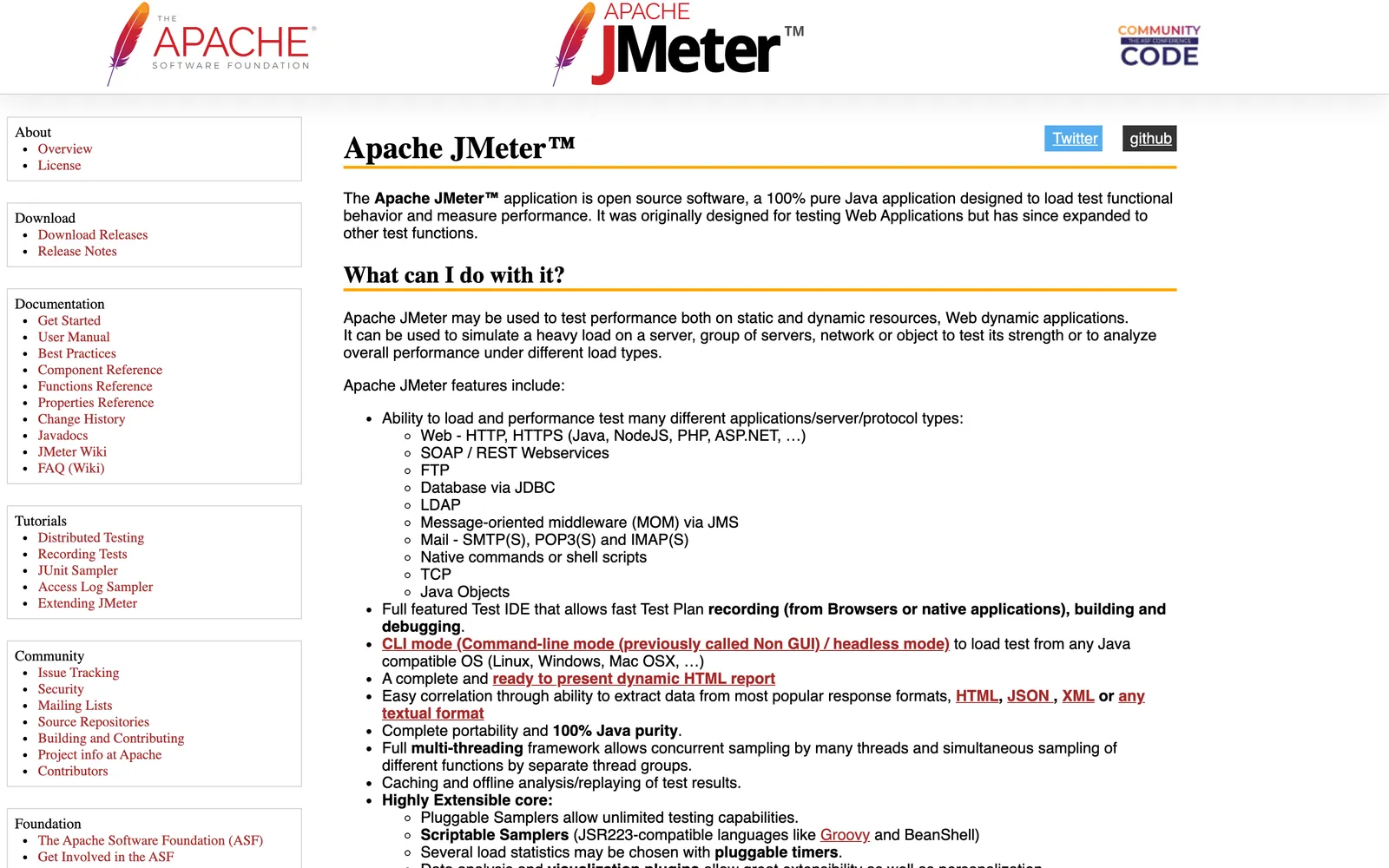
Apache JMeter is a Java application from the Apache Software Foundation, built to load test functional behavior and measure performance. The current release is 5.6.3, which needs Java 8 or later. You build a test plan in its GUI, then run it from the command line for the real load.
What it does well. It costs nothing at any scale, it covers more than HTTP (databases over JDBC, message queues over JMS, LDAP, mail, raw TCP), and a plugin ecosystem extends it further. CLI mode produces a results file, and one more flag turns that file into an HTML dashboard. Because a test plan is a file, it lives in Git beside the code. For API-only work, see our JMeter API testing guide.
Its limits. JMeter's own site says it plainly: "JMeter is not a browser". It does not execute JavaScript or render pages, so it measures server response, not what a user sees. Correlation, the work of capturing a session token from one response and sending it in the next, is manual: you add an extractor for each dynamic value. Distributed load, monitoring of the servers under test and trend comparison across runs are yours to assemble. Nobody is contractually on the hook when you are stuck.
Who it suits. Teams that can script, want tests in version control, and test web services, APIs or databases without packaged enterprise applications in the path.
What NeoLoad is
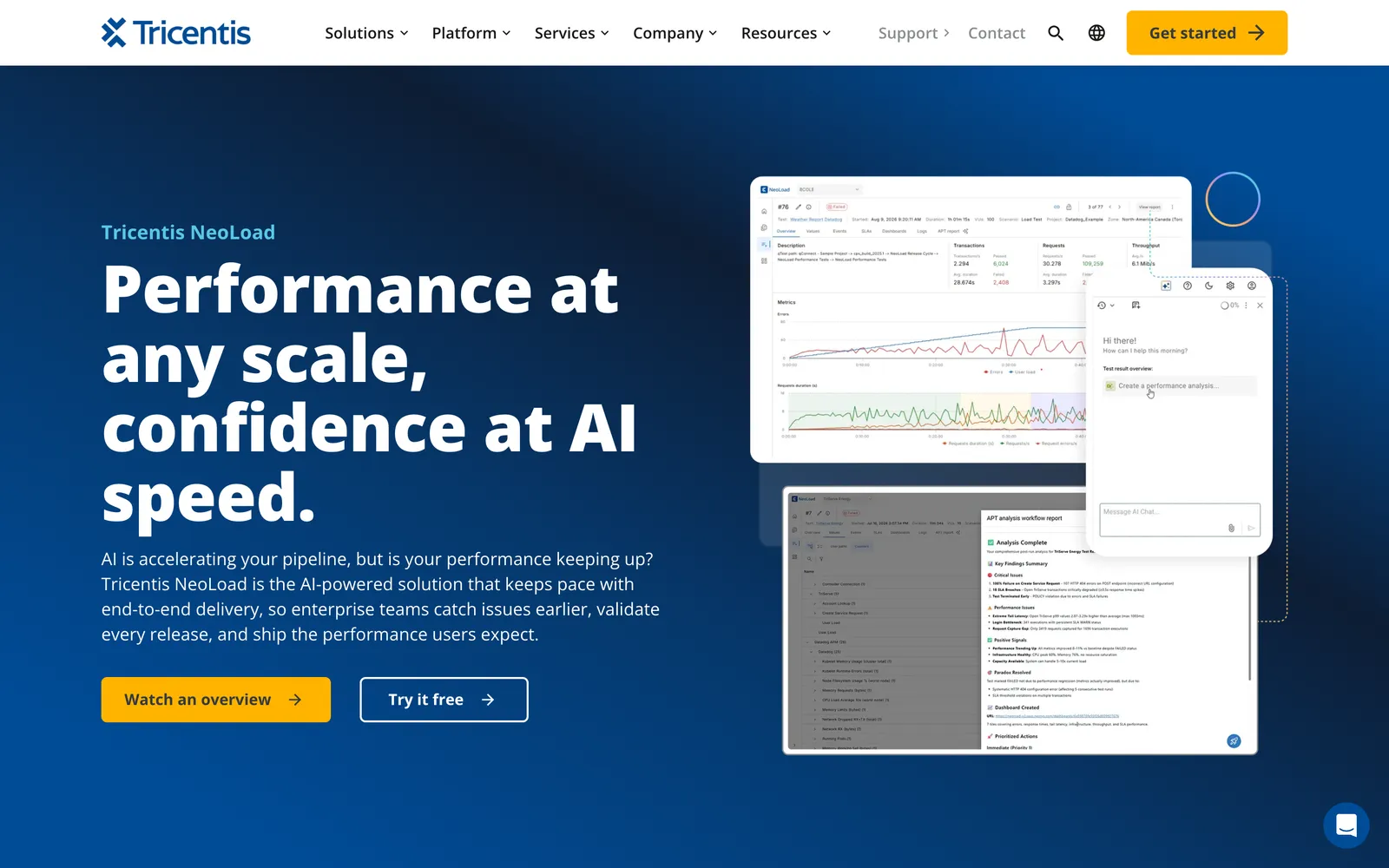
NeoLoad is the load and performance testing platform from Tricentis, which acquired its maker Neotys. It has two parts. The NeoLoad desktop application is where you record user interactions, design test scripts and configure scenarios. NeoLoad Web is the central platform where you run tests at scale, allocate controllers and load generators, schedule runs and share results.
What it does well. Recording a user path and getting a working script takes less hand work, because NeoLoad detects and handles dynamic parameters with predefined rules for common frameworks. When the application changes, you update a script from a new recording and it keeps the variable extractors, think times and SLAs from the original design. It covers packaged applications that JMeter's core does not: SAP GUI and Fiori, Oracle, Citrix, Salesforce, Workday. RealBrowser adds browser-level timings to the same run.
Its limits. It is paid, and the price is not public, so you cannot budget without a sales conversation. Tests and results live in a vendor's platform. For a team that only load tests a REST API, most of what NeoLoad sells will go unused.
Who it suits. Performance teams in larger companies testing SAP, Oracle or Citrix workloads, teams that need browser-level and protocol-level results together, and teams that must have a support contract.
The six differences in detail
1. Cost
JMeter's license cost is zero. Its real cost is engineer time: building scripts, fixing correlation after each application change, and running load machines. NeoLoad moves part of that cost into a license. Tricentis argues on its own NeoLoad versus JMeter page that faster design and script maintenance lower the total cost. That is the vendor's claim, and it publishes no price to check it against, so price a trial on your own application before you accept it.
2. Test design and script maintenance
In JMeter you record through its proxy, then group requests into transactions, add extractors for dynamic values and parameterize data yourself. That needs someone who understands the application's requests. In NeoLoad, correlation rules run after a recording and most parameterization is done in the interface. The larger difference shows up later: when a release changes the application, a JMeter script is edited by hand, and a NeoLoad script can be refreshed from a new recording.
3. Protocol and application support
For HTTP APIs, SOAP services, databases and JMS queues, both tools work. The split is at the edges. JMeter's core list stops at open protocols, and anything else depends on a community or commercial plugin. NeoLoad lists SAP, Oracle, Salesforce, ServiceNow, Workday and Citrix as supported technologies, along with MQTT, AMQP and Kafka. If the system under test is SAP GUI or a Citrix-delivered desktop, that row decides the comparison.
4. Browser-level results
JMeter sends requests the way a browser would but does not behave like one. A single-page application that does most of its work in JavaScript can look fast in JMeter and slow to a user. NeoLoad's RealBrowser drives a real browser as part of the load test. With JMeter, teams usually pair it with a separate browser tool for that measurement.
5. CI/CD integration and scale
Both run headless. JMeter's CLI mode fits any pipeline that can run a Java command, and Maven, Gradle and Jenkins support comes from third-party open-source libraries. Pass or fail rules are something you script on the results. NeoLoad ships integrations for Jenkins, Azure DevOps, GitHub, GitLab, CircleCI and TeamCity and treats performance thresholds as pass or fail criteria for the build. For scale, JMeter's distributed mode runs on machines you provision; NeoLoad can start load generators in the cloud or use your own servers.
6. Reporting and monitoring
JMeter generates an HTML dashboard with response times, throughput, percentiles and an APDEX score from a results file. It does not watch the servers under test; you correlate with your monitoring tool by hand. NeoLoad shows results in real time, compares runs across releases, and exchanges data with Datadog, Dynatrace, AppDynamics, New Relic and Prometheus.
You can use both
The choice is not always either-or. NeoLoad Web can execute JMeter tests: you upload a JMX file and choose JMeter as the load injection provider, and NeoLoad Web supports JMeter 5.6.3. The NeoLoad documentation lists the limits: JMeter tests run in Static and Dynamic Zones but not Cloud Zones, do not support multi-node runs, and NeoLoad Web does not display page values or SLAs for them. A team with years of JMeter scripts can keep them and still report in one place.
Which one to choose
Choose JMeter when the budget for tools is zero, the system under test speaks HTTP, JDBC or JMS, and you have engineers who can script and keep load infrastructure running.
Choose NeoLoad when you load test SAP, Oracle, Citrix or Salesforce, when testers who do not code must build the tests, when you need browser-level and protocol-level numbers in one run, or when a support contract is required.
Look wider if neither fits. Code-first tools such as k6, Gatling and Locust sit between the two. Our performance testing tools guide compares them.
One thing neither tool does is tell you whether the API returns the right answer. A load test on an endpoint that is functionally broken measures the wrong thing. Qodex is an AI QA agent that writes and runs functional API tests on every pull request, which is the check to have in place before a load test, and it also runs load tests on APIs. For where load tests sit in a pipeline, see CI/CD testing.
Frequently Asked Questions
What is the difference between NeoLoad and JMeter?
JMeter is free, open-source software under the Apache License 2.0 that you script and operate yourself. NeoLoad is a commercial Tricentis platform with codeless test design, automatic handling of dynamic parameters, support for packaged applications such as SAP and Citrix, browser-level testing and vendor support.
Is NeoLoad better than JMeter?
For SAP, Oracle, Citrix or Salesforce workloads, and for teams that cannot script, NeoLoad covers more out of the box. For HTTP APIs, databases and message queues on a zero budget, JMeter is enough and costs nothing. Neither is better in general.
Is JMeter free? How much does NeoLoad cost?
JMeter is free under the Apache License 2.0, with no charge per virtual user. Tricentis does not publish a NeoLoad list price; its site offers a free trial and a demo, as read on 11 November 2026.
Can NeoLoad run JMeter scripts?
Yes. NeoLoad Web can execute JMeter JMX projects with JMeter as the load injection provider and supports JMeter 5.6.3. JMeter tests cannot use Cloud Zones or multi-node runs there.
Which is better for CI/CD pipelines?
Both run headless. JMeter's CLI mode runs anywhere Java runs, with Maven, Gradle and Jenkins support from third-party libraries. NeoLoad provides integrations for Jenkins, Azure DevOps, GitHub, GitLab, CircleCI and TeamCity and pass or fail gates based on performance thresholds.
Does JMeter support SAP or Citrix testing?
Not in its core. JMeter's site lists HTTP, SOAP and REST, FTP, JDBC, LDAP, JMS, mail, TCP, native commands and Java objects. SAP GUI and Citrix are on NeoLoad's supported list.