7 Best Momentic Alternatives for AI Testing in 2026

Quick Comparison: Momentic Alternatives at a Glance
| Tool | Approach | Tests exportable as code? | Pricing (verified June 2026) |
|---|---|---|---|
| Qodex | Autonomous AI QA agent | Yes, standard Playwright + HTTP scripts | Free tier; paid plans via sales |
| mabl | ML-driven low-code platform | No | Quote-based, credit-metered cloud runs |
| QA Wolf | Managed service + platform | Yes, Playwright + Appium you keep | Quote-based service contract |
| testRigor | Plain-English tests | No | Free public tier; private from $300/month |
| Testsigma | NLP scriptless platform | No | Quote-based Pro and Enterprise; free trial |
| Functionize | ML-driven enterprise platform | No | Quote-based; demo-led |
| Playwright | Open-source framework | It is the code | Free (Apache 2.0) |
Momentic is one of the fastest-moving AI testing startups: a $15M Series A, customer logos like Notion, Webflow, Retool, and Quora, and a genuinely quick authoring loop where engineers describe flows in plain English and an AI agent handles the rest. If you are evaluating it, you have probably seen the demo and been impressed. The thing to evaluate just as carefully is what you can take with you. Momentic's own FAQ answers the question "Do you generate Playwright code?" directly: it does not generate or save any code; its AI agent interprets test steps at run time in the browser. Your tests exist as platform artifacts, not as code you own. This guide covers seven alternatives through that lens, including where Momentic is still the right choice.
What Momentic Does Well
The honest case for Momentic first:
Fast, accessible authoring. Tests are written in plain English in a low-code editor, or recorded from your actions. Customers report large reductions in time-to-automate, and the learning curve is genuinely shallow.
Intent-based self-healing locators. Because steps track user intent rather than exact DOM structure, tests survive UI churn that breaks selector-based suites. This is the core of their reliability pitch against raw Playwright and Cypress.
An autonomous exploration agent. Momentic's agent explores your app, finds critical user flows, generates tests, and keeps them updated, which moves real authoring work off your engineers.
AI-powered assertions. Validating screenshots, page content, and non-deterministic output (Quora uses it to validate Poe's AI chatbot responses) is ahead of what most platforms offer.
Momentum. A funded team shipping quickly, with mobile support recently added. Betting on Momentic is not a risky-startup bet the way it was two years ago.
The Lock-In Question, Stated Precisely
This deserves its own section because it is the structural difference between Momentic and the tools that hand you code. Verified against Momentic's site in June 2026:
No generated code, by design. From their FAQ: Momentic does not generate or save any code; the AI agent interprets test steps at run time and executes them in the browser. There is nothing to export to Playwright because no Playwright exists. If you leave, you rebuild.
Chromium only, for now. Their FAQ states tests currently run on Chromium and Chrome; Safari and Firefox support is on the roadmap without a release date.
No public pricing. There is no pricing page on momentic.ai as of June 2026; the motion is free start plus demo-led sales, so you cannot model costs without a conversation.
Run-time interpretation is not a defect; it is how Momentic's self-healing works, and for teams that never leave the platform it may never matter. But "the tests are the vendor" is a real architectural commitment, and you should make it deliberately.
The 7 Best Momentic Alternatives in 2026
1. Qodex
Qodex is the direct counter-architecture to Momentic. It is also an AI agent that explores your app and authors tests from natural language, but the output is the opposite of run-time interpretation: the agent generates standard Playwright and HTTP test scenarios with executable scripts, stored as code you can read, version, and take with you. Authoring happens once with the LLM; replays are deterministic with no LLM in the loop.
What that architecture buys you:
Ejectable tests. Generated scripts are standard, git-syncable code. If you leave Qodex, you leave with a working Playwright suite, not a memory of one.
Zero-cost replays. Because cached scenarios replay without LLM calls, rerunning the suite on every deploy adds nothing to the bill. Tools that interpret steps with AI at run time carry per-run inference cost in some form.
Full-stack coverage from one agent. The same chat drives UI testing, functional API testing, and OWASP-aligned security checks (IDOR, BOLA, auth bypass, injection) with inverted semantics, so a passing security test means the attack was blocked.
Failure triage built in. Every failure is classified as a real bug, a stale test, or an environment issue, so the agent does not cry wolf on infrastructure noise.
Pricing: free tier with no credit card; paid plans are scoped with sales (see pricing).
Pros: agent-authored coverage like Momentic, but with standard code output; UI + API + security in one tool; deterministic replays; per-project memory that compounds across runs.
Cons: no native mobile app testing, where Momentic has been investing; chat-first authoring rather than a visual low-code editor; younger ecosystem than the big platforms.
Best for: engineering-led teams that want Momentic-style AI authoring without giving up code ownership. Start free and diff the generated Playwright against what you have today.
2. mabl
mabl is the established platform Momentic is implicitly chasing: ML-trained auto-healing refined over years of production runs, a polished low-code editor, and web, mobile, API, accessibility, and performance testing in one place, with enterprise support including a designated CSM.
Pricing: quote-based; cloud runs consume credits (starting around 500/month per their FAQ) while local and CI runs are free and unlimited. Full breakdown in our mabl alternatives guide.
Pros: the most battle-tested ML self-healing in the category; broad surface coverage; strong enterprise support and training.
Cons: like Momentic, tests live inside the platform with no code export; credit metering puts a price on every cloud run; quote-only pricing.
Best for: mid-market and enterprise teams that want low-code maturity and vendor support over startup velocity.
3. QA Wolf
QA Wolf solves the same problem with humans plus a platform: their QA engineers map your app, write deterministic Playwright and Appium tests, run them in parallel, and investigate every failure under a coverage guarantee. It is the fully-outsourced answer.
Pricing: quote-based service contract; no public pricing page as of June 2026.
Pros: hands-off in a way no self-serve tool matches; the tests are standard Playwright you keep; failure noise filtered by humans.
Cons: service economics rather than tool pricing; coverage moves at their team's pace; in-house QA muscle never develops. See our QA Wolf alternatives guide for the full trade-off analysis.
Best for: funded teams with no QA function that want coverage delivered, not tooling.
4. testRigor
testRigor shares Momentic's plain-English authoring but aims it at a different user: manual QA teams with no engineers at all. Tests read like instructions to a person and execute via AI-based element identification across web, mobile, desktop, and even mainframe surfaces.
Pricing (verified June 2026): free public tier (tests and results publicly visible), private plans from $300/month for Linux Chrome only, quote-based Private Complete for full cross-platform coverage. Details in our testRigor alternatives guide.
Pros: non-engineers automate real coverage; selectorless execution resists UI churn; very wide surface support.
Cons: every step is hand-written; no code export, same as Momentic; realistic plans are quote-based.
Best for: manual QA teams automating regression checklists without engineering help.
5. Testsigma
Testsigma is the breadth play: NLP-driven scriptless authoring across web, mobile web, native mobile, desktop, Salesforce, and API testing, with 2,000+ real devices in its cloud and AI-assisted authoring via Copilot.
Pricing (verified June 2026): quote-based Pro and Enterprise with a free trial; Pro includes unlimited testing minutes, so there is no per-run meter.
Pros: covers surfaces Momentic does not (desktop, Salesforce, deep mobile device cloud); unlimited minutes; on-prem option.
Cons: authoring is still manual; platform-bound tests; breadth can mean depth trade-offs. See our Testsigma alternatives guide.
Best for: teams that need one platform across many surfaces more than they need the fastest web-app loop.
6. Functionize
Functionize is the enterprise ML platform: self-healing tests, visual testing, and specific strength in packaged applications (Salesforce, SAP, Workday, Oracle, Guidewire) where DOM-based tools struggle.
Pricing: no public pricing; demo-led with a free trial. Enterprise budgets apply.
Pros: packaged-app depth nothing else on this list matches; mature ML self-healing; enterprise integrations.
Cons: heavyweight sales motion for a startup-speed team; proprietary format; overkill for testing your own web product.
Best for: large QA organizations standardizing across enterprise app estates.
7. Playwright
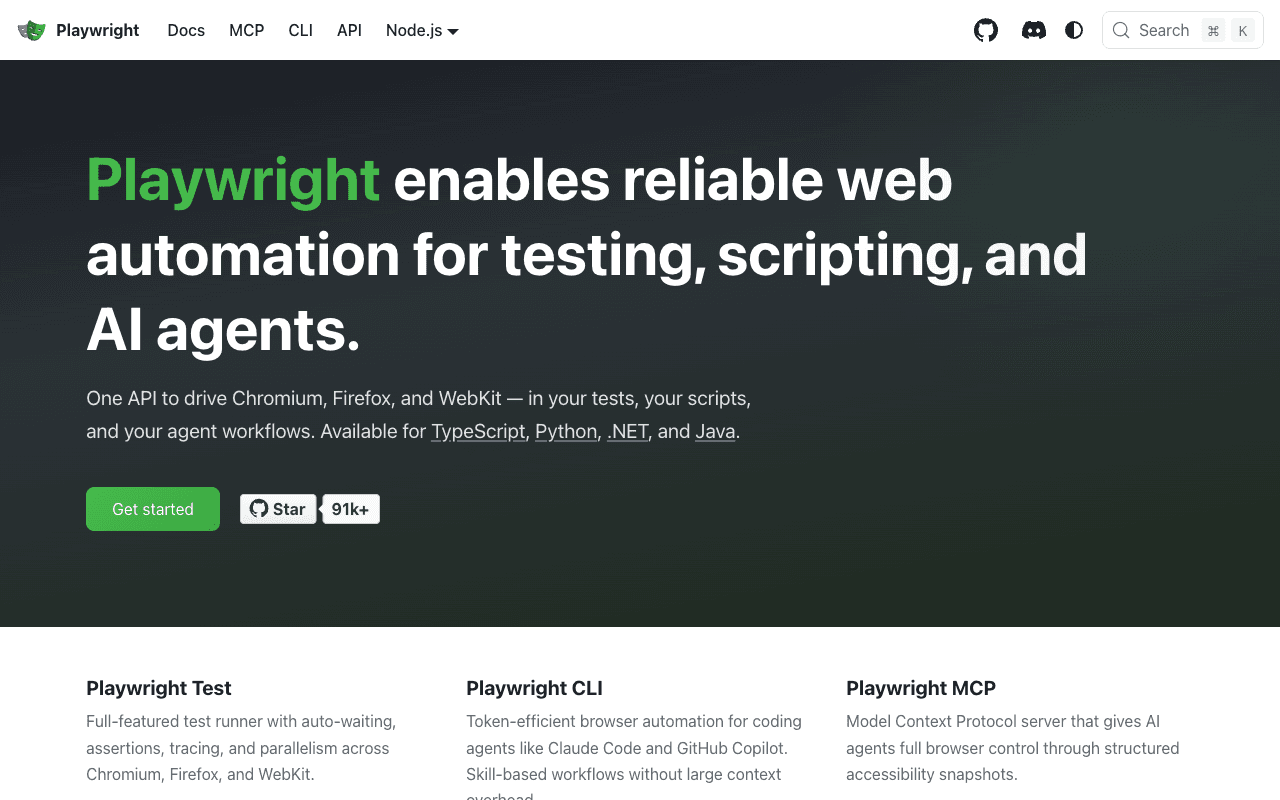
Playwright is the open-source foundation this whole category builds on, and the purest expression of the ownership argument: the test is the code, full stop. Chromium, Firefox, and WebKit engines, auto-waiting, parallelism, and a first-class trace viewer, free.
Pricing: free, Apache 2.0.
Pros: total control and portability; cross-browser where Momentic is Chromium-only today; massive ecosystem.
Cons: no AI authoring, no self-healing, no platform; your engineers do everything, and engineer time is the most expensive line item you have. See our Playwright alternatives guide for that side of the decision.
Best for: teams with engineering capacity who want the standard. And note the hybrid path: Qodex and QA Wolf both produce standard Playwright, so AI assistance and code ownership are not mutually exclusive.
Decision Framework: Which Momentic Alternative Fits Your Team
| Your situation | Start with | Why |
|---|---|---|
| Want AI authoring AND code you own | Qodex | Agent generates standard Playwright + HTTP; zero-cost deterministic replays |
| Mid-market team wanting a mature, supported platform | mabl | Years of ML training data and a real support org |
| No QA function, budget for a service | QA Wolf | Humans build and maintain Playwright you keep |
| Manual QA team, no engineers | testRigor | Plain-English authoring for non-coders |
| Testing web, mobile, desktop, and Salesforce together | Testsigma | Widest surface coverage in one platform |
| Enterprise estate of SAP/Workday/Salesforce | Functionize | Packaged-app depth |
| Strong eng team, full control, no budget | Playwright | Free, portable, cross-browser standard |
| Web-app team that values authoring speed over portability | Stay with Momentic | Fastest low-code loop, strong self-healing, real momentum |
How to Choose
Decide if the tests are an asset or a subscription. With Momentic, mabl, testRigor, Testsigma, and Functionize, your test suite exists only while you pay; it is a subscription. With Qodex, QA Wolf, and Playwright, the suite is an asset: standard code that outlives any vendor relationship. Neither model is wrong, but mislabeling a subscription as an asset gets expensive at migration time.
Check browser coverage against your traffic. Momentic runs on Chromium today, with Safari and Firefox on the roadmap. If a meaningful share of your users is on WebKit, weigh that now, not after the suite is built. Playwright (and tools that generate it) covers all three engines.
Price the run, not the seat. Run-time AI interpretation, credit meters, and unlimited-minute plans produce very different bills at CI frequency. Qodex's deterministic replays and the open-source frameworks are the only entries here where running tests more often costs nothing more.
Ask what happens below the UI. Momentic and most of its peers test through the browser. Auth logic, API contracts, and OWASP-class vulnerabilities live below that. If those are on your risk register, you need API-level testing, and Qodex is the only tool here that runs it from the same agent as UI checks.
Frequently Asked Questions
Does Momentic export Playwright code?
No. Momentic's own FAQ states it does not generate or save any code; its AI agent interprets test steps at run time and executes them in the browser. That run-time interpretation powers its self-healing, but it also means there is no code to export. If you leave the platform, the suite does not come with you. Tools that do hand you standard Playwright include Qodex (agent-generated) and QA Wolf (human-written).
How much does Momentic cost?
Momentic does not publish pricing. As of June 2026 there is no pricing page on momentic.ai; the motion is a self-serve free start plus a demo-led sales conversation for teams. Budgeting requires talking to them.
Which browsers does Momentic support?
Per their FAQ as of June 2026, Momentic currently supports Chromium and Chrome for test execution. Safari and Firefox are on the roadmap with no announced release date. If cross-engine coverage matters today, Playwright-based approaches cover Chromium, Firefox, and WebKit.
What is the best Momentic alternative for code ownership?
Qodex, if you want the same AI-authoring experience with standard output: the agent explores your app and generates Playwright and HTTP scripts that are git-syncable and ejectable, with deterministic zero-LLM replays. QA Wolf, if you would rather have humans write the Playwright for you as a managed service. Plain Playwright, if your engineers will write everything themselves.
Is Momentic better than mabl?
They occupy different maturity points. Momentic moves faster and its plain-English authoring loop is arguably quicker; mabl has years more ML training data, broader surface coverage (including accessibility and performance testing), and an enterprise support organization. Both keep tests inside their platforms and both price by conversation. Teams choosing between them should weight startup velocity against platform maturity, then ask whether either constraint beats owning the code outright.
Do any Momentic alternatives include security testing?
Qodex is the only tool in this comparison that runs API security checks (IDOR, BOLA, auth bypass, injection, aligned to the OWASP API Top 10) from the same agent that does functional testing, with pass/fail semantics inverted so a pass means the attack was blocked. Everything else here tests functional quality only.