8 Best Testsigma Alternatives for Test Automation in 2026
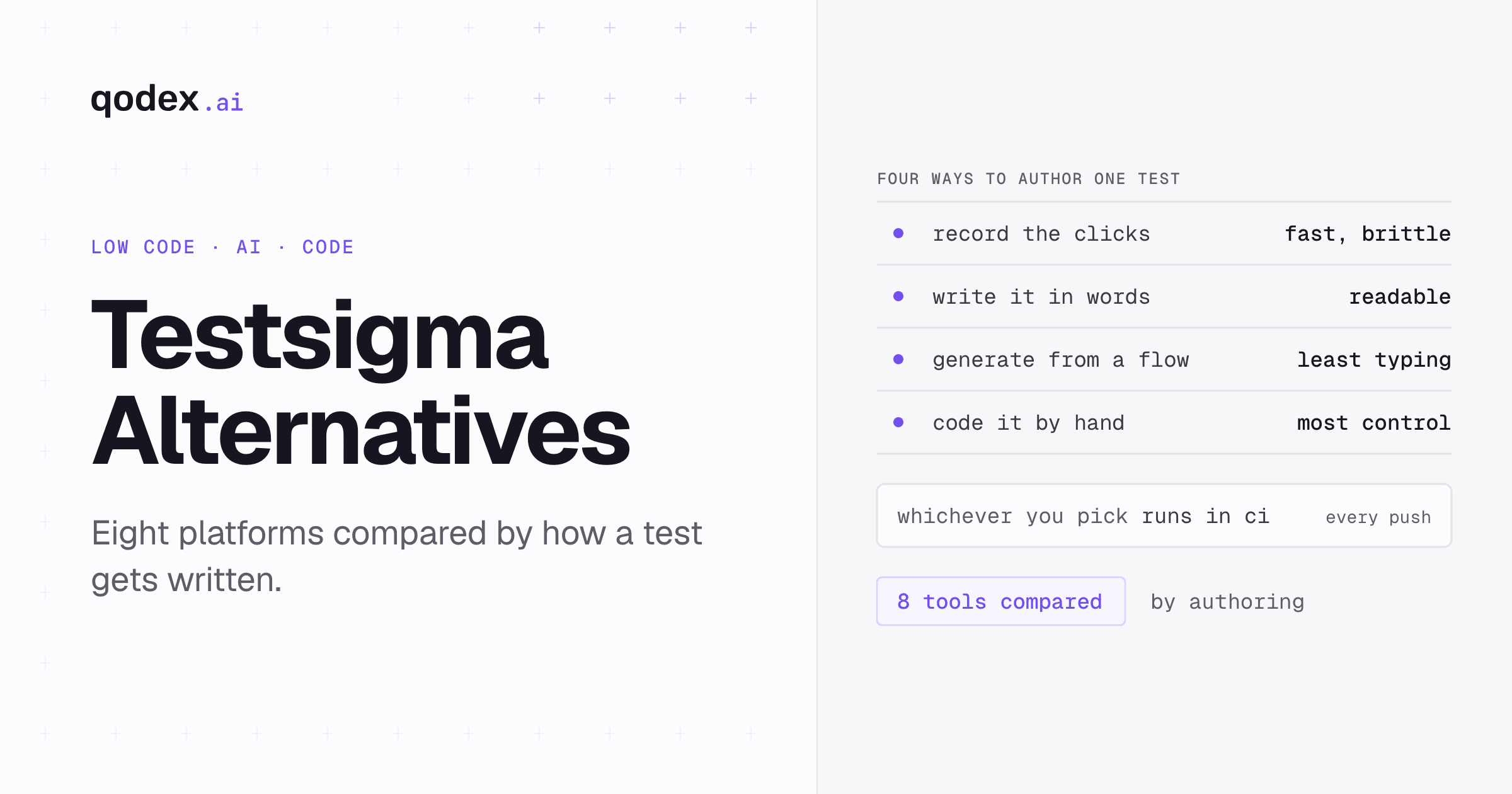
Quick Comparison: Testsigma Alternatives at a Glance
| Tool | Approach | Best For | Pricing (verified June 2026) |
|---|---|---|---|
| Qodex | Autonomous AI QA agent | UI + API + security with ejectable Playwright code | Free tier; paid plans via sales |
| Katalon | Low-code platform + IDE | Teams wanting a free IDE with a paid platform path | Team plans from $167/seat/month annually; $4,000/year first-purchase offer for 5 seats |
| testRigor | Plain-English tests | Manual QA teams automating without code | Free public tier; private from $300/month |
| mabl | ML-trained low-code platform | Mid-market teams wanting vendor-managed QA + CSM | Quote-based; credit-metered cloud runs |
| TestGrid | Codeless + device cloud + on-prem | Teams needing real devices plus on-prem options | Starter at $199/seat/month; enterprise custom |
| Functionize | ML-driven enterprise platform | Enterprises testing packaged apps (SAP, Salesforce) | Quote-based; demo-led |
| QA Wolf | Managed service + platform | Outsourcing QA with a coverage guarantee | Quote-based service |
| Playwright | Open-source framework | Engineering teams owning their suite | Free (Apache 2.0) |
Testsigma has built one of the broadest scriptless platforms in the market: web, mobile web, native mobile, desktop, Salesforce, and API testing with natural-language authoring, all in one place. It is affordable relative to enterprise incumbents and its content engine has made it one of the most visible names in test automation. But breadth is not the same as fit. Depending on whether your constraint is authoring time, code ownership, device access, or budget, one of these eight alternatives may serve you better. We will be explicit about when Testsigma is still the right call.
What Testsigma Does Well
Credit where due, because Testsigma's strengths are real:
Surface breadth: few platforms cover web, mobile web, native Android and iOS, desktop, Salesforce, and API testing in one product. If your team tests all of those, consolidation is a legitimate win.
NLP authoring: tests written in structured natural language lower the barrier for manual QA engineers, and Testsigma's Copilot adds AI-assisted test generation on top.
Real device cloud: the Pro plan advertises 800+ browser/OS combinations and 2,000+ real mobile devices, with parallel execution and auto-healing scripts.
Unlimited minutes: Pro includes unlimited automated testing minutes and unlimited applications, which removes the per-run metering anxiety that credit-based competitors create.
Deployment flexibility: Enterprise offers public, private, or on-prem cloud deployment with SSO, which matters for regulated industries.
Testsigma Pricing: What Changed
As of June 2026, Testsigma's pricing page lists two plans, Pro ("for fast-growing teams") and Enterprise ("for high-scale teams"), and both are quote-based: the published CTA is "Request Pricing," and their own FAQ says the cost of a Pro license depends on expected usage. There is a free trial, but no public dollar figure. If you saw a fixed monthly price quoted for Testsigma in an older article, treat it as outdated; today you budget through a sales conversation, the same as with mabl and Functionize.
Why Teams Look for Testsigma Alternatives
Quote-only pricing. You cannot put a number in a budget spreadsheet without a sales call, and renewals are negotiations.
NLP authoring is still authoring. Natural language lowers the skill floor, but a human still writes and curates each test, step by step. Agentic tools now draft entire suites from exploration.
Proprietary test format. Testsigma tests live in Testsigma. There is no eject-to-Playwright path, so switching costs grow with every test you add.
Breadth over depth. Covering six surfaces in one product means some areas (security testing, for instance, which is absent) get no coverage at all.
The 8 Best Testsigma Alternatives in 2026
1. Qodex
Qodex takes the opposite architectural bet from Testsigma. Instead of a human writing natural-language steps in a low-code editor, an autonomous agent explores your web app in a real Chromium browser and your API via direct HTTP calls, learns the critical flows, and generates runnable Playwright and HTTP test scenarios. You review the generated code, promote what you want, and schedule or trigger runs from CI.
Three differences that matter in a Testsigma comparison:
Authoring is delegated, not simplified. Testsigma makes writing tests easier; Qodex makes the agent write them. The human role shifts from author to reviewer.
Output is standard code. Generated tests are plain Playwright and HTTP scripts, git-syncable and ejectable. No proprietary format, no migration wall.
Security is included. The same agent runs OWASP-aligned API security checks (IDOR, BOLA, auth bypass, injection) alongside functional tests, with inverted semantics: a passing security test means the attack was blocked. Testsigma does not cover security testing. See API testing and API assurance for details.
Pricing: free tier, no credit card; paid plans scoped with sales (see pricing). Saved scenarios replay deterministically with zero LLM cost, so rerunning the full suite on every deploy adds nothing to the bill.
Pros: agent-drafted coverage; UI, API, and security in one tool; ejectable standard code; zero-cost replays; failure triage that classifies real bugs vs stale tests vs environment issues.
Cons: no native mobile, desktop, or Salesforce testing (Testsigma covers all three); no physical device cloud; younger product than Testsigma.
Best for: web and API teams that want autonomous coverage and code ownership. Start free and have the agent draft its first suite in a session.
2. Katalon
Katalon sits between open-source frameworks and enterprise platforms: Katalon Studio is a free desktop IDE for building web, mobile, API, and desktop tests, and the paid TrueTest platform adds AI agents for test creation, execution, bug reporting, and analytics.
Pricing (verified June 2026): Team Edition Standard at $167/seat/month billed annually ($185 monthly), with a first-purchase offer of $4,000/year flat for 5 seats (effectively $67/seat/month). Enterprise is quote-based.
Pros: public per-seat pricing you can budget; free Studio IDE to start; record-and-script hybrid suits mixed-skill teams; mature integrations (Jira, TestRail, CI tools).
Cons: per-seat pricing climbs fast for large teams; Studio's Groovy scripting is a niche skill; AI capabilities arrived later than competitors.
Best for: teams that want published pricing and a free on-ramp, with a paid platform when they outgrow it.
3. testRigor
testRigor shares Testsigma's core promise (tests in plain English, no code) but executes it differently: vision-based, selectorless element identification that reads the screen the way a user does, which makes tests resilient to DOM churn.
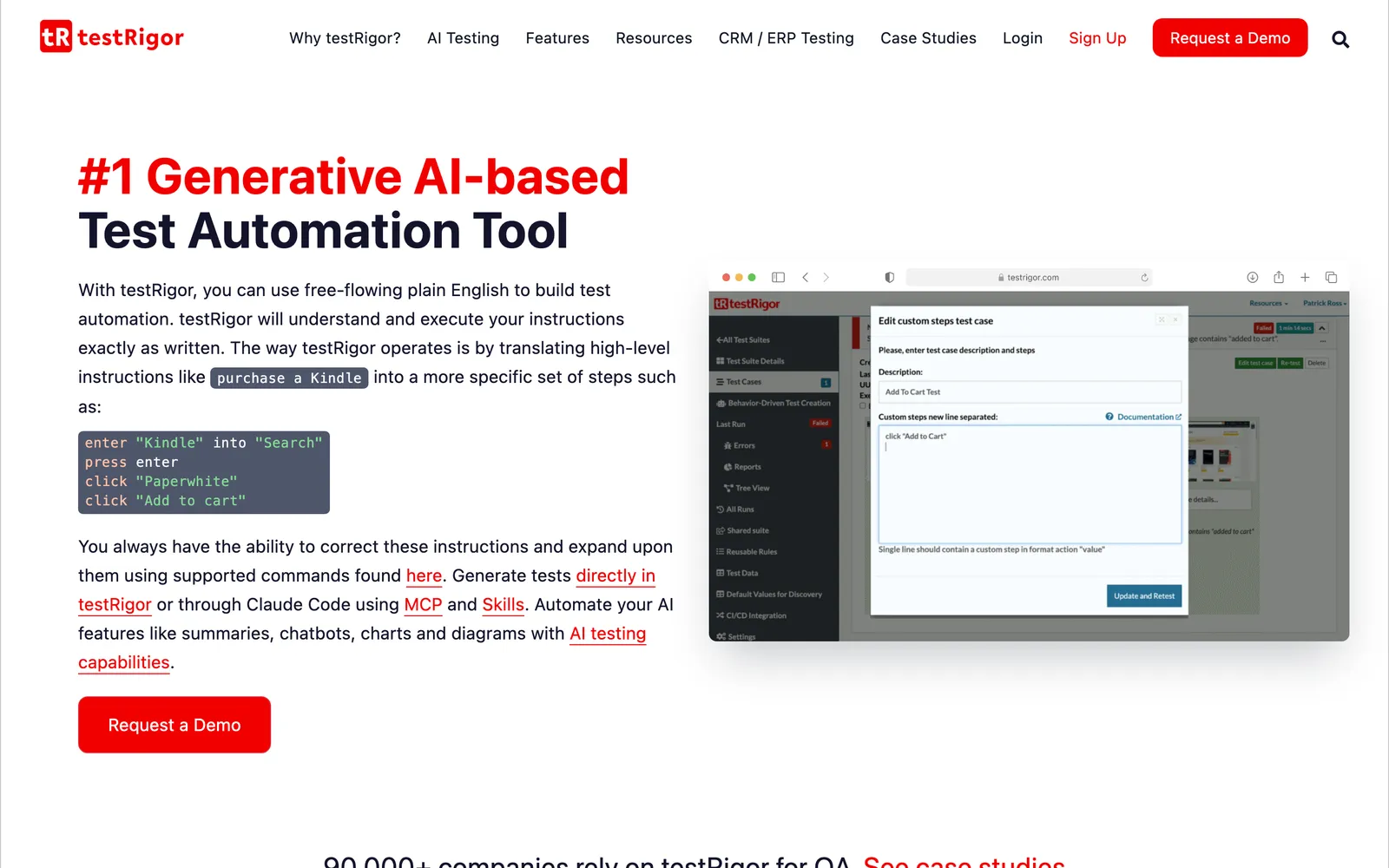
Pricing (verified June 2026): a free forever public tier (tests and results are publicly visible); private plans from $300/month for Linux Chrome; the full cross-platform private plan is quote-based with a 14-day trial.
Pros: the most accessible authoring on this list for non-engineers; selectorless resilience; covers web, mobile, desktop, and mainframe.
Cons: writing long flows line-by-line in English gets tedious; proprietary format; complex data-driven scenarios strain the plain-English model.
Best for: manual QA teams converting regression checklists to automation without engineering help.
4. mabl
mabl is the most direct commercial rival to Testsigma: a low-code platform with ML-trained auto-healing, agentic runtime recovery, and unified web, mobile, API, accessibility, and performance testing. Its support model (designated Customer Success Manager, mabl University training) is a genuine differentiator for teams that want a partner, not just a tool.
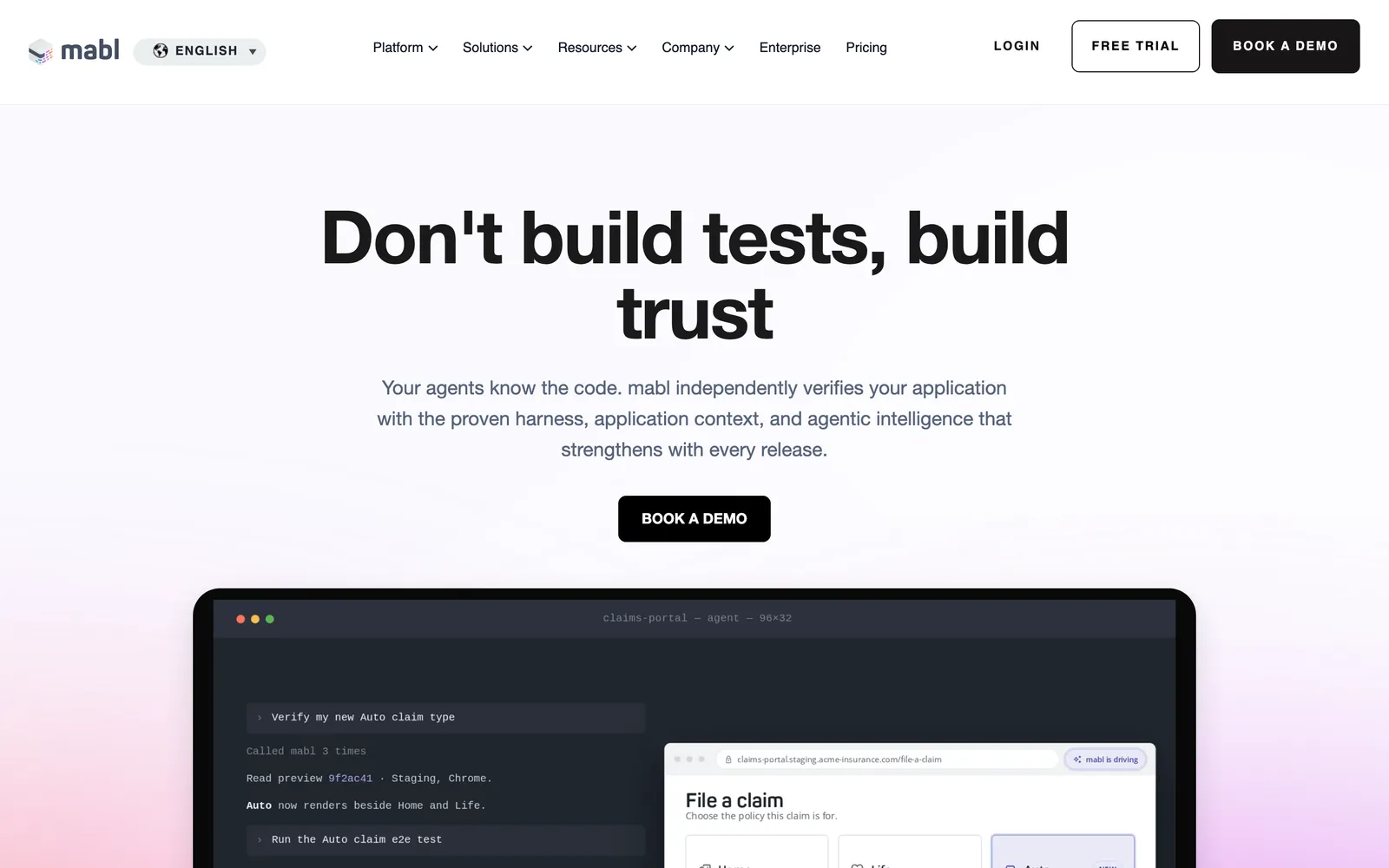
Pricing: quote-based, like Testsigma. Cloud test runs are credit-metered (their FAQ describes a starting point of 500 credits per month), while local and CI runs are unlimited and free. Native mobile testing is an add-on. We break the model down fully in our mabl alternatives guide.
Pros: best-in-class auto-healing maturity; strong enterprise support; unlimited local and CI runs.
Cons: credit-metered cloud runs put a price on testing more; no code export; quote-only pricing.
Best for: mid-market and enterprise teams that value vendor support depth over coverage breadth.
5. TestGrid
TestGrid bundles codeless test authoring with the thing Testsigma charges Enterprise prices for: device infrastructure you can run on-prem. It offers a public device cloud, dedicated cloud, and a "device lab on wheels" for fully segregated teams, plus CoTester, its AI testing agent.
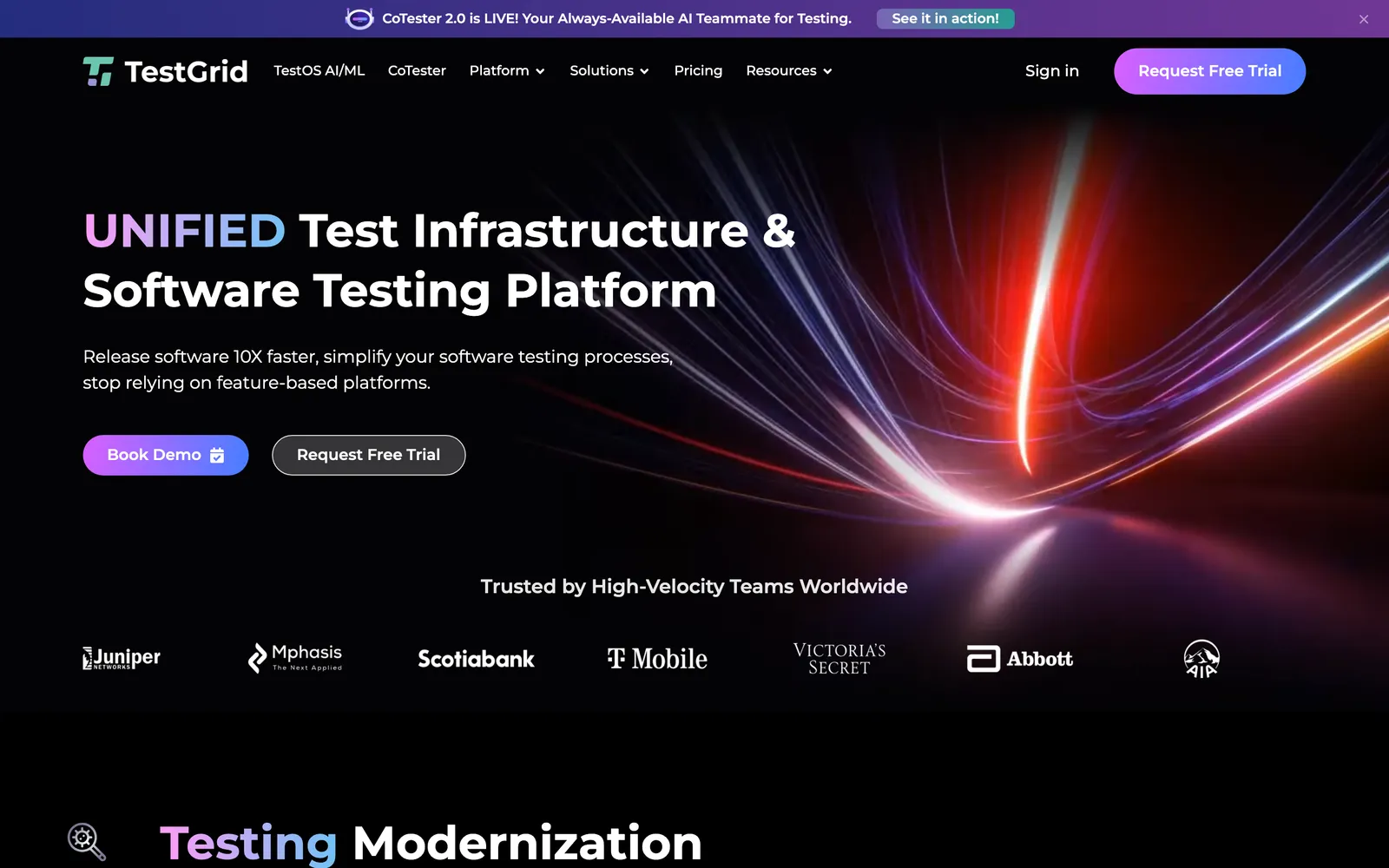
Pricing (verified June 2026): Starter at $199/seat/month (4 devices/browsers, 5,000 tokens, real-device execution, AI autoheal, visual testing); Growth and Enterprise tiers are custom, with on-prem hosting options.
Pros: published entry pricing; real iOS and Android devices including on-prem; codeless authoring with AI assistance; ERP testing (Salesforce, SAP, Dynamics) like Testsigma.
Cons: token-metered usage on Starter; less polished than the category leaders; smaller community and ecosystem.
Best for: teams that need real devices under their own roof, or budget-conscious teams wanting published device-cloud pricing.
6. Functionize
Functionize is the enterprise heavyweight: ML-driven test creation and self-healing aimed at large QA organizations, with dedicated depth in packaged applications (Salesforce, Workday, SAP, Oracle, Guidewire) where DOM-based tools struggle.
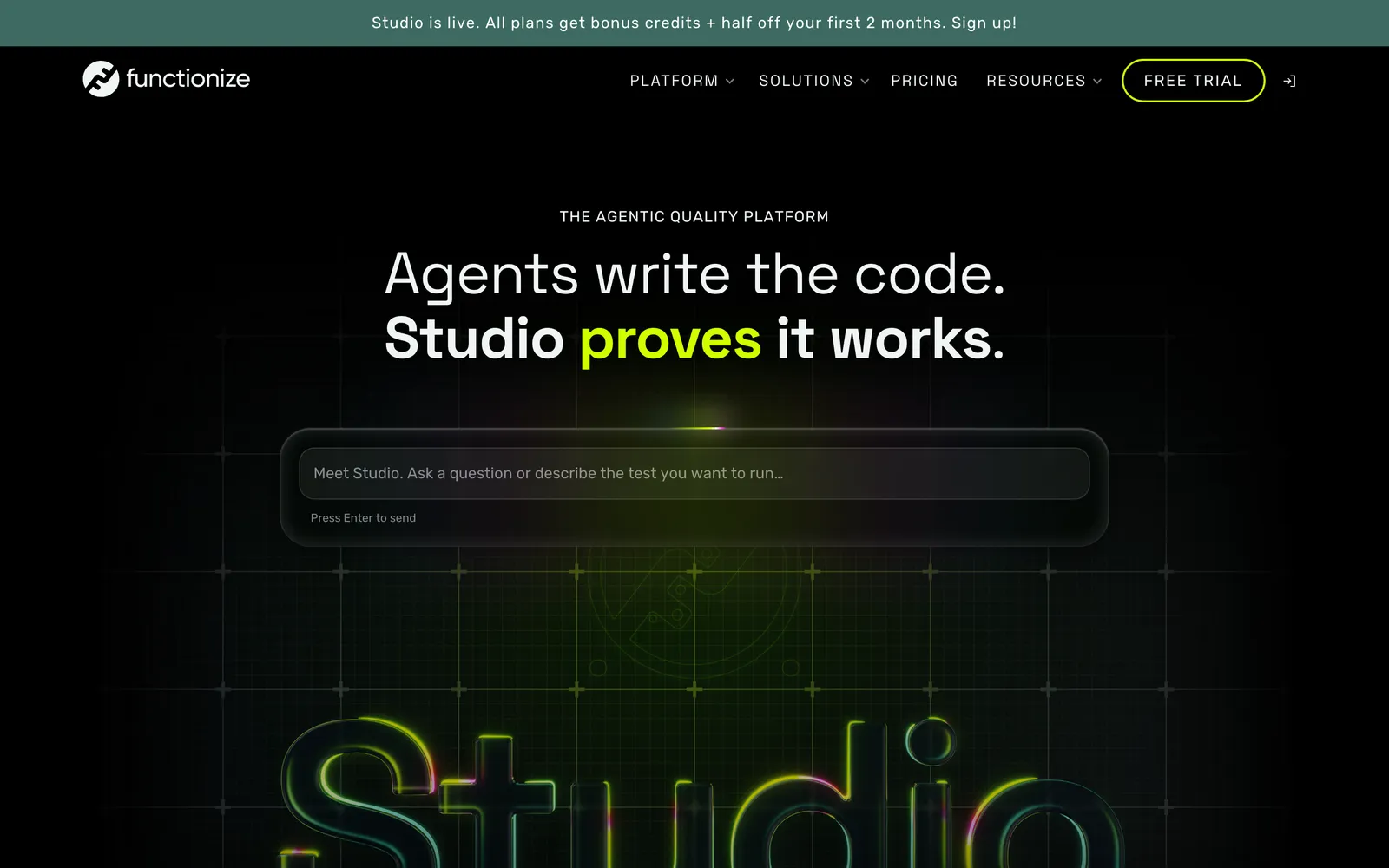
Pricing: no public pricing; demo-led with a free trial. Budget expectations are enterprise-grade.
Pros: packaged-app testing depth; mature ML self-healing; enterprise integrations and support.
Cons: priced and shaped for enterprises only; proprietary format; slower evaluation cycle (sales-led).
Best for: large enterprises standardizing QA across SAP/Salesforce estates alongside custom apps.
7. QA Wolf
QA Wolf answers the build-vs-buy question with "neither, hire us": a hybrid platform plus managed service whose team maps your app, writes Playwright and Appium tests, maintains them, and human-verifies every failure (their Zero Flake Guarantee). They claim 80%+ automated coverage in under four months.
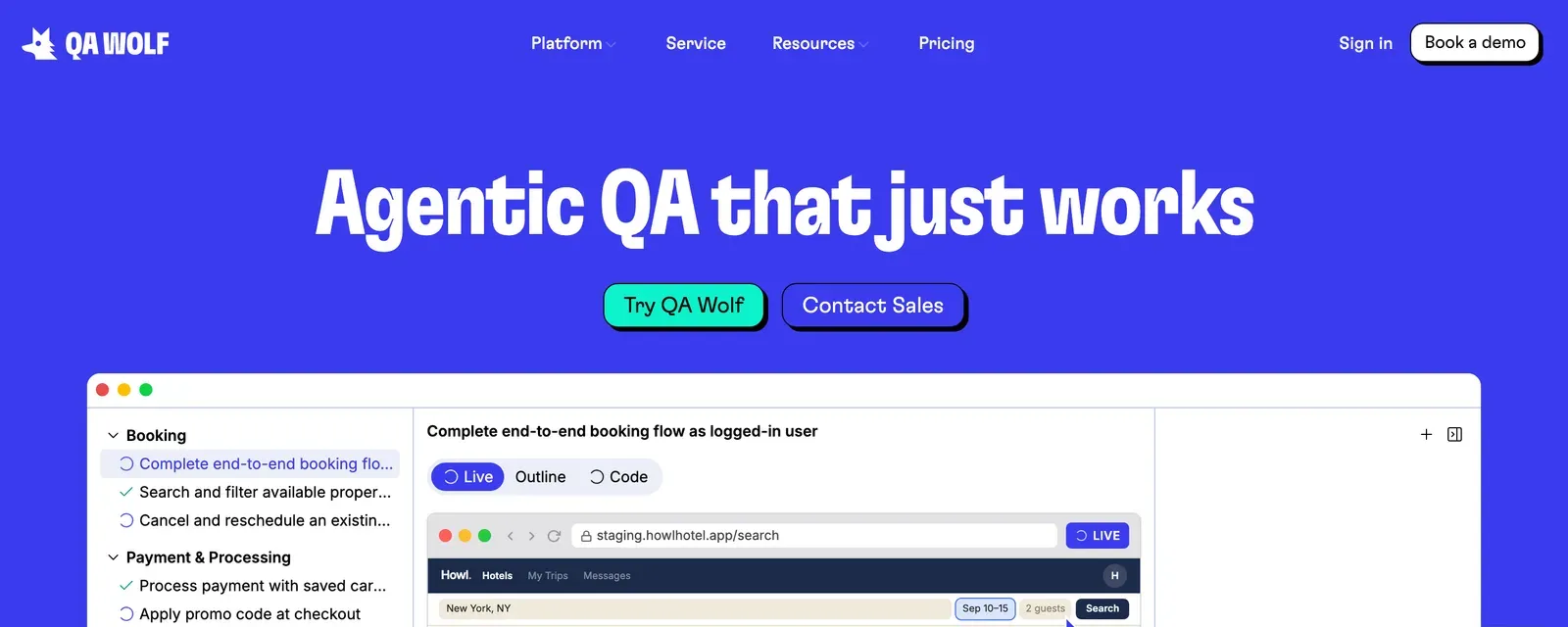
Pricing: quote-based service contract; no public pricing page.
Pros: zero internal lift; verified failures only; deliverable is standard Playwright code you own.
Cons: a service line in the budget, not a tool subscription; no in-house capability building; throughput follows their staffing.
Best for: teams with budget but no QA function who want guaranteed coverage now.
8. Playwright
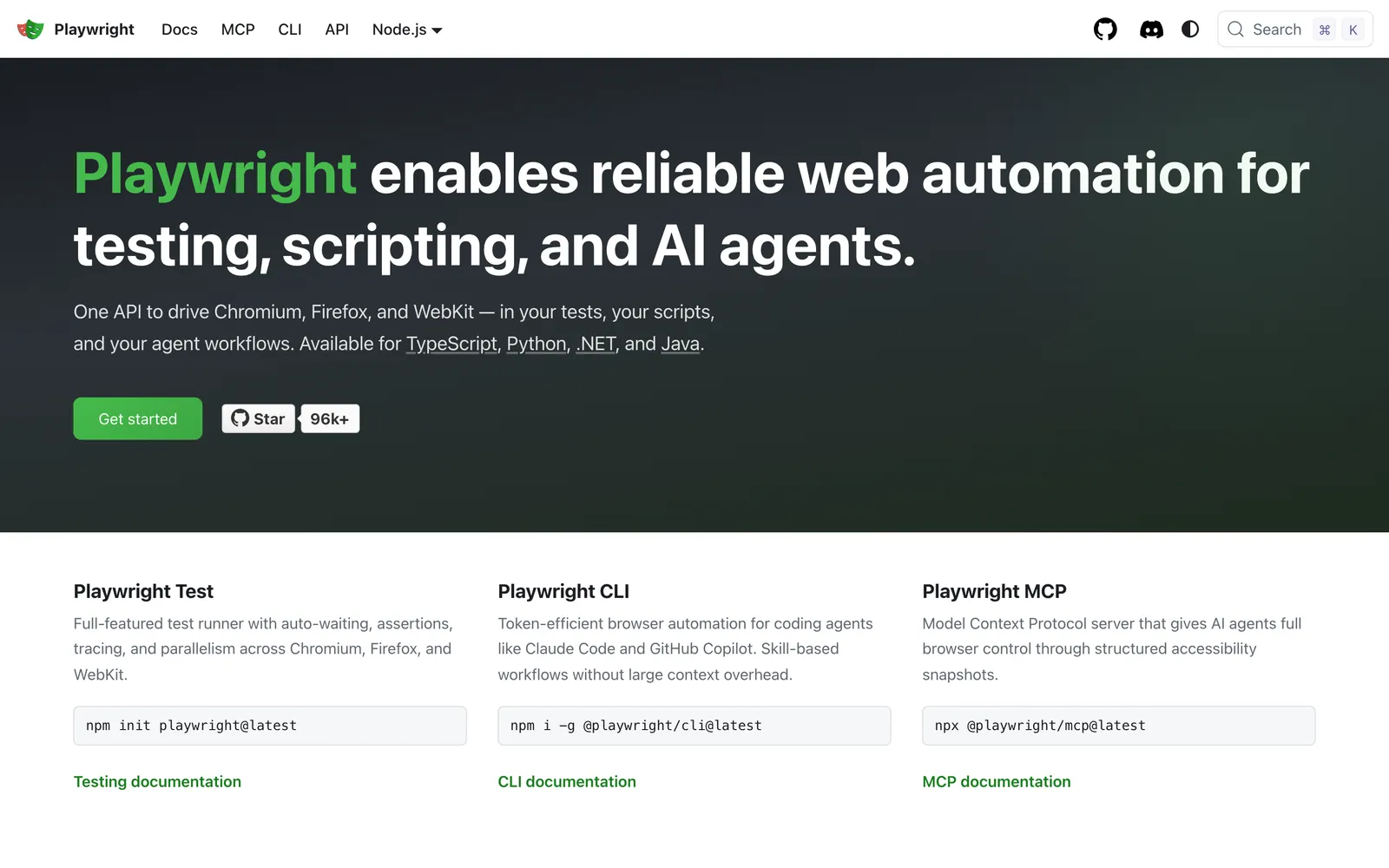
Playwright is the free, open-source baseline. Microsoft's framework drives Chromium, Firefox, and WebKit with auto-waiting, parallelism, and excellent debugging. Several tools on this list (Qodex, QA Wolf) generate Playwright code precisely because it is the portable industry standard.
Pricing: free, Apache 2.0.
Pros: no meter, no vendor, total control, huge community.
Cons: everything is on your engineers: authoring, maintenance, infrastructure, reporting. No NLP authoring, no auto-healing, no device cloud.
Best for: engineering teams with the capacity and desire to own their test suite end to end.
Decision Framework: Which Tool for Which Team
| Your situation | Start with | Why |
|---|---|---|
| Web + API team, wants agent-drafted tests and code ownership | Qodex | Autonomous authoring, ejectable Playwright, security included |
| Mixed-skill team, needs published per-seat pricing | Katalon | Transparent plans, free IDE on-ramp |
| Manual QA team, zero engineers | testRigor | Plain-English, selectorless, built for non-coders |
| Mid-market team wanting deep vendor support | mabl | CSM-led model, mature auto-healing |
| Need real devices on-prem or cheap device cloud | TestGrid | On-prem device labs, published entry price |
| Enterprise with SAP/Workday/Salesforce | Functionize | Packaged-app depth |
| Budget but no QA team at all | QA Wolf | Managed service with coverage guarantee |
| Strong engineering team, no tooling budget | Playwright | Free and portable |
| Testing web + native mobile + desktop + Salesforce in one tool | Stay with Testsigma | Its breadth is still unmatched at its price point |
How to Choose
Map your surfaces first. Testsigma's pitch is breadth. If you genuinely test native mobile, desktop, and Salesforce, the alternatives list shrinks to Katalon, TestGrid, and Functionize, and Testsigma may still win. If you actually ship a web app with an API (most teams), breadth you do not use is complexity you pay for, and focused tools like Qodex or Playwright fit better.
Decide your authoring model. There are three: humans write simplified tests (Testsigma, testRigor, Katalon), an agent drafts and humans review (Qodex), or someone else does it entirely (QA Wolf). Pick the model before the vendor; it determines who on your team does the work.
Price the exit. Quote-based platforms with proprietary formats (Testsigma, mabl, Functionize) combine two switching costs: unknown renewal pricing and a non-portable suite. Tools that output standard Playwright (Qodex, QA Wolf) or are open source (Playwright) keep the exit cheap. Ask every vendor: "if we leave in two years, what do we take with us?"
Cover the API and security gap. UI-first platforms treat API testing as a feature checkbox and security testing as out of scope. If your API is the product, evaluate API depth separately (our Postman alternatives guide covers that landscape) and note that Qodex is the only option here running functional and security checks from one agent.
Frequently Asked Questions
How much does Testsigma cost?
As of June 2026, Testsigma does not publish prices. Both plans, Pro and Enterprise, are quote-based ("Request Pricing" on their site), and their FAQ states that Pro license cost depends on your expected usage. A free trial is available. Pro includes unlimited automated testing minutes, 800+ browser/OS combinations, and 2,000+ real mobile devices; Enterprise adds on-prem deployment, SSO, and accessibility testing.
What is the best free Testsigma alternative?
Playwright is the strongest fully free option: open source, cross-browser via Chromium, Firefox, and WebKit, with no usage limits. Qodex offers a free tier where the AI agent generates Playwright tests for you. testRigor has a free public tier, but tests and results are publicly visible, which rules it out for most commercial work.
Is Testsigma better than Katalon?
They target different buying preferences. Testsigma is cloud-first with NLP authoring, broader device coverage (2,000+ real devices), and quote-based pricing. Katalon offers a free desktop IDE, published per-seat pricing ($167/seat/month billed annually, with a $4,000/year first-purchase offer for 5 seats), and a record-and-script hybrid that suits teams with some coding skill. Pick Testsigma for scriptless breadth, Katalon for pricing transparency and a free on-ramp.
Does Testsigma lock you in?
Tests built in Testsigma run only in Testsigma; there is no supported export to standard Playwright or Selenium code. That is true of most low-code platforms (mabl, testRigor, Functionize as well). If portability matters, choose tools whose output is standard code: Qodex generates ejectable Playwright and HTTP scripts, and QA Wolf delivers Playwright suites you own.
Which Testsigma alternative handles security testing?
Qodex is the only tool on this list that includes security testing: OWASP-aligned API checks for IDOR, BOLA, auth bypass, and injection run from the same agent as functional tests. Testsigma, Katalon, mabl, TestGrid, and Functionize cover functional quality only, so security testing in those stacks means buying and integrating a separate scanner.
Can I use Testsigma and an alternative together?
Yes, and hybrid stacks are common. A typical split: Testsigma (or TestGrid) for native mobile and desktop coverage where real devices matter, plus Qodex or Playwright for web UI and API regression in CI where speed and code ownership matter. Since Qodex replays are free and Testsigma Pro minutes are unlimited, neither side of that stack meters your runs.