Comparison
Qodex vs QA Wolf: Managed Service or In-House Agent?
The short answer: QA Wolf is QA done for you, a managed service whose engineers and AI build and maintain your tests, priced per test under management. Qodex is QA done by you, faster: an agent your team drives that writes ejectable Playwright and HTTP code with security checks built in.
Outsource the work, or automate it?
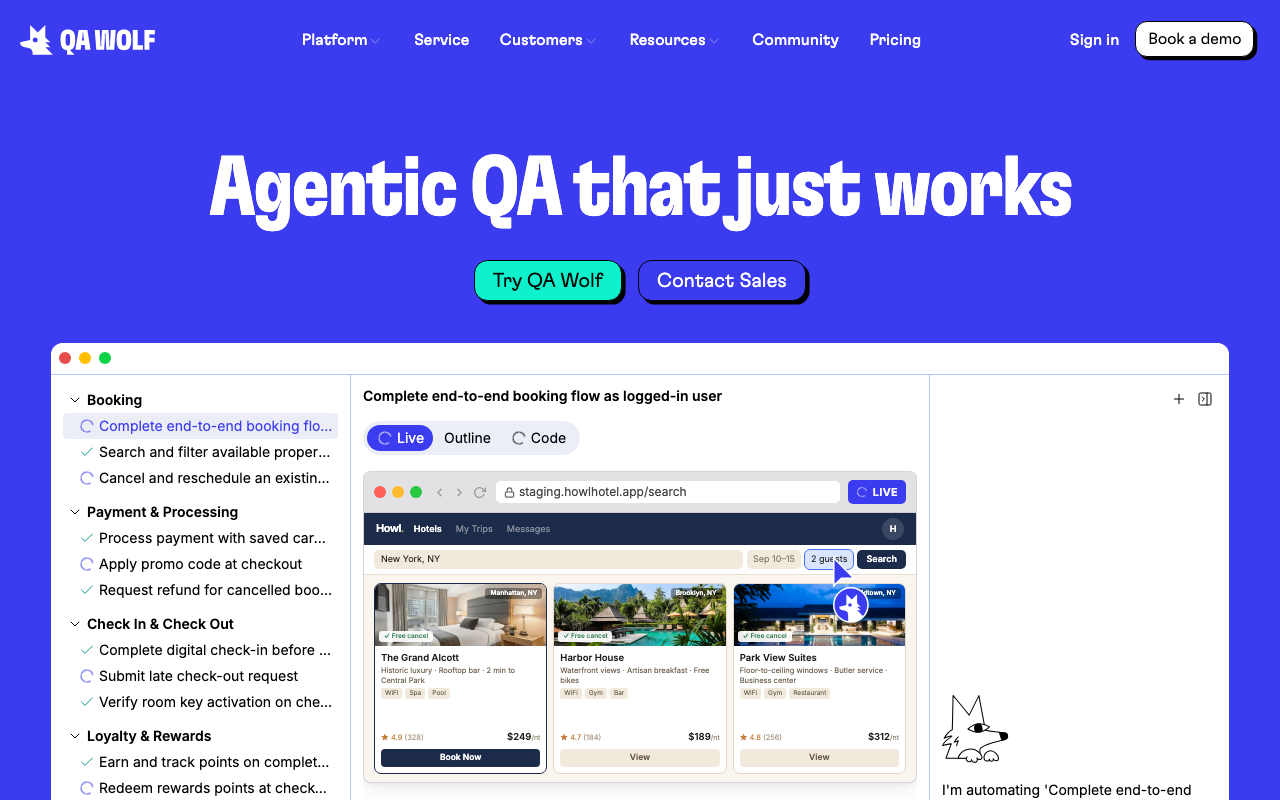
QA Wolf calls its model Coverage-as-a-Service, and the name is accurate. You do not buy software; you buy an outcome. Their QA engineers, working with their Automation AI, map your application, write production-grade test code for web, iOS, and Android flows, run the suite, investigate every failure, and keep the tests maintained. Their site is explicit about the economics: costs are locked to the number of tests they manage, with unlimited runs and maintenance included. For a team with no QA function and no desire to build one, that is a complete answer.
Qodex sells the other answer: keep QA in-house, but give your team an agent so it stops being a grind. You brief the agent in chat; it explores your app with a real browser and direct API calls, writes runnable Playwright and HTTP scenarios, verifies them on save, and replays them deterministically at zero LLM cost. Security testing, OWASP Top 10 and OWASP API Top 10, runs in the same suite. Your engineers review and promote; the knowledge and the code stay with you.
The real question is organizational, not technical: do you want to own QA capability or rent QA outcomes? For more options across both models, see our QA Wolf alternatives guide.
Qodex vs QA Wolf at a glance
| Dimension | QA Wolf | Qodex |
|---|---|---|
| Authoring model | Outsourced. QA Wolf embeds its own QA engineers, assisted by its Automation AI, to map your app, write the tests, and maintain them. Your team reviews coverage, not code. | In-house. Your team briefs the agent in chat; it explores your app with a real browser and direct API calls, writes scenarios with assertions, and verifies them on save. |
| Generated assets | Production-grade test code built and maintained by their team for web, iOS, and Android cases, managed inside the QA Wolf service relationship. | Standard Playwright and HTTP scripts your team owns from day one, parameterized via environment variables and git-syncable. Eject and run them anywhere, anytime. |
| Replay cost | Unlimited runs and unlimited maintenance are included in the service; their site says costs are locked to the number of tests under management. | LLM tokens are spent once at authoring time. Saved scenarios replay deterministically at zero LLM cost on schedules, webhooks, or CI. |
| Security testing | The service is built around functional end-to-end regression coverage. OWASP-style security scanning is not among the offerings listed on qawolf.com as of June 2026. | OWASP Top 10 and OWASP API Top 10 scenarios run in the same suite as functional tests, with inverted semantics: pass means the attack was blocked. |
| Mobile support | Yes. Their site lists complex web, iOS, and Android test cases within the managed service. | Web applications and APIs only. No native mobile testing today. |
| Pricing model | Per test under management, through a sales process. No public dollar figures on qawolf.com as of June 2026; investigation, maintenance, and runs are bundled in. | Free tier and published plans, self-serve. Bring your own OpenAI key with every token logged, so AI spend is transparent and capped per scan. |
| Target team | Teams that want QA handled for them: no internal QA hires, no test maintenance, a guaranteed coverage outcome delivered as a service. | Teams that want QA capability in-house: developers who review tests like code and want the suite, the knowledge, and the costs under their own control. |
QA Wolf service and pricing-model claims checked against qawolf.com, June 2026. Their offering evolves; confirm specifics on their site.
When QA Wolf is the right choice
If you genuinely want QA off your plate, a managed service beats any tool, including ours. QA Wolf is the stronger fit when:
- You have no QA function and do not want to build one. Embedded QA engineers plus their AI deliver coverage as an outcome. Nobody on your team writes, reviews, or maintains a test.
- You want failure investigation done for you. Their team investigates every failed run and hands you confirmed bugs, not flaky-test archaeology. That labor is the hidden cost of most automation, and they absorb it.
- You need complex web, iOS, and Android flows covered. Their engineers handle cases that are genuinely hard to automate, and native mobile is in scope. Qodex does not test native mobile apps.
- Predictable, bundled costs appeal to you. Per-test pricing with unlimited runs and maintenance included means the bill maps to coverage, not to hours or run counts.
When Qodex is the right choice
Qodex fits teams that want the capability in-house, without the grind:
- Your developers own quality. Tests gate deploys, so engineers want to read them like code. Qodex generates standard Playwright and HTTP scripts they can review in pull requests, diff, and git-sync. The suite is yours from day one, not an artifact of a service relationship.
- You want testing knowledge to compound internally. The agent keeps per-project memory of your app's auth, API behavior, and past findings, and your team sees all of it. Outsourcing builds that institutional knowledge inside someone else's company.
- Security testing belongs in the same suite. OWASP Top 10 and OWASP API Top 10 scenarios run alongside functional tests, with multiple auth profiles for IDOR and role-escalation checks. Pass means the attack was blocked.
- You want to start now, not after a sales cycle. Self-serve signup, a free tier, and published plans. The first verified scenarios exist the same afternoon.
- You want AI costs you can audit. LLM tokens are spent once at authoring; replays are deterministic at zero LLM cost. With bring-your-own-key, every token is logged against your own account.
The honest bottom line
This is a fork in the road, not a feature shootout. QA Wolf is the strongest version of the outsourcing argument: real engineers, AI leverage, guaranteed coverage, bundled economics. If that is what you want, buy it. Qodex is the strongest version of the ownership argument: an agent that does the heavy lifting while your team keeps the code, the knowledge, and the security posture in-house. Teams that expect QA to become a core engineering competency, or that cannot ship their test suite's institutional knowledge outside the building, should own the agent rather than rent the outcome.
Qodex vs QA Wolf: common questions
Straight answers for teams weighing a managed service against an in-house agent.
Are Qodex and QA Wolf even the same kind of product?+−
If we want to fully outsource QA, which should we pick?+−
How does pricing differ between Qodex and QA Wolf?+−
Who owns the tests in each model?+−
Does QA Wolf cover security testing?+−
Can Qodex match a managed service on maintenance?+−
Keep QA in-house. Skip the grind.
Point the Qodex agent at your app. It writes verified Playwright and HTTP scenarios your team owns, runs security checks in the same suite, and replays everything at zero LLM cost.