13 Best Selenium Alternatives in 2026: Python, No-Code and AI
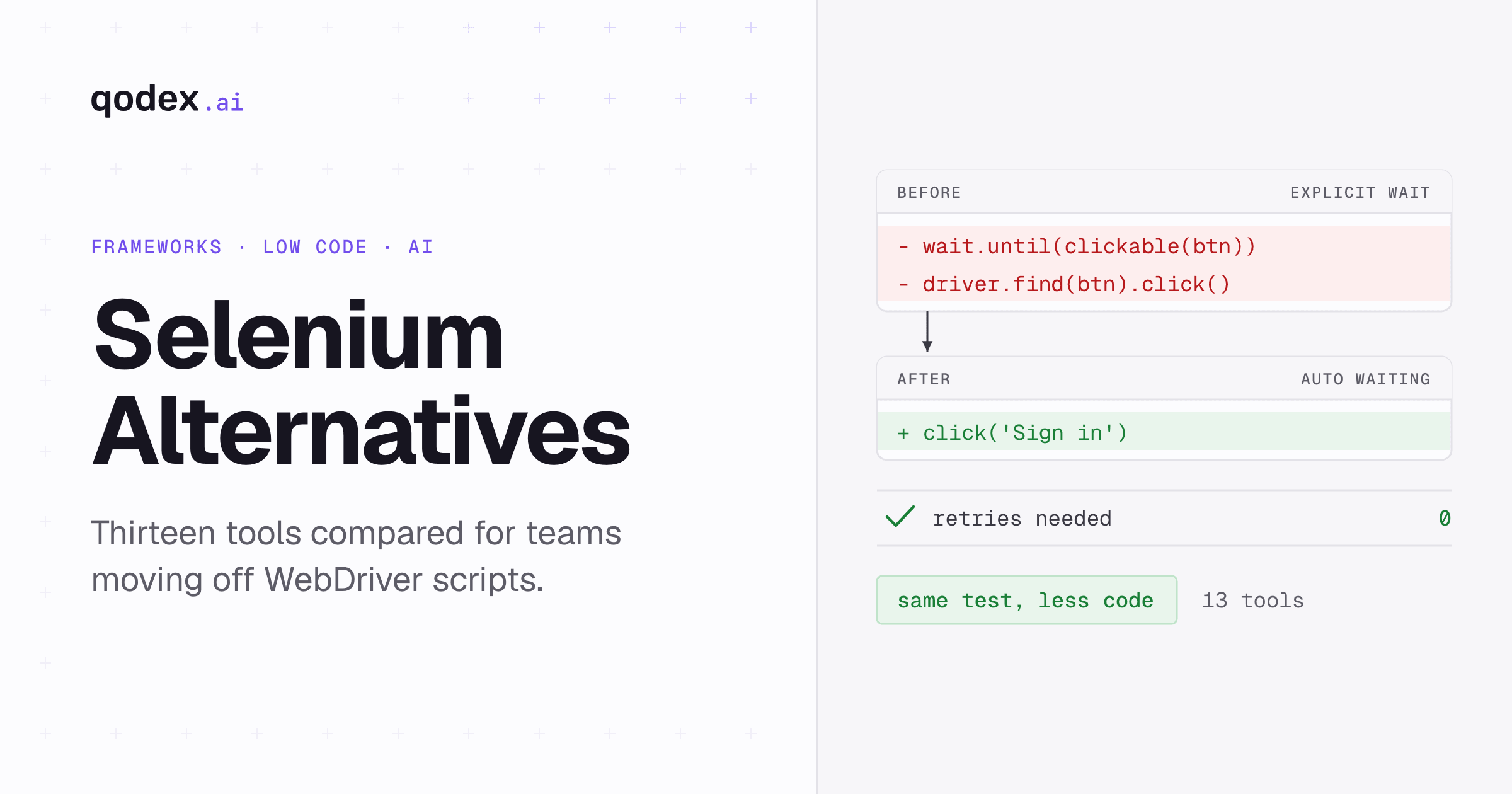
The Selenium alternatives worth your time in 2026 do two different jobs. Code-first frameworks (Playwright, Cypress, WebdriverIO, TestCafe, Nightwatch, Puppeteer) are where your engineers write tests, and Playwright publishes Python, Java and .NET bindings. AI and no-code platforms (Katalon, testRigor, mabl, Testim, Momentic, Qodex, Panto) are where somebody or something else writes them. Every price and license below was read off the vendor's own pages on 4 October 2026. Where a vendor publishes no number, this guide says so instead of guessing. You can also see how Qodex compares to every major QA tool.
Quick answer by job
A Python, Java or .NET suite: Playwright. Apache 2.0, three browser engines, and bindings in all three languages.
JavaScript frontend, fast feedback: Cypress. The app is MIT; Cloud Team is $67 a month billed annually.
Keep WebDriver and the Grid: WebdriverIO or Nightwatch. Both MIT, both speak W3C WebDriver.
No WebDriver setup: TestCafe. MIT, no Selenium or browser plugins, one flag for concurrency.
Driving Chrome rather than testing: Puppeteer. Apache 2.0 library, bring your own runner.
No-code, or replacing Selenium IDE: Katalon. Studio Free records and plays back, and Katalon imports Selenium IDE projects.
Tests in plain English: testRigor. A free public plan, if your tests can be public.
Lifting an existing suite across: mabl. Its CLI records your Selenium runs and an agent writes mabl tests from them.
Nobody has time to write tests: Qodex or Momentic. Both generate tests rather than give you a better place to type them.
Real phones: Panto publishes 150+ real Android and iOS device and OS combinations. See our BrowserStack alternatives guide for device clouds.
Staying on Selenium: a fair answer. The stay-put case is below.
Six of those cost nothing to license and one starts at $1,299 a month. That gap is the point: "Selenium alternative" hides two questions, a better framework to write tests in, or fewer tests written by hand at all.
How we evaluated
On 4 October 2026 we opened each vendor's homepage, pricing page, docs and license file, and wrote down what each one states. Then we sorted every tool on three questions. What does it test? Who writes the tests? What do you have to move to leave Selenium? We did not port a Selenium suite into each tool, so the migration notes are what each vendor documents, not what we measured. "Nothing documented" means the pages we read did not say, not that the feature is missing.
What kind of Selenium replacement do you need?
Selenium is a browser automation project with three parts that get replaced separately. There is the WebDriver API you write tests against, the W3C WebDriver standard that browsers implement, and Grid, which spreads sessions across machines.
A code-first framework replaces the API. You own the tests and the repository, with AI help in some frameworks; the win is auto-waiting, a bundled runner and a real debugger. Playwright, Cypress, WebdriverIO, TestCafe, Nightwatch and Puppeteer.
An AI or no-code platform replaces the author. Tests are plain English, recorded steps or generated code, and the pitch is that maintenance stops being your job. Katalon, testRigor, mabl, Testim, Momentic, Qodex and Panto.
Execution infrastructure runs the tests. BrowserStack, Sauce Labs and a self-hosted Grid rent or host browsers and devices, and both clouds now sell AI test authoring too. Treat them as a column in the decision, not a competitor to Playwright.
Scraping tools are a fourth category that shows up in the same search results. There is a short section on them near the end.
When to keep Selenium
Your suite is in a language the others do not cover. Playwright publishes JavaScript, TypeScript, Python, Java and .NET bindings, and no official Ruby, PHP or Kotlin binding. The other five frameworks here are JavaScript-based. If your tests are Ruby, PHP or Kotlin, there is no framework on this page to move them to.
Your infrastructure already works. WebdriverIO, Nightwatch and Testim run on Selenium-compatible grids, Playwright has experimental Grid 4 support for Chrome and Edge, and mabl's CLI records sessions from Grid, Sauce Labs and BrowserStack.
Few tools move your test code. Two products here publish a path for existing Selenium work. Katalon copies Selenium 4.x, TestNG and JUnit code into a project and imports Selenium IDE files. mabl's CLI records your Selenium runs and has an agent write mabl tests from them. Everywhere else, migration means rewriting.
The pain is not the framework. If your failures come from test data, environments or nobody having time to write coverage, a new API fixes none of it.
Move when you can name the thing that will get better. "Selenium is old" is not that thing.
Decision table: what each tool tests, who writes the tests, what you move
| Tool | What it tests | Who writes tests | What moves | Price; free option |
|---|---|---|---|---|
| Playwright | Browser tests on Chromium, Firefox and WebKit | Developers in code; planner, generator and healer agents help | Rewrite; experimental Grid 4 support for Chrome and Edge | $0 license. Free: Apache 2.0 |
| Qodex | API, UI and security tests an AI agent writes, run on Playwright browsers | An AI agent, from a chat brief; people approve repairs | Imports scenarios from OpenAPI, Postman, spreadsheets and existing tests | Startup from $1,299 per project/mo. Free: 25 scenarios, 100 runs a month |
| Cypress | Browser tests that run inside the browser beside the app | Developers in JavaScript or TypeScript, with AI generation | Rewrite, with a migration guide and an AI prompt for it | Cloud Team $67/mo annual. Free: App is MIT; Cloud Starter, 10 users |
| WebdriverIO | Browser tests over WebDriver, mobile through Appium | Developers in JavaScript or TypeScript | Grid and cloud endpoints keep working; test code rewritten | $0 license. Free: MIT |
| TestCafe | Browser tests plus API tests | Developers in code, or recorded steps | Rewrite; it does not use Selenium | Studio $249.99 per user. Free: MIT framework |
| Nightwatch | End-to-end, component, accessibility, API and mobile tests | Developers in Node.js; a browser recorder helps | Grid and cloud endpoints keep working; test code rewritten | $0 license. Free: MIT |
| Puppeteer | Browser control for Chrome and Firefox | Developers, plus a test stack they assemble | Rewrite; no Grid path documented | $0 license. Free: Apache 2.0 |
| Katalon | Web, API, mobile and Windows desktop tests | QA in low-code, developers in Groovy or Java, AI agents | Copies Selenium, TestNG and JUnit code; imports Selenium IDE projects | Professional promo $1,000/seat/yr. Free: Studio Free |
| testRigor | Web, mobile, API, Windows and mainframe tests | Anyone, in plain English | Rewrite as plain English; manual cases can be pasted in | Private plans: no public price. Free: Public plan, tests made public |
| mabl | Web, mobile and API tests | QA in low-code, plus agents that author and repair | CLI records Selenium runs; an agent writes mabl tests | Quote only. Free: 14-day trial |
| Testim | Web, mobile and Salesforce tests | QA records tests, adds code; AI from natural language | Runs on your Grid; no Selenium importer documented | Quote only. Free: Community plan after trial |
| Momentic | Web tests in Chromium; mobile on emulators | Plain-English steps saved as YAML in your repo | Rewrite as YAML | $125/mo plus usage. Free: 2,000 credits a month, about 200 runs |
| Panto | Android and iOS tests on real devices | Plain-English commands to an AI agent | No Selenium path documented | QA Scale $20 per 500 credits. Free: Playground |
Read on 4 October 2026. Languages, parallel runs and hosting sit in each tool's fact block below.
The 13 best Selenium alternatives in 2026
Playwright leads because its Python, Java and .NET bindings let a Selenium suite change frameworks without changing language. Qodex, our own product, sits second by this site's rule for alternatives pages. Then come the five other code-first frameworks (3 to 7), which replace the API you write against, and the six AI and no-code platforms (8 to 13), which replace the author.
1. Playwright
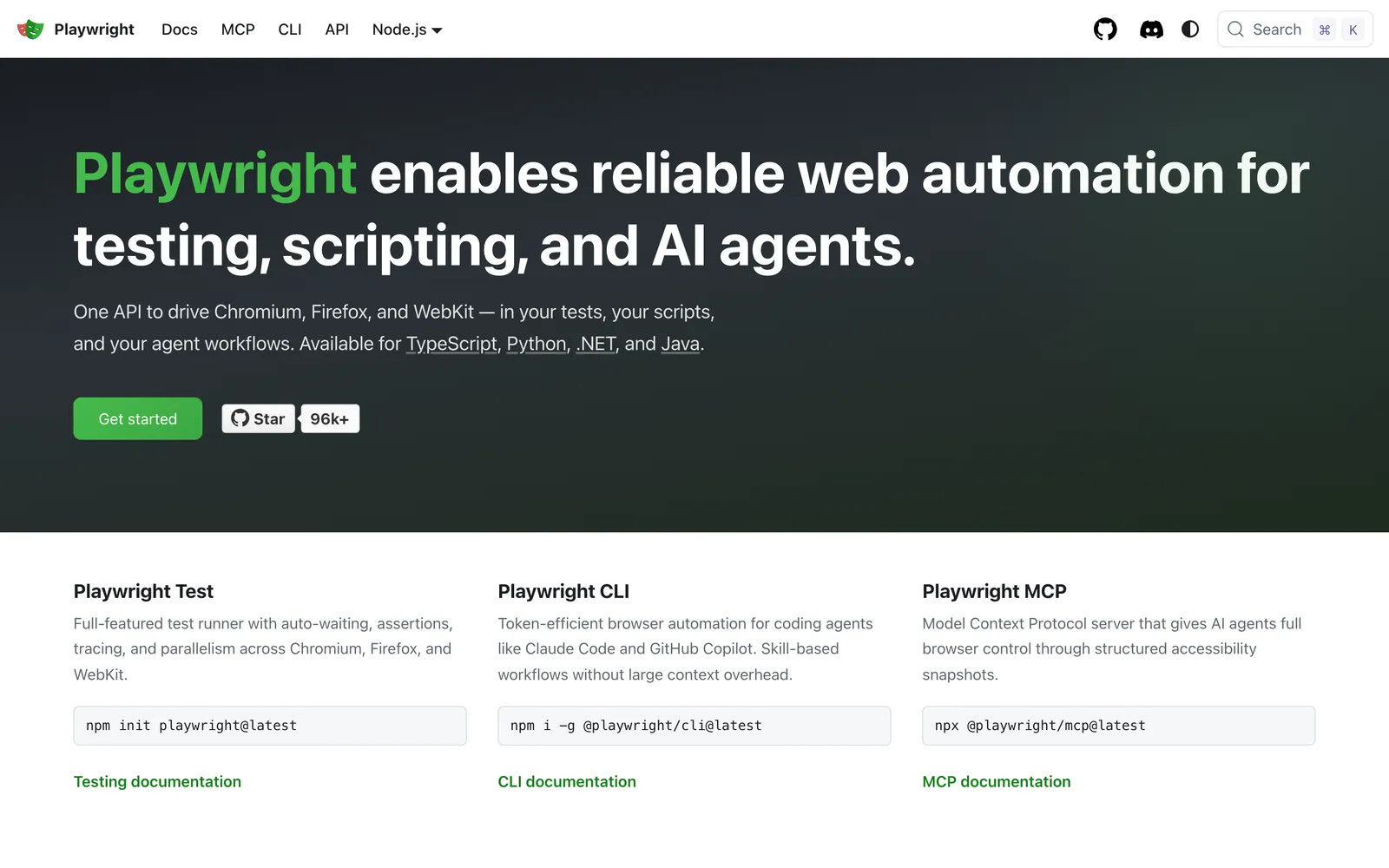
Playwright is Microsoft's open-source framework, with one test runner and bindings in five languages.
License: Apache 2.0, with no license fee.
Languages and browsers: JavaScript, TypeScript, Python, Java, .NET. Chromium, Firefox and WebKit, plus branded Chrome and Edge. Not branded Safari.
Parallel and hosting: files run in parallel by default and shard across machines. Local or CI.
Migration from Selenium: nothing documented for running Selenium code unchanged. Experimental Selenium Grid 4 support launches Chrome or Edge, so a Grid can stay while the tests change.
CI and AI: examples for GitHub Actions, GitLab, Bitbucket and Jenkins. Planner, generator and healer agents help write and fix tests, and an MCP server gives AI agents browser control.
Best for: teams leaving Selenium with a Python, Java or .NET suite. See Playwright alternatives and Playwright vs Cypress.
Watch out for: WebKit is not Safari, and your team still owns and maintains the suite.
2. Qodex
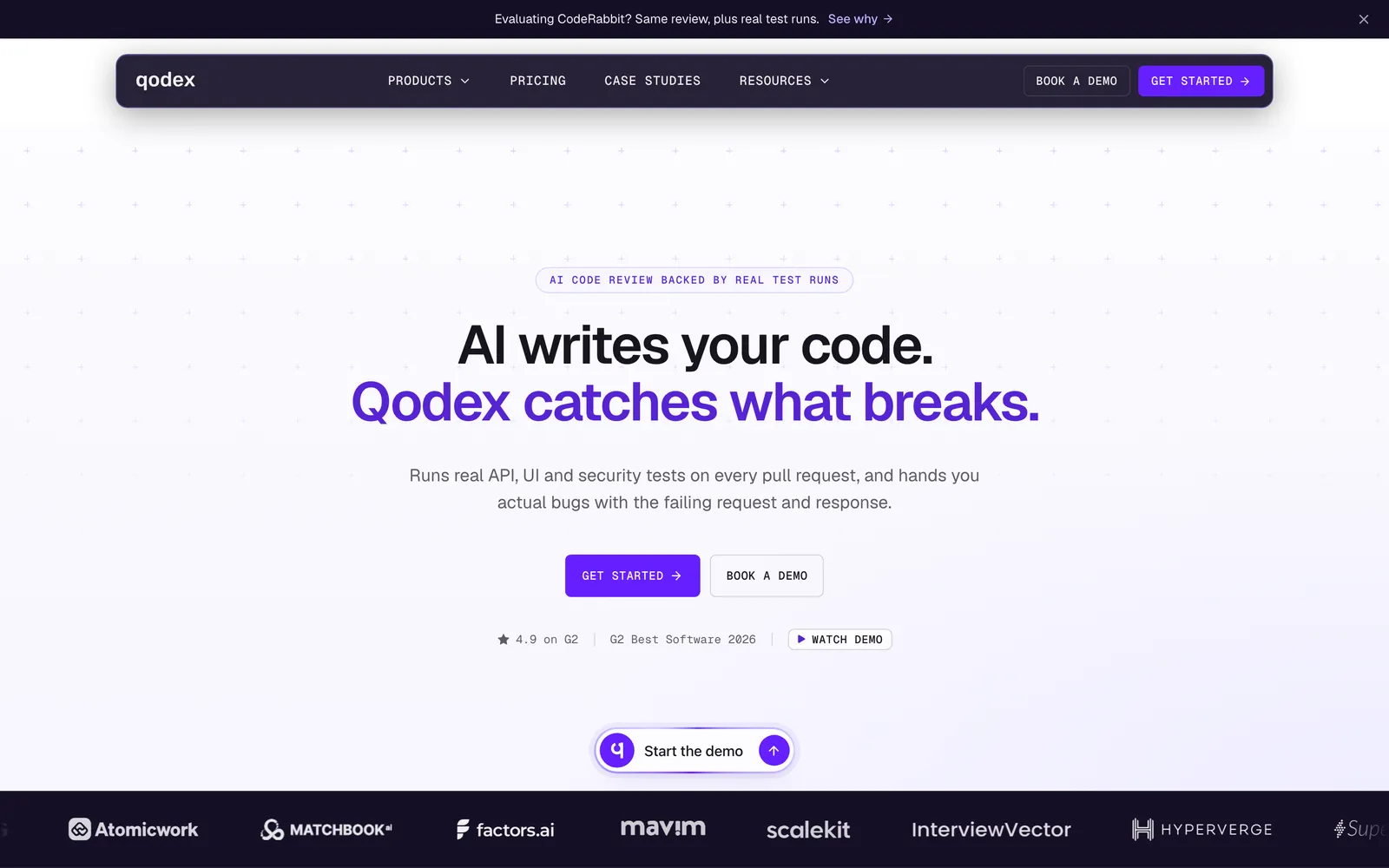
Qodex is an AI QA agent that writes and runs API, UI and security tests on every pull request, from your spec and your running app. UI runs happen on Playwright browsers. It is not a framework you write tests in, and it is not a device farm.
Price, 4 Oct 2026: Startup from $1,299 per project per month, with 200 scenarios, 10,000 runs and two concurrent runs. Scale from $2,500 per project per month. See Qodex pricing.
Free: Individual is $0 with 25 scenarios, 100 runs a month, one repository, one AI chat session, one run at a time.
Authoring and coverage: you describe the flow in chat and the agent generates the scenario. Tests export as standard Playwright and HTTP code. UI runs use Playwright browsers, Chromium first.
Parallel and hosting: one run at a time on Individual, two on Startup, high concurrency on Scale. Self-hosting is published for PR Review Enterprise.
Migration from Selenium: scenarios import from OpenAPI, Postman, spreadsheets and existing tests. A Selenium-specific importer is not documented; the agent writes new tests against the running app.
CI and AI: CI/CD integrations, schedules and webhooks from Startup. AI covers generation, failure classification, maintenance as diffs you approve, security testing and code review.
Best for: teams whose Selenium suite is expensive to keep alive rather than wrong. See UI testing, or start free against staging.
Watch out for: free to $1,299 is a steep step and the unit is the project, not the seat. To hand-write every selector, use Playwright.
3. Cypress
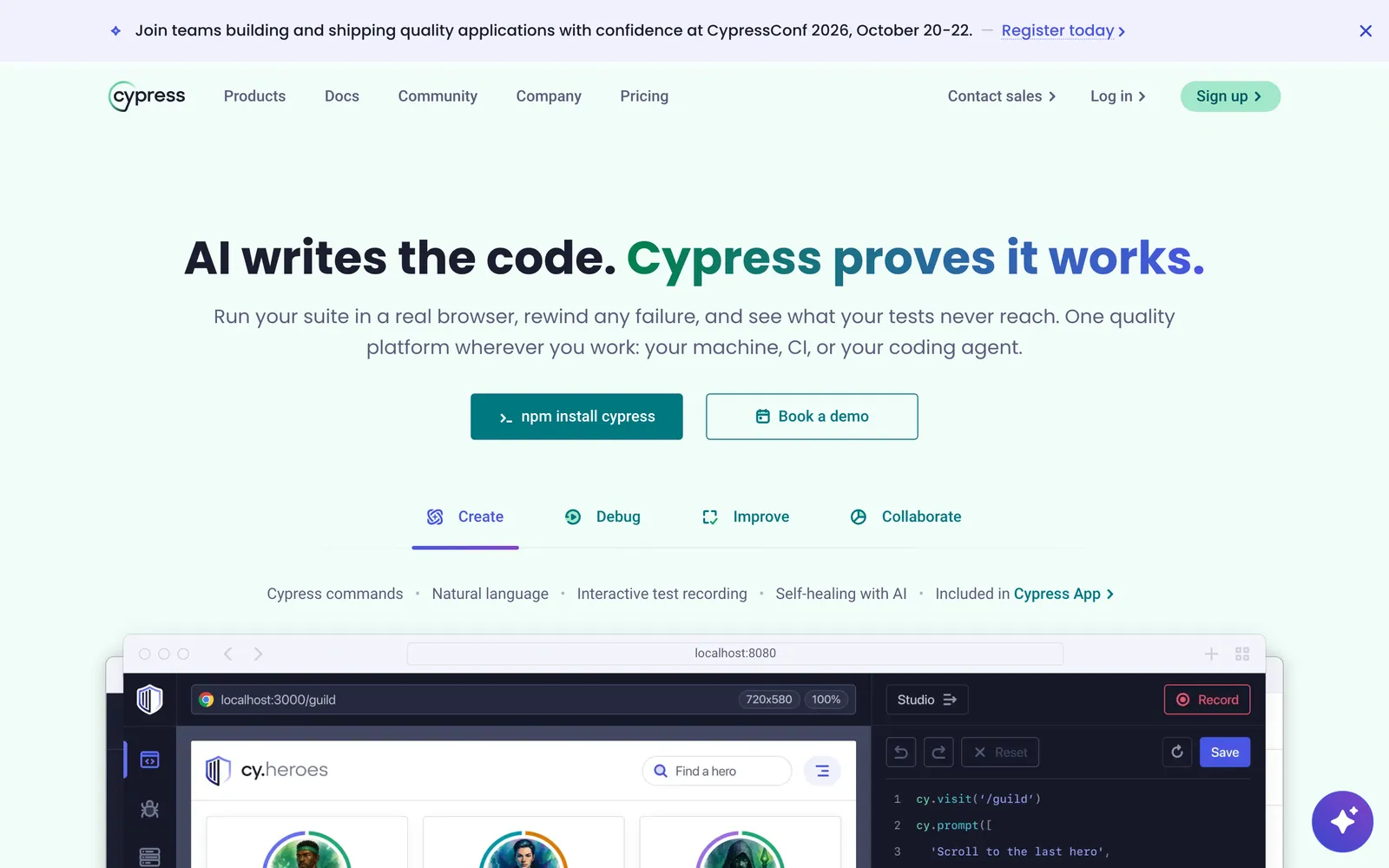
Cypress runs inside the browser alongside your app instead of driving it from outside, and publishes a detailed Selenium migration guide.
License: Cypress App is MIT. Cypress Cloud is a separate paid product.
Price, 4 Oct 2026: Cloud Team from $67 a month billed annually at $799. Business from $267 a month annual.
Free: Starter covers 10 users, 500 test results a month, 100 prompt executions, 30-day retention.
Languages and browsers: JavaScript and TypeScript only. Chrome is the default test browser, and it uses the browsers on your machine. Electron is deprecated.
Parallel and hosting: Cloud parallelization comes on every plan, Starter included, metered by test results rather than seats.
Migration from Selenium: the first-party guide, updated 20 September 2026, maps waits, locators, assertions and CI, and includes a prompt for an AI assistant. Java, Python, C# and Ruby suites get rewritten in JavaScript, and it recommends keeping Selenium tests until the replacements pass.
AI: natural-language test generation and self-healing.
Best for: JavaScript teams where debugging speed beats browser breadth. See Cypress alternatives.
Watch out for: one language, and a big suite meets the results meter fast.
4. WebdriverIO
WebdriverIO is a small infrastructure change: a Node.js framework around the protocol you already run.
License: MIT.
Languages and browsers: JavaScript and TypeScript. It drives browsers over W3C WebDriver, defaulting to WebDriver BiDi. Appium adds native mobile.
Parallel and hosting: spec files run in workers, and maxInstances sets concurrency. Local, CI, Selenium Grid or a commercial grid.
Migration from Selenium: Grid and cloud endpoints keep working. Nothing documented for converting the test code itself.
AI: an MCP server lets AI agents drive browser and mobile automation.
Best for: teams with a Grid, a cloud contract or Appium tests to keep. See Selenium vs WebdriverIO.
Watch out for: a JavaScript rewrite is still a rewrite.
5. TestCafe
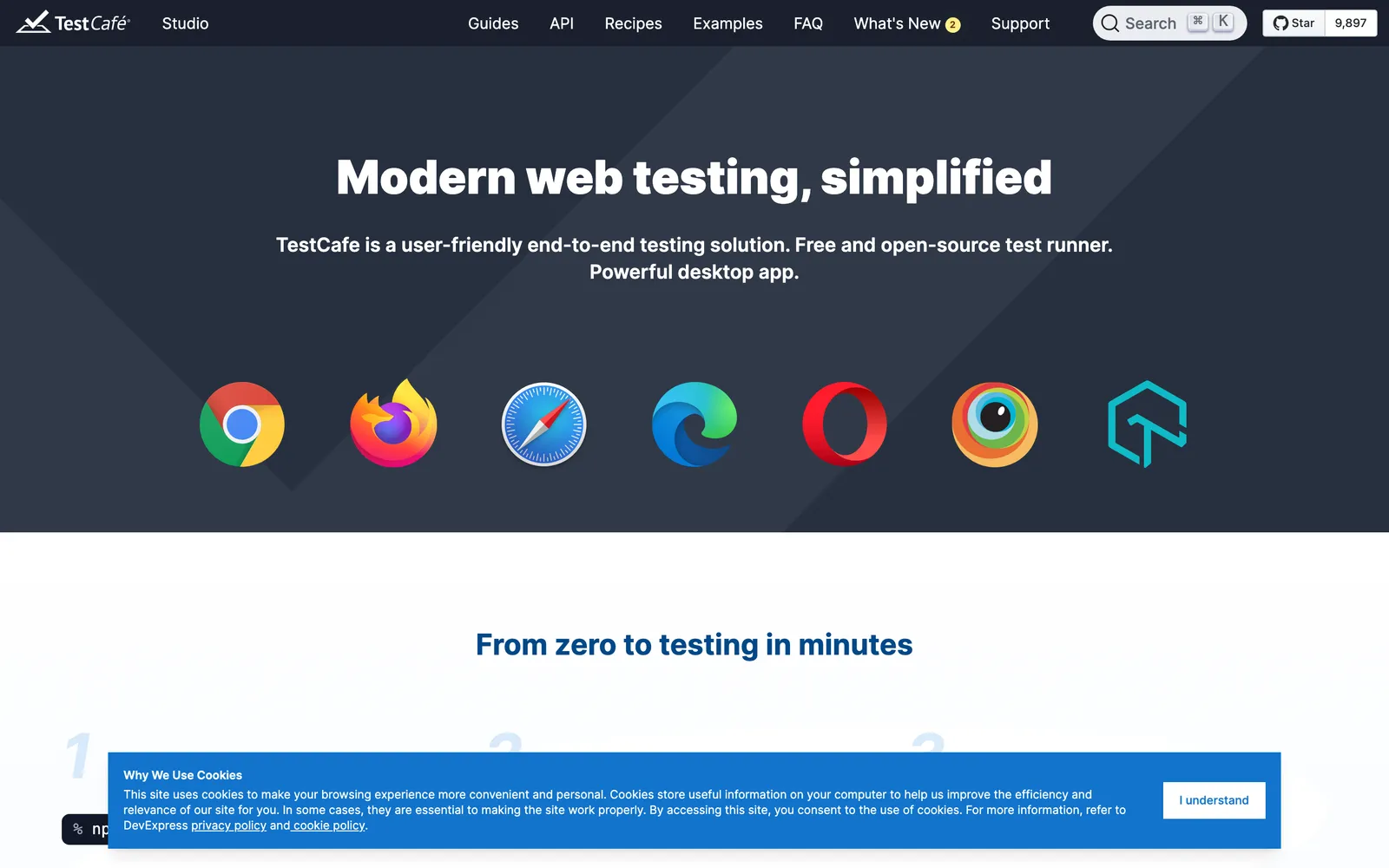
TestCafe, from DevExpress, does not use Selenium and needs no browser plugins.
License: MIT for the framework. TestCafe Studio is a separate commercial IDE: $249.99 per user, or $499.99 for Studio Pro, each with 12 months of updates.
Languages and browsers: JavaScript, TypeScript and CoffeeScript. Modern Chromium, Chrome, Edge, Firefox, Opera and Safari, plus headless, remote, mobile and cloud browsers. IE 11 and legacy Edge were dropped in TestCafe 3.
Parallel and hosting: a concurrency flag launches several instances per browser. Local, remote or cloud browsers.
Migration from Selenium: nothing documented for importing Selenium tests, so the tests and the way they run both change.
CI: runs from its CLI, with documented CI integrations. It also covers API testing.
Best for: small JavaScript teams who want to be running tests an hour after deciding to.
Watch out for: the recorder lives in the paid Studio, not the free framework.
6. Nightwatch
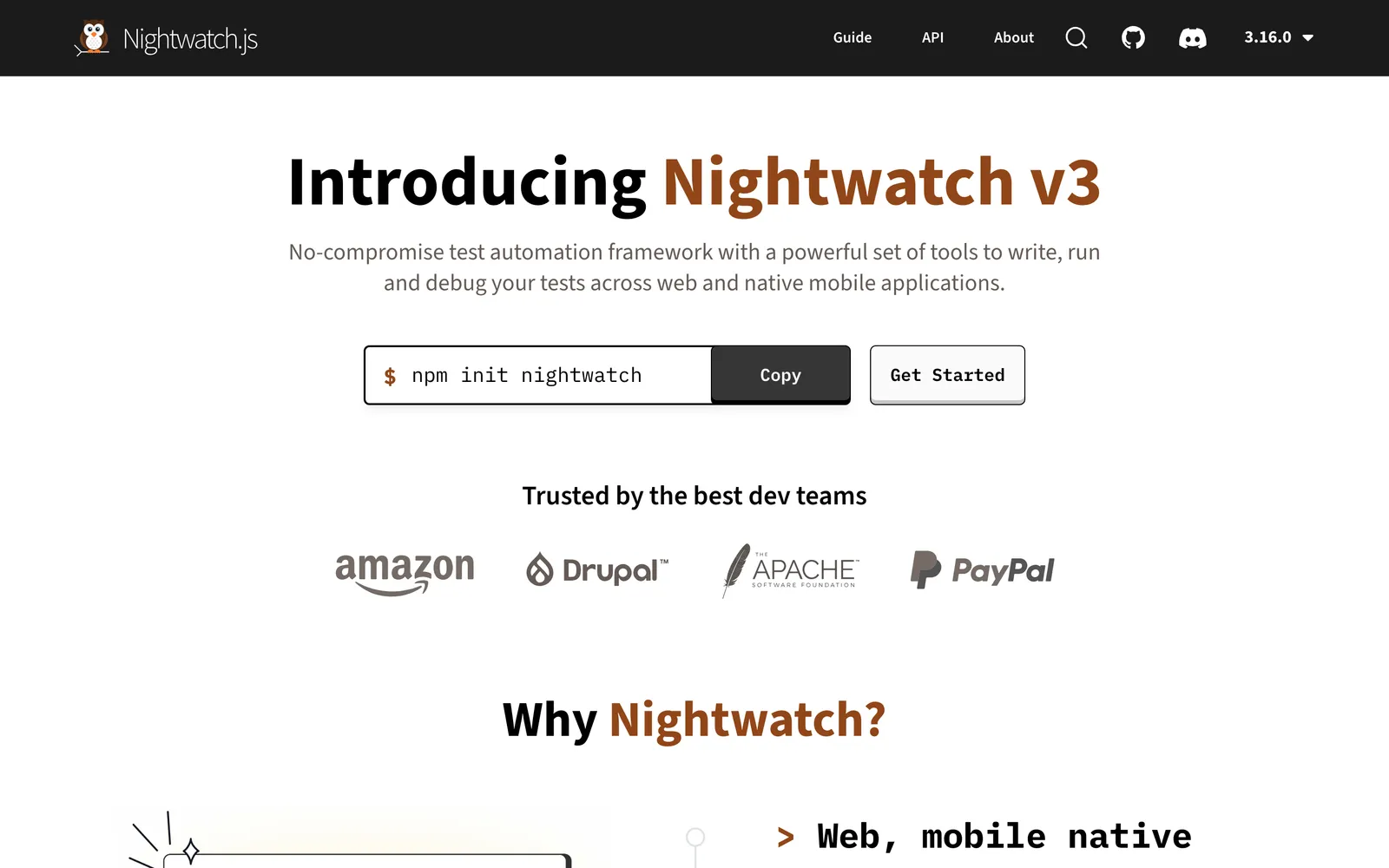
Nightwatch is the other WebDriver-native option, maintained at BrowserStack, with one runner for end-to-end, component, accessibility, API and mobile tests. Version 3.16.0, published 25 May 2026, was the latest release on 4 October 2026.
License: MIT.
Languages and browsers: JavaScript and TypeScript on Node.js, over W3C WebDriver. Chrome, Firefox, Safari and Edge, plus native mobile through Appium.
Parallel and hosting: parallel running is documented. Local, a Selenium Grid, CI, or BrowserStack and Sauce Labs endpoints.
Migration from Selenium: your Grid and cloud endpoints keep working, and the test code becomes JavaScript.
CI and recording: guides for Jenkins, GitHub Actions, Bamboo, Azure Pipelines, CircleCI and GitLab CI. A browser recorder helps write tests.
Best for: WebDriver teams who want component and accessibility coverage in the same runner as end-to-end.
Watch out for: it still speaks WebDriver, so leaving Selenium for speed alone is not a reason to pick it.
7. Puppeteer
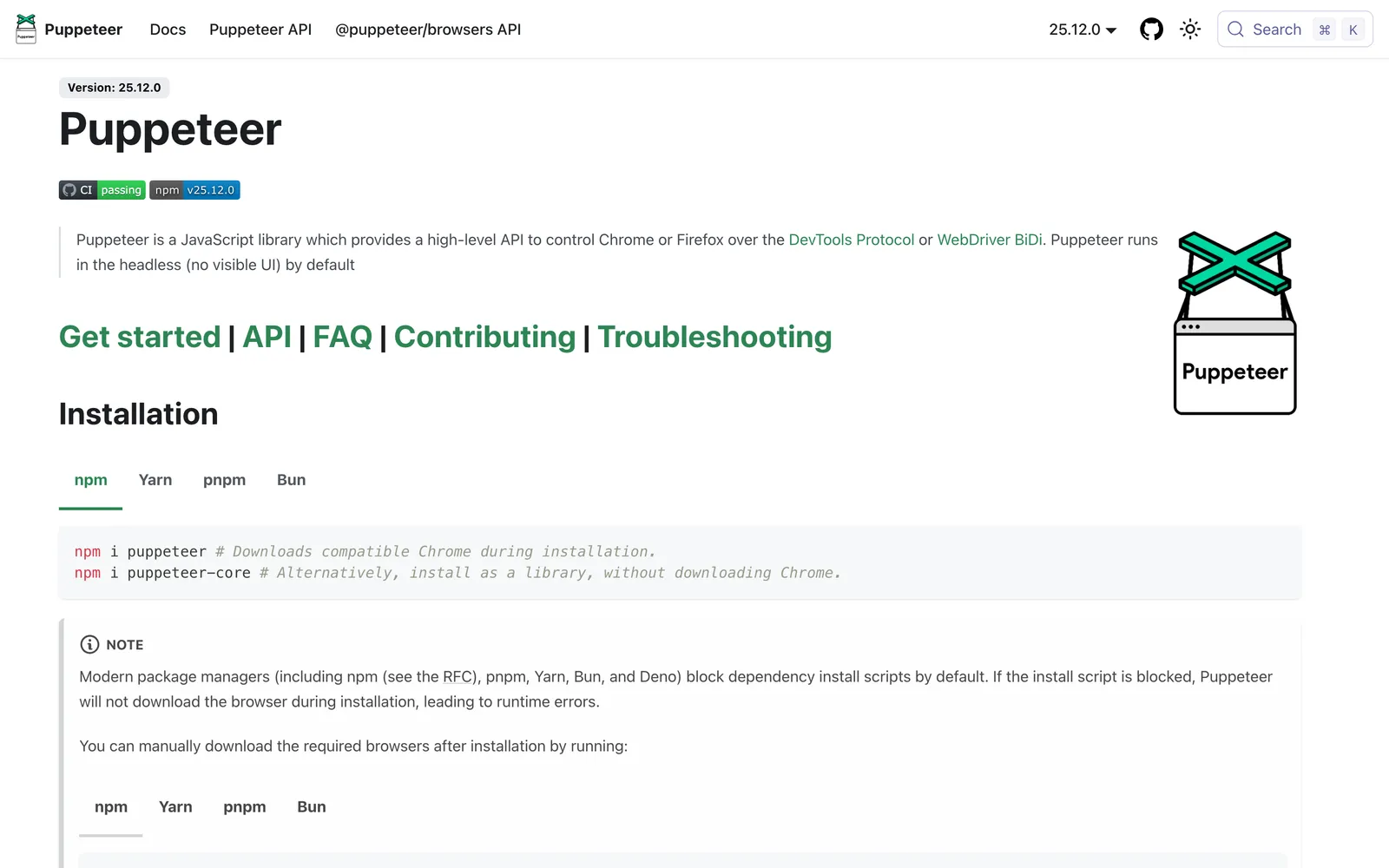
Puppeteer is a browser-control library from Google, not a test framework. That distinction decides whether it belongs on your shortlist.
License: Apache 2.0.
Languages and browsers: JavaScript and TypeScript. Official support is Chrome for Testing and stable Firefox, over the Chrome DevTools Protocol or WebDriver BiDi.
Parallel and hosting: no test runner, so parallelism comes from whatever you pair it with. Local or CI.
Migration from Selenium: tests get rewritten against Puppeteer's API, and you assemble the runner, assertions and reporting yourself.
CI and AI: official CI guidance. Its docs link the Chrome DevTools MCP server and document experimental WebMCP support.
Best for: Chrome automation, screenshots, PDFs and page instrumentation.
Watch out for: if what you dislike about Selenium is assembling a stack, this hands you the same job.
Cucumber sits on top, not instead
Official implementations cover JavaScript, Java, Kotlin, Scala, Ruby, Android Java and C++, and Cucumber-JVM is MIT. It is a specification and runner layer, not a browser driver: Gherkin scenarios run through step definitions, and the browser comes from Selenium, Playwright, WebdriverIO or another adapter. Cucumber-JVM has built-in multithreaded execution.
AI and no-code platform profiles
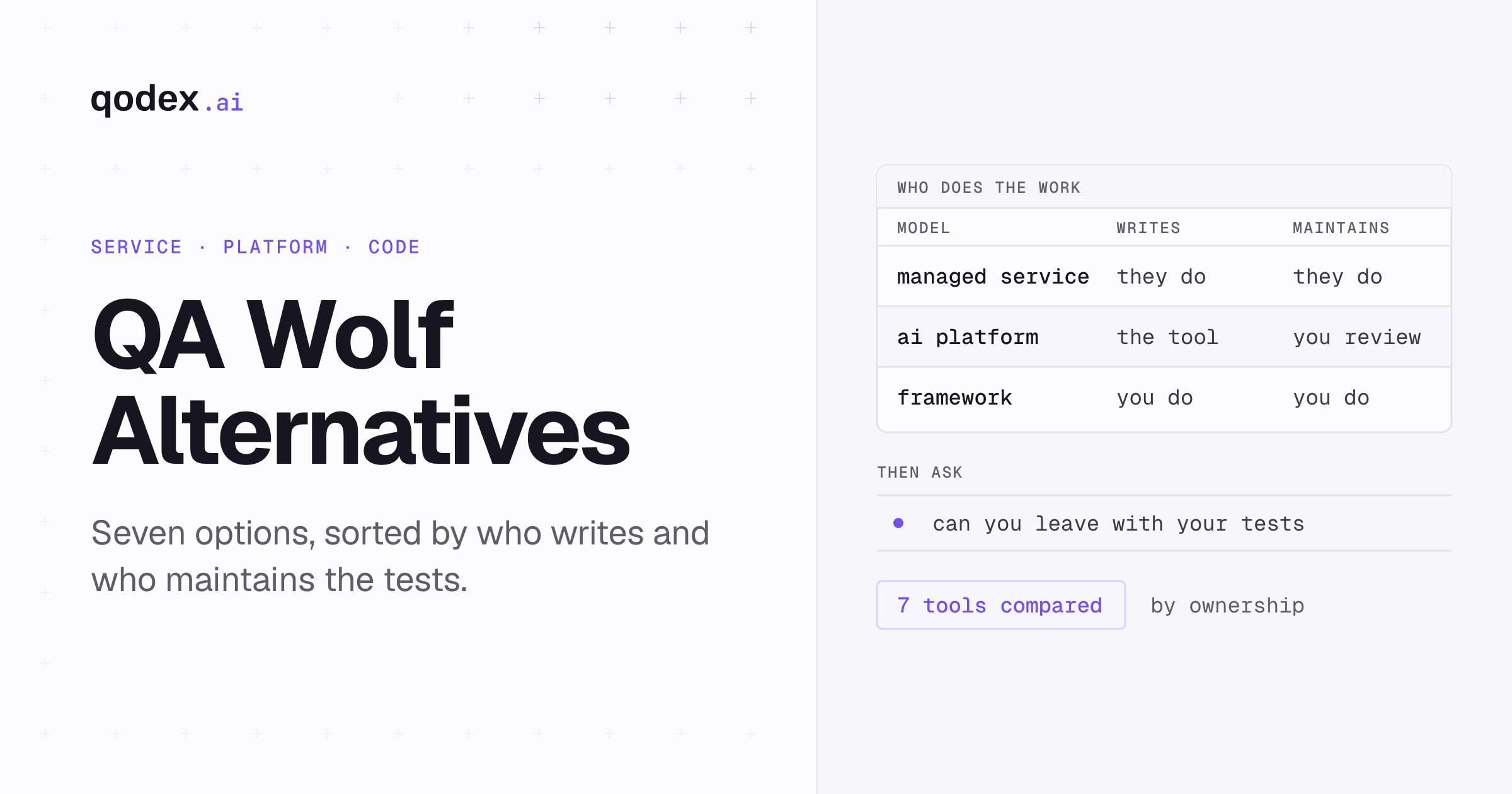
These replace the author rather than the API. The trade is the same in all six: less code to maintain, less control over what runs, and a bill.
8. Katalon
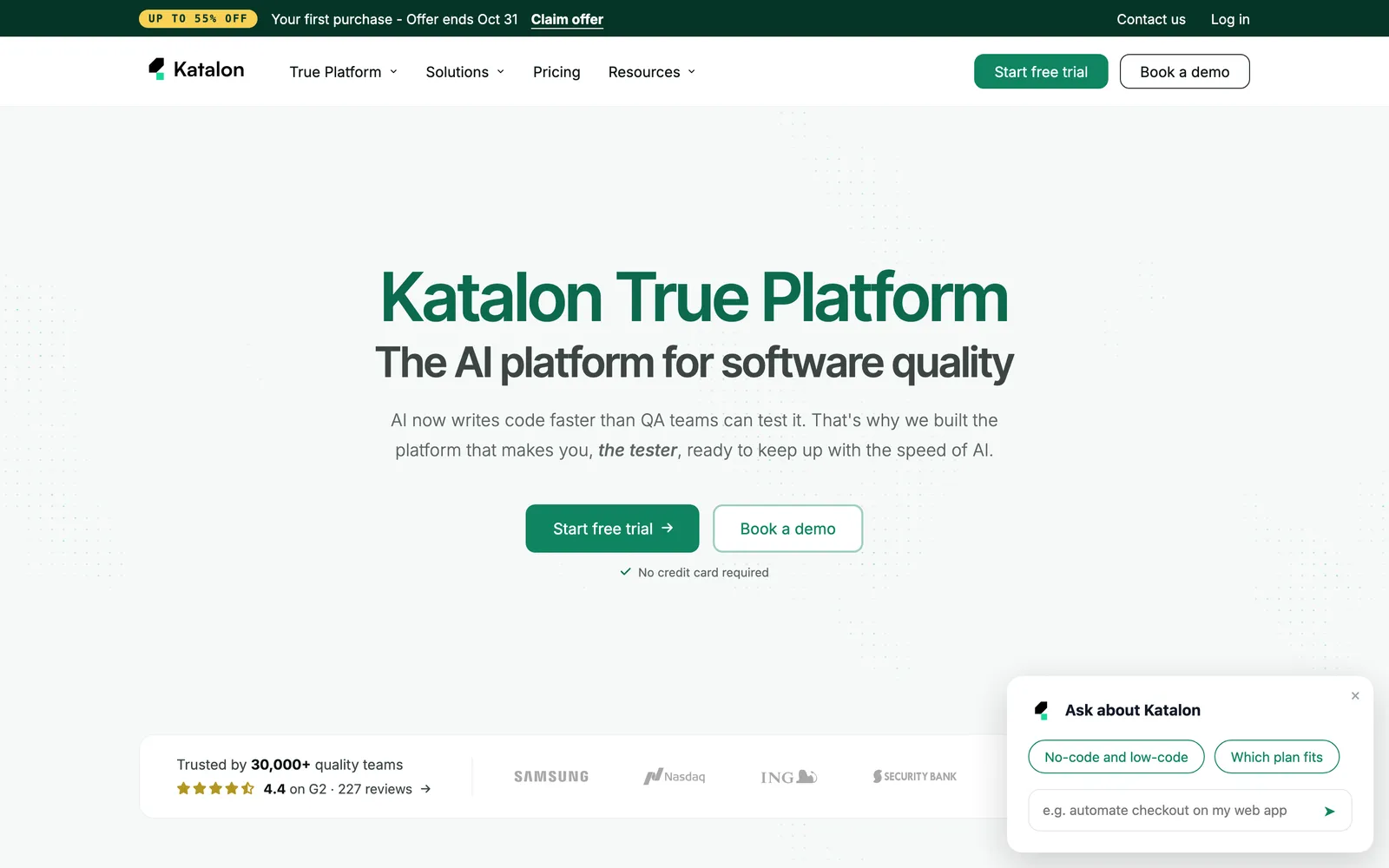
Katalon is a low-code platform built on Selenium and Appium, which gives it a literal migration story.
Price, 4 Oct 2026: Studio Professional is $1,000 per seat per year for the first three seats on a first online purchase, through 31 October. The displayed regular price is $2,199 a year.
Free: Studio Free covers local authoring and execution, basic web and mobile record and playback, and up to 40 static suites. A 30-day trial is also offered.
Authoring and coverage: low-code with Groovy and Java source. Web, Android, iOS, APIs and Windows desktop.
Parallel and hosting: parallel execution comes with Professional, not Free. Enterprise lists hybrid and offline licenses, private cloud and on-premises deployment.
Migration from Selenium: the docs support copying Selenium 4.x, TestNG 6.11 and JUnit 4.12 code into a project, with those dependencies bundled. Katalon also imports Selenium IDE projects, tests and suites.
CI and AI: Runtime Engine runs from the CLI in Jenkins, GitHub Actions, Azure DevOps and GitLab. AI agents cover generation, failure analysis and self-healing.
Best for: QA teams with a Java or TestNG suite, and Selenium IDE users who want a recorder with more behind it. See Katalon alternatives.
Watch out for: the $1,000 seat price is a promotion with an end date. Budget on the regular price.
9. testRigor
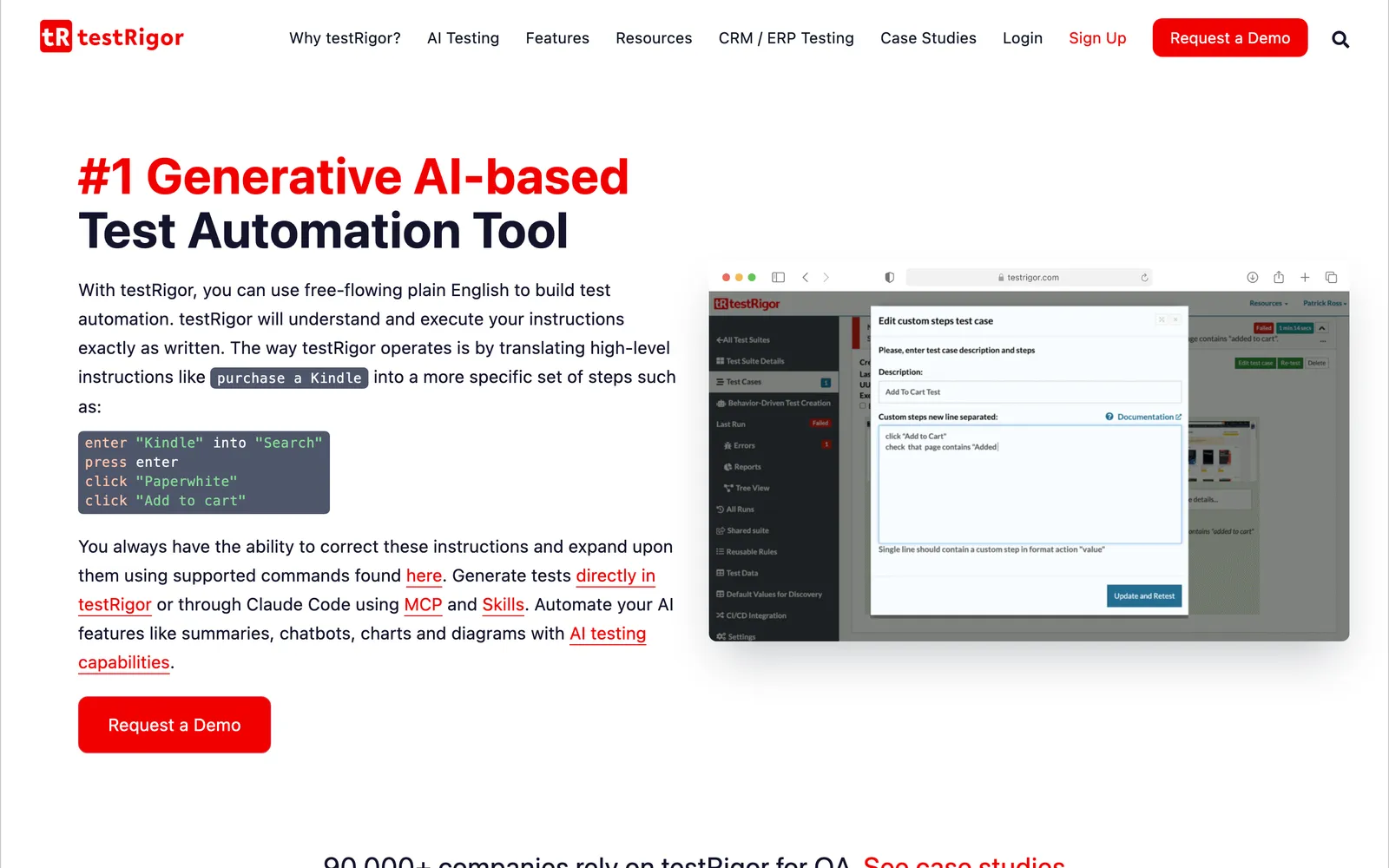
testRigor replaces selectors with plain English steps, so anyone who knows the product can read a test.
Price, 4 Oct 2026: the private plans show no public price on the sign-up page. Private Complete has a 14-day trial, and Enterprise is custom.
Free: a permanent public plan, on the condition that your tests and results are public under the Unlicense.
Authoring and coverage: plain English across web, mobile, API, Windows native and mainframe.
Parallel and hosting: parallel by default, priced by execution infrastructure rather than seats or runs. An on-premise option is offered.
Migration from Selenium: you recreate tests as plain English rather than port code. Copied plain-English manual test cases can run after terminology setup.
CI and AI: CLI and CI integrations, with AI test generation and execution.
Best for: teams where the people who know what to test do not write code.
Watch out for: free means public. If your steps describe an unreleased flow, the free plan is out.
10. mabl
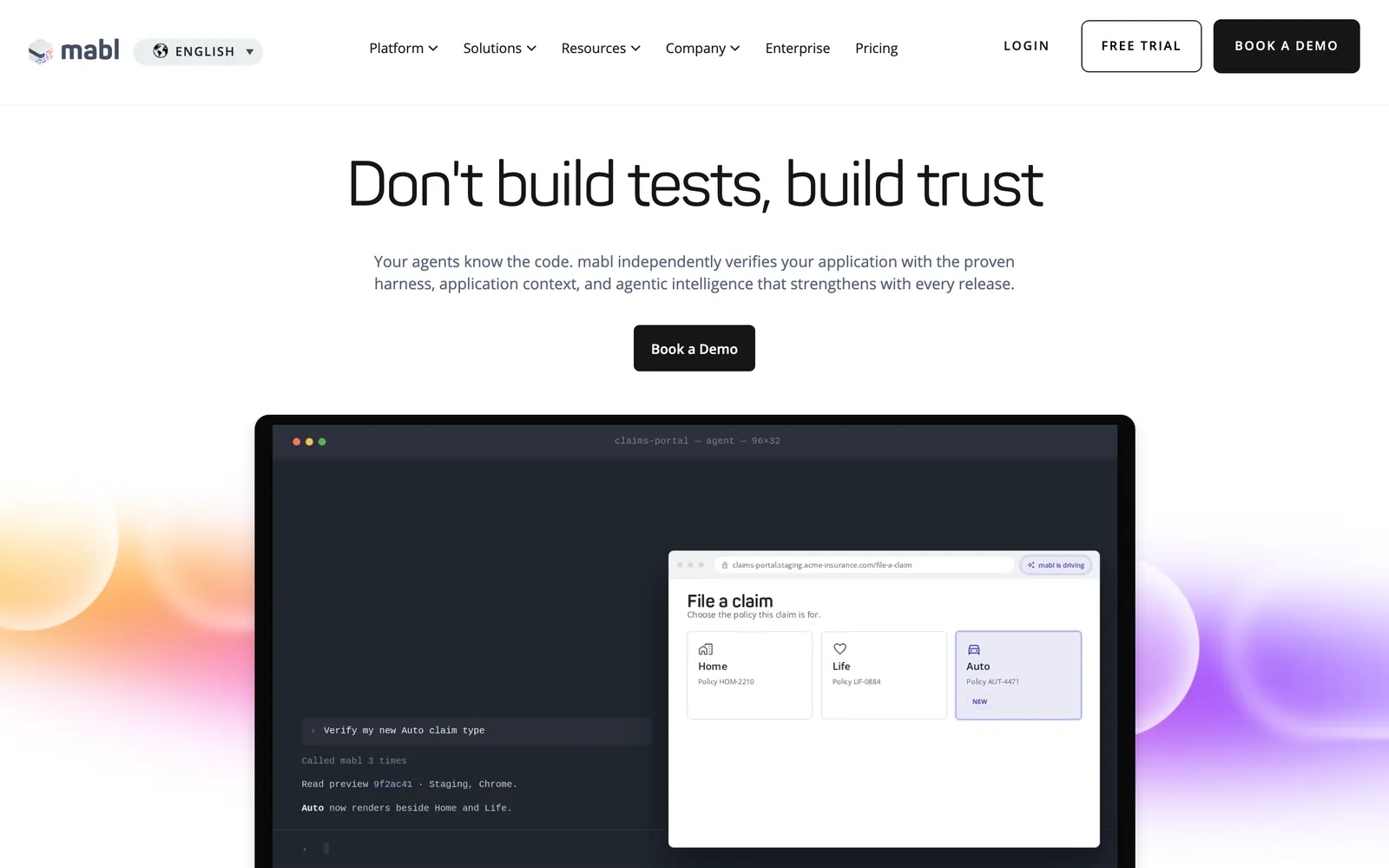
mabl publishes an automated route off Selenium code, and the limits of that route are worth reading closely.
Price, 4 Oct 2026: quote-based, no amount published. A 14-day trial is available.
Plans: start with 500 cloud-run credits a month. Local and CI runs, participant licenses, applications, environments, workspaces and cloud concurrency are unlimited.
Authoring and coverage: low-code and agentic web, mobile and API testing.
Migration from Selenium: the CLI records Selenium sessions in any language, from local or remote WebDriver, Grid, Sauce Labs and BrowserStack. An agent then writes a complete mabl test, with assertions, variables and waits, for you to review. The proxy cannot capture file uploads or downloads, hover, iframe interaction or cookie inspection.
CI and AI: CLI and local runner, with autonomous authoring and maintenance, auto-healing, runtime recovery and root-cause insights.
Best for: teams with a large Selenium suite who want it re-authored rather than retyped.
Watch out for: assertions inside your test code are invisible to the proxy, so check what the agent wrote against what the old test checked.
11. Testim
Testim records low-code tests with custom code support, and is flexible about where they run. For what its AI does and how it compares with 12 other tools, see our Testim AI test automation review.
Price, 4 Oct 2026: no list price is published.
Free: a Community plan after the trial, one per organization.
Authoring and coverage: recorded tests, custom code and natural-language AI authoring, for web, mobile and Salesforce. Local runs use Chrome; grids add Firefox, Safari and Edge Chromium.
Parallel and hosting: a CLI flag sets concurrent tests, on Testim's grid, a third-party grid or your own Selenium grid.
Migration from Selenium: pointing it at your grid reuses the infrastructure. Professional plans export tests to Selenium, Playwright or Puppeteer, which is an exit, not an entry.
CI and AI: CLI integration for CI, with smart locators, self-healing and root-cause analysis.
Best for: teams that want recorded tests but refuse to give up their own grid.
Watch out for: no published price means the budget conversation happens before the evaluation.
12. Momentic
Momentic writes tests from natural language, saves them as YAML in your repository, and prices them in credits rather than seats.
Price, 4 Oct 2026: pay-as-you-go is $125 a month plus usage, with 10,000 credits, about 1,000 runs.
Free: 2,000 credits a month, about 200 runs, one concurrent mobile device, 30-day retention. Hosted emulators draw from credits: 8 a minute on Android, 15 on iOS.
Authoring and coverage: natural language and YAML. Web on Chromium-based browsers, mobile on local or hosted iOS simulators and Android emulators.
Parallel and hosting: your machines, CI or Momentic's infrastructure. Paid runs five Android and five iOS devices at once.
Migration from Selenium: nothing documented for importing Selenium code. Tests are recreated as YAML.
CI and AI: GitHub Actions and CircleCI guidance. The AI authors, runs and heals tests from natural-language goals and records its reasoning.
Best for: product teams who want plain-English web coverage fast, with a free tier big enough to judge it.
Watch out for: credits are the meter, so a flaky suite costs more every week until someone fixes it.
13. Panto
Panto is a mobile testing platform: an AI agent takes plain-English commands and runs them on real Android and iOS devices.
Price, 4 Oct 2026: QA Scale lists $20 per 500 credits, with one real device at a time. Enterprise concurrency is quoted.
Free: a Playground is offered.
Authoring and coverage: natural language for Android and iOS, across 150+ real device and OS combinations.
Parallel and hosting: tests run on Panto's device farm. Enterprise offers dedicated or on-premise cloud, and Azure, AWS, GCP or custom-cloud deployment.
Migration from Selenium: no Selenium path is documented. Its pricing page advertises Appium and Maestro test creation, while its homepage FAQ says it uses a proprietary framework, so ask which one applies.
CI and AI: CI/CD, pull request, Slack, webhook and API triggers. AI agents crawl workflows, generate tests, find root causes and self-heal.
Best for: mobile app teams who want real hardware coverage without writing Appium.
Watch out for: ask Panto how a Selenium web suite would move before you plan on it.
Free versus open source
Two different claims, mixed constantly. Open source is about the license on the code: you can read it, fork it, and nobody can change the terms on the copy you have. Free is the price of a plan, and a plan can change next quarter.
Open source, license confirmed: Playwright and Puppeteer are Apache 2.0. WebdriverIO, TestCafe and Nightwatch are MIT, as are the Cypress App and Cucumber-JVM. No meter, no seat count. Your cost is machines and engineering time.
Proprietary with a free plan: Qodex Individual is $0 with 25 scenarios and 100 runs a month. Momentic gives 2,000 credits, roughly 200 runs. Katalon Studio Free records and plays back locally. Cypress Cloud Starter allows 500 test results across 10 users. Testim offers a Community plan after its trial. Real ceilings, set by the vendor.
Free with a condition: testRigor's public plan keeps your tests and results public under the Unlicense. That is a license on your test artifacts, not on their platform.
Trials only: Katalon Professional runs 30 days, and mabl and testRigor Private Complete run 14. Panto offers a Playground.
Selenium migration matrix
"Can I convert my suite?" has three different answers, and only one of them involves a tool doing the work.
| Tool | Path in | Carries over | You rewrite | Grid reuse |
|---|---|---|---|---|
| mabl | CLI records Selenium runs; an agent writes mabl tests | Flows, with agent-written assertions, variables and waits | Uploads, downloads, hover, iframes, cookies; review every assertion | Records from Grid and clouds |
| Katalon | Copy code in; import Selenium IDE projects | Selenium 4.x, TestNG and JUnit code; IDE tests and suites | Structure, to fit the project | Built on Selenium |
| Cypress | Migration guide and AI prompt | Test intent and flow structure | All code, in JavaScript | No |
| WebdriverIO | None documented | Grid and cloud endpoints | All test code, in JavaScript | Yes, Grid and commercial grids |
| Nightwatch | None documented | Grid and cloud endpoints | All test code, in JavaScript | Yes, Grid, BrowserStack, Sauce Labs |
| Playwright | None documented | Test intent | All code, in JS, Python, Java or .NET | Experimental, Chrome and Edge |
| TestCafe | None documented | Test intent | All code, and the execution model | No |
| Puppeteer | None documented | Test intent | All code, plus the runner around it | None documented |
| Testim | Runs on your grid | Grid infrastructure | Every test, as recordings | Yes, Selenium-compatible grids |
| testRigor | Paste plain-English manual cases | Manual test cases, after setup | Every coded test, as plain English | None documented |
| Momentic | None documented | Nothing mechanical | Every test, as YAML | None documented |
| Qodex | Imports existing tests, specs and collections as scenarios | The agent reads the running app | You review what it writes | None documented |
| Panto | None documented | Nothing mechanical | Every test | None documented |
Two things worth saying out loud. Cypress recommends keeping your Selenium tests until the replacements pass, which is the advice that protects you whichever tool you pick. And a tool that re-authors your tests still needs someone to check that the new assertions match the old ones.
Three small code mappings
Much of a Selenium test is waiting, finding and asserting. Here is what those three become, in Python for Selenium and Playwright. These are excerpts that show the shape of each call, not complete scripts: each one needs a driver or page object set up first.
Waiting. Selenium makes synchronization your job. The others fold it into the assertion.
# Selenium, Python
WebDriverWait(driver, 10).until(
    EC.visibility_of_element_located((By.CSS_SELECTOR, "#cart"))
)

# Playwright, Python: the assertion does the waiting
expect(page.locator("#cart")).to_be_visible()

// Cypress: the command retries until it passes or times out
cy.get('#cart').should('be.visible')
Finding and clicking. The shift is from CSS selectors to what the user sees, which is what survives a redesign.
# Selenium, Python
driver.find_element(By.CSS_SELECTOR, "button.checkout").click()

# Playwright, Python
page.get_by_role("button", name="Checkout").click()

// Cypress
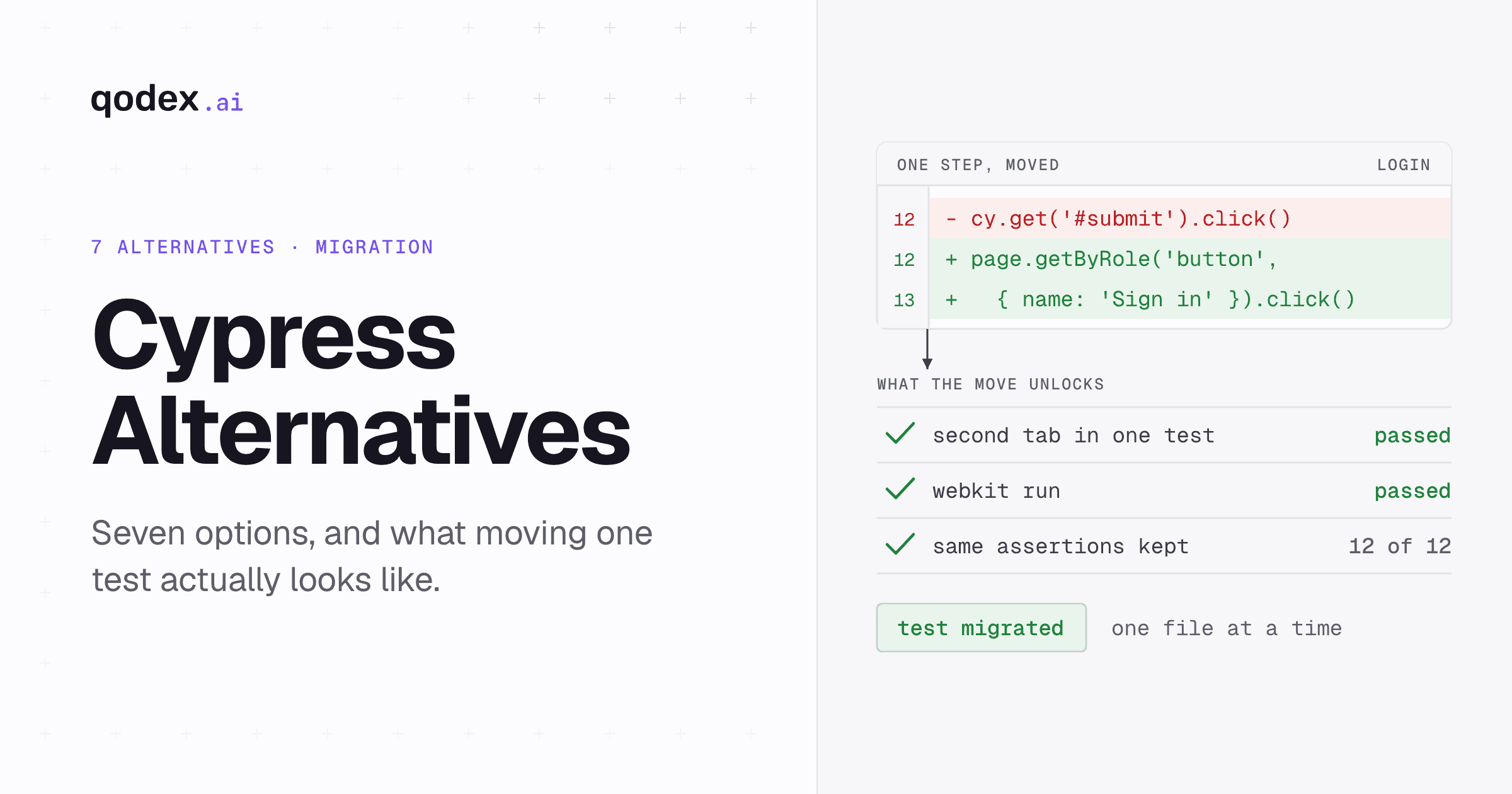
cy.contains('button', 'Checkout').click()
Asserting. Selenium hands you a value and your test framework checks it. Playwright and Cypress retry the check.
# Selenium, Python
assert driver.find_element(By.CSS_SELECTOR, "h1").text == "Order confirmed"

# Playwright, Python
expect(page.locator("h1")).to_have_text("Order confirmed")

// Cypress
cy.get('h1').should('have.text', 'Order confirmed')
Line by line the translation is mechanical. What is not mechanical is everything around it: fixtures, test data, custom waits somebody wrote years ago, and the helper library your team built on WebDriver. Budget for that, not for the three lines above.
Where tests run
Authoring and execution are separate decisions, and mixing them up is how a device cloud ends up on a shortlist against Playwright.
Local machines. Every framework here runs on a laptop, and mabl and Momentic both publish local runners.
Your CI. The normal home for a suite. The frameworks publish CI guidance, and the platforms hook in through a CLI: Katalon's Runtime Engine, testRigor's CLI, Momentic's GitHub Actions and CircleCI examples, Qodex from Startup upward.
A Selenium Grid you run. Still the answer when nothing may leave your network. WebdriverIO, Nightwatch and Testim connect to it, Playwright has experimental support, and mabl records from it during a migration.
A commercial device cloud. BrowserStack, Sauce Labs and the rest rent browsers and real phones, and run Selenium and its alternatives alike. Both now sell AI test authoring too, so ask which product you are actually buying. See BrowserStack alternatives.
A vendor's own cloud. testRigor prices by execution infrastructure, mabl by cloud-run credits, Momentic by credits including emulator time, Panto by credits per device, Qodex by runs per project. Cheapest to start, and the meter is the thing to model before you commit a suite.
Looking for a Selenium alternative for scraping?
Different job, same search box. Selenium, Playwright and Puppeteer are browser libraries: they drive a real browser and hand you a DOM, which is what you want for testing and for scraping sites that need a session. Firecrawl, ZenRows and Browserbase sit a layer up and return extracted content or a hosted browser instead. If your goal is data rather than a green build, this is the wrong list. The short answer is Playwright or Puppeteer when you need the browser, a scraping API when you only need the page.
How to choose
Five questions. Each has two answers, and the pair eliminates much of this page.
| Question | One answer | The other |
|---|---|---|
| Who writes the tests? | Engineers: Playwright or WebdriverIO | Nobody has time: Qodex or mabl |
| What language is the suite in? | Python, Java or .NET: Playwright, or stay | JavaScript only: Cypress or Nightwatch |
| Web only, or mobile too? | Web: Playwright or Cypress | Mobile: WebdriverIO with Appium, or Panto |
| Keep the Grid or drop it? | Keep: WebdriverIO or Nightwatch | Drop: Playwright or TestCafe |
| Must tests stay in your repo? | Yes: any framework, Momentic's YAML, or Qodex exports | No: testRigor or Testim |
Count maintenance hours, not license fees. Six of these frameworks cost nothing and still cost somebody's time every week. That is the number the platforms compete with.
Check the exit before you commit a suite. Framework tests are portable by definition, Momentic keeps YAML in your repository, and Qodex exports Playwright and HTTP code. Testim exports from Professional plans. For the rest, ask what leaves with you.
Frequently Asked Questions
Is Selenium dead in 2026?
No, and the alternatives are the evidence. WebdriverIO, Nightwatch and Testim run on Selenium-compatible grids, Katalon is built on Selenium, Playwright added experimental Grid support, and mabl's CLI records from Grid, Sauce Labs and BrowserStack. What has changed is how many other options now exist for a new suite.
What is the best free alternative to Selenium?
Playwright: Apache 2.0, bindings for JavaScript, Python, Java and .NET, three engines, parallel runs by default. To keep WebDriver, WebdriverIO and Nightwatch are both MIT. TestCafe is MIT with the least setup, Puppeteer is Apache 2.0 for Chrome work, and the Cypress App is MIT, with Cloud parallelization on its free Starter plan.
Is Playwright better than Selenium?
For a new suite, it bundles the runner, retrying assertions, auto-waiting, parallel execution and tracing that Selenium expects you to assemble. Selenium keeps two advantages: your existing code runs today, and it covers languages Playwright has no official binding for. If your tests are Ruby, PHP or Kotlin, this is not a migration, it is a rewrite in a new language.
Can I automatically convert my Selenium tests to another framework?
Partly, in two products. mabl's CLI records your Selenium runs and an agent writes complete mabl tests from them, which you then review. Katalon lets you copy Selenium 4.x, TestNG 6.11 and JUnit 4.12 code into a project and imports Selenium IDE projects. Everywhere else migration means rewriting, and Cypress publishes a guide and an AI prompt for that.
What is the best Selenium alternative for Python?
Playwright. It publishes Python bindings, and its Python API maps cleanly onto what a Selenium test already does. If you would rather not rewrite, mabl's CLI records Python Selenium runs too, and an agent writes the mabl tests from them.
Do I need to know JavaScript to move off Selenium?
No. Playwright publishes Python, Java and .NET bindings, Katalon is low-code with Groovy and Java, testRigor is plain English, Momentic takes natural language or YAML. But Cypress, WebdriverIO, Nightwatch and Puppeteer are JavaScript and TypeScript, and TestCafe adds only CoffeeScript.
What is the best no-code or Selenium IDE alternative?
Katalon if you want record and playback with more behind it: Studio Free covers it locally, and Katalon imports Selenium IDE projects. testRigor if tests should read like sentences, with a free plan that makes them public. Testim offers a Community plan after its trial, and Momentic about 200 free runs a month.
Which alternatives keep my Selenium Grid?
WebdriverIO and Nightwatch drive browsers over W3C WebDriver, so a Grid, Sauce Labs or BrowserStack endpoint keeps working. Testim runs on your own Selenium-compatible grid, and mabl records from Grid during a migration. Playwright's Grid support is experimental and covers Chrome and Edge. Cypress and TestCafe do not use the Grid.
Which Selenium alternative handles mobile as well as web?
WebdriverIO with Appium is the code-first answer, and Nightwatch documents Appium too. Among platforms, Katalon covers Android and iOS alongside web, API and Windows desktop. testRigor covers web, mobile, API, Windows native and mainframe, and mabl covers web, mobile and API. Momentic runs simulators and emulators, and Panto publishes 150+ real device and OS combinations.
What should I use instead of Selenium for scraping?
Playwright or Puppeteer if you need a real browser session, since both are free and both do the job Selenium was doing. If you only want the content of a page, a scraping API returns extracted data without you running a browser at all. Different product category, and a testing guide is the wrong place to pick one.