7 Best QA Wolf Alternatives in 2026
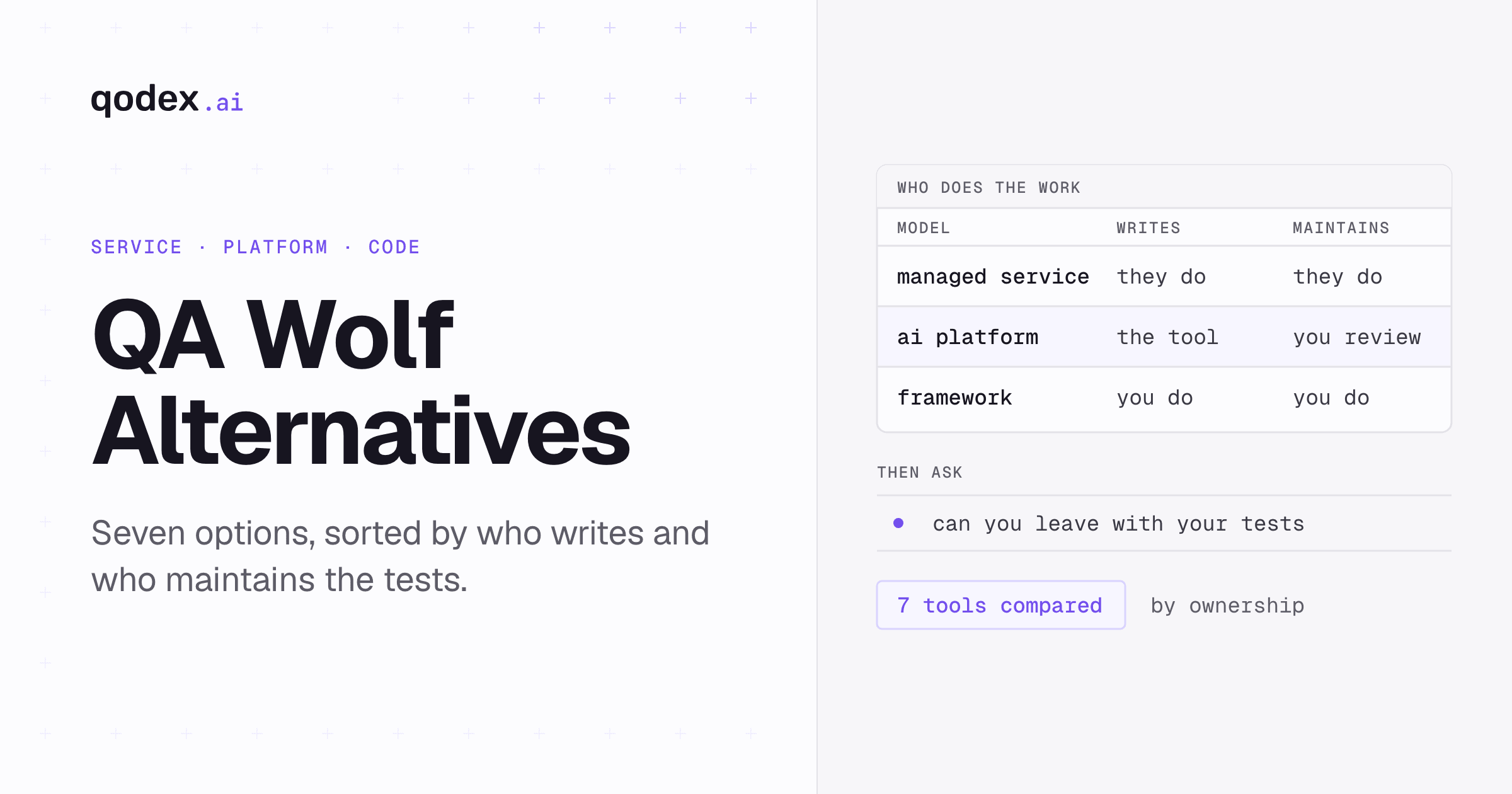
The best QA Wolf alternatives are Qodex if you want an AI agent to write tests your team owns, mabl or Testsigma for a supported low-code platform, testRigor for plain-English tests written by manual testers, Momentic for AI authoring with a free plan, and Playwright if your engineers will write everything. QA Wolf now charges per run: $1 a web run, read 11 November 2026.
How to choose a QA Wolf alternative
Decide who writes the tests, who fixes them when they break, and whether you keep the code. Then check how the bill grows. Prices were read on each vendor's own page on 11 November 2026; "quote" means the vendor shows no price.
| Tool | Who writes the tests | You keep the code | Price (read 11 November 2026) |
|---|---|---|---|
| QA Wolf (baseline) | QA Wolf's AI agents; human QA engineers as a paid add-on | Yes, Playwright and Appium | $1 per web run, $2 per mobile or desktop run; no seat fee |
| Qodex | An AI agent, reviewed by your team | Yes, Playwright and HTTP code | $0 Individual; Startup from $1,299 and Scale from $2,500 per project a month |
| mabl | Your team, low-code with AI help | No | Quote; credit-metered cloud runs |
| testRigor | Your team, in plain English | No | Free public plan; private plans by quote |
| Testsigma | Your team, scriptless | No | Quote; free trial |
| Rainforest QA | Your team, no-code, with managed options | No | Demo-led; no public price |
| Momentic | Your team, plain English with AI | No | Free with $50 of usage a month; Scale $500 a month |
| Playwright | Your engineers | Yes | Free, Apache 2.0 |
Sources: qawolf.com/pricing, mabl.com/pricing, testRigor plans, testsigma.com/pricing, momentic.ai/pricing and Qodex pricing, all read 11 November 2026.
QA Wolf pros and cons
Pros: the tests are standard Playwright and Appium you keep. Each run is retried up to three times for free to filter flaky failures, and a run is billed on its longest attempt. There is no seat fee, parallel runs cost nothing extra, and you can set a monthly spending limit.
Cons: the bill grows with every run. QA Wolf's own calculator puts 50 web tests run once a business day at $1,083 a month, or $13,000 a year. A test longer than five minutes is billed in five-minute blocks. Human test planning and review (Coverage-as-a-Service) is quoted separately. Its focus is end-to-end UI, not API contracts or security.
Why engineering teams choose QA Wolf
Teams pick QA Wolf when nobody in-house owns QA and they want working end-to-end coverage fast, without hiring. The code stays portable, and failures are retried before anyone is paged. If that is your situation and the per-run bill fits, QA Wolf is a sound choice.
Rainforest QA alternatives
The same list works if you are leaving Rainforest QA. Teams who liked its no-code editor usually look at testRigor or mabl. Teams who want the tests as code look at QA Wolf, Qodex or Playwright.
What QA Wolf Does Well
Credit where due, because QA Wolf earns its reputation:
Hands-off coverage if you want it. Their agents plan and write the tests, and the Coverage-as-a-Service add-on puts human QA engineers on planning, creation and result checks. Your engineers review results, not selectors.
Real code, not a proprietary format. The tests QA Wolf writes are standard Playwright (web) and Appium (mobile). If you part ways, you keep a working suite.
Free retries for flaky runs. Each run is retried up to three times for free before a failure reaches you, which cuts flaky-test alerts.
Hard surfaces covered. Web apps, Electron apps, native iOS and Android, canvas-based UIs where DOM selectors cannot reach, even LLM-as-a-judge assertions for non-deterministic AI output.
If you have funding, no QA function, and no desire to build one, you can stop reading here: QA Wolf is probably the strongest fully-outsourced option on the market, and an alternatives list should say so plainly.
QA Wolf pricing
QA Wolf publishes a per-run price on qawolf.com/pricing, read 11 November 2026. A web run on Chrome, Firefox or WebKit costs $1. A mobile run on real iPhones, iPads or Android devices costs $2, and so does a Windows or macOS desktop run. Each run includes five minutes; longer tests are billed in five-minute blocks. Test creation is not billed separately, there is no seat fee, and new teams get free runs to start. Jump Start and Coverage-as-a-Service, where QA Wolf's human engineers plan and review your suite, are quoted by sales.
You can now model the cost yourself: tests times runs per day times business days. Volume discounts come through sales.
A suite that runs on every pull request costs more than one that runs nightly. A flat-fee tool or an open-source framework has no per-run cost.
Why Teams Look for QA Wolf Alternatives
You want the muscle in-house. Outsourced QA means your team never develops testing expertise, and product knowledge lives with the vendor's staff. Some teams are fine with that; others regret it at scale.
Turnaround follows their staffing, not your sprint. New test coverage is requested, then built by their team. In-house tools let you generate coverage the moment a feature branch exists.
A bill that grows with every run. At $1 a web run, running a large suite on every pull request adds up. Flat-fee tools and open-source frameworks do not meter runs.
API and security depth. QA Wolf's center of gravity is end-to-end UI testing. If your risk lives in API contracts, auth logic, or OWASP-class vulnerabilities, you need tooling aimed at that layer.
The 7 best QA Wolf alternatives
1. Qodex
Qodex is the closest you can get to QA Wolf's outcome (someone else writes and maintains the tests) without outsourcing the function. It is an autonomous, chat-first AI QA agent: it explores your web app in a real Chromium browser and your API via direct HTTP calls, learns how the system behaves, and generates runnable Playwright and HTTP test scenarios with executable scripts. Your engineers review and promote scenarios instead of writing them.
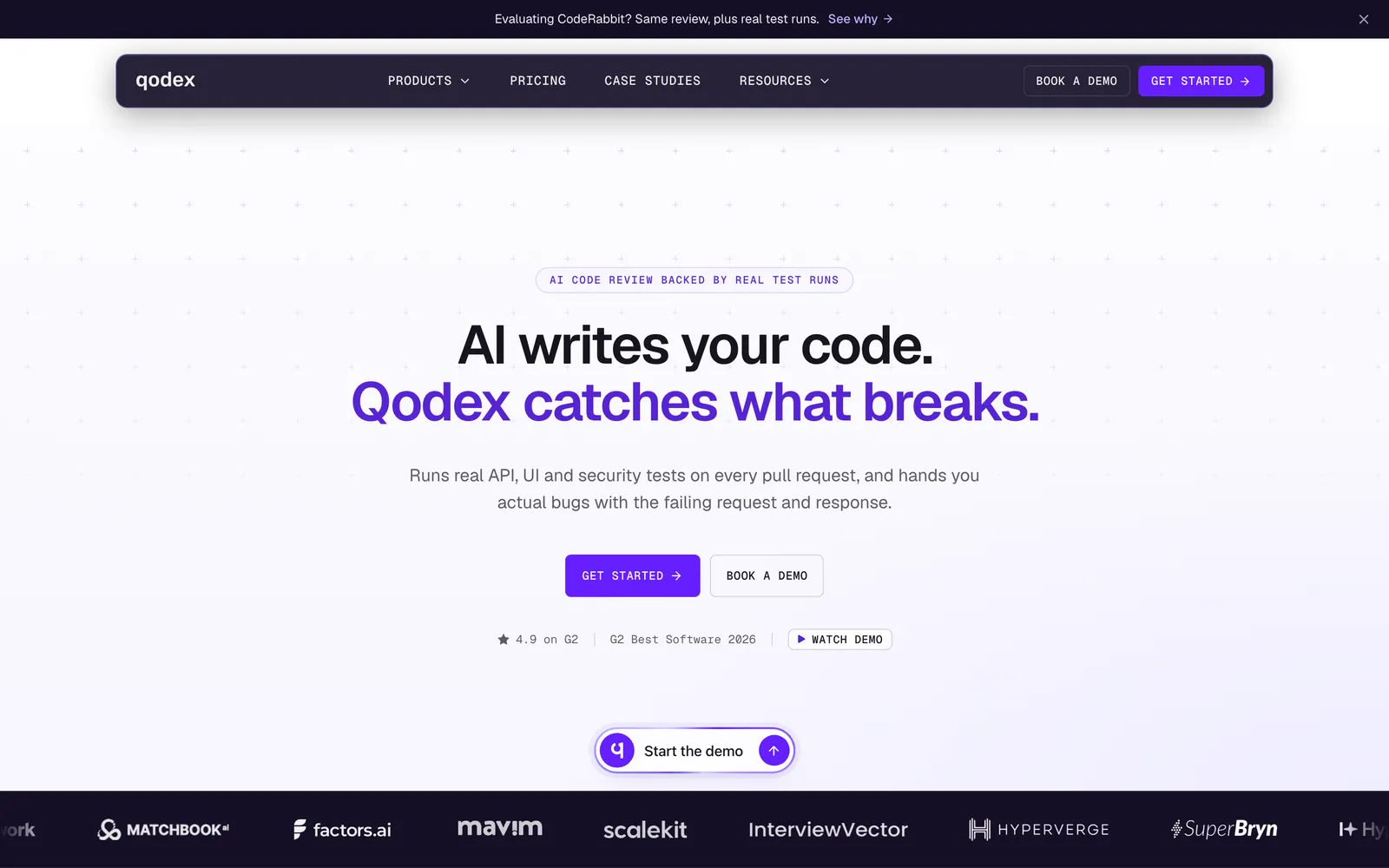
Where the comparison with QA Wolf gets interesting:
Same output format, different author. Both hand you standard Playwright. QA Wolf's agents write it, with its human engineers as a paid add-on; Qodex's agent writes it inside your own workspace, and you keep the suite.
Triage without the service contract. Qodex classifies every failure as a real bug, a stale test, or an environment issue, so a failure reaches you already sorted.
Replays with no model spend. Scenarios are authored once by the LLM and replayed deterministically with no LLM in the loop, so a growing suite adds no model spend, within plan run limits.
Deeper API and security coverage. The same agent runs functional API tests and OWASP-aligned security checks (IDOR, BOLA, auth bypass, injection), with inverted semantics so a passing security test means the attack was blocked. See API testing.
Pricing (read 11 November 2026): Individual is $0 with 25 scenarios and 100 runs a month, no credit card. Startup starts at $1,299 per project per month and Scale at $2,500, scoped with sales (see pricing).
Pros: agent does the authoring and triage; UI, API, and security from one tool; standard ejectable code; in-house knowledge compounds in per-project memory.
Cons: your team still reviews and promotes tests, so it is not zero-touch the way a managed service is; no native mobile app testing, where QA Wolf covers iOS and Android; younger product and ecosystem.
Best for: engineering-led teams that want QA Wolf's outcome while keeping control, code, and product knowledge in-house. Start free and see what the agent generates for your app.
2. mabl
mabl is the most mature platform answer: ML-trained auto-healing, a polished low-code editor, and web, mobile, API, accessibility, and performance testing under one roof, with a designated Customer Success Manager as part of the package. It is in-house tooling, but with enough vendor support that it can feel service-adjacent.
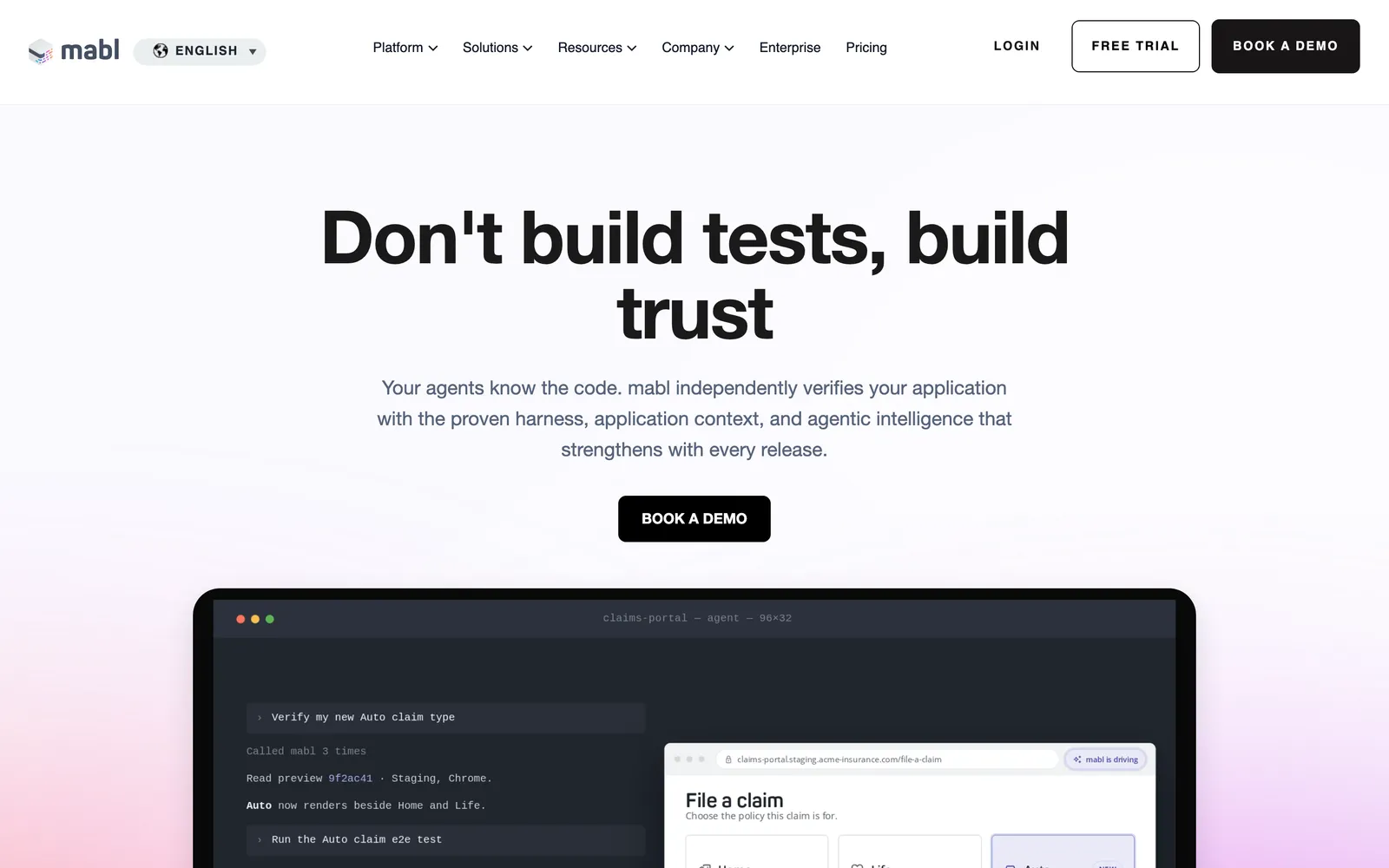
Pricing: quote-based; cloud runs are credit-metered (starting around 500 credits/month per their FAQ) while local and CI runs are free and unlimited. Full breakdown in our mabl alternatives guide.
Pros: mature ML self-healing; broad surface coverage; strong enterprise support model.
Cons: your team still authors flows in the low-code editor; credit metering gives regression runs a marginal cost; tests are not exportable code.
Best for: mid-market and enterprise teams that want a supported platform rather than a service or a framework.
3. testRigor
testRigor lets manual QA staff write tests in plain English that execute against the real UI using AI-based element identification rather than selectors. If the reason you considered QA Wolf was "our QA team cannot code," testRigor is the keep-it-in-house version of that fix.
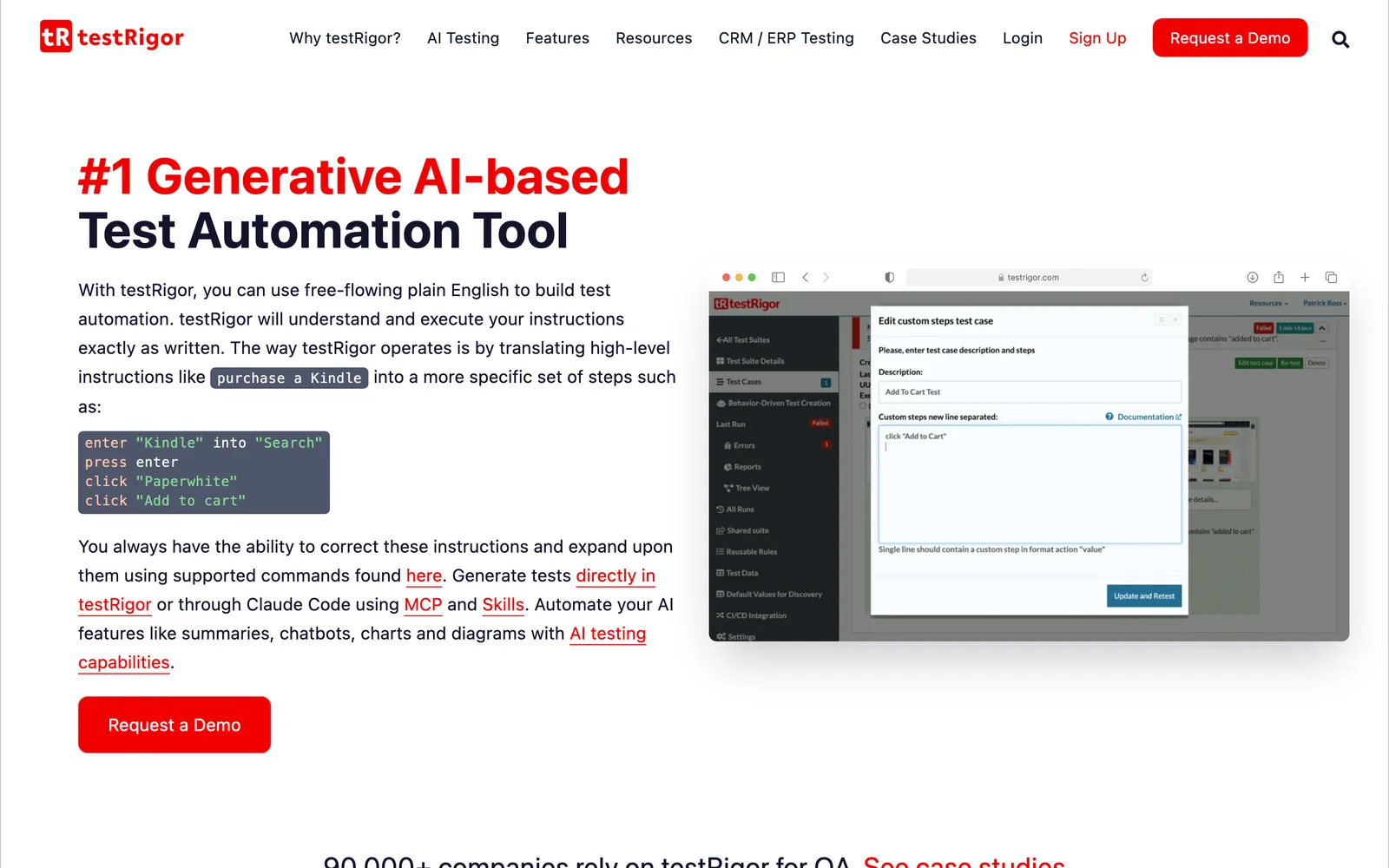
Pricing (read 11 November 2026): a free public plan where tests and results are publicly visible, a Pay As You Go plan with no amount shown (called Private Complete in October), and Enterprise at custom pricing. testRigor's plans page shows no prices. More in our testRigor alternatives guide.
Pros: genuinely accessible to non-engineers; selectorless approach resists UI churn; wide surface coverage including desktop and mainframe.
Cons: every step is still hand-written; tests live in testRigor's format with no code export; realistic configurations are quote-based.
Best for: manual QA teams automating their own regression checklists without engineers.
4. Testsigma
Testsigma is an NLP-driven scriptless platform covering web, mobile web, native mobile, desktop, Salesforce, and API testing, with 2,000+ real devices in its cloud and AI-assisted authoring via Copilot.
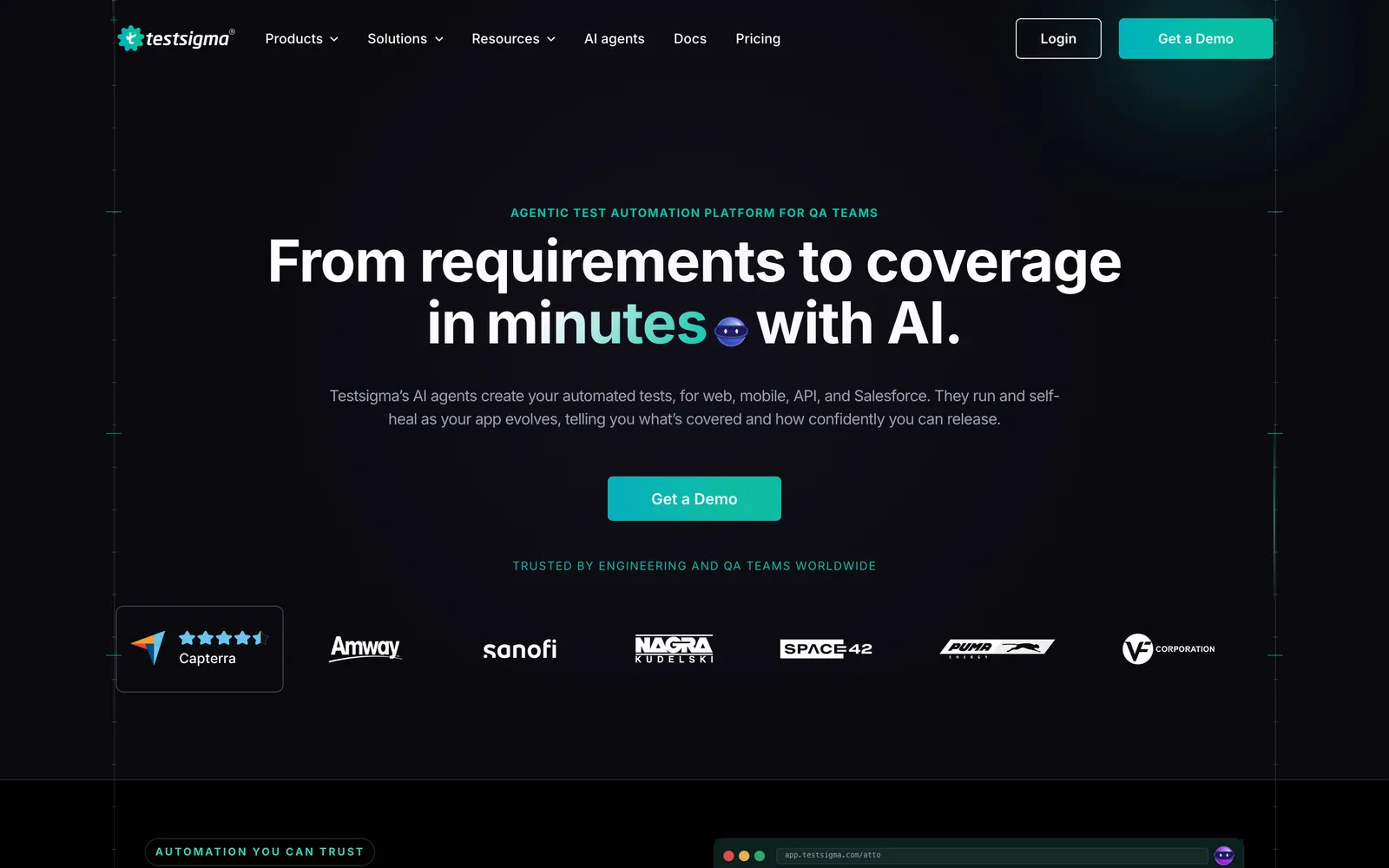
Pricing (read 11 November 2026): quote-based Pro and Enterprise plans; Pro includes unlimited automated testing minutes, so runs are not metered.
Pros: widest surface coverage of the platforms here; unlimited testing minutes; on-prem option for regulated industries.
Cons: quote-based pricing; scriptless authoring is still manual authoring; breadth over depth in places. See our Testsigma alternatives guide.
Best for: teams that need one in-house platform across web, mobile, and desktop.
5. Rainforest QA
Rainforest QA sits between a tool and a service, which makes it the most direct hybrid alternative to QA Wolf: no-code test automation with AI-accelerated authoring, plus optional human execution when you need extra hands. Tests assert against the visual layer (what users actually see) rather than the DOM.
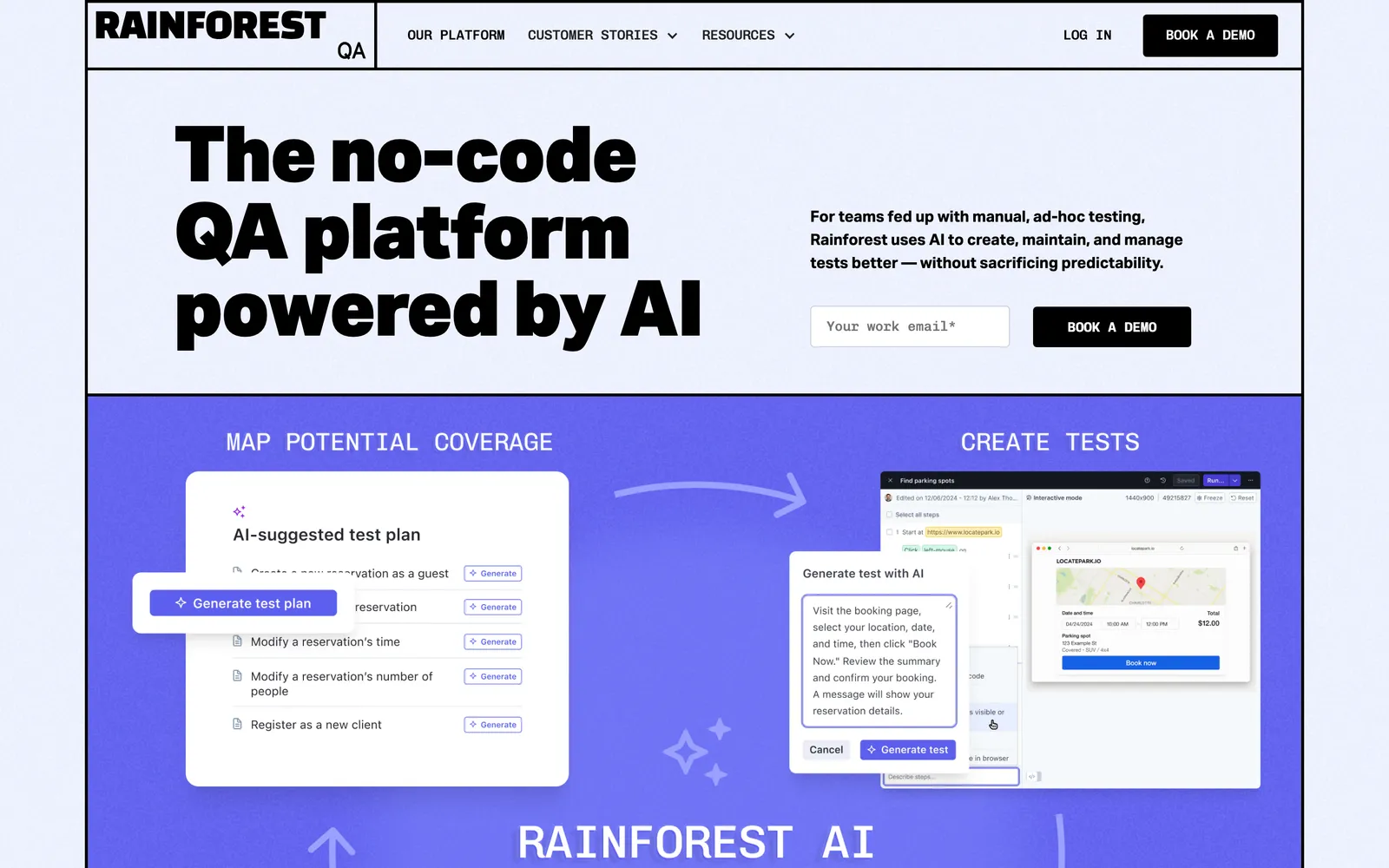
Pricing: demo-led with a free trial; no public price sheet we could verify at the time of writing.
Pros: visual-layer testing catches rendering bugs DOM tools miss; accessible to non-engineers; managed options without a full service contract.
Cons: visual-first tests can run slower; smaller ecosystem than mabl or Testsigma; pricing requires a conversation.
Best for: product teams that own QA without engineering support but want a service-like safety net.
6. Momentic
Momentic is a fast-rising AI testing platform: a low-code editor where any engineer writes tests in plain English, intent-based self-healing locators, and an autonomous agent that explores your app and generates tests. Customer logos like Notion, Webflow, and Retool signal real traction with engineering-led teams.
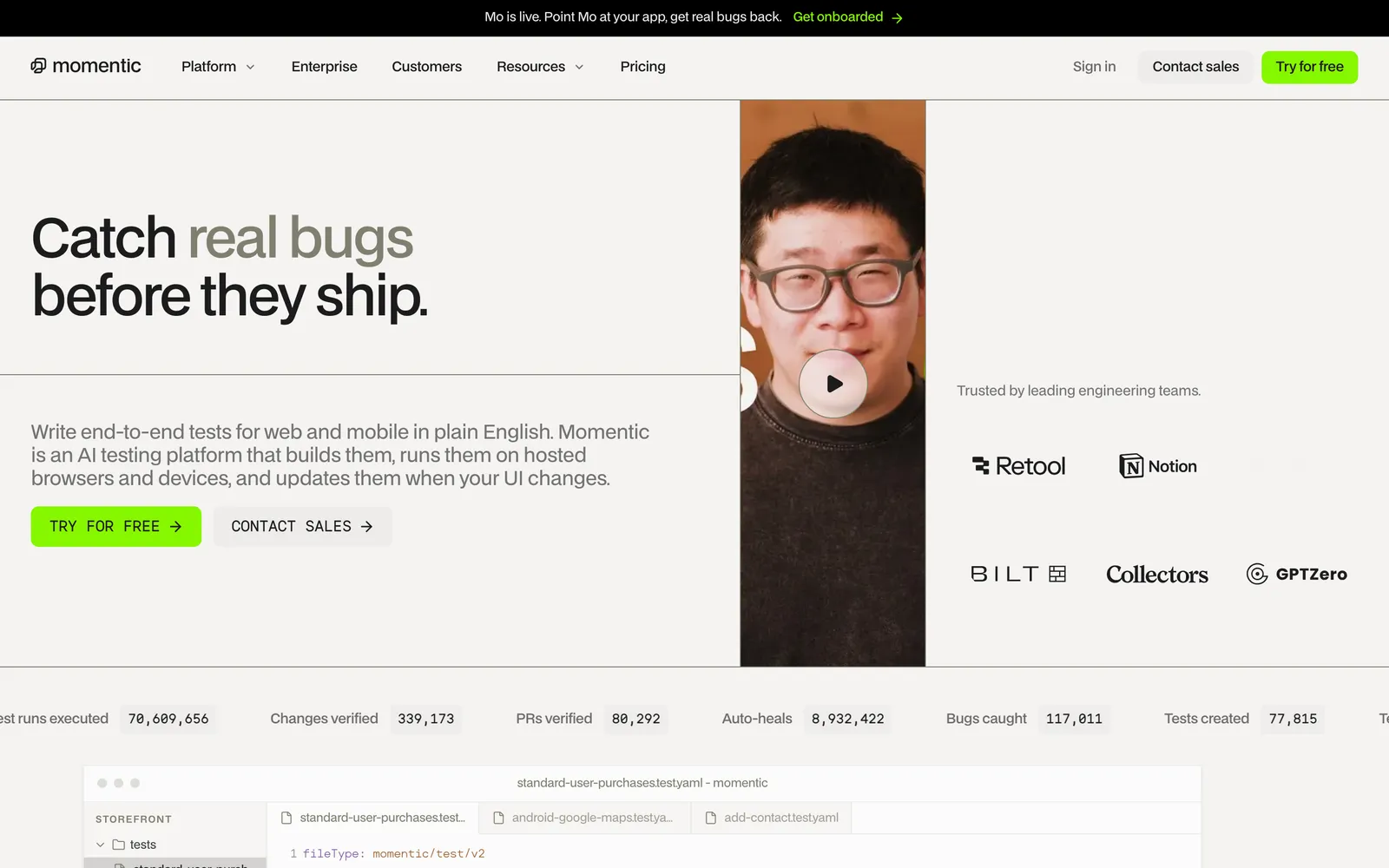
Pricing (read 11 November 2026): Free is $0 with $50 of usage a month. Scale is $500 a month with $500 of usage included, and runs pause at $0 instead of billing overages. Enterprise is priced by test count. No seat fees.
Pros: very fast authoring loop for engineers; self-healing locators reduce maintenance; AI assertions handle non-deterministic output.
Cons: tests are not exportable code; per Momentic's own FAQ, it does not generate or save code, and its AI interprets test steps at run time, so everything lives inside the platform. Chromium/Chrome only today. Full analysis in our Momentic alternatives guide.
Best for: engineering teams that want fast in-house AI test authoring and accept platform lock-in.
7. Playwright
Playwright is the do-it-yourself baseline, and in this list it carries extra meaning: it is the same framework QA Wolf's engineers write for you. Microsoft's open-source tool covers Chromium, Firefox, and WebKit with auto-waiting, parallelism, and a first-class trace viewer.
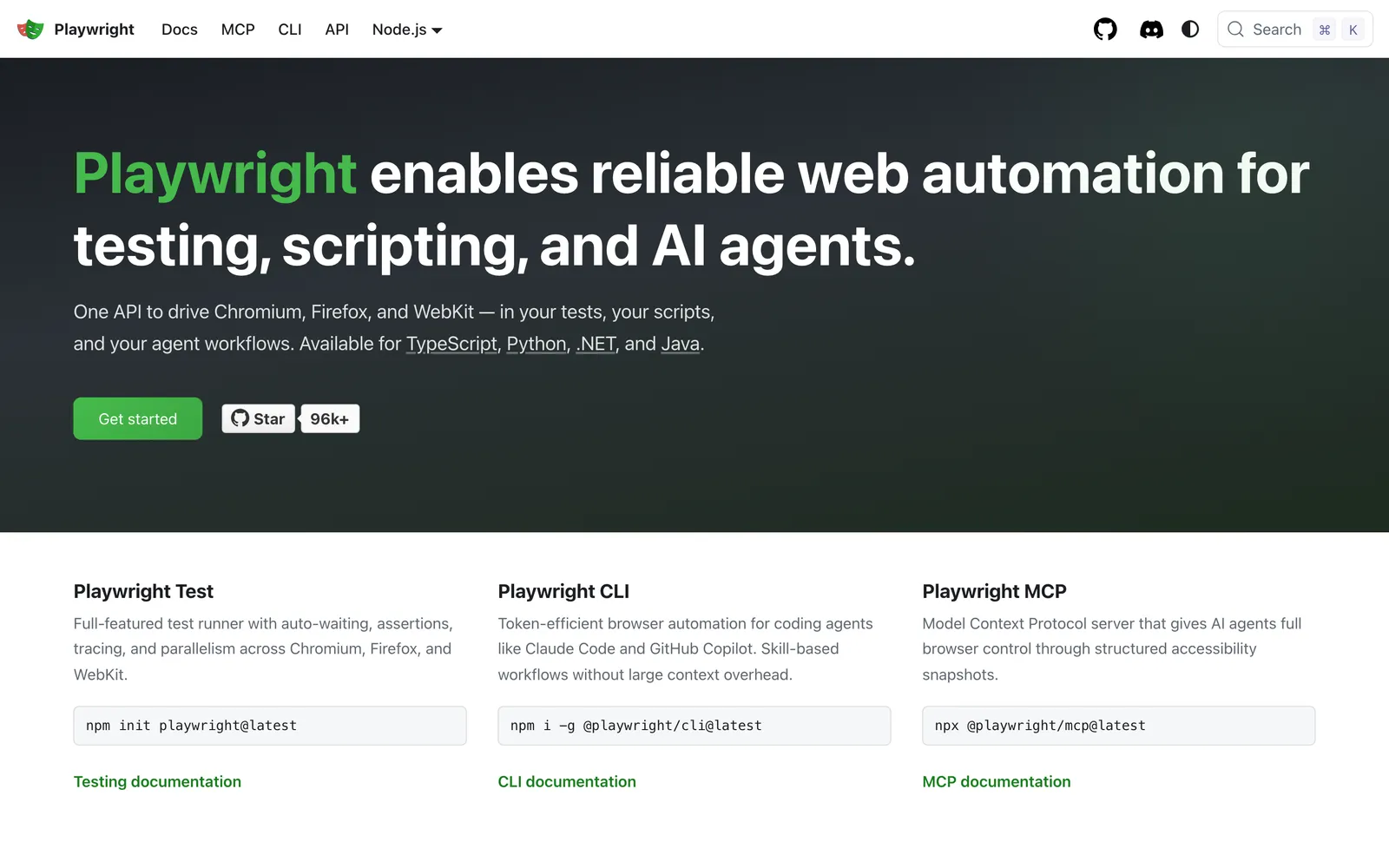
Pricing: free, Apache 2.0.
Pros: no meter, no vendor, total control; the largest ecosystem in browser automation.
Cons: your engineers write and maintain every test, triage every failure, and run the infrastructure. That time is the real price.
Best for: teams with engineering capacity who want full ownership. If you want Playwright output without writing it by hand, that is exactly the gap Qodex (a platform you run) and QA Wolf (a vendor that runs it for you) fill from opposite directions.
Decision Framework: Which QA Wolf Alternative Fits Your Team
| Your situation | Start with | Why |
|---|---|---|
| Engineering-led team, wants coverage without outsourcing | Qodex | Agent authors standard Playwright + HTTP tests in-house; replays add no model spend, within plan run limits |
| Mid-market team wanting a supported low-code platform | mabl | Mature ML platform with a CSM attached |
| Manual QA team, no engineers | testRigor | Plain-English authoring built for non-coders |
| One platform across web, mobile, desktop, Salesforce | Testsigma | Widest surface coverage, unlimited minutes |
| Non-engineers who want optional human help | Rainforest QA | No-code plus managed execution on demand |
| Engineers who want fast AI authoring, accept lock-in | Momentic | Quick plain-English loop, self-healing locators |
| Full control, no budget, strong eng team | Playwright | Free, portable, industry standard |
| No QA function, funded, want it fully handled | Stay with QA Wolf | The strongest fully-outsourced model on the market |
How to Choose
Decide where you want the QA muscle to live. This is the real question behind every QA Wolf evaluation. Outsource it and you get speed without organizational learning. Keep it in-house with an agent or platform and your team's product knowledge compounds. Neither answer is wrong; mixing them up is.
Count what code ownership is worth. QA Wolf and Qodex both hand you standard Playwright. mabl, testRigor, Testsigma, Rainforest, and Momentic keep tests inside their platforms. If you ever change vendors, exported code is the difference between migrating and rebuilding.
Price the model, not the demo. A per-run price (QA Wolf), a credit meter (mabl), a usage balance (Momentic), a quote-based platform (Testsigma, Rainforest), a per-seat tool, and an agent whose deterministic replays add no model spend (Qodex) produce wildly different bills at the same test volume. Model a year of your actual deploy cadence.
Do not let UI coverage stand in for API coverage. End-to-end UI suites, managed or not, rarely exercise auth logic, contract edge cases, or OWASP-class vulnerabilities. If that risk matters, look at API-level testing as its own requirement rather than a checkbox.
Frequently Asked Questions
How much does QA Wolf cost?
QA Wolf charges per run: $1 for a web run and $2 for a mobile or desktop run, each covering up to five minutes, with no seat fee (read on qawolf.com/pricing on 11 November 2026). Its own estimate for 50 web tests run once a business day is $1,083 a month. Human planning and review services are quoted separately.
Do you own the tests QA Wolf writes?
Yes. QA Wolf writes standard Playwright tests for web (and Appium for mobile), and customers keep the code. That makes QA Wolf and Qodex the two options in this comparison where leaving the vendor does not mean rebuilding the suite from scratch.
Is QA Wolf a tool or a service?
Both. The platform, with AI agents that plan, write and run Playwright and Appium tests, is sold per run. Coverage-as-a-Service adds human QA engineers who plan, create and verify tests, and is quoted by sales.
What is the best QA Wolf alternative for in-house teams?
For engineering-led teams, Qodex is the most direct swap: an AI agent authors and maintains standard Playwright and HTTP tests in-house, with security testing included and deterministic replays that add no model spend, within plan run limits. For QA-led teams without engineers, testRigor or Testsigma keep authoring in-house with plain-English tests. Plain Playwright is the right answer if you have the engineering capacity to own everything.
Why would anyone leave QA Wolf if the service is good?
The common reasons are structural, not quality complaints: teams want testing expertise and product knowledge to live in-house, want coverage created at branch speed rather than request speed, want a bill that does not grow with every run, or need API and security depth beyond end-to-end UI flows. If none of those apply, staying put is a defensible decision.
Does any QA Wolf alternative cover security testing?
Qodex is the only option in this list that runs API security checks (IDOR, BOLA, auth bypass, injection, aligned to the OWASP API Top 10) from the same agent that handles functional testing. The platform tools focus on functional quality, and managed services generally scope security testing separately.