8 Best mabl Alternatives for AI Test Automation in 2026
mabl is a low-code AI test automation platform with auto-healing, agentic runtime recovery, and one license across browser, mobile, API, accessibility and performance testing. It is also quote-priced and credit-metered on cloud runs. If you are evaluating mabl or planning to leave it, the eight tools below are the rest of the shortlist, including the cases where mabl is the better pick.
How We Evaluated These mabl Alternatives
How we evaluated: on 23 October 2026 we opened each vendor's homepage, pricing page and documentation, and wrote down what each page states. We sorted every tool on three questions. What does it test? Who writes the tests? What do you have to move or rewrite to leave mabl for it? Where a vendor page states nothing, the table says so. We did not run a speed or reliability benchmark, so nothing below ranks those.
Here is what changed since our June check:
mabl tests can leave as code. The mabl CLI exports a browser test to Playwright TypeScript or to the Selenium IDE format, with listed step types left out (mabl export docs). The migration matrix below shows what that leaves for you to rewrite.
QA Wolf now publishes prices. Its pricing page charges per test run, from $1 for a web test.
Functionize sells self-serve plans. Its Studio product lists Free, $20 and $100 monthly plans next to a custom Enterprise plan.
testRigor no longer shows a private-plan price. Its plans page lists a free public plan, a Private Complete plan by trial, and a custom Enterprise plan.
The open-source frameworks write tests with AI too. Playwright documents planner, generator and healer agents, and Cypress offers
cy.prompt.
And here is the decision table: one row per tool, read off each vendor's own pages on 23 October 2026.
| Tool | What it tests | Who writes the tests | Price; free option |
|---|---|---|---|
| mabl (baseline) | Browser and mobile UI, API, accessibility, performance | Low-code editor; mabl advertises autonomous creation and maintenance | Quote only; 500 cloud credits a month as a starting point. Free: a 14-day trial |
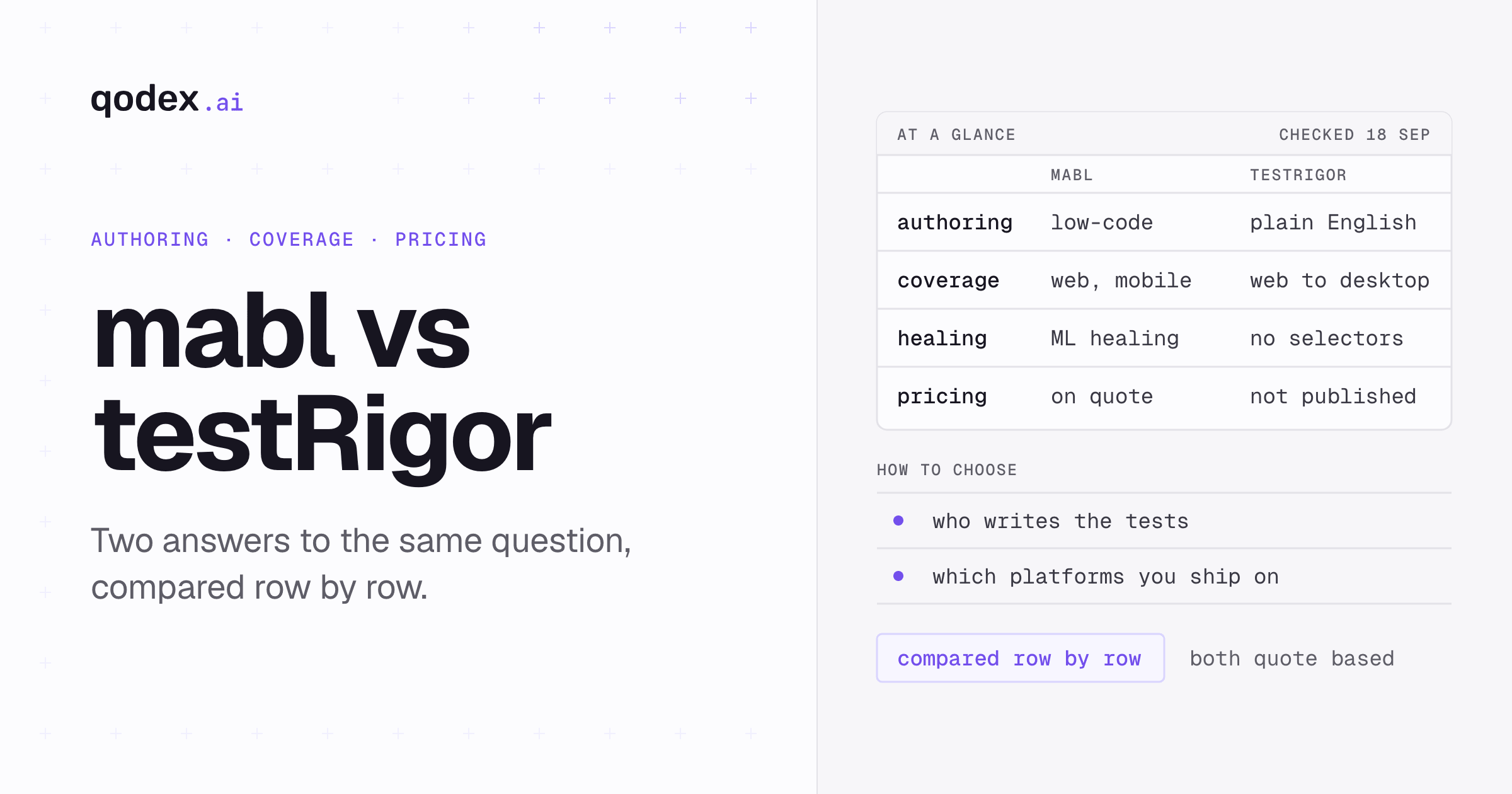
| testRigor | Web, mobile, Windows desktop and mainframe | Manual QA in plain English; AI generates tests too | No private-plan price shown; Enterprise custom. Free: a public plan where tests are public |
| Qodex.ai | Web apps and APIs, plus security probes | An AI agent, from a plain-English chat | Individual $0; Startup from $1,299 per project a month. Free: 25 scenarios and 100 runs a month |
| Testsigma | Web, iOS and Android, API, Windows desktop, Salesforce, SAP | Natural-language steps, a recorder, or AI generation | Custom pricing for every paid plan. Free: a trial |
| Functionize | Web UI workflows | An agent turns plain-language requests into test steps | Growth $20/month; Scale $100; Enterprise custom. Free: a $0 plan |
| QA Wolf | Web, iOS and Android, Windows and macOS desktop | Agents write Playwright and Appium; QA Wolf's team on the managed service | $1 per web run, $2 mobile or desktop, per 5-minute block. Free: starter runs for new teams |
| Rainforest QA | Web UI, through visual no-code tests | No-code editor with AI drafting; a test-writing service on request | No public price; talk to sales. Free: a trial |
| Playwright | Chromium, Firefox and WebKit browsers; HTTP APIs | Engineers in code; codegen and AI agents help | Free, Apache-2.0 |
| Cypress | End-to-end and component tests in the browser | Engineers in JavaScript or TypeScript; cy.prompt helps | App free, MIT; Cloud Team from $67/month billed annually. Free: Cloud Starter |
What mabl Does Well
Any honest alternatives list starts here, because mabl earns its shortlist spot. Each point below is on mabl's pricing page, read 23 October 2026:
Auto-healing and runtime recovery: the page lists "Advanced auto-healing" and "Agentic test runtime recovery" for tests that break when the UI changes.
Breadth under one license: browser and mobile UI, API, accessibility and performance testing share one platform, with cross-platform reporting.
Unlimited local and CI runs: the credit meter applies to cloud runs. Runs on your own machines and in your CI do not use credits.
A support model: a Customer Success Manager and the mabl University training and certifications are part of the package.
If you are a team that wants a vendor-supported, low-code platform with a named contact at the vendor, mabl fits that, and you may not need an alternative at all.
mabl Pricing: How It Works
"mabl pricing" is one of the questions people search about the product, so here is what the pricing page says, read 23 October 2026. mabl publishes no dollar figures. Pricing is a quote you request, "tailored to your organization's testing requirements".
The structure underneath the quote, from mabl's own pricing FAQ:
Credit-metered cloud runs: "Credits are consumed based on your usage of cloud test runs." mabl gives "a starting point of 500 credits per month for cloud test runs", shared across browser and mobile UI, API, performance and accessibility testing.
Unlimited local and CI runs: listed as "Unlimited local and CI test runs".
One license for the core: unlimited apps, environments and workspaces, and unlimited participant licenses.
Add-ons: native mobile app testing is listed under add-ons, and a Technical Account Manager comes "at additional cost".
No setup fees: "There are no setup fees or hidden charges."
What this means in practice: more cloud runs consume more credits, and runs in your own CI consume none. Before you compare prices, count how many of your runs would happen in mabl's cloud.
Why Teams Look for mabl Alternatives
Quote-only pricing. You cannot budget from a public price sheet; the page asks you to request a quote.
Metered cloud runs. Cloud runs consume credits, so a suite that runs in mabl's cloud on every deploy has a running cost to watch.
You want the tests in your repository. mabl tests live in mabl. The CLI can export browser tests to Playwright, but several step types do not export, so leaving still means rewriting part of the suite.
A different authoring model. Some teams want plain English, some want an agent in chat, and some want engineers writing code they review.
The 8 Best mabl Alternatives in 2026
1. testRigor
testRigor runs tests written in plain English against the real UI. Its homepage says it identifies "elements as you see them on the screen instead of using element locators", and that "Manual QA teams can create and maintain automated tests". It can also generate tests with AI and import existing manual test cases.
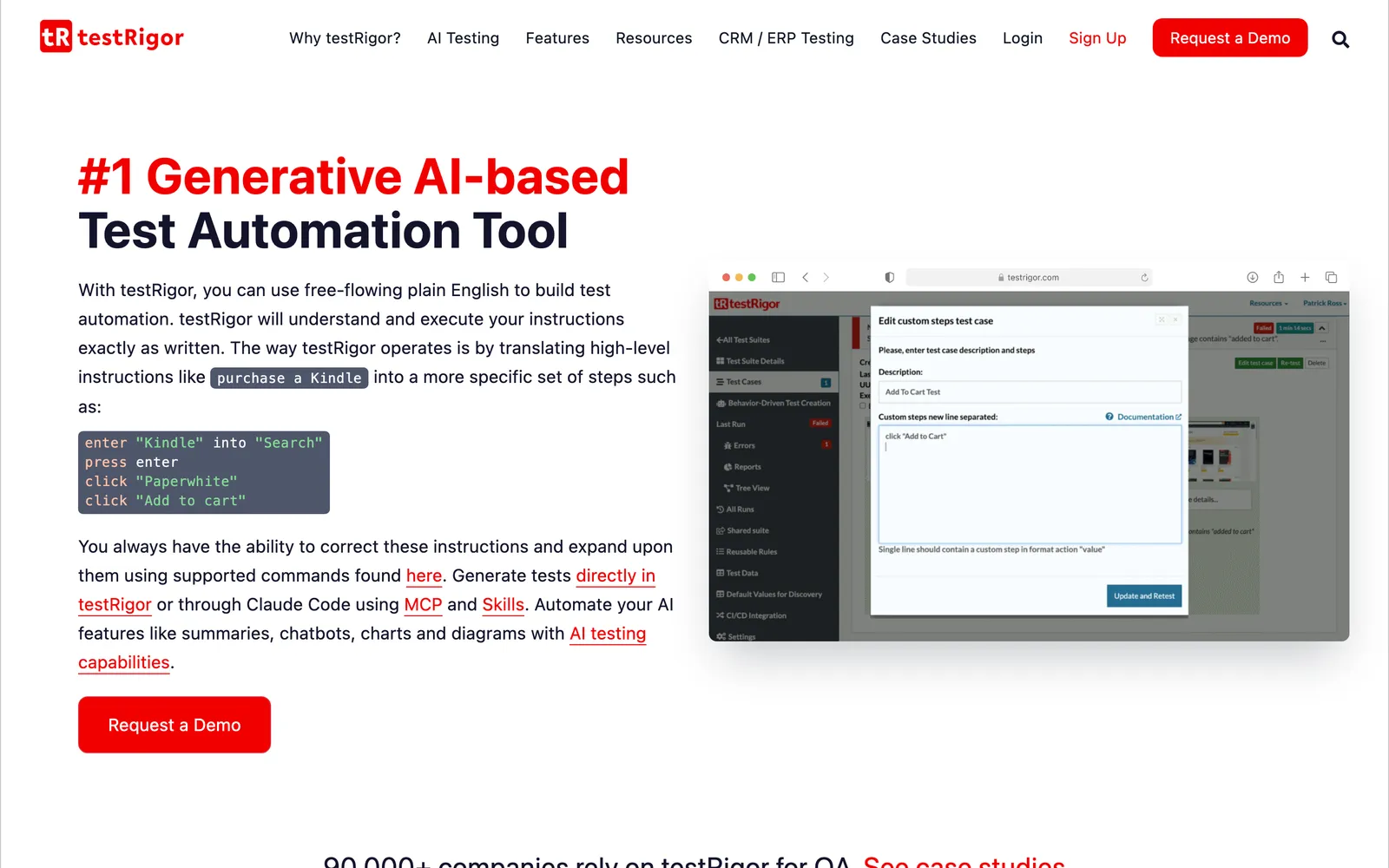
Pricing (read 23 October 2026): the plans page lists a free Public Open Source plan, where "All tests and test results are PUBLIC". Private Complete has a 14-day trial covering Ubuntu, Windows, Mac, Android, iOS and Windows Native, with no price shown. Enterprise is custom pricing.
Pros: manual QA staff can automate without code; one tool for web, mobile, Windows desktop and mainframe; tests written from the user's point of view.
Cons: tests are testRigor plain English, which runs only in testRigor; the free plan makes tests public; no private-plan price is published.
Best for: QA teams without engineers who want to automate manual regression checklists. For more options in this style, see testRigor alternatives, and for the pair itself, mabl vs testRigor.
2. Qodex
Qodex is an agentic QA platform you talk to. You describe what matters in plain English; it explores your web app in a real Chromium browser and your API with direct HTTP calls. It then saves runnable scenarios as standard Playwright or HTTP code, and replays them on demand, on a schedule, by webhook, or against every pull request.
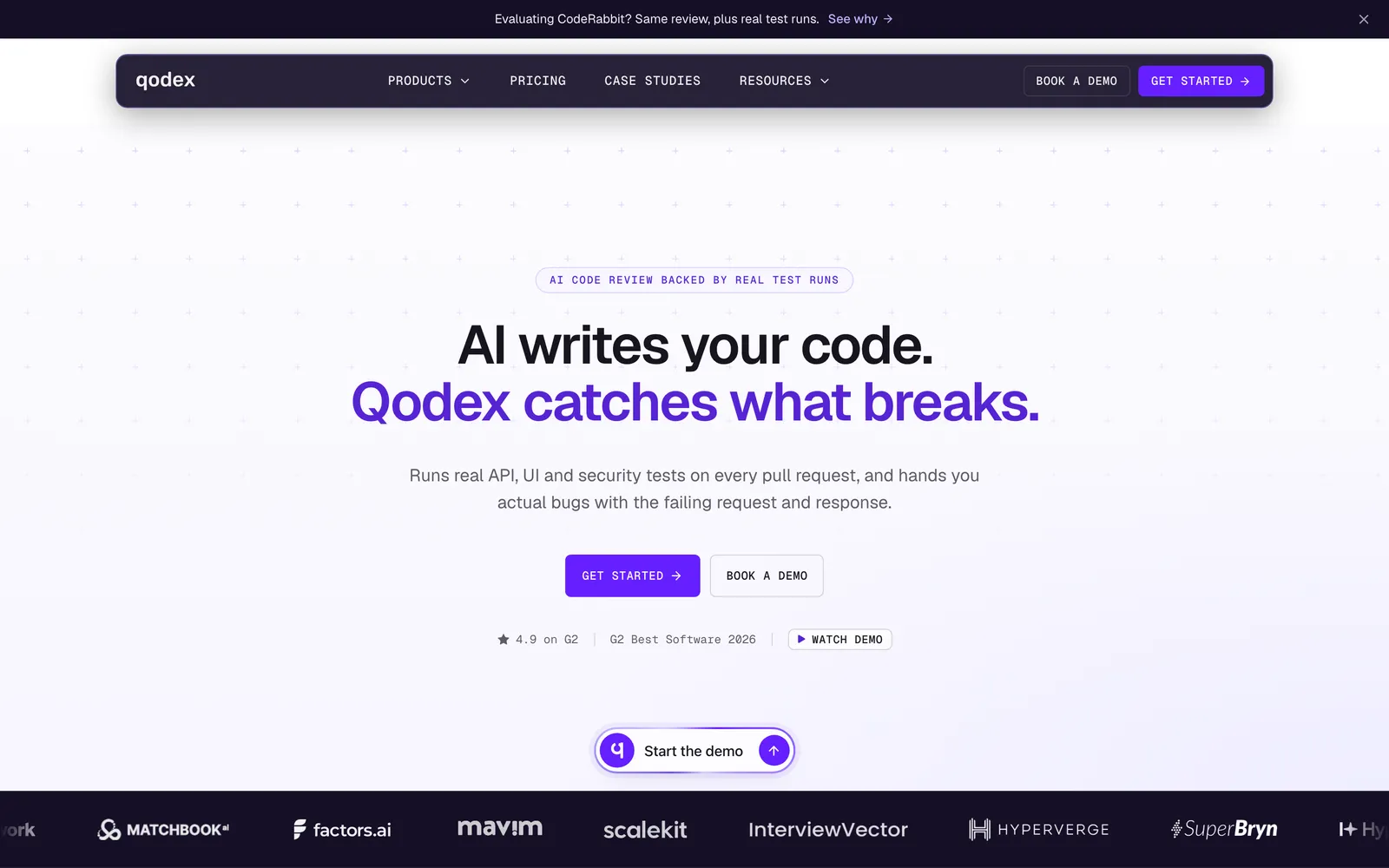
The two structural differences from mabl:
Code you can take with you: scripts are standard Playwright or HTTP code that you can export, run locally, edit and check into git.
Security in the same agent: OWASP-aligned probes for SQL injection, XSS, SSRF, IDOR and BOLA, and auth bypass run from the same agent as functional tests. A passing security scenario means the attack was blocked.
When a run fails, Qodex triages the evidence as a real bug, a stale test or an environment problem. Coming from mabl, its importer takes OpenAPI files, Postman collections, spreadsheets and existing tests.
Pricing (read 23 October 2026): Individual is $0, with up to 25 test scenarios and 100 test runs a month. Startup is from $1,299 per project a month, with 10,000 runs, and extra runs cost $20 per 1,000. See pricing.
Pros: the agent does the authoring; UI, API and security in one tool; standard code you can export; failure triage.
Cons: chat-first authoring is a workflow change for a team used to a visual editor; the paid tier starts at a project price rather than a seat price.
Best for: engineering-led teams that want autonomous coverage with code they can take with them. Start free and compare the first generated suite against your mabl flows, or read Qodex vs mabl for the head-to-head.
3. Testsigma
Testsigma covers "Web, mobile (iOS and Android), API (REST and SOAP), desktop (Windows), Salesforce, and SAP", per its homepage. Tests are ordered natural-language steps, which you write, record with its browser extension, or generate with AI.
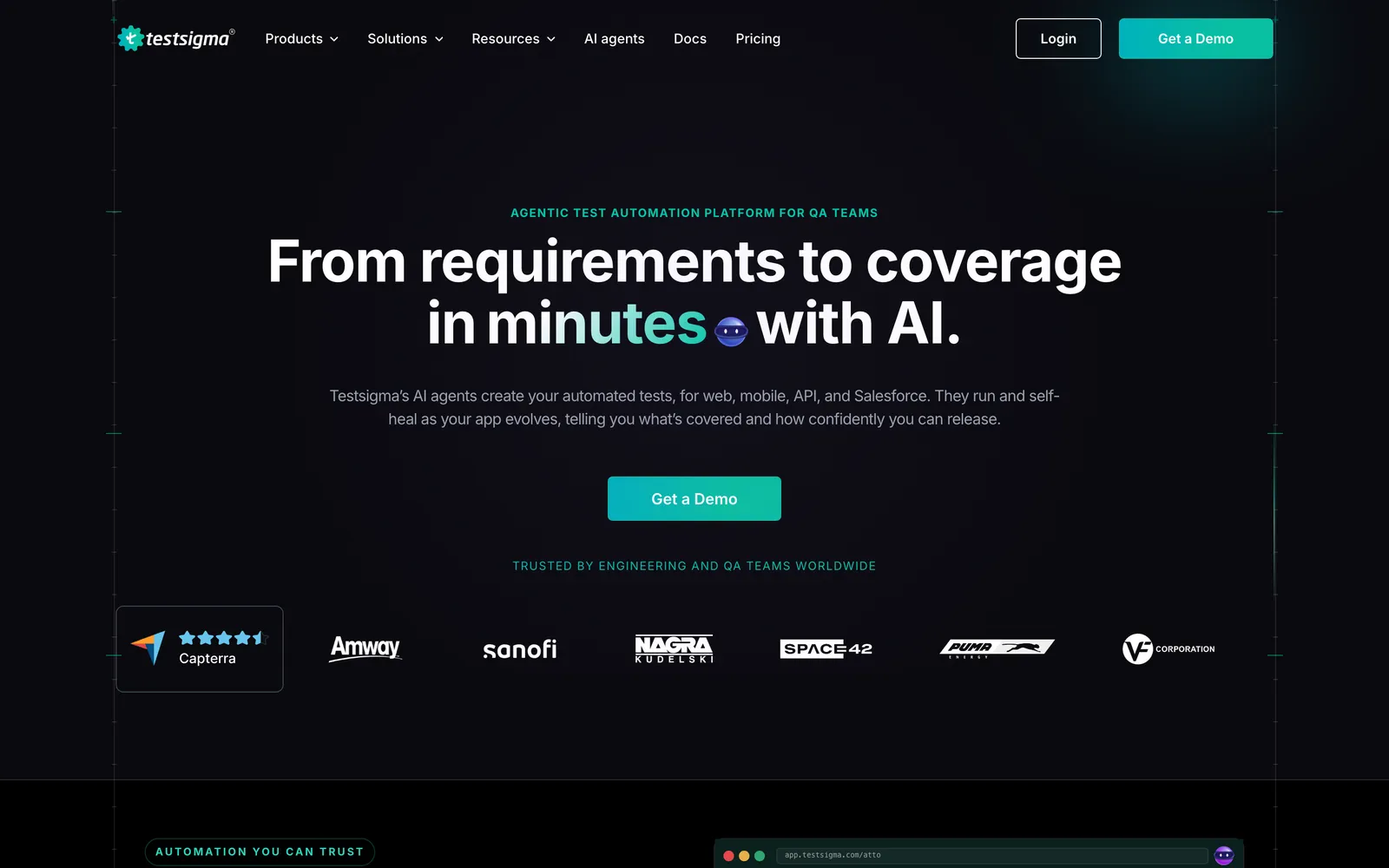
Pricing (read 23 October 2026): every paid plan says "Get Custom Pricing", and a free trial is offered. The pricing page lists unlimited automated testing minutes, unlimited applications and projects, and auto-healing scripts. Its top plan adds public, private or on-prem cloud deployment, SAML single sign-on and accessibility testing. Its pricing page cites "2000+ real mobile devices" while its homepage cites 800+, so ask which applies to your plan.
Pros: one scriptless platform across web, mobile, desktop, Salesforce and SAP; unlimited testing minutes instead of metered runs; an on-prem option for regulated teams.
Cons: quote-based pricing, like mabl; tests are Testsigma steps rather than standard code. We compare it in detail in our Testsigma alternatives guide.
Best for: teams testing across many surfaces that want one scriptless platform.
4. Functionize
Functionize now leads with Studio, which its homepage calls "An independent testing agent for your full web UI workflow." An agent maps what you ask for into ordered test steps. The task pages list "Self-healing on every run" and visual validation.
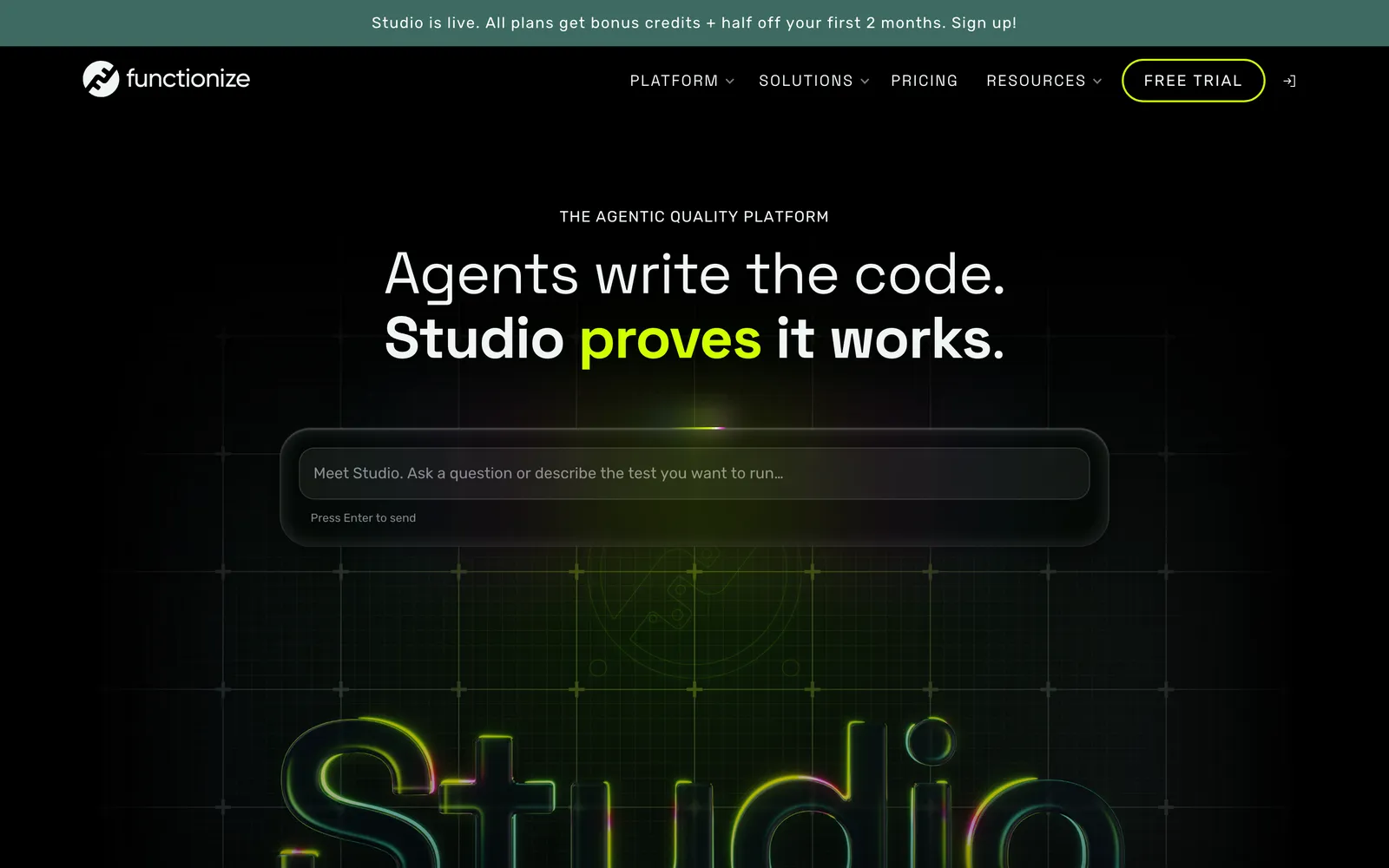
Pricing (read 23 October 2026): the pricing page lists Free at $0, Growth at $20 a month and Scale at $100 a month, each with a monthly credit allowance. Enterprise is custom, with a 12-month minimum.
Pros: a free plan and published self-serve prices; plain-language authoring; self-healing on every run.
Cons: usage is metered in credits, like mabl; the current pages document no importer for existing tests and no test-code export.
Best for: teams that want to try an agent-driven web testing tool on a self-serve plan before talking to sales.
5. QA Wolf
QA Wolf is a platform where agents write tests "in open-source Playwright and Appium", with an optional managed service. On the service, "QA Wolf's team writes, runs, and maintains your tests", and QA Wolf guarantees "80%+ automated coverage". On the platform, "Every failure is diagnosed by an agent before anyone on your team looks at it."
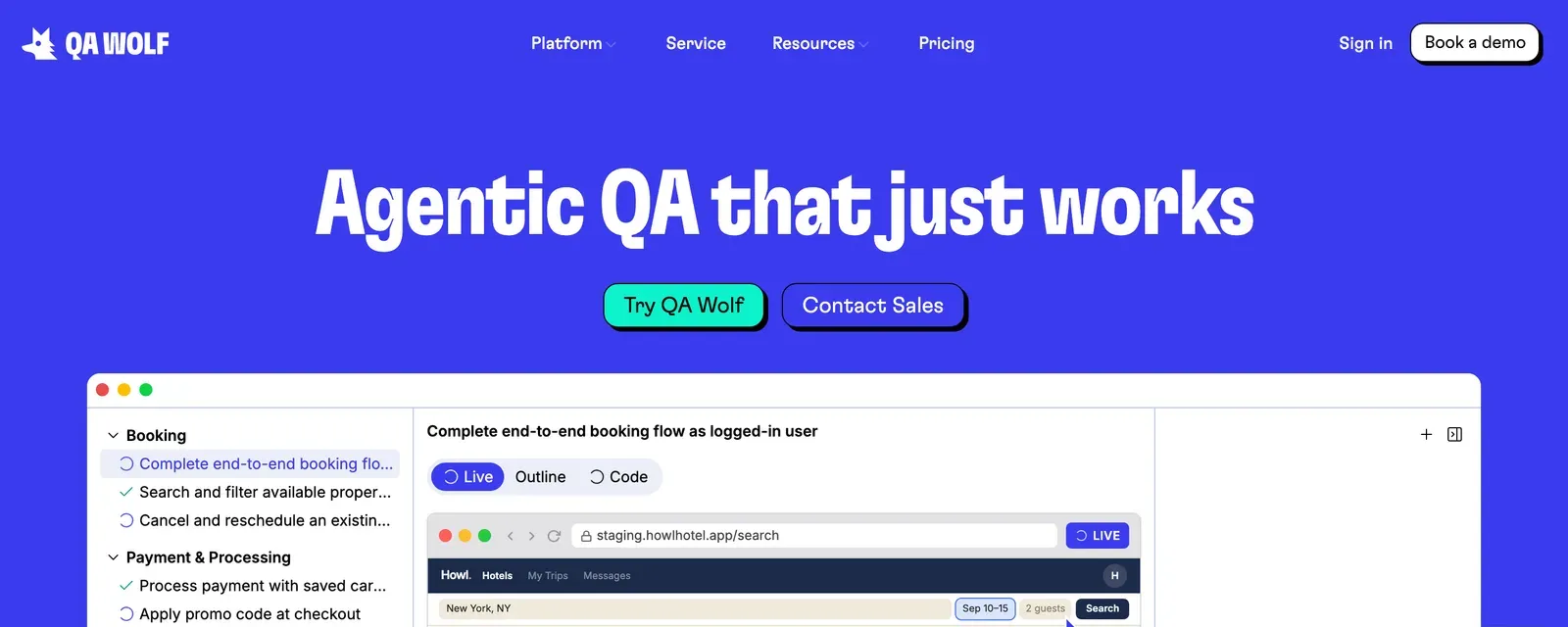
Pricing (read 23 October 2026): the pricing page says "Pay per test run": $1 per web run and $2 per mobile or desktop run. That covers up to 5 minutes of run time, with longer tests billed in 5-minute blocks. Volume pricing and the managed service go through sales.
Pros: "Your tests are open-source Playwright and Appium code you can export anytime"; you can bring your own Playwright tests; published per-run prices.
Cons: every run has a price, so a large suite on every deploy adds up; the coverage guarantee applies to the managed service, which is quoted.
Best for: teams that want Playwright code they own, written and run by someone else.
6. Rainforest QA
Rainforest QA is a no-code QA platform powered by AI. Its help centre says tests made in the visual editor interact "with the UI, not the Document Object Model (DOM)". It also offers a service where you send text outlines or video walkthroughs and its team writes the tests.
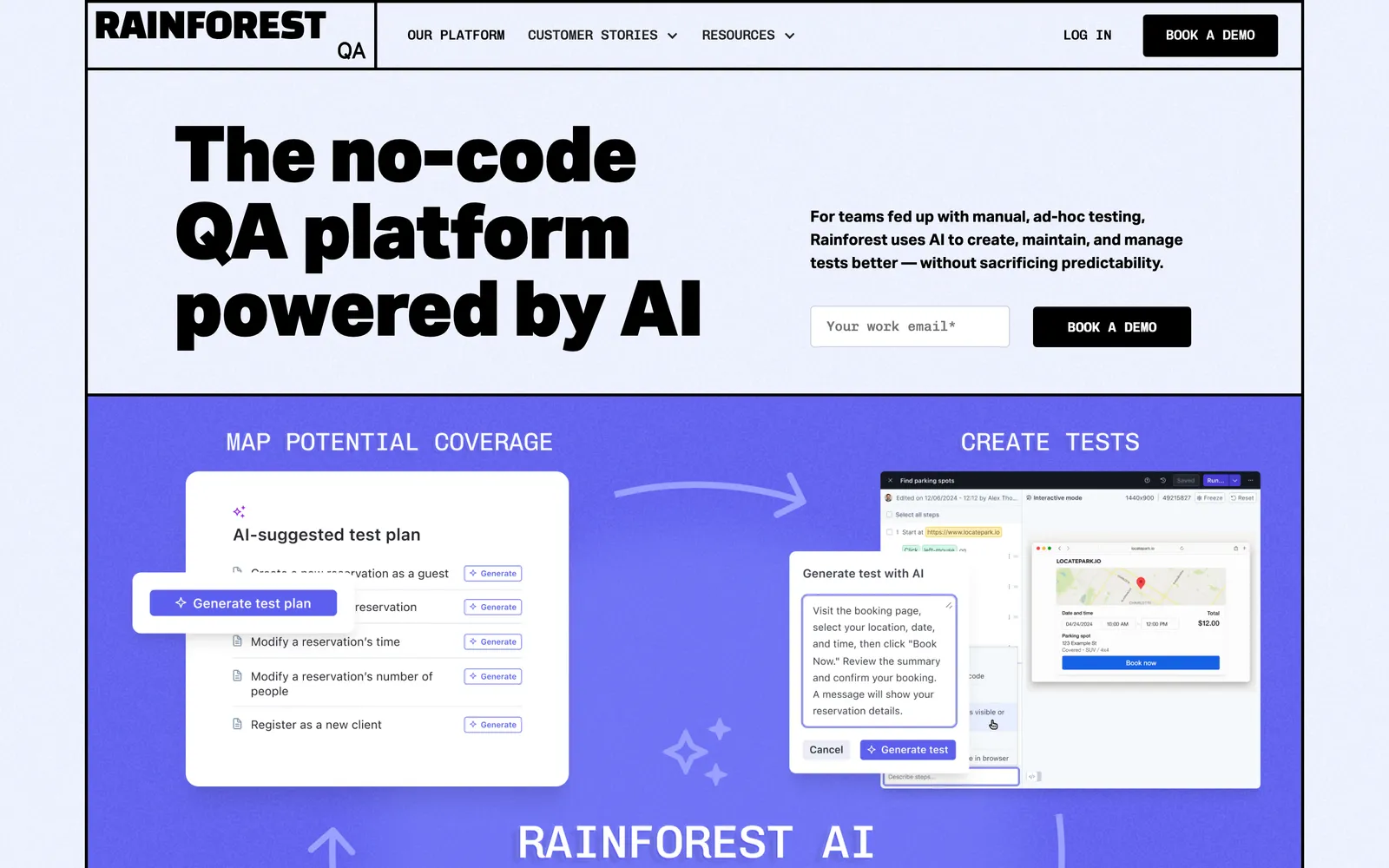
Pricing (read 23 October 2026): the pricing link leads to a talk-to-sales page with no public price, and the homepage offers a free trial.
Pros: tests check what a user sees on screen; the help centre calls it "easy for technical and nontechnical teammates to own testing"; a test-writing service when you need extra hands.
Cons: tests are in Rainforest's own format; pricing needs a conversation.
Best for: product and support teams that own QA without engineering support and care about what the screen shows.
7. Playwright
Playwright is the open-source framework from Microsoft, under the Apache-2.0 license. It drives Chromium, Firefox and WebKit, with auto-wait, web-first assertions and a trace viewer. It now documents planner, generator and healer agents, and its codegen records a flow into test code.
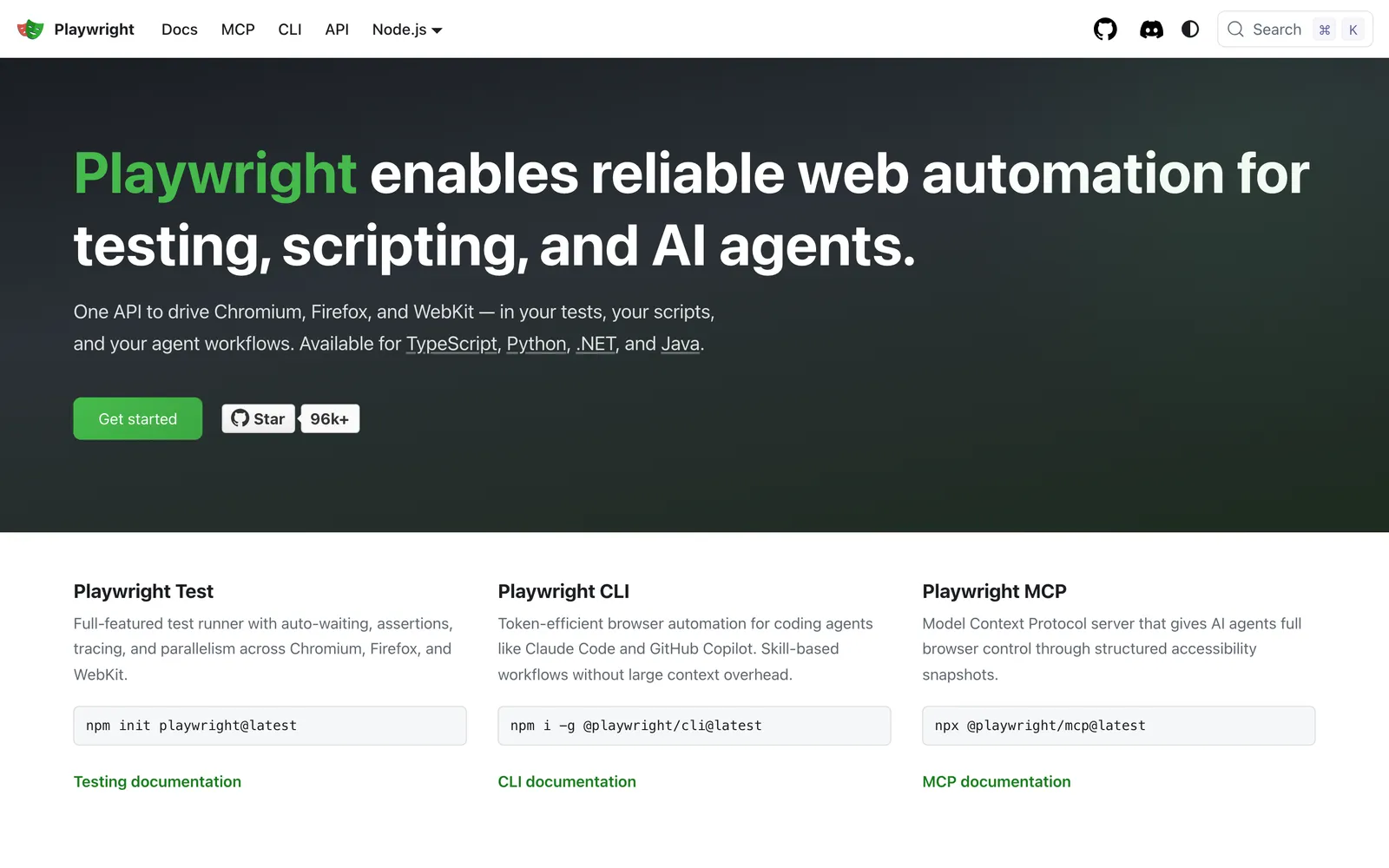
Pricing: free, Apache-2.0. You pay for the machines that run it.
Pros: no meter; tests are ordinary code in your repository; mabl's own CLI exports browser tests into it.
Cons: engineers own the suite, its upkeep and the infrastructure it runs on.
Best for: engineering teams with capacity to own their suite. Qodex and QA Wolf both produce standard Playwright, so Playwright against a platform is not an either-or choice.
8. Cypress
Cypress runs end-to-end and component tests directly in the browser, and the app is free and open source under MIT. Cypress Cloud adds parallelization across machines, flake detection, analytics and Test Replay, and cy.prompt generates tests with AI.
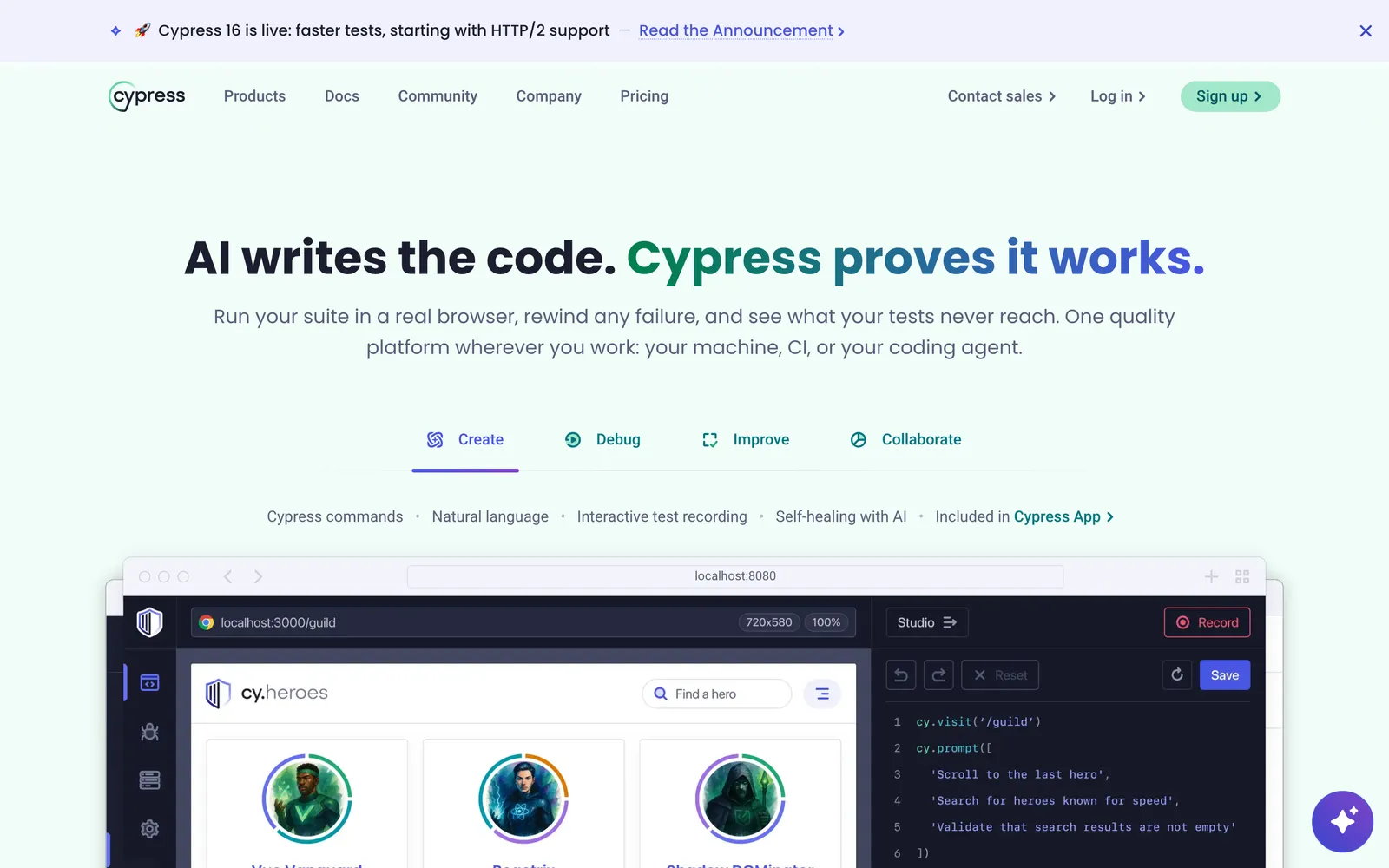
Pricing (read 23 October 2026): the app is free. Cypress Cloud's Starter tier is free with 10 users and 500 test results a month. Team is from $67 a month billed annually, and Business from $267.
Pros: Time Travel debugging, where you hover a command to see the app at that step; component and end-to-end tests in one tool; specs live in your repository.
Cons: JavaScript or TypeScript only; multiple tabs need a plugin. Our Playwright vs Cypress comparison runs the same test in both.
Best for: JavaScript teams that want component and end-to-end testing in one familiar toolchain.
Migration Matrix: What Moves From mabl and What You Rewrite
Leaving mabl is the cost no pricing page shows. This matrix is read off the mabl CLI documentation and each destination's own docs on 23 October 2026. mabl's export to Playwright or Selenium covers browser tests only, and it leaves out mabl-generated tests. It also skips these step types: select, drag and drop, JavaScript snippets, API steps, cookies, file uploads, download assertions, accessibility checks, MFA authenticator steps and more (mabl export docs).
| Destination | Its test format | What moves from mabl | What you rewrite |
|---|---|---|---|
| Playwright | TypeScript or JavaScript code | Browser tests, through mabl tests export <test-id> --format playwright | Every step type the export skips, plus waits and test data setup |
| QA Wolf | Playwright and Appium code | The same Playwright export, since QA Wolf runs your own Playwright tests | Skipped steps; no direct mabl importer is documented |
| Qodex.ai | Playwright and HTTP code | API tests through Postman, since mabl documents a Postman export for them. No mabl-specific importer is documented | Flows the agent regenerates from your app rather than from mabl steps |
| Cypress | JavaScript or TypeScript specs | Scenarios and data; Cypress publishes migration guides from Selenium and from Playwright | Commands, waits and assertions, in Cypress syntax |
| Testsigma | Natural-language steps | API tests through a Postman import, without test or prerequisite scripts, GraphQL, or unsupported auth types and methods | Browser tests, as Testsigma steps |
| testRigor | Plain-English steps | Manual test cases through its import | Every automated mabl test, in plain English |
| Functionize | Studio test steps | CSV test data for data-driven tests | Every test; no importer is documented on its current pages |
| Rainforest QA | Rainforest's no-code format | Written outlines or video walkthroughs, through its test-writing service | Every test, in its visual editor |
Two practical notes. First, export one representative mabl test to Playwright before you sign anything, and count the skipped steps. Second, the Playwright export builds selectors from what mabl learned in one environment, so pick the environment you will test against.
Decision Framework: Which mabl Alternative Fits Your Team
| Your situation | Start with | Why |
|---|---|---|
| Manual QA team, no engineers, web and mobile checklists | testRigor | Plain-English authoring built for manual QA |
| Engineering-led team that wants code ownership and AI authoring | Qodex | An agent writes standard Playwright and HTTP code you can export |
| Testing web, native mobile, desktop, Salesforce and SAP | Testsigma | One scriptless platform across those surfaces |
| A small team that wants a self-serve agent to try first | Functionize | A $0 plan and published monthly prices |
| No QA function, budget for runs or a service | QA Wolf | Agents or its team write Playwright, priced per run |
| Non-engineers who care about what the screen shows | Rainforest QA | Visual no-code tests and a test-writing service |
| Strong engineering team, no tool budget, full control | Playwright | Free, and mabl's export lands in it |
| JavaScript team where component testing matters | Cypress | Component and end-to-end tests in one runner |
| Team wanting vendor-managed low-code with a named contact | Stay with mabl | Its license and support model fit this profile |
How to Choose
Price the runs, not the seat. mabl meters cloud runs with credits, QA Wolf charges per run, and Functionize meters credits. Work out what your regression suite costs to run per deploy across a year, including runs in your own CI, which mabl does not meter.
Decide who authors tests. If the answer is "an agent should draft, engineers review," look at Qodex. If it is "our manual QA team," look at testRigor, Testsigma or Rainforest. If it is "someone else entirely," QA Wolf's managed service is the service-shaped answer.
Check the exit before the entrance. Export one mabl test before you choose, and read what each destination can import. Qodex and QA Wolf produce standard Playwright, and open-source frameworks are portable by definition. Migration cost is real; ask about it up front.
Scope security honestly. If API security is on your risk register, check whether the tool you pick tests for it, or whether you are buying a second tool. And if your evaluation is about API testing depth rather than UI automation, start from our Postman alternatives guide instead.
Frequently Asked Questions
How much does mabl cost?
mabl does not publish prices. Its pricing page, read 23 October 2026, asks you to request a quote. Its FAQ describes the model: cloud test runs consume credits, from a starting point of 500 credits a month shared across browser, mobile, API, performance and accessibility testing. Local and CI runs are unlimited. Native mobile app testing and a Technical Account Manager cost extra.
What is the best mabl alternative for small teams?
It depends on who writes the tests. For an engineering-led team, Qodex has a $0 Individual plan and Playwright is free. For a QA-led team without engineers, testRigor has a free public plan, and Functionize has a $0 plan with self-serve upgrades from $20 a month.
Can you export tests from mabl?
Yes, partly. The mabl CLI exports browser tests to Playwright TypeScript or the Selenium IDE format, and tests to YAML, JSON or CSV. Some step types do not export, including JavaScript snippets, API steps, file uploads and accessibility checks, and mabl-generated tests are excluded. Plan to rewrite those parts by hand.
Is mabl better than Testsigma?
They overlap: both are low-code platforms with auto-healing, API testing and quote-based pricing. mabl bundles a Customer Success Manager and its training program into the package. Testsigma covers Windows desktop, Salesforce and SAP, and lists unlimited automated testing minutes. Choose by the surfaces you test and the support model you want.
Can open-source tools replace mabl?
If you have engineering capacity, yes. Playwright drives Chromium, Firefox and WebKit for free, and mabl's CLI can export browser tests into it. You give up mabl's hosted platform, auto-healing, dashboards and vendor support, and you take on the upkeep. A middle path is a tool that writes standard Playwright for you, such as Qodex or QA Wolf.
Does any mabl alternative include security testing?
Qodex runs OWASP-aligned security probes for SQL injection, XSS, SSRF, IDOR and BOLA, and auth bypass from the same agent that runs functional tests. A passing security scenario means the attack was blocked. For the other tools here, check each vendor's current documentation for security coverage before you buy.