Comparison
Qodex vs Katalon: All-in-One Platform or Autonomous Agent?
The short answer: Katalon is an established all-in-one platform, a test IDE plus management and execution across web, API, mobile, and desktop, priced per seat. Qodex is an agent that writes ejectable Playwright and HTTP tests for you, replays them at zero LLM cost, and runs security checks in the same suite.
A workbench for testers, or an agent for the team
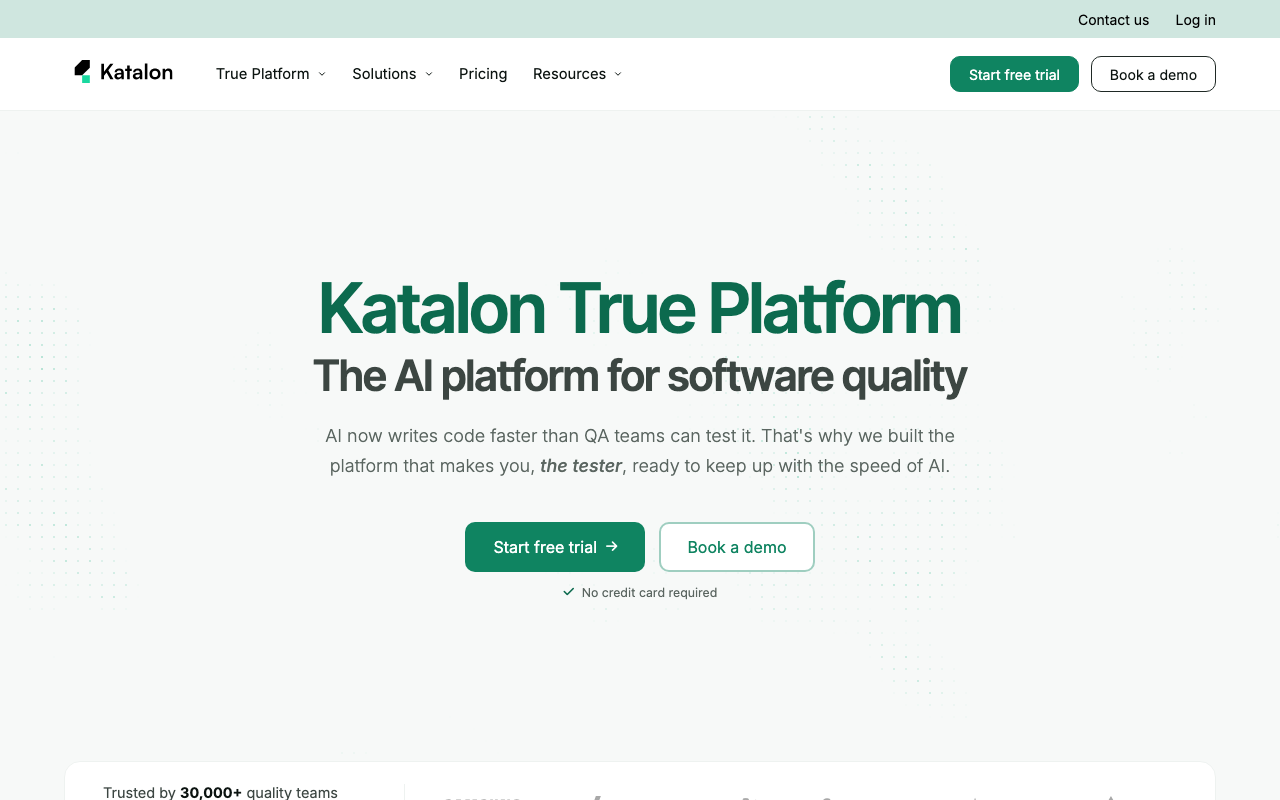
Katalon comes from the generation of tools that professionalized QA. Its center of gravity is Katalon Studio, a dedicated IDE where testers build automation with no-code recording, low-code keywords, or full-code scripting, then execute across web, APIs, Android and iOS devices, and Windows desktop apps, in the cloud or self-hosted. Around the IDE sits a true platform: manual test management, requirements traceability, dashboards, and AI agents for test creation and bug reporting. It is a complete QA department in software form, priced per seat.
Qodex starts from a different premise: the bottleneck is not the workbench, it is the work. You describe what to test in chat, and the agent explores your app with a real browser and direct API calls, writes runnable Playwright and HTTP scenarios, verifies them on save, and replays them deterministically at zero LLM cost. OWASP Top 10 and OWASP API Top 10 security scenarios run in the same suite, from the same agent. There is no IDE to learn because there is nothing to build by hand.
If you are weighing a full migration rather than a head-to-head, our Katalon alternatives guide covers the wider field.
Qodex vs Katalon at a glance
| Dimension | Katalon | Qodex |
|---|---|---|
| Authoring model | Katalon Studio, a dedicated test IDE spanning no-code, low-code, and full-code authoring, with AI agents for test creation, execution, and bug reporting layered on top. | Chat-first and autonomous. You describe the goal; the agent explores your app with a real browser and direct API calls, writes scenarios with assertions, and verifies them on save. |
| Generated assets | Tests built and maintained in Studio projects that execute through the Katalon runtime, in the cloud or self-hosted, with results managed in its TestOps layer. | Standard Playwright and HTTP scripts, parameterized via environment variables and git-syncable. Eject the suite and run it with plain Playwright, no Qodex required. |
| Replay cost | Runs execute through the Katalon runtime under per-seat licensing, with cloud and self-hosted execution included in the plan. | LLM tokens are spent once at authoring time. Saved scenarios replay deterministically at zero LLM cost on schedules, webhooks, or CI. |
| Security testing | Covers functional web, API, mobile, and desktop testing plus manual test management. OWASP-style security scanning is not among the capabilities listed on katalon.com as of June 2026. | OWASP Top 10 and OWASP API Top 10 scenarios run in the same suite as functional tests, with inverted semantics: pass means the attack was blocked. |
| Mobile support | Yes. Android and iOS testing across browsers, devices, and operating systems, plus desktop Windows apps. A genuine breadth advantage. | Web applications and APIs only. No native mobile testing today. |
| Pricing model | Published per-seat pricing: $167 per seat per month billed annually ($185 monthly) for the Team plan, with a $4,000 per year five-seat first-purchase offer. Enterprise is quote-based. Checked June 2026. | Free tier and published plans, self-serve. Bring your own OpenAI key with every token logged, so AI spend is transparent and capped per scan. |
| Target team | QA organizations that want one platform for manual and automated testing across web, API, mobile, and desktop, with a familiar IDE workflow. | Developer-led teams that want autonomous authoring, security coverage in the same suite, flat replay economics, and tests as code they own. |
Katalon capability and pricing claims checked on katalon.com/pricing, June 2026. Prices and plans change; always confirm on their site.
When Katalon is the right choice
Katalon has survived a decade in a brutal market for good reasons. It is the better fit when:
- You run a dedicated QA organization. Studio gives professional testers a serious workbench, and the platform adds manual test management and requirements traceability that an agent-first tool simply does not have. If your process includes manual test cycles, Katalon manages them; Qodex does not.
- Your coverage spans mobile and desktop. Android, iOS, and Windows desktop testing are first-class capabilities. Qodex covers web apps and APIs only, so this requirement alone can settle the comparison.
- You want one vendor for manual plus automated. Planning, executing, and tracking manual and automated tests in one place is Katalon's strongest structural advantage over point tools and agents alike.
- Mixed skill levels need one tool. No-code recording for manual testers, full-code scripting for SDETs, in the same project. That range is real and few competitors match it.
When Qodex is the right choice
Qodex makes sense when you want outcomes without staffing a workbench:
- Nobody wants to live in a test IDE. The agent authors scenarios from a chat brief, auto-verifies them on save, and classifies failures as real bugs, stale tests, or environment issues. Developer-led teams get a maintained suite without a dedicated automation engineer.
- You want tests as standard code, not platform projects. Generated Playwright and HTTP scripts are git-syncable and run anywhere. No Studio project format, no platform runtime, no export problem if you leave.
- Security testing should not be a separate purchase. OWASP Top 10 and OWASP API Top 10 scenarios run alongside functional tests, with multiple auth profiles for IDOR and role-escalation checks. Pass means the attack was blocked.
- You prefer usage-shaped costs over seats. Katalon's Team plan runs $167 per seat per month billed annually (June 2026), about $10,000 a year for five seats at standard rates. Qodex starts free, publishes its plans, and spends LLM tokens only at authoring time; replays cost zero in AI spend.
- You want to validate before you commit. Self-serve signup means the agent is writing verified scenarios against your staging environment today, not after a procurement cycle.
The honest bottom line
Katalon and Qodex are answers to different decades of the same problem. Katalon equips a QA team to do the work efficiently: one IDE, every surface, manual and automated under one roof. Qodex removes most of the work: an agent authors, verifies, and maintains the suite while your engineers review code instead of writing it. If you have a QA organization with mobile and desktop scope, Katalon earns its seats. If you have a web product, an API, and a team that would rather review pull requests than operate a test IDE, the agent model costs less, starts faster, and leaves you holding standard code either way.
Qodex vs Katalon: common questions
Straight answers for teams evaluating both tools.
Is Qodex an alternative to Katalon?+−
How does pricing compare between Qodex and Katalon?+−
Does Katalon require coding skills?+−
Does Katalon include security testing?+−
Can I take my tests with me if I leave Qodex?+−
Which is the better fit for a small engineering team without dedicated QA?+−
Skip the test IDE. Keep the code.
Point the Qodex agent at your app. It writes verified Playwright and HTTP scenarios, runs security checks in the same suite, and replays everything at zero LLM cost.