Comparison
Qodex vs testRigor: Plain English vs an Agent That Writes Code
The short answer: testRigor lets your whole team write tests in plain English and executes them through its engine. Qodex is a chat agent that writes the tests for you, as standard Playwright and HTTP code you can eject, with security checks in the same suite and zero-LLM replay.
Two ways to kill the scripting bottleneck
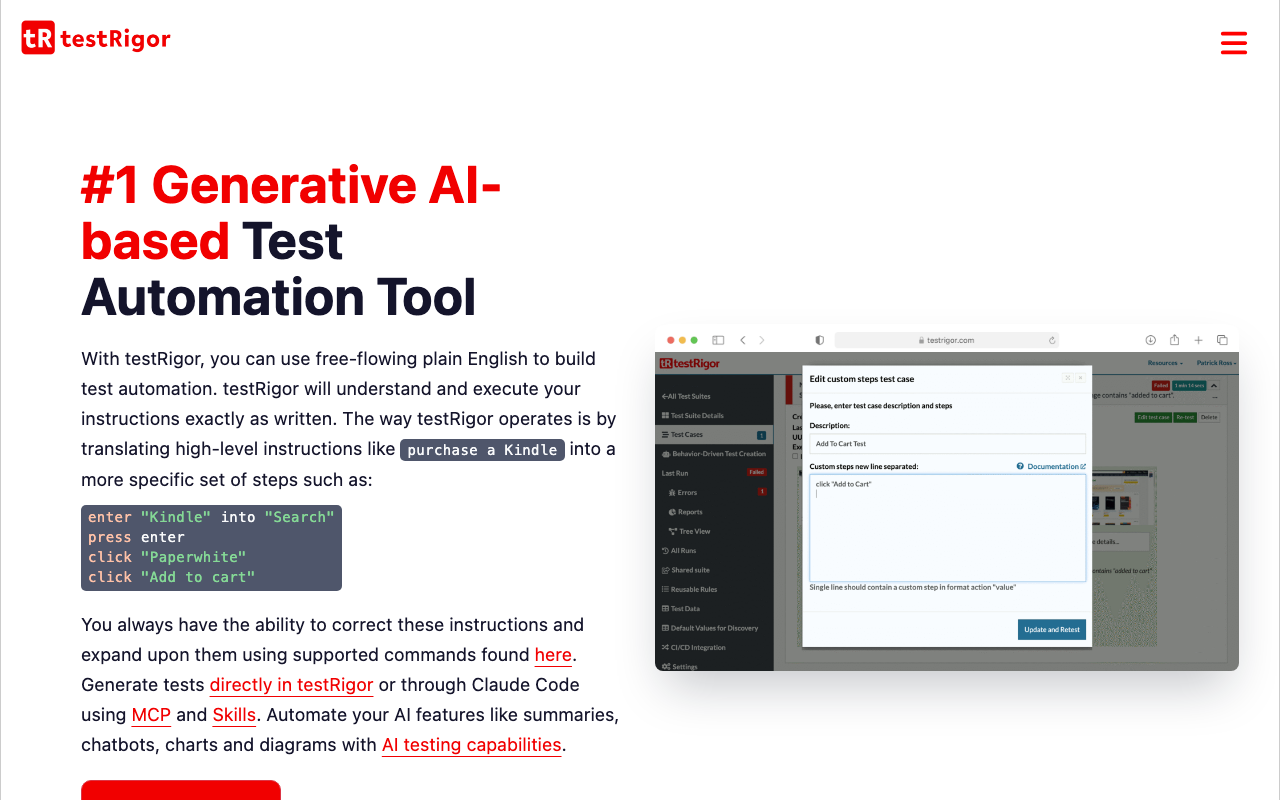
testRigor and Qodex agree on the diagnosis: hand-coded test scripts are expensive to write and worse to maintain. They disagree on the cure. testRigor's answer is a language. You write steps in free-flowing plain English, and its engine interprets and executes them, resolving elements the way a human would describe them rather than through brittle selectors. That makes automation accessible to manual testers and analysts, and it extends across an unusually wide set of surfaces: web, native and hybrid mobile, desktop Windows apps, APIs, even mainframes.
Qodex's answer is an agent. Nobody on your team writes test steps in any language. You describe what to test in chat, and the agent explores your app with a real browser and direct API calls, then writes runnable scenarios with assertions and verifies them against your environment before saving. The output is standard Playwright and HTTP code, the replay path is deterministic with zero LLM spend, and OWASP-style security testing runs from the same agent.
The choice mostly comes down to who maintains your tests and what artifact you want to own. For the wider field of options, see our testRigor alternatives guide.
Qodex vs testRigor at a glance
| Dimension | testRigor | Qodex |
|---|---|---|
| Authoring model | You write test steps yourself in free-flowing plain English, or import manual test cases and refine them. testRigor interprets and executes your instructions; a recorder helps bootstrap. | You describe the goal in chat. The agent explores your app with a real browser and direct API calls, writes complete scenarios with assertions, and verifies them on save. |
| Generated assets | Tests are plain-English specifications that live in testRigor and execute through its engine. Anyone can read them, but they are not standard code you can run elsewhere. | Standard Playwright and HTTP scripts, parameterized via environment variables and git-syncable. Eject the suite and run it outside Qodex at any time. |
| Replay cost | Runs execute on testRigor infrastructure under your plan, with capacity tied to parallelizations. The plain-English steps are re-interpreted by its engine on each run. | LLM tokens are spent once at authoring time. Saved scenarios replay deterministically at zero LLM cost, so regression spend stays flat as the suite grows. |
| Security testing | Focused on functional test automation. OWASP-style security scanning is not among the product capabilities listed on testrigor.com as of June 2026. | OWASP Top 10 and OWASP API Top 10 scenarios run in the same suite as functional tests, with inverted semantics: pass means the attack was blocked. |
| Mobile support | Yes. Native and hybrid mobile apps, plus desktop Windows applications and even mainframe testing. The breadth of surfaces is a genuine strength. | Web applications and APIs only. No native mobile testing today. |
| Pricing model | A free public open-source tier plus paid private plans. Dollar figures are not published on the pricing page as of June 2026; private plans go through sales. | Free tier and published plans, self-serve. Bring your own OpenAI key with every token logged, so AI spend is transparent and capped per scan. |
| Target team | Mixed-skill QA teams where manual testers, analysts, and engineers all contribute to automation without writing code. | Developer-led teams that want tests as reviewable code, API depth, and security coverage from one agent. |
testRigor capability and pricing-model claims checked against testrigor.com, June 2026. Their product evolves; confirm specifics on their site.
When testRigor is the right choice
testRigor's plain-English bet pays off for real teams. It is the better fit when:
- Your testers are not engineers and never will be. Manual testers and business analysts can write and maintain automation in English they already speak. That is the core promise, and it genuinely works for mixed-skill teams.
- You have a pile of manual test cases. testRigor lets you import existing manual cases and refine them into automation, which is a pragmatic migration path for QA organizations with years of documented test plans.
- You need coverage beyond web and API. Native and hybrid mobile, desktop Windows applications, and mainframe flows are all in scope. Qodex does not touch native mobile or desktop today, full stop.
- You want everyone reading the same tests. Plain-English steps double as living documentation that product managers and stakeholders can read without translation.
When Qodex is the right choice
Qodex fits a different team and a different set of constraints:
- You do not want to write tests at all. Plain English still means a human authors and maintains every step. The Qodex agent explores your app, writes the scenarios, verifies them on save, and classifies every failure as a real bug, a stale test, or an environment issue. Your job shrinks to review and promote.
- You want tests as code you own. Generated scenarios are standard Playwright and HTTP scripts: git-syncable, reviewable in pull requests, and runnable outside Qodex forever. Leaving is always possible, which is exactly why staying is comfortable.
- Security belongs in the same suite. One agent covers functional API and UI testing plus OWASP Top 10 and OWASP API Top 10 scenarios, with inverted semantics: a green security run means the attack was blocked, and the agent will not relax an assertion to force a pass.
- You care about the replay cost curve. Qodex spends LLM tokens at authoring time only. Saved scenarios replay deterministically at zero LLM cost, on a schedule, from a webhook, or in CI.
- You want to start self-serve today. A free tier and published plans instead of a sales conversation.
The real difference: what artifact do you end up owning?
Strip away the AI labels and the comparison gets simple. With testRigor, your asset is a library of plain-English specifications that execute inside testRigor. They are wonderfully readable, and they stay valuable as long as you stay a customer. With Qodex, your asset is a directory of standard Playwright and HTTP scripts that happen to be authored and maintained by an agent. They run inside Qodex with scheduling, failure triage, and security scanning attached, but they would keep running without it.
If your team will never read code, testRigor's artifact is more useful to you. If your engineers review everything that gates a deploy, an ejectable code suite with deterministic replay is the safer long-term position.
Qodex vs testRigor: common questions
Straight answers for teams evaluating both tools.
Is Qodex an alternative to testRigor?+−
Who actually writes the tests in each tool?+−
Does testRigor support security testing?+−
Can I export my tests from Qodex like I can read them in testRigor?+−
Which is better for a team of manual testers?+−
How do the costs compare as a suite grows?+−
Skip writing tests in any language, even English
Point the Qodex agent at your app. It writes verified Playwright and HTTP scenarios, runs security checks in the same suite, and replays everything at zero LLM cost.