13 Best API Testing Tools (2026)
API testing tools send requests to an API and check the responses against what you expected. The good ones turn those checks into tests that run again on every change: in a pipeline, as a contract check against the schema, as a load run, or as a security probe. The right tool depends on the job: letting an agent write and maintain the tests, exploring an API by hand, keeping a regression suite honest in CI, proving a contract, or measuring throughput. This page compares thirteen tools and groups them by that job, starting with the agent. Ten of them ran against one fixture API. Each of those entries shows the command that runs the tool unattended, and the three that did not run say why. The full method is in API testing.
How we tested these tools
On 2 September 2026 we ran every tool here that has a command line against one fixture API: a small Node service on port 4010 with five routes, list, create, fetch by id, update, delete. Every route needs a bearer token, and a second token owns nothing, so it is the 403 case.
Every tool ran the same six requests. List the todos and check the status and the shape. Create a todo and capture its id, then fetch that id and check the title. Post a body with no title and expect 400. Send no token and expect 401, and fetch with the second token and expect 403. Then we broke the contract, renaming the title field to name in the fetch-by-id response, and reran everything.
Each tool ran in a container on an isolated Docker network. The machine was an Apple M3 Pro with 11 cores and 18 GB of memory, on macOS 27.0 and Docker 28.5.2, with Node 20 in the containers and Temurin 17 for the Maven runs. The commands in the cards are the plain form you would put in CI. Each one points at that tool's own collection, project or script file for the fixture, which you would swap for your own. For Newman, Bruno, Hoppscotch and SoapUI the exact original command line was not kept, so the command shown is the rerun form rather than a transcript.
Three of the thirteen were not run. Apidog's CLI asked for an account first, and Katalon's Runtime Engine is a paid licence. Qodex is our own product and sat this run out, which its entry says plainly. For those three, and for every price and desktop feature here, we read the vendor's own page on 2 September 2026 and say so at the point of use. Apidog is the one exception: its pricing page returned no readable body that day, so its prices come from the vendor's own comparison pages, read 29 August 2026.
Timings are one machine's stopwatch against a local fixture: how long a tool takes to start and report, not how fast it will be on your API. The fixture's OpenAPI file:
openapi: 3.0.3
info:
  title: Todo fixture
  version: 1.0.0
servers:
  - url: http://localhost:4010
components:
  securitySchemes:
    bearerAuth:
      type: http
      scheme: bearer
  schemas:
    Todo:
      type: object
      required: [id, title, completed]
      properties:
        id: { type: string }
        title: { type: string }
        completed: { type: boolean }
security:
  - bearerAuth: []
paths:
  /todos:
    get:
      responses:
        "200":
          description: list of todos
          content:
            application/json:
              schema:
                type: array
                items: { $ref: "#/components/schemas/Todo" }
        "401": { description: no token }
    post:
      responses:
        "201":
          description: created
          content:
            application/json:
              schema: { $ref: "#/components/schemas/Todo" }
        "400": { description: title missing or not a string }
        "401": { description: no token }
  /todos/{id}:
    parameters:
      - name: id
        in: path
        required: true
        schema: { type: string }
    get:
      responses:
        "200":
          description: one todo
          content:
            application/json:
              schema: { $ref: "#/components/schemas/Todo" }
        "401": { description: no token }
        "403": { description: token does not own this todo }
    patch:
      responses:
        "200": { description: updated }
    delete:
      responses:
        "204": { description: deleted }
The thirteen tools at a glance
| Tool | Job | Licence | Free limit | Paid from | CI command | Our run |
|---|---|---|---|---|---|---|
| Qodex | AI agent | Proprietary | $0, 25 scenarios, 100 runs/mo | $1,299/project/mo | Runs on the pull request | Not run here |
| Postman | Explore | Proprietary | $0, 50 AI credits/mo | Solo $9/mo | newman run | Green 0.145s, break caught |
| Insomnia | Explore | Apache 2.0 desktop | $0, Git Sync 3 users, Inso CLI | Pro $12/user/mo | inso run test | Green 2.74s, break caught |
| Bruno | Explore | MIT core | $0, 2 workspaces | Pro $6/user/mo | bru run | Green, break caught |
| Hoppscotch | Explore | MIT | $0, unlimited runners | Org $6/user/mo | hopp test | Green 0.255s, break caught |
| Apidog | Explore | Proprietary | Free for 4 users | Basic $9/user/mo | apidog run | Not run, needed an account |
| REST Assured | Automation | Open source | $0, no quota | Free | mvn test | Green 1.309s, break caught |
| Karate | Automation | MIT core | $0, full framework | Pro $64/user/mo | mvn test | Green 4.74s, named the key |
| Playwright | Automation | Apache 2.0 | $0, no quota | Free | npx playwright test | Green 3.49s, break caught |
| k6 | Load | Open source core | Cloud free, 500 VU hours/mo | $0.15/VU hour | k6 run | Green 0.66s, break exit 99 |
| Apache JMeter | Load | Apache open source | $0, no quota | Free | jmeter -n -t plan.jmx | Green 4.18s, break exited 0 |
| SoapUI and ReadyAPI | Enterprise | SoapUI open source | SoapUI $0, no quota | ReadyAPI not published | testrunner.sh | Green 3.136s, break caught |
| Katalon | Enterprise | Proprietary | Trial only | $84/seat/mo annual | Runtime Engine, paid | Not run, licence is paid |
The job column is the only ranking here, because a load generator and a request client are not competing for the same seat. Every price is the vendor's own claim, read on 2 September 2026, and every free limit is the number the vendor published. "Our run" means the six requests plus the contract break. Three rows say "not run", and each says why in its own entry.
Read the table by the job you actually have. For manual exploration, Postman, Insomnia, Bruno, Hoppscotch and Apidog are the products built for it. For contract checks, Karate, Apidog and ReadyAPI treat schema assertions as a first-class job, while Insomnia, Bruno, Hoppscotch and k6 leave you to script the shape check yourself. For load, k6, JMeter, Karate and ReadyAPI are the four with a dedicated performance mode. For generating tests rather than rerunning them, Katalon and Qodex put it at the centre of the product, and Postman, Karate, Apidog and Bruno publish narrower AI authoring beside their main job. Those groupings are our reading of the vendor pages cited in each entry, not a benchmark.
API testing strategies and the tool each needs
Five jobs hide behind the phrase "API testing". Few teams need a separate tool for all five.
Manual exploration. A new endpoint, and you want to see what it returns. This needs saved requests, environment variables and a readable response pane. Any of the five clients below will do.
Functional regression. The same checks on every pull request, with nobody clicking anything. This needs a headless runner, a machine-readable report and a non-zero exit code on failure. API automation testing covers what changes when tests stop being manual.
Contract checks. You want to know when a response stops matching its schema, before a consumer finds out. This needs assertions on shape, not on values. Our contract break separated the tools that report a missing key from the ones that only report a wrong value. Contract testing covers the method.
Load. What happens when many users hit the API at once, whether that is ten or ten thousand. This needs virtual users, thresholds and percentiles. k6 and JMeter are the dedicated load tools here, and Karate and ReadyAPI also publish a performance mode.
Security. The hostile requests should fail. Our 401 and 403 cases are the floor. Real coverage means authorization on every route, injection and fuzzed input, and belongs in dedicated API security tools and API fuzz testing, not stretched out of a functional client.
One tool rarely leads all five. The common shape is a client for exploring, a framework or an agent for regression and contracts, and a load tool that runs before a release rather than on every commit. Protocol matters too: a GraphQL endpoint usually answers 200 with an errors array in the body, so the assertions move, which GraphQL API testing covers. The rest sits in the API testing guide.
The AI API testing agent
1. Qodex
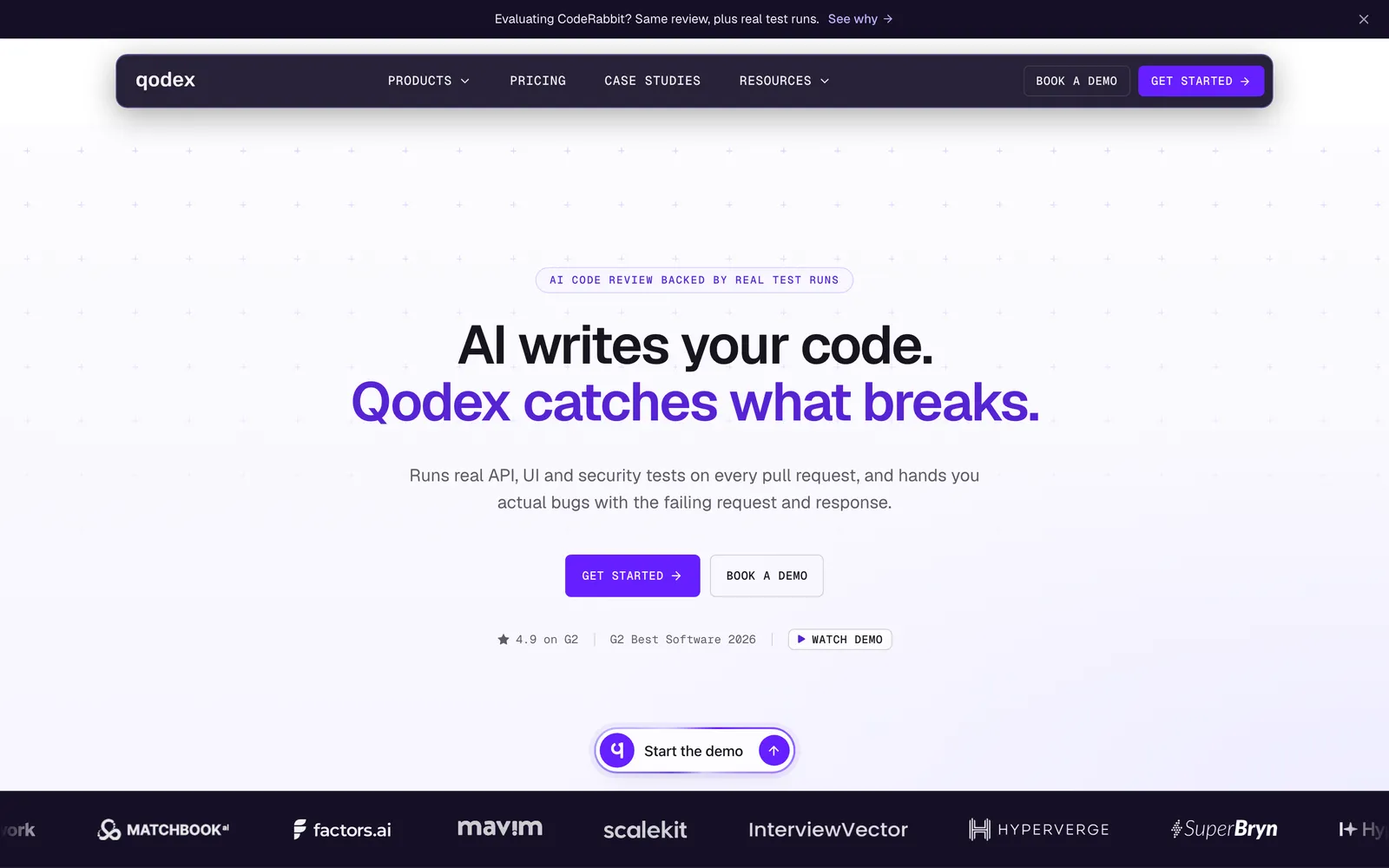
Disclosure, and a gap. Qodex is our product, and the one entry we could not put on the same footing as the other twelve, because it was not part of the 2 September run. So there is no exit code, no timing and no contract-break result for Qodex here, and we are not going to invent one.
What the product does, from our own product page, read 2 September 2026. It imports an OpenAPI spec, a Postman collection, a spreadsheet or a sentence describing a flow, and generates runnable scenarios, including the auth and role boundaries our 401 and 403 requests cover. It runs them against the pull request's own preview, on a schedule, from CI, or from a webhook. Each failure comes back with the request, the response and a screenshot. It is classified as a real bug, as a stale test with the repair proposed as a diff you approve, or as an environment problem, which is flagged and not counted. A replay is Playwright and HTTP with no model call, so the hundredth run costs what the first did.
Plans. Individual is $0 with one repository, 25 scenarios and 100 runs a month. Startup starts at $1,299 per project a month with 200 scenarios and 10,000 runs. Scale starts at $2,500 per project a month, unlimited.
The honest comparison. Most tools here rerun what a person wrote, and several now bolt some AI authoring onto that. The claim an agent makes is that it writes the tests and repairs them when the API moves. Nothing on this page proves that. The next update will put the same six requests and the same contract break through Qodex and publish the output, including the scenarios we rejected. See how Qodex API testing works.
Best tools for exploring an API by hand
2. Postman
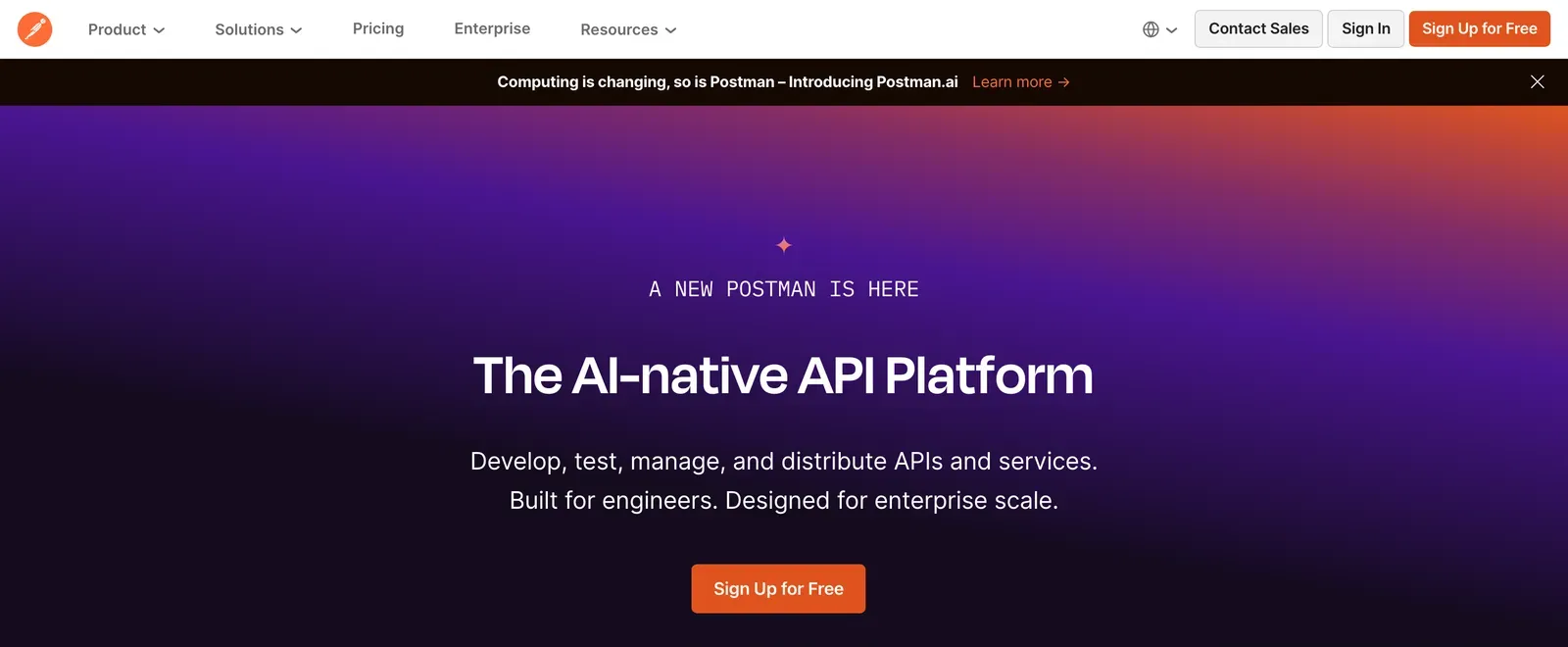
Postman is a request client built around shared collections, and it is the one most teams have already met. You build requests by hand, group them into collections, and run the collection headless through Newman or the Postman CLI.
Plans. Free is $0 with 50 AI credits a month and no published cap on users, collections or runs. Solo is $9 a month, Team $19 and Enterprise $49 per user a month, billed annually. Vendor claims, read 2 September 2026.
The command and our run. newman run collection.json --env-var baseUrl=http://localhost:4010 -r junit --reporter-junit-export newman.xml. All six passed and the JUnit file was written in 0.145 seconds, with the first request and the first assertion both at 0.093 seconds. That is the shortest time to green we recorded.
The contract break. Two failures, one for the missing value and one for the schema check: expected undefined to deeply equal "created by newman".
The limit. Automation still rests on collections and scripts somebody wrote, team pricing is per seat, and no open-source licence for the platform is published.
Pick it if your team already shares Postman collections. If you are leaving, Postman alternatives covers what an import carries over.
3. Insomnia
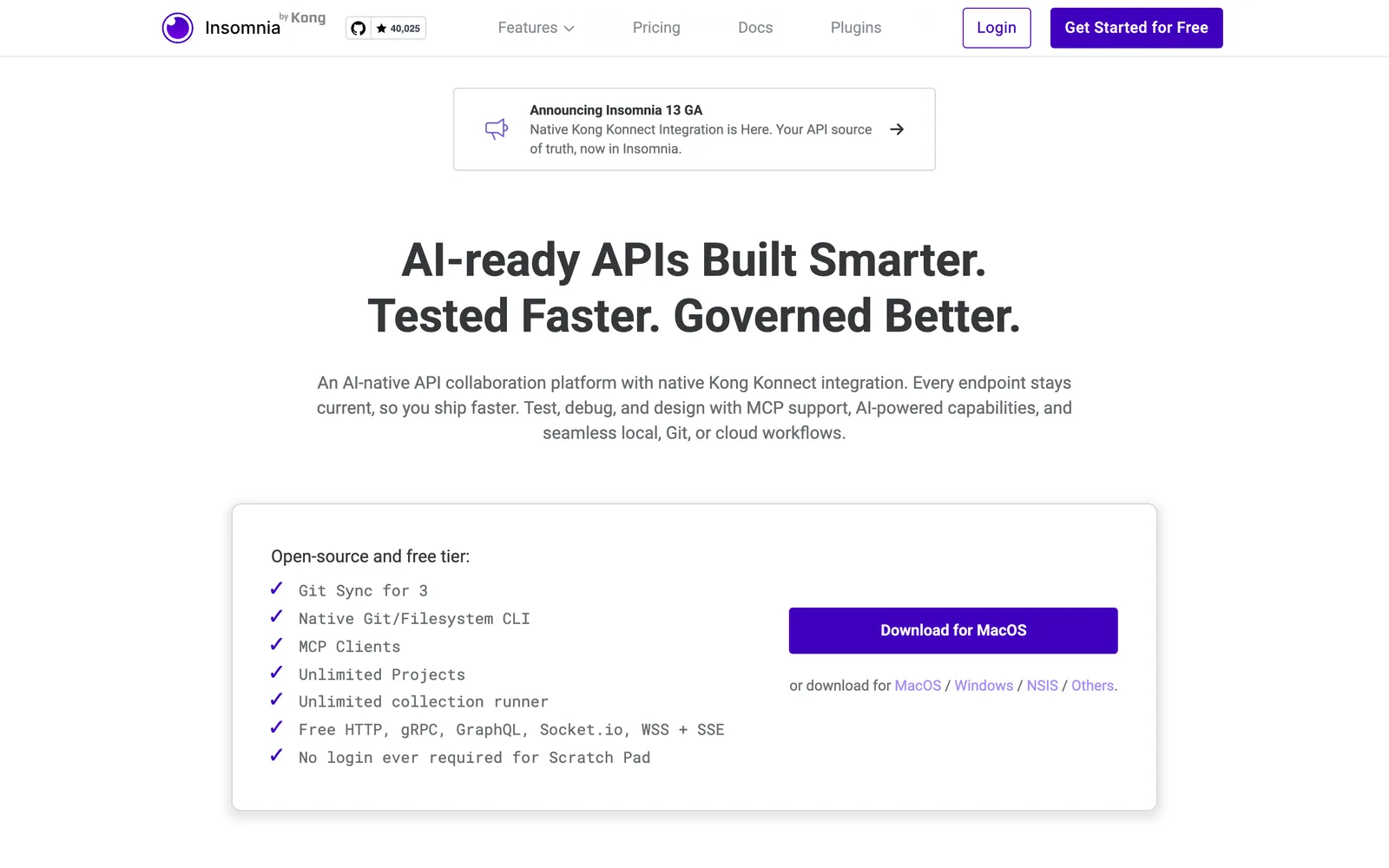
Insomnia is a focused client for REST, GraphQL and gRPC work, with local, Git or cloud storage per project. Its command line tool, Inso, is on the free plan.
Plans. Essentials is $0 and claims unlimited local and cloud projects, Git Sync for three users, unlimited collection runs, Inso CLI and 1,000 mock requests a month. Pro is $12 and Enterprise $45 per user a month. Vendor claims, read 2 September 2026.
The command and our run. inso --ci --workingDir . run test "Fixture API six-request suite" --env "Base Environment" --reporter tap, on Inso 13.1.0. Green, exit 0, TAP output, 2.74 seconds. Inso emitted no per-request timings, so there is no first-request number.
The contract break. One failure and exit 1: expected undefined to equal "Seed todo one".
The limit. A smaller sharing ecosystem than Postman's, and self-hosting the full platform is not published.
Pick it if you want a lean client and a free CI runner without a seat charge. Insomnia alternatives covers the move the other way.
4. Bruno
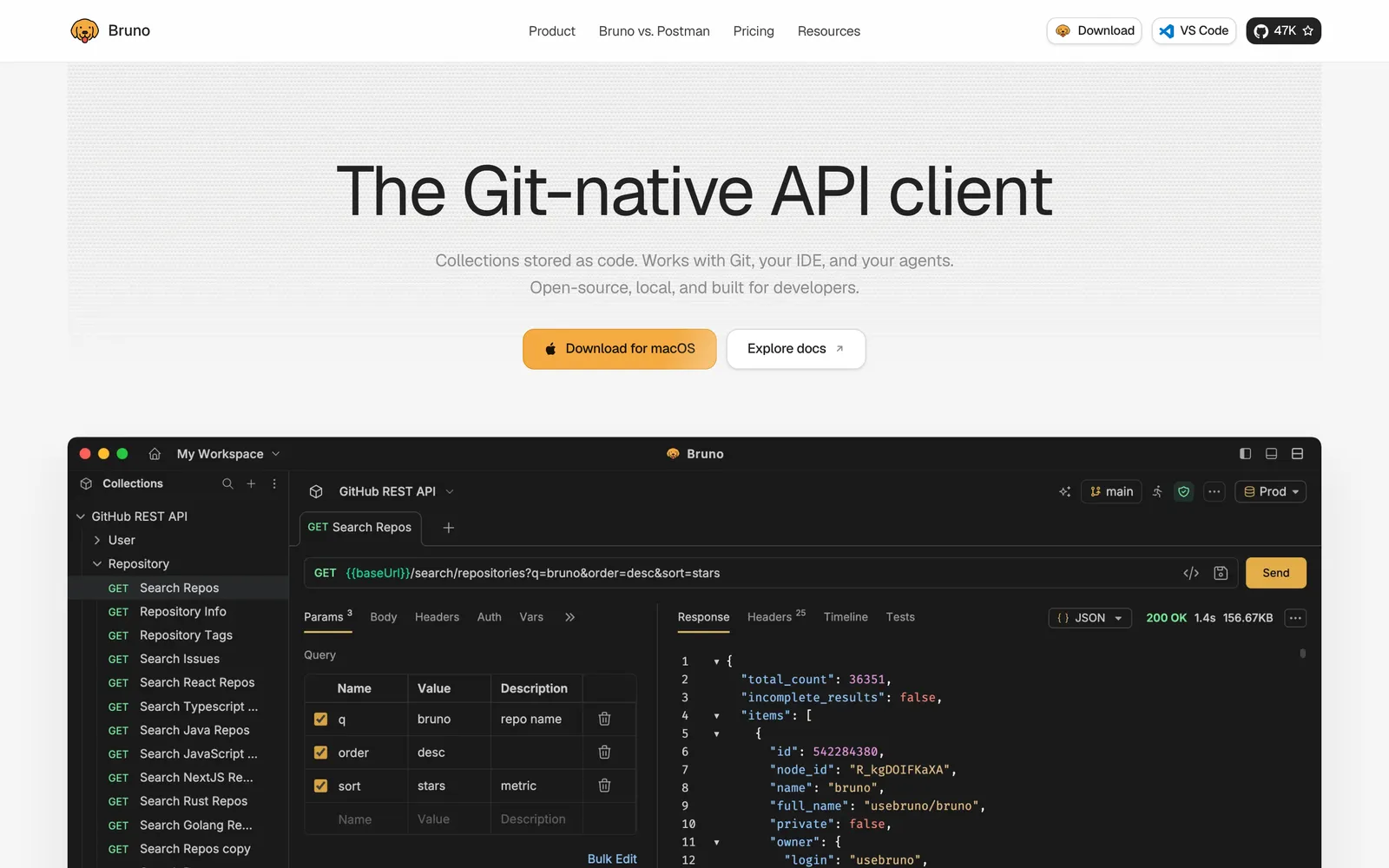
Bruno stores collections as plain text files in your repository instead of a vendor's cloud. That one decision is the whole pitch: a request change shows up in a pull request diff like any other.
Plans. Open Source is $0 with two workspaces and an unlimited runner. Pro is $6 and Ultimate $11 per user a month, billed annually, with a 14-day trial. Reports and data-driven runs are paid. Vendor claims, read 2 September 2026.
The command and our run. bru run fixture --env Local --format junit --output bruno.xml. Green, JUnit XML, first request at 0.081 seconds. The runner printed no suite total, so there is no time-to-green figure.
The contract break. One failure: expected undefined to equal 'created by Bruno'.
The limit. Cloud-style collaboration is deliberately absent, and the free tier stops at two workspaces.
Pick it if you want the collection reviewed in the same pull request as the code that changed it.
5. Hoppscotch
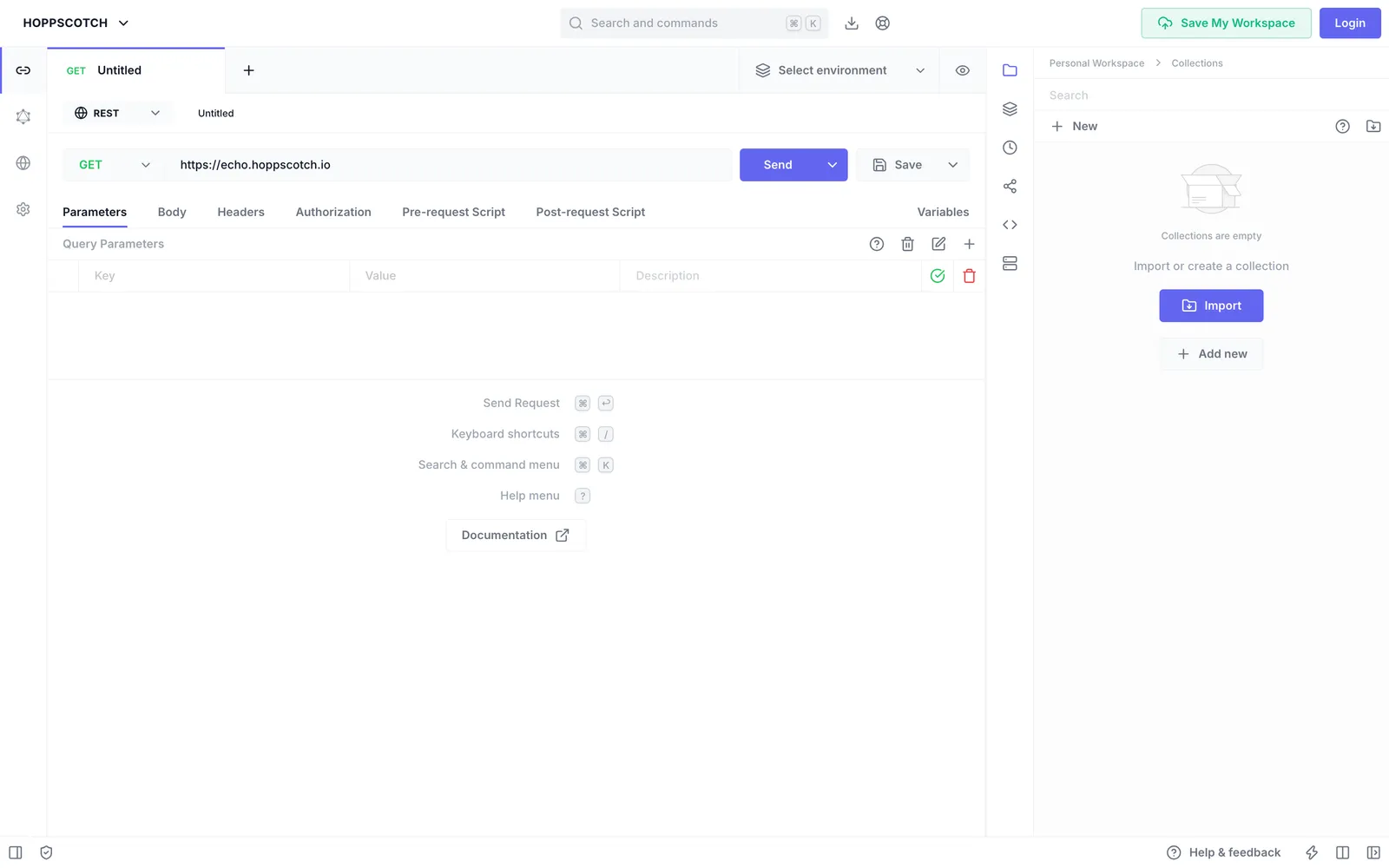
Hoppscotch runs in the browser with nothing to install, and is MIT licensed if you would rather self-host it. Its command line tool emits JUnit, so it drops into CI without a wrapper.
Plans. Free is $0 forever and claims unlimited workspaces, collections, requests and runners. Organization is $6 per user a month billed annually. Vendor claims, read 2 September 2026.
The command and our run. hopp test collection.json --env local.environment.json --reporter junit --output hoppscotch.xml. Twenty assertions across the six requests, zero failures, 0.255 seconds, first request at 0.082 seconds.
The contract break. One failure out of the twenty assertions.
The limit. Native gRPC and Git-native collection files are not published on the pages we read.
Pick it if you want a client a new teammate can open in a browser tab, or a self-hosted client with no licence cost.
6. Apidog
Apidog puts API design, documentation, a request client, mocks, automated tests and broad protocol support in one application.
Plans. Free supports up to four users with unlimited APIs, requests, projects and test runs. Basic is $9, Professional $18 and Enterprise $27 per user a month annually. Those figures come from Apidog's own comparison pages, read 29 August 2026, because the pricing page returned no readable body on 2 September 2026 or when we rechecked it.
Not run. The Apidog CLI asked for an account before it would create or run a project, so it never reached our fixture. There is no run result and no contract-break result here.
The limit. A price you cannot verify on the vendor's own pricing page is a procurement problem, and self-hosting is not published.
Pick it if you want one application for the whole API lifecycle and an account is not a blocker.
Best tools for automation and contract checks
7. REST Assured
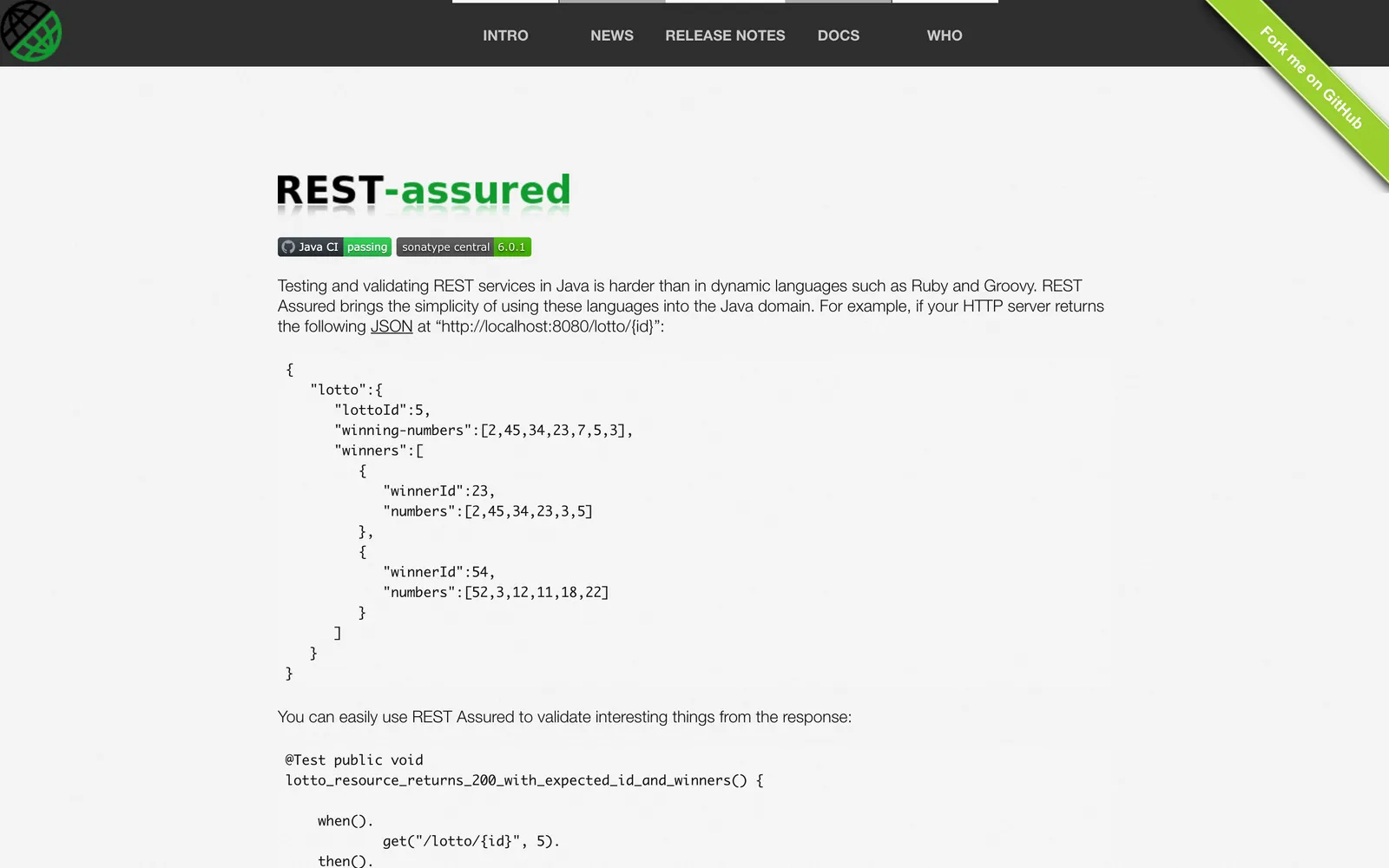
REST Assured is a Java library, not an application. You write tests as JUnit or TestNG methods in a readable given, when, then style, and they run in whatever Maven or Gradle job you already have.
Plans. Version 6.0.1, released 10 July 2026. Free, open source, no vendor quota. Version 6 needs Java 17 or later.
The command and our run. mvn -Dtest=TodoApiTest test. Green, exit 0, Surefire JUnit XML. The first run took 20.43 seconds because the Maven cache was empty; the test itself ran in 1.309 seconds.
The contract break. Exit 1, with TodoApiTest.sixRequestSet:29 JSON path title doesn't match. Expected: created by REST Assured Actual: null. It tells you the value is wrong, not that the field was renamed. That is the difference between a failing test and a contract report.
The limit. Java only, code only. Not an exploratory client, and no load mode.
Pick it if your service is on the JVM and you want API tests beside the unit tests, in the same build.
8. Karate
Karate covers API assertions, mocks, contract checks and performance in one syntax that needs no Java code, though it runs on the JVM. We ran the 1.5.2 Maven artifact; the current documentation is Karate v2.
Plans. Free is $0 forever and includes the MIT-licensed framework, API and UI automation, performance testing and CI integration. Pro is $64 per user a month or $640 a year and adds the IDE plugins. Async protocols at runtime in CI need the custom-priced Enterprise edition. Vendor claims, read 2 September 2026.
The command and our run. mvn -DbaseUrl=http://localhost:4010 test. Green in 4.74 seconds, first request at about 4.2 seconds, reporting to JUnit XML and HTML.
The contract break. Karate named the schema rather than the value: match failed: actual does not contain key - 'title', printed beside the object that had name in it. If you care about contract drift, that is the reason to look at it.
The limit. A domain-specific language to learn, and a JVM in your pipeline.
Pick it if you want contract checks, mocks and a load run in one file a non-Java tester can read.
9. Playwright
Playwright is a browser automation framework with a request fixture that sends HTTP directly. The point is not that it is the best API tool, but that your API tests and your browser tests share a runner, a reporter and an authenticated session.
Plans. Version 1.62. Free, Apache 2.0, no vendor quota. The official CI guide ships a GitHub Actions workflow you can paste.
The command and our run. npx playwright test. Green in 3.49 seconds of wall clock, with the test itself at 40 milliseconds, reporting JUnit XML.
The contract break. Exit 1, with Expected: "created by Playwright" Received: undefined.
The limit. API testing is secondary in a browser-first framework, and there is no built-in OpenAPI contract manager. You assert on shape yourself.
Pick it if you already run Playwright for the interface. Reusing the storage state so an API test runs as a logged-in user is the real win. Continuous API testing in DevOps pipelines covers the wiring.
Best tools for load and performance
10. k6
k6 runs load tests written in JavaScript from the command line, with thresholds that decide pass or fail instead of a graph you interpret. The core is open source; Grafana Cloud k6 is the paid service on top.
Plans. Version 2.2.0, core free. Grafana Cloud Free is always $0, limited to 500 virtual user hours a month. Self-serve starts at $0.15 per virtual user hour with a $19 a month platform fee that includes 500 hours. Enterprise has a $25,000 a year minimum. Vendor claims, read 2 September 2026.
The command and our run. k6 run --summary-export summary.json functional.js for the six functional requests: green, exit 0, first iteration at 7.56 milliseconds, 0.66 seconds total. Then the load subset: a one-user warm-up for five seconds, then 10 virtual users for 30 seconds, with thresholds of under 1 percent failed requests and a p95 under 500 milliseconds. Both held, at 0.00 percent failed and a p95 of 212 microseconds. That is a local fixture on a laptop: proof the thresholds work, not a performance number.
The contract break. Exit 99. The get preserves title check failed and the checks threshold dropped to 87.50 percent, the threshold doing its job.
The limit. k6 proves behaviour under load, not coverage or a contract, and large distributed runs move onto paid cloud usage.
11. Apache JMeter
JMeter is a mature multi-protocol load tool. You build the plan in a desktop GUI and run it headless.
Plans. Version 5.6.3, Java 8 or later. Free, Apache licensed, no vendor quota.
The command and our run. jmeter -n -t plan.jmx -l results.jtl -e -o report/. Green in 4.18 seconds, reporting summary = 6 in 00:00:01 = 11.9/s Avg: 4 Min: 1 Max: 19 Err: 0 (0.00%), plus a JTL file and an HTML report.
The contract break. The most useful failure of the run. The fetch sample's assertion failed, the summary showed Err: 1 (16.67%), and the process still exited 0. Gate the build on the JTL contents, because the exit code will not fail for you.
The limit. JMX plans are XML and painful to review in a diff. Apache's manual is blunt about the other trap: GUI mode is for creating the test script, and CLI mode must be used for load testing.
Neither replaces functional testing. They tell you how an API behaves under pressure, after something else has said it behaves correctly at all. The API load testing guide covers both.
Best tools for SOAP and enterprise QA
12. SoapUI and ReadyAPI
SoapUI Open Source is the free desktop tool for SOAP, WSDL and REST functional tests, assertions and mocks. ReadyAPI is SmartBear's commercial edition of the same lineage.
Plans. SoapUI Open Source 5.10.0 is a $0 download with no vendor quota. ReadyAPI has no list price: the pricing page offers a trial, points to sales, and does not state the trial length. SmartBear's own comparison reserves data generation, dynamic data sources, assertion groups, security testing, performance testing, service virtualization and CI/CD integrations for ReadyAPI. Vendor claims, read 2 September 2026.
The command and our run. testrunner.sh -r -j -f output/soapui-green fixture-soapui-project.xml. Green in 3.136 seconds, reporting JUnit XML.
The contract break. Exit 1, and the Groovy assertion printed the object it received, with name where title used to be, which makes the diagnosis obvious even though the assertion was on a value.
The limit. The free edition is capable for functional SOAP work, and most of what an enterprise team asks for next sits behind ReadyAPI at an unpublished price.
Pick it if you have SOAP or WSDL services, or already own ReadyAPI licences.
13. Katalon
Katalon is a low-code platform covering API, web, mobile and desktop testing in one managed product.
Not run. Executing tests outside the IDE needs the Runtime Engine, a paid licence, so there was no free path to our fixture. This entry is read from Katalon's pricing page on 2 September 2026.
Plans. Katalon Studio is $180 per seat a month billed monthly, or $84 per seat a month for the first three seats billed annually. True Automation, the team platform, is $200 per seat a month, or $167 annually. The local Runtime Engine is a separate $182 per licence a month, or $1,749 a year. Enterprise is custom. There is a 30-day trial and no permanent free plan. Vendor claims.
The limit. For a team that only tests APIs, the floor is high and the execution licence is a second line on the invoice.
Pick it if you want one vendor across API, web, mobile and desktop, and the budget is approved.
One runnable REST Assured test
Here is a complete test. It uses a public API by default and switches to your own with an environment variable, the same pattern the fixture run used.
Add the dependency to your Maven project, next to the JUnit 5 dependency the test imports (org.junit.jupiter:junit-jupiter, test scope). REST Assured 6 needs Java 17 or later.
<dependency>
  <groupId>io.rest-assured</groupId>
  <artifactId>rest-assured</artifactId>
  <version>6.0.1</version>
  <scope>test</scope>
</dependency>
Then the test. It asserts the status code, one field's exact value, and one field's type. The type assertion is the one people skip, and the one that catches a backend that starts returning "false" as a string.
import static io.restassured.RestAssured.given;
import static org.hamcrest.Matchers.equalTo;
import static org.hamcrest.Matchers.instanceOf;

import org.junit.jupiter.api.Test;

class TodoApiTest {
  @Test
  void getsOneTodo() {
    String baseUrl = System.getenv().getOrDefault(
        "BASE_URL",
        "https://jsonplaceholder.typicode.com"
    );

    given()
        .baseUri(baseUrl)
    .when()
        .get("/todos/1")
    .then()
        .statusCode(200)
        .body("id", equalTo(1))
        .body("completed", instanceOf(Boolean.class));
  }
}
Run it with mvn -Dtest=TodoApiTest test. A pass prints Tests run: 1, Failures: 0, Errors: 0, Skipped: 0 and then BUILD SUCCESS. Point BASE_URL at your own service and you will also need to change the path and the three assertions to match a route that service has. REST Assured API test automation takes it from here through auth, request specs and data-driven runs.
Free and open-source API testing tools
Two things get called free, and the difference matters at scale. The first list is open source with no vendor quota: download it, run it as often as you like. The second is a proprietary product with a free plan, where the published cap is what to read before you commit.
Open source, no vendor run quota.
SoapUI Open Source, SOAP and REST functional testing.
REST Assured, open source, a Java library.
Karate core, MIT, API, UI and performance on the free tier.
Playwright, Apache 2.0, API and browser tests in one runner.
Apache JMeter, Apache licensed, load and functional.
k6 core, load from the command line.
Bruno core, MIT, capped at two workspaces.
Hoppscotch, MIT, self-hostable at no licence cost.
Insomnia desktop, Apache 2.0 source, hosted plans sold separately.
Proprietary, with a published free plan.
Postman Free, $0, 50 AI credits a month, other caps not published.
Apidog Free, up to four users, unlimited requests and test runs.
Qodex Individual, $0, one repository, 25 scenarios, 100 runs a month.
Grafana Cloud k6 Free, $0, 500 virtual user hours a month.
Katalon has no free plan, only a trial, so it belongs on neither list. If you want the agent version of this, with scenarios generated from your spec and rerun on every pull request, Qodex API testing is where to start.
Frequently Asked Questions
What are API testing tools?
They send requests to an API and check the responses against what you expected. The good ones save those checks as tests that rerun on every change, with a machine-readable report. They span request clients you drive by hand, code libraries, load generators and agents that write the tests for you.
What is the best API tool for testing?
There is no single best one, because these tools do different jobs. For exploring by hand, pick any of Postman, Insomnia, Bruno, Hoppscotch or Apidog. For regression in CI, pick REST Assured, Karate or Playwright to match your stack. For load, pick k6 or JMeter.
How can I test an API?
Send a request, then assert on what comes back: the status code, the fields and their types, the auth behaviour, and the change the call was meant to make. Start with one endpoint and three checks, like the REST Assured test above. Once you have run a check by hand twice, move it into a suite.
What is API in QA testing?
An API is the interface one piece of software uses to talk to another, usually over HTTP with JSON. In QA it is the layer below the user interface, where the logic and the data live. Testing it directly checks that layer on its own, without the browser, the page and the network in between.
Which API testing tools are best for automation and CI/CD?
Anything with a command line, a machine-readable report and a non-zero exit code on failure. In our run that was Newman, Inso, Bruno, Hoppscotch, REST Assured, Karate, Playwright, k6 and SoapUI. Check the exit code yourself: JMeter failed an assertion during the contract break and still exited 0.
What are the best free and open-source API testing tools?
SoapUI Open Source, REST Assured, Karate, Playwright, JMeter, k6, Bruno and Hoppscotch are all open source with no vendor run quota, and Insomnia's desktop source is Apache 2.0. Free plans on proprietary tools are a different thing: Postman Free publishes 50 AI credits a month, and Apidog Free stops at four users.
Is Postman the best API testing tool, and what are its alternatives?
Postman is the familiar shared-collection client and it produced the shortest time to green we recorded, but it covers one job out of five. The alternatives worth a look are Insomnia for a leaner client, Bruno for plain-text collections in Git, and Hoppscotch for a browser-based option.
Which tools are for API load and performance testing?
k6 and JMeter. k6 writes load scripts in JavaScript with thresholds that decide pass or fail; JMeter builds plans in a desktop GUI and runs them headless across many protocols. Pick k6 if you want the load run gated in CI by a threshold that fails the build, and JMeter if you want the HTML report. Neither replaces functional testing. Run them before a release, not on every commit.