Comparison
Qodex vs Testsigma: Breadth vs Depth in AI Testing
The short answer: Testsigma is the broad scriptless platform, one tool across web, mobile, API, and enterprise apps with a 3,000+ browser and device cloud. Qodex goes deep instead: an agent that writes ejectable Playwright and HTTP tests, runs security scans in the same suite, and replays at zero LLM cost.
One goes wide, one goes deep
Testsigma's pitch is unification. Web, native mobile on real devices, APIs, desktop Windows apps, SAP, and Salesforce, all tested from one scriptless platform where your team writes steps in plain English or records flows, with its Atto agents and Copilot assisting. Execution runs across a cloud of 3,000+ browsers and devices, with self-healing to keep tests stable. For a QA organization that has to cover five kinds of application without five tools, that breadth is the product.
Qodex narrows the aperture and pushes further down. It covers web apps and APIs only, but with an autonomous agent rather than an assisted editor: you brief it in chat, it explores your API and UI with real calls and a real browser, writes runnable Playwright and HTTP scenarios, and verifies them before saving. OWASP Top 10 and OWASP API Top 10 security scans run in the same suite, and saved scenarios replay deterministically with zero LLM spend.
Which trade wins depends on your surface area and who owns quality. For the wider field, see our Testsigma alternatives guide.
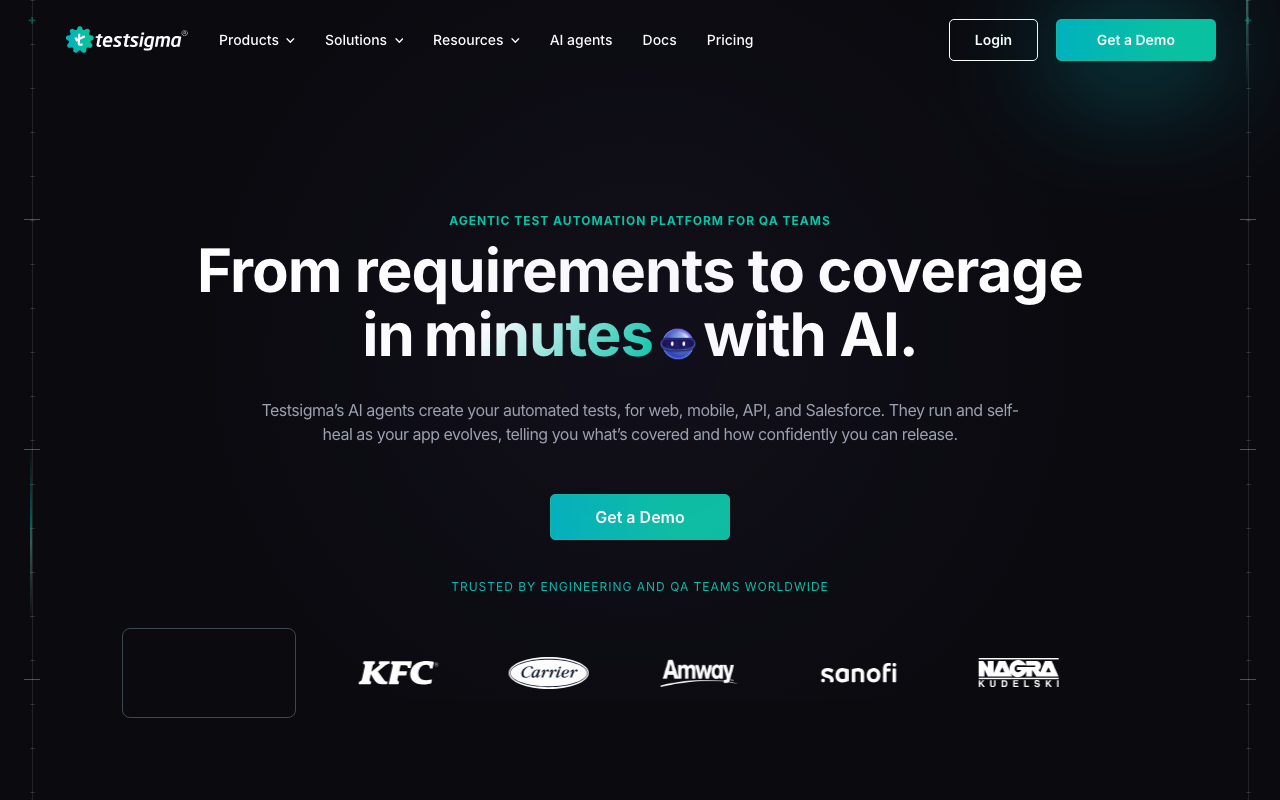
Qodex vs Testsigma at a glance
| Dimension | Testsigma | Qodex |
|---|---|---|
| Authoring model | Scriptless NLP authoring: your team writes test steps in plain English or records flows with the Testsigma Recorder, assisted by its Atto agents and Copilot. | Chat-first and autonomous. You describe the goal; the agent explores your app with a real browser and direct API calls, writes scenarios with assertions, and verifies them on save. |
| Generated assets | Tests live inside the Testsigma platform as natural-language steps and execute on its cloud or your local setup. The platform is the system of record. | Standard Playwright and HTTP scripts, parameterized via environment variables and git-syncable. Eject the suite and run it outside Qodex at any time. |
| Replay cost | Runs execute against plan capacity, priced per parallel. Self-healing keeps tests stable through UI churn at run time. | LLM tokens are spent once at authoring time. Saved scenarios replay deterministically at zero LLM cost, so regression spend stays flat as the suite and run frequency grow. |
| Security testing | Covers functional, cross-browser, visual, and accessibility testing (WCAG 2.2). OWASP-style security scanning is not among the capabilities listed on testsigma.com as of June 2026. | OWASP Top 10 and OWASP API Top 10 scenarios run in the same suite as functional tests, with inverted semantics: pass means the attack was blocked. |
| Mobile support | Yes, and it is a real advantage: Android and iOS on real devices and simulators, plus desktop Windows, SAP, and Salesforce, executed across a 3,000+ browser and device cloud. | Web applications and APIs only. No native mobile testing today. |
| Pricing model | Quote-based. Pro and Enterprise tiers both list "Request Pricing" on testsigma.com as of June 2026, with a free trial to start. | Free tier and published plans, self-serve. Bring your own OpenAI key with every token logged, so AI spend is transparent and capped per scan. |
| Target team | QA organizations that want one scriptless platform across web, mobile, API, desktop, and enterprise apps, with a managed device cloud. | Developer-led teams that want deep API and security coverage, tests as reviewable code, and predictable replay economics. |
Testsigma capability and pricing-model claims checked against testsigma.com, June 2026. Their platform evolves quickly; confirm specifics on their site.
When Testsigma is the right choice
Testsigma's breadth is not marketing fluff; it solves real problems. Pick it when:
- You test more than web and API. Native Android and iOS on real devices, desktop Windows apps, SAP, and Salesforce in one platform. Qodex covers none of those surfaces, so if they are in scope, this comparison is already decided.
- You need a managed device and browser cloud. Running tests across 3,000+ browser and device combinations without maintaining your own grid is genuinely valuable for compatibility-sensitive products.
- Your QA team prefers scriptless authoring. Plain-English steps plus a recorder let manual testers automate without code, and 30+ integrations slot into existing CI/CD and bug-tracking workflows.
- Accessibility compliance is on your checklist. Built-in WCAG 2.2 accessibility testing ships today. Qodex has accessibility coverage on its roadmap, not in the product.
When Qodex is the right choice
Qodex wins when depth on the API and security side matters more than surface count:
- Your product is an API or a web app, and it has to be secure. One agent authors functional tests and OWASP Top 10 plus OWASP API Top 10 security scenarios, including IDOR and role-escalation checks using multiple auth profiles per environment. Pass means the attack was blocked.
- You want code, not platform entries. Every generated test is a standard Playwright or HTTP script your engineers can review, diff, git-sync, and run anywhere. No proprietary runtime, no export problem.
- You want authoring to be autonomous. The agent explores your app, learns auth, writes scenarios, verifies them on save, and classifies failures as real bugs, stale tests, or environment issues. Nobody on your team builds steps, in English or otherwise.
- You want flat replay economics. LLM tokens are spent once at authoring. Scheduled, webhook, and CI replays are deterministic scripts at zero LLM cost, so running the full suite on every deploy is economically boring.
- You want published pricing and a self-serve start. A free tier and visible plans instead of a request-pricing form.
The honest bottom line
This one is decided by your surface area. If your test matrix spans native mobile, desktop, and enterprise apps, Testsigma's breadth and device cloud make it the rational pick, and no amount of agentic cleverness on the web-and-API side changes that. If your product lives in the browser and behind an API, Qodex gives you something Testsigma does not have: an autonomous agent producing ejectable code, security testing in the same suite, and a replay path that costs nothing in AI spend no matter how often you run it. Teams with both profiles sometimes run both: Testsigma for the device matrix, Qodex for API depth and security.
Qodex vs Testsigma: common questions
Straight answers for teams evaluating both platforms.
Is Qodex an alternative to Testsigma?+−
Does Testsigma cover mobile apps better than Qodex?+−
How do the authoring models differ?+−
Does Testsigma include security testing?+−
How does pricing compare?+−
Can I take my tests with me if I leave Qodex?+−
Depth where it counts: API, security, and code you own
Point the Qodex agent at your app. It writes verified Playwright and HTTP scenarios, runs OWASP-style security checks in the same suite, and replays everything at zero LLM cost.