Keploy Alternatives in 2026: 7 Tools for API Testing
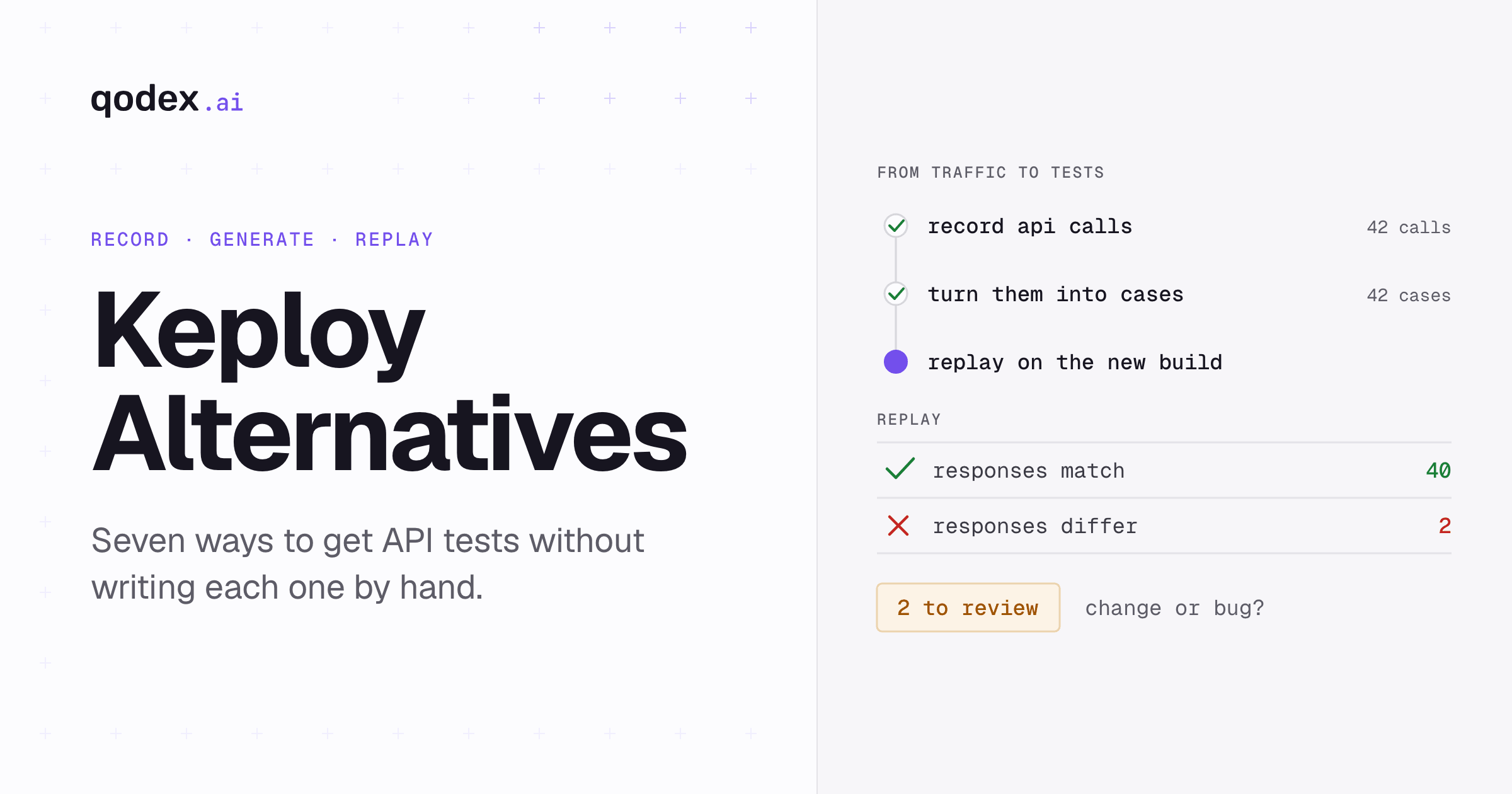
Keploy is an open-source API testing tool that records real API traffic and turns it into replayable test cases and mocks, with no code changes and no per-language SDK. On Linux it captures with eBPF, and its installation docs (read 4 October 2026) say it now runs natively on Apple Silicon Macs and x86-64 Windows too. It can also generate tests with AI from a spec, a collection, cURL or an endpoint. If you adopted it and are now looking for something else, the walls teams report are replays that go flaky on non-deterministic data, coverage that follows the traffic you recorded, and a scope centred on APIs. This guide is an honest roundup of seven alternatives, grouped by the approach they take, with pricing read on each vendor's site on 4 October 2026. You can also see how Qodex compares against every major QA and API tool in one place.
One thing up front, because it sets up everything below: none of the seven tools here copies Keploy's model. Keploy's trick is turning captured production traffic into tests automatically. So "Keploy alternative" here does not mean an identical tool. It means a different way to get to the same goal, a reliable API regression suite you did not have to hand-write, without the constraint that pushed you to look in the first place.
Quick Comparison: Keploy Alternatives at a Glance
| Tool | Category | Best for | Pricing |
|---|---|---|---|
| Qodex | Agentic AI QA agent (API + UI + security) | Teams that want an agent to author and maintain API tests in plain English, no traffic capture, plus UI and security | Individual $0; Startup from $1,299 per project/mo |
| KushoAI | Agentic AI test generator | Spec-driven AI test generation that self-heals when the API changes | Free Developer tier; enterprise quote-based |
| Postman | API client + CI runner | A widely used client for manual and CI API testing | Free; Solo $9/mo, Team $19 per user/mo; Enterprise by sales |
| Hoppscotch | Open-source API client | A fast, free, self-hostable Postman-style client | Free and self-hostable; Business $6/user/mo |
| Bruno | Open-source, git-native client | Engineering teams that want collections versioned in Git, offline | Free core; Pro $6, Ultimate $11 per user/mo |
| Schemathesis | Spec-driven property-based testing | Fuzzing edge cases straight from an OpenAPI or GraphQL spec | Free, open source (MIT) |
| Pact | Consumer-driven contract testing | Microservice teams catching cross-service breakage before deploy | Free OSS; PactFlow from $115/mo (annual), enterprise quote-based |
Keploy is Apache-2.0 open source, self-hostable, and free for its core engine, so the metered cost only kicks in for its cloud and AI-generation layer. That makes the free floor here unusually high: Hoppscotch, Bruno, Schemathesis, and Pact's core are all free open source, and Qodex and KushoAI both have free tiers. Every paid option below has to beat "a free open-source client plus Schemathesis fuzzing your spec in CI," which is the honest bar and the right one.
What "Moving Off Keploy" Actually Means
Keploy did two distinct jobs. It captured real traffic and turned it into tests and mocks (the automation), and it gave you a regression net that flagged when behavior changed (the coverage). Every alternative below replaces one or both, but through a different mechanism. They fall into four approaches, and picking the wrong one is the expensive mistake here.
1. Agentic AI test generation (Qodex, KushoAI). An agent generates and maintains tests from a spec, a collection, or by exploring the API, and you steer it in plain English. This is the closest match to what you actually valued in Keploy, getting a maintained regression suite without hand-writing it, but with the traffic-capture dependency removed. Because the agent generates cases proactively, it can cover negative, edge, and security paths that your recorded traffic never exercised. Qodex extends the same agent to UI and security testing.
2. API clients and collection-based tools (Postman, Hoppscotch, Bruno). You author requests and assertions into collections by hand (with some AI assist) and run them locally and in CI. Maximum control, maximum manual effort. This is the honest "you write the tests yourself" path.
3. Spec and contract-driven tools (Schemathesis, Pact). Generate tests from the contract instead of from traffic. Schemathesis fuzzes edge cases from your OpenAPI or GraphQL spec; Pact verifies that independently deployed services honor the contracts they agreed on. Zero traffic capture, and no live end-to-end environment needed, but bounded by spec quality (Schemathesis) or most valuable with several services in play (Pact).
4. Record-replay traffic tools (Keploy's own category). Commercial peers such as Speedscale exist. If traffic-to-test recording is specifically the feature you cannot live without, the honest answer is that leaving Keploy means changing approach, not swapping in an identical tool, so read the "when to stay on Keploy" section before you migrate anything.
The through-line: because Keploy's core is free, the do-it-yourself and open-source options are always the floor. Any paid agent has to be worth more than the maintenance hours it saves versus a free client plus spec-based fuzzing. That is the number to hold every tool below against, including ours.
The 7 Best Keploy Alternatives in 2026
1. Qodex
Qodex is an autonomous AI QA agent, and it is the closest thing to "the regression net Keploy gave you, without the recording." You point the agent at an OpenAPI spec, a Postman collection, or a live endpoint; it maps your endpoints and writes runnable HTTP test scenarios covering functional flows, auth, and error handling. You tell it what to verify in plain English, no DSL and no test scripts. Where Keploy learns tests from traffic you have to capture, Qodex generates them proactively, so it can write the negative, boundary, and security cases your recorded traffic never happened to hit.
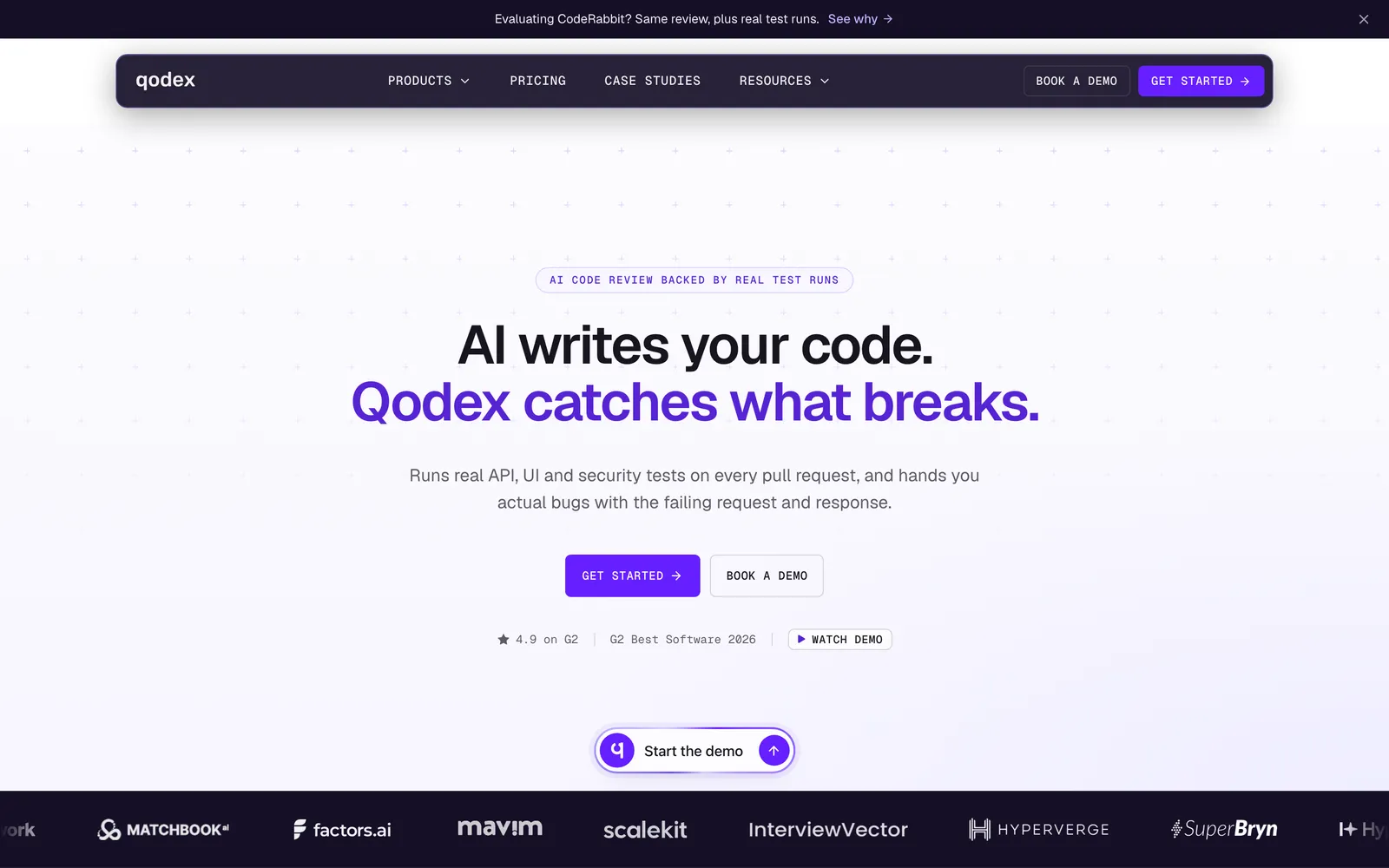
Why it fits a Keploy refugee: it removes the coverage boundary, because it generates tests rather than waiting for traffic. And one agent runs across API testing, UI testing, security checks, and pull request review, so the move is also a chance to add UI and security coverage. Security is not a separate tool: it runs OWASP-aligned checks (IDOR and BOLA via multi-role auth profiles, auth bypass, injection) in the same suite as the functional tests.
Pricing (read 4 October 2026): Individual is $0 with 25 scenarios and 100 runs a month. Startup starts at $1,299 per project per month and Scale at $2,500, scoped with sales. See Qodex pricing. A structural difference worth naming: Keploy's core record-replay has no per-run cost, but its AI test generation is metered (5 credits a month free, then roughly $0.16 per test generated and $0.22 per test run on the Pro tier). Qodex replays are deterministic with no LLM in the loop, so once a scenario is saved, a rerun costs nothing in model spend. Plan scenario and run limits still apply.
Pros:
One agent covers API, UI, and security testing, plus PR review, not just backend APIs
Generates tests from a spec, collection, or live endpoint, with no dependency on capturing production traffic
Proactively writes negative, edge, and security cases that recorded traffic would miss
Deterministic replays at zero LLM cost as the suite scales; schedules and CI webhook triggers included
Generated tests are standard, ejectable scripts, not a proprietary runtime format
Cons:
Not a manual request client for quick ad-hoc exploration
AI-generated tests still deserve human review before you promote them to scheduled runs
Best for: teams whose real loss with Keploy would be the automated regression net, and who want that back without the traffic-capture dependency, and with UI and security testing in the same agent. You can start free and have the agent generate its first API suite against your staging environment. For the security side specifically, see our best API security testing tools roundup.
2. KushoAI
KushoAI is the other agentic option, and conceptually the nearest to Qodex on the "AI writes your API tests" axis. It generates and maintains API test suites from an OpenAPI spec or a Postman collection, and its differentiator is self-healing: when the API contract drifts, it detects the change and updates the affected tests rather than leaving you to re-record or re-write them. That covers the same job as Keploy's own self-healing, from the spec side.
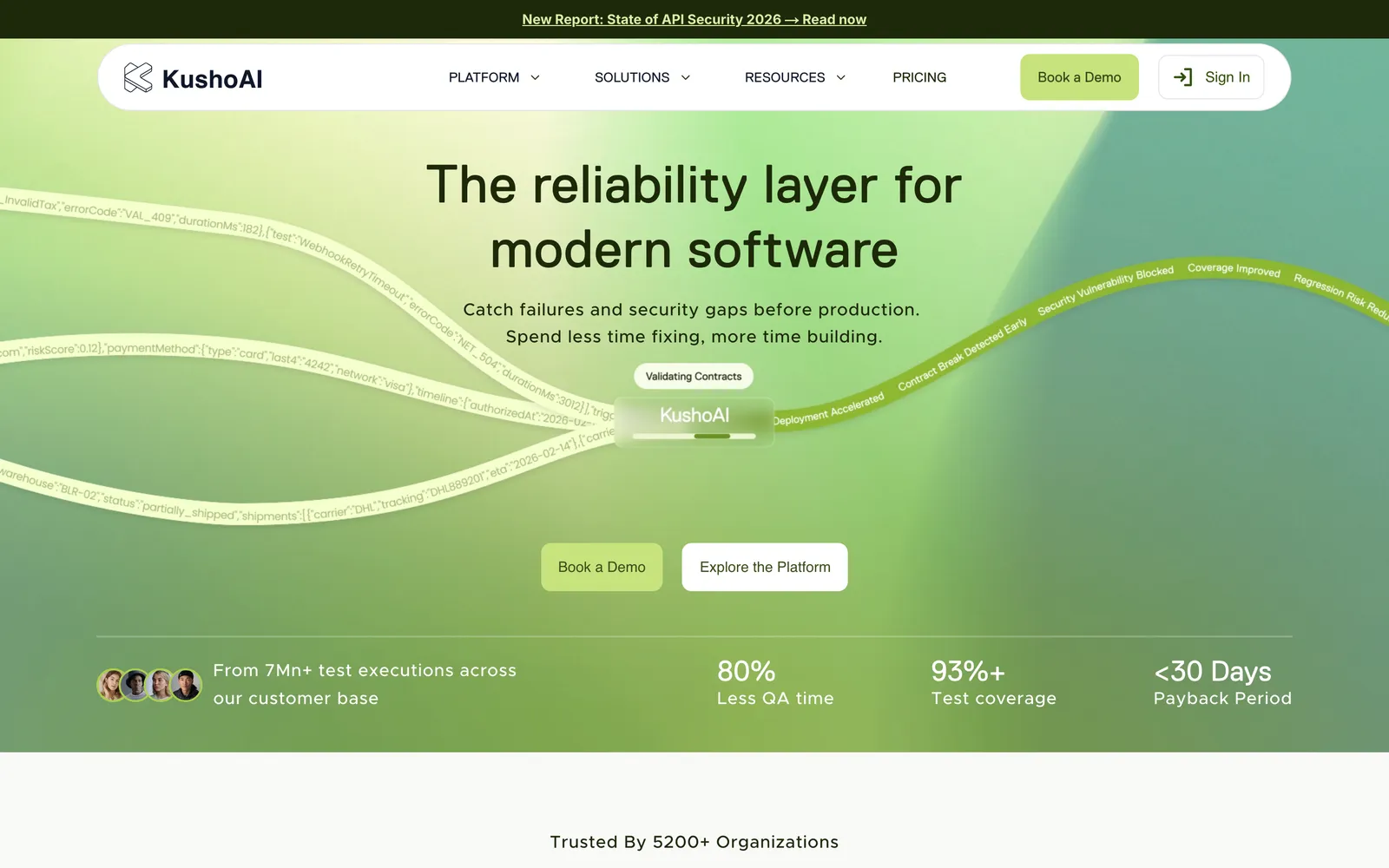
How it differs from Keploy: KushoAI generates from the spec or collection, not from captured traffic, so it shares Qodex's freedom from the record-replay dependency. It now covers API, UI and workflow tests, plus continuous security testing.
Pricing: a free Developer Edition and a custom-priced Enterprise plan. Its pricing page did not load in full for us on 4 October 2026, so confirm the plan limits with KushoAI before you rely on them.
Pros: genuinely addresses test maintenance via self-healing on API drift; usable free tier for real evaluation. Cons: confirm the plan limits and price with KushoAI before you rely on them.
Best for: teams that already maintain an OpenAPI spec and want generated API tests that survive spec changes without manual upkeep, and are comfortable with a sales process to grow.
3. Postman
Postman is a widely used API client. It is not a record-replay tool; you author requests, collections, and assertions by hand, then run them in CI with Newman (its Apache-2.0 open-source CLI runner). Its AI features now assist with workflows and tests, and a built-in Interceptor can capture HTTP traffic into a collection.
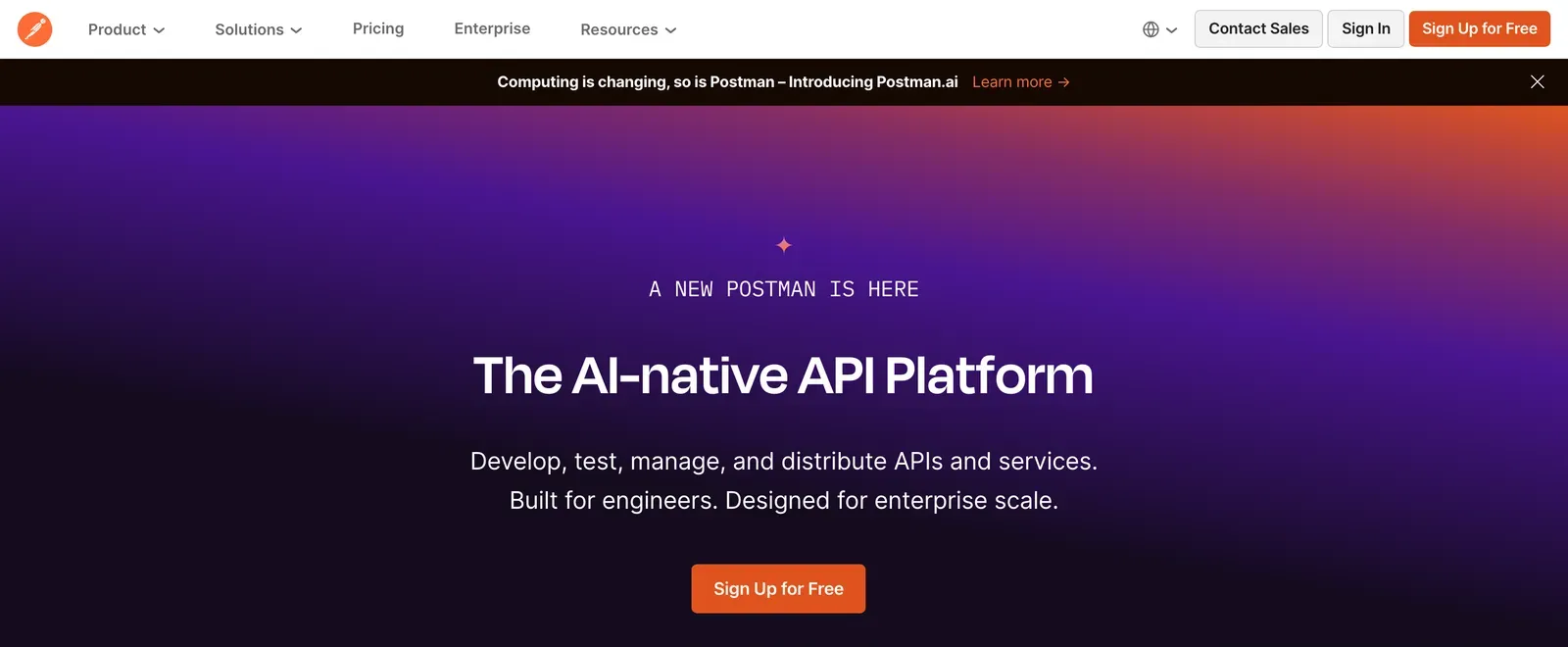
How it differs from Keploy: this is the manual, high-control end of the spectrum. You get mock servers, monitors, and docs in one hosted platform, and you write the tests yourself with AI assistance.
Pricing (read 4 October 2026): Free ($0, one user, 50 AI credits a month); Solo $9 a month billed annually; Team $19 per user a month, billed annually; Enterprise is priced by sales. AI credits are metered and can run out mid-workflow.
Pros: team familiarity; design, testing, docs, mocks, and monitoring in one tool; free CI via Newman. Cons: metered AI credits, and the hosted platform is the default way of working. See our full Postman alternatives guide for the wider client field.
Best for: teams that want one shared, hosted platform for API design plus manual and CI testing and do not need self-hosting or automated test generation.
4. Hoppscotch
Hoppscotch is the open-source answer to Postman: an MIT-licensed, web-first API client that you can self-host with the Docker configs in its repo. It covers REST, GraphQL, WebSocket, SSE, and more, with collections, environments, and a collection runner, and its core is genuinely free rather than a trial.
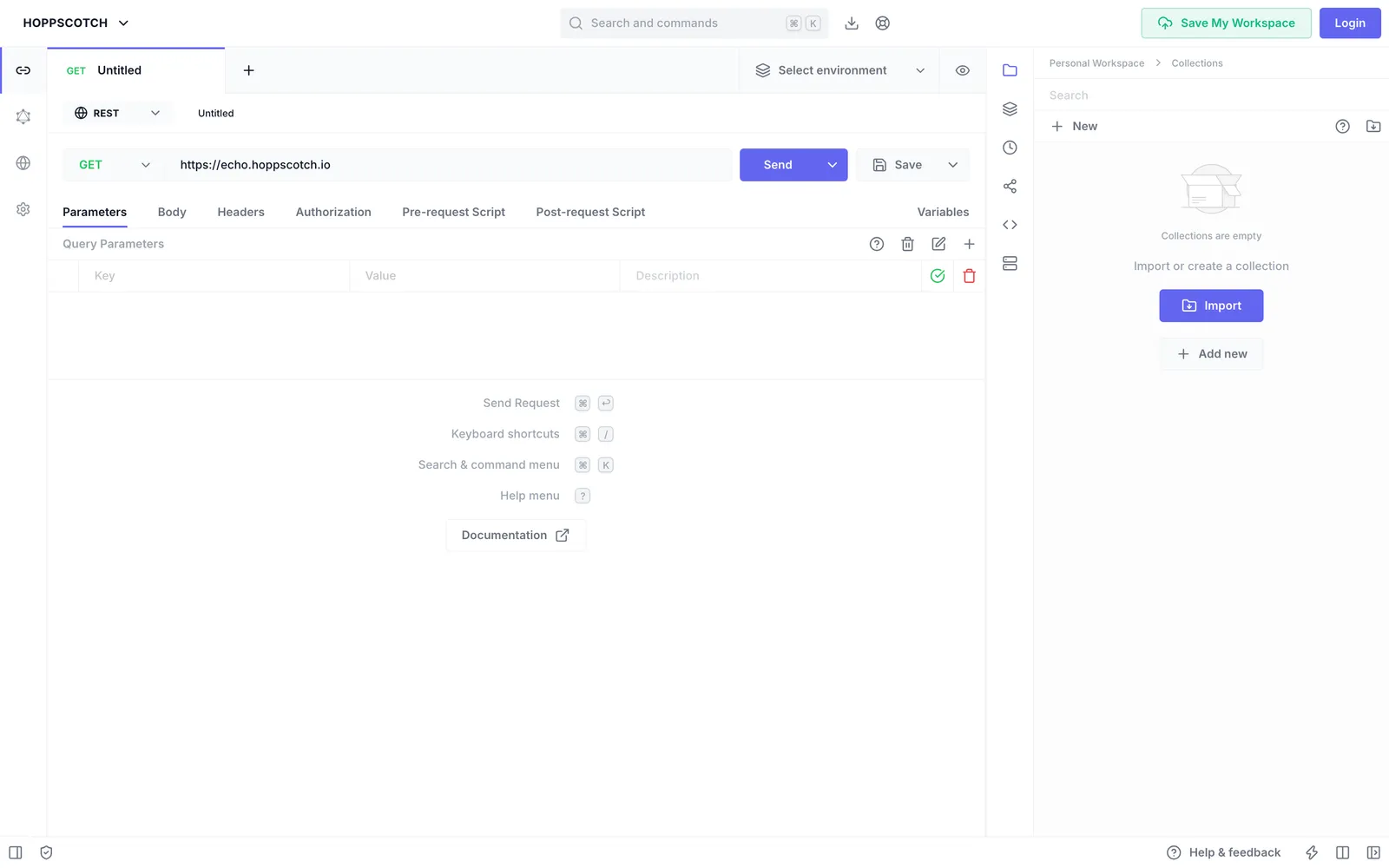
How it differs from Keploy: same manual, collection-based model as Postman, with self-hosting as the headline advantage. If part of why you ran Keploy was to keep data off third-party clouds, Hoppscotch gives you that same control in a client, but you are back to authoring tests by hand.
Pricing (read 4 October 2026): free and self-hostable at the core tier; the cloud Business plan is $6 per user a month billed annually. Enterprise Cloud, added on 29 September 2026, is $11 per user a month annually or $14 monthly.
Pros: genuinely free and self-hostable core; real MIT license, no vendor lock-in. Cons: it is a request client first; the agentic AI Assistant that writes tests comes with the Enterprise plans.
Best for: teams that want Postman-equivalent functionality but need self-hosting or want to avoid depending on a proprietary hosted tool.
5. Bruno
Bruno is an MIT-licensed, git-native, offline-first API client that stores every collection as plain-text .bru files on disk. That makes collections diffable and reviewable in pull requests like any other code, which is its defining difference from Postman and Hoppscotch. It is a local desktop and CLI app by design, with no cloud sync even as an option.
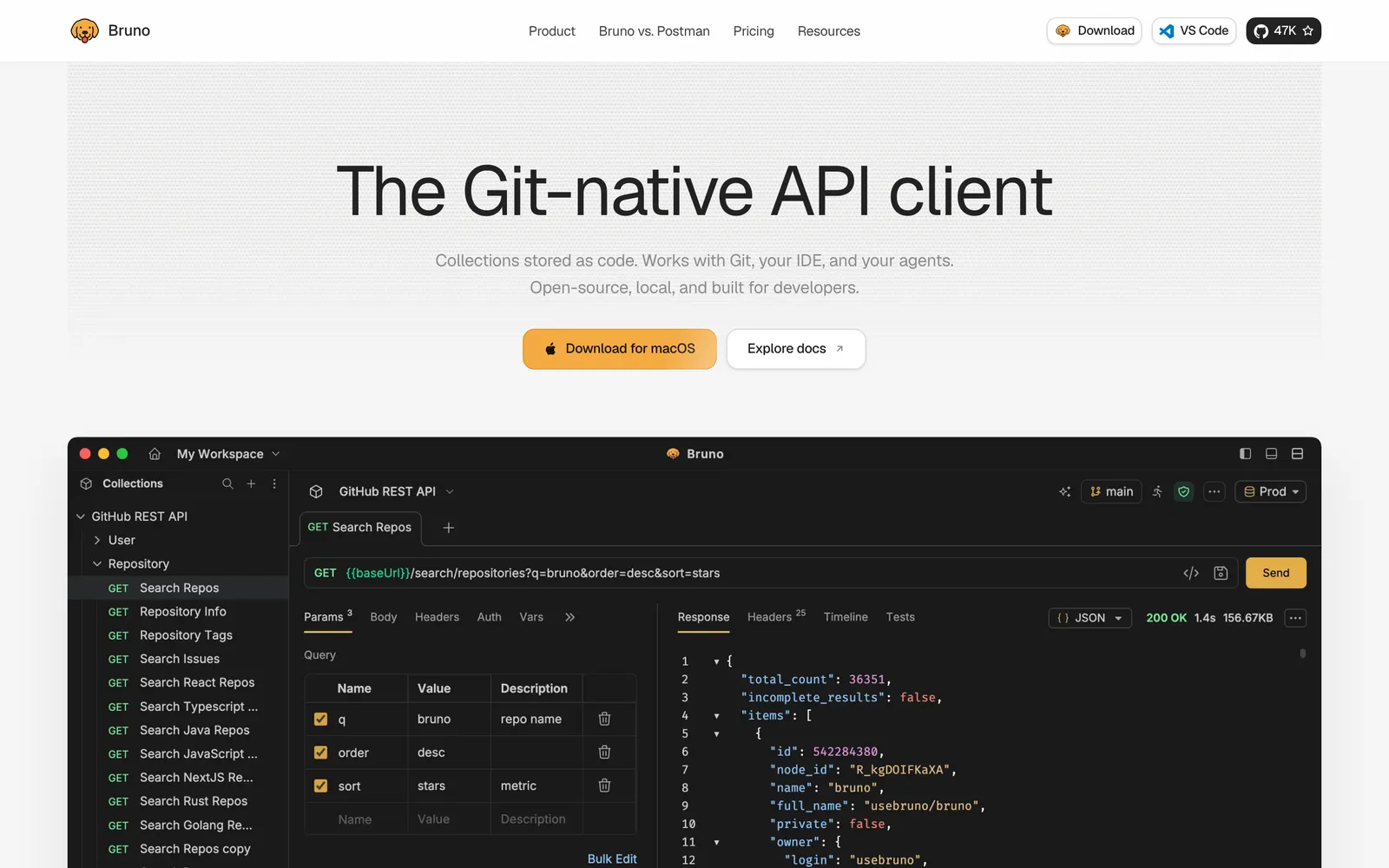
How it differs from Keploy: like the other clients, you write the requests and tests. What it shares with Keploy's spirit is the local-first, no-cloud stance, and it takes that further by keeping everything in Git alongside your code.
Pricing (read 4 October 2026): free open-source core; Pro $6 per user a month and Ultimate $11 per user a month, both billed annually. The current pricing page lists only those subscription tiers.
Pros: git-native workflow that fits engineering teams reviewing collections in PRs; offline and local-first; Pro shares the lowest paid price of the three clients with Hoppscotch Business, $6. Cons: no cloud sync even when a distributed team would want it.
Best for: engineering-first teams that want API collections versioned in Git like code and are happy with, or prefer, no cloud dependency.
6. Schemathesis
Schemathesis is the spec-driven opposite of Keploy. Instead of learning tests from observed traffic, it generates them from your OpenAPI or GraphQL schema, using property-based testing (built on Python's Hypothesis library) to fuzz malformed enums, boundary integers, unicode edge cases, and other inputs the spec technically allows, then checks that responses conform to the schema and do not crash. It is MIT-licensed and fully free.
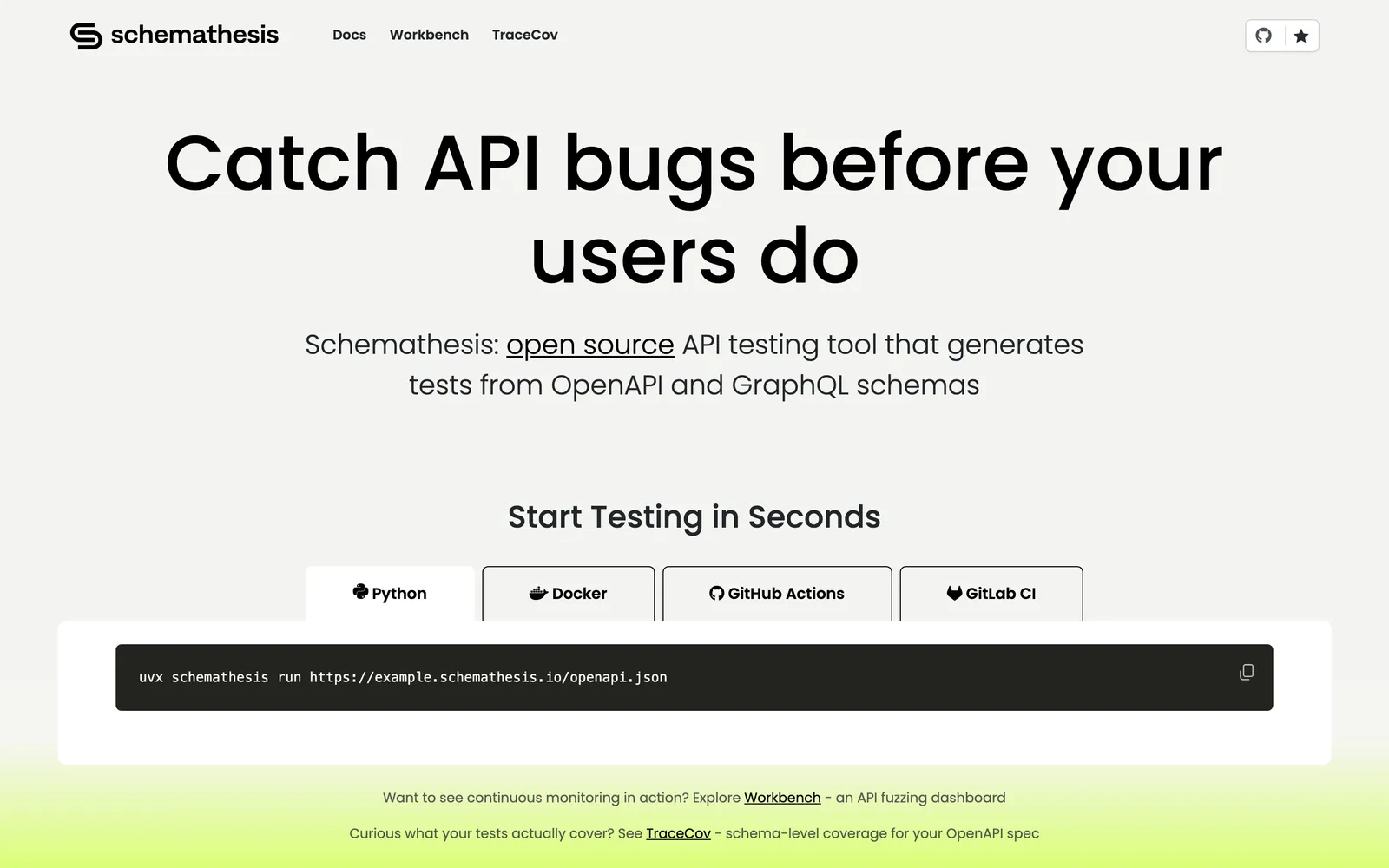
How it differs from Keploy: Keploy's record-replay coverage is a function of the traffic you recorded; Schemathesis needs zero traffic and generates inputs from the spec. The trade is that it is only as good as your spec; its built-in checks cover conformance and crashes, and custom Python checks can assert business rules.
Pricing: open source under MIT. A hosted public Workbench dashboard is live; a managed service for private APIs is not described on its pages.
Pros: generates boundary and constraint-violation cases from the spec; needs only a valid spec, no traffic and no manual authoring; genuinely free with no paywall. Cons: output quality tracks spec quality, so a loose OpenAPI doc yields shallow or noisy tests; business rules need custom checks. If GraphQL is your surface, see our GraphQL API testing guide.
Best for: teams with a well-maintained OpenAPI or GraphQL spec who want automated edge-case fuzzing in CI without writing test cases by hand.
7. Pact
Pact specialises in consumer-driven contract testing. Consumers define the interactions they expect, providers verify against them, and you catch breaking API changes across independently deployed services without spinning up a full integration environment. It is MIT-licensed with implementations in nine-plus languages, and the Pact Broker (its contract storage and verification hub) is self-hostable.
How it differs from Keploy: this is a different axis entirely. Keploy records one service's traffic to build a regression net; Pact verifies that two or more services still agree on their contract before either deploys. If your Keploy pain was really "we keep breaking each other across service boundaries," a record-replay tool was never the right fix and Pact is.
Pricing: core Pact plus the self-hosted Broker is free and open source. PactFlow, the hosted commercial layer (owned by SmartBear), has a free Starter tier (2 integrations), a Team tier at $127 a month or roughly $115 a month billed annually, and quote-based Enterprise with SSO, RBAC, and on-prem.
Pros: catches cross-service breakage that single-service tools miss, and enables safe independent deploys without a shared staging environment; genuinely open source with a real free self-hosted broker; backed by SmartBear for stability. Cons: a steep conceptual shift, contract testing is a mindset, not a drop-in; its value grows with the number of independently deployed services, though it also applies to one client and one API; PactFlow's free tier is thin. SmartBear also documents a migration from PactFlow to Swagger Contract Testing. For the fundamentals, see our contract testing guide.
Best for: microservice teams where multiple teams own multiple services and need to catch breaking changes before deploy, though it also applies to one client and one API.
How to Move From Keploy Without Losing Coverage
Run this in order. Each step is also the exact question to ask any tool on this list before you commit.
Step 1: Export your Keploy test cases and your spec
Before anything else, get your recorded assets out. Keploy stores test cases and mocks as YAML, so pull that YAML and, more importantly, your OpenAPI or Swagger spec into your own repository. For most alternatives the spec is the more portable and useful asset, because agentic and spec-driven tools (Qodex, KushoAI, Schemathesis) generate directly from it. Confirm the spec is accurate and current, because from here on it is doing the work your captured traffic used to.
Step 2: Decide what you are actually replacing
Keploy did two jobs: it captured traffic into tests, and it gave you a regression net. Be honest about which one was the reason you used it. If you valued the automated generation, you want an agentic tool (Qodex, KushoAI). If you only ever used it as a coverage net and are happy to author tests, a client (Postman, Hoppscotch, Bruno) or a spec-driven tool (Schemathesis, Pact) is enough. Choosing the wrong category is the expensive mistake, so name the job first.
Step 3: Check platform fit and coverage scope
Screen every candidate for two things. Platform: does it run on your team's actual machines? Keploy now runs natively on Linux, Apple Silicon macOS and x86-64 Windows, with Lima on Intel Macs and WSL on Windows ARM. Scope: if you need UI or security testing beyond Keploy's auth, schema and input checks, confirm the replacement covers it. Qodex does both in one agent. Do not migrate only to rediscover the same gaps.
Step 4: Verify test portability and CI integration
Ask one blunt question of every tool: if we leave, do we walk away with runnable, standard tests, or a proprietary format? Qodex generates standard, ejectable scripts; Postman, Hoppscotch, Bruno, Schemathesis, and Pact all leave you with open or standard artifacts. Then confirm it plugs into the CI you actually run and can gate a pull request, because a regression net that does not block a bad merge is theater. All seven integrate with common CI; verify yours specifically.
Step 5: Pilot on your five most critical endpoints
Do not migrate the whole suite blind. Pick the five endpoints that would hurt most if they broke, rebuild or generate them in your top one or two candidates, and run them for a sprint. You are measuring the thing Keploy actually did for you: how much authoring and maintenance the tool removes versus how much it hands back, and whether replays stay stable without constant noise tuning. That number, not the marketing, decides the migration.
Decision Framework: Match the Tool to Your Team
Find your row:
| Your situation | Right approach | Start with |
|---|---|---|
| Want the regression net back without recording or hand-writing it | Agentic AI QA agent | Qodex |
| Need API, UI, and security testing from one agent | Agentic AI QA agent | Qodex |
| Want AI-generated API tests that self-heal on spec changes | Agentic AI generator | KushoAI |
| Want a widely used client for manual and CI testing | API client | Postman |
| Need a free, self-hostable Postman-style client | Open-source API client | Hoppscotch |
| Want API collections versioned in Git, offline | Git-native client | Bruno |
| Want automated edge-case fuzzing from your OpenAPI spec | Spec-driven property testing | Schemathesis |
| Run many services and keep breaking each other on deploy | Contract testing | Pact |
| API security beyond auth, schema and input checks | Agentic AI QA agent | Qodex (see best AI QA tools) |
| Mostly on Linux, want a free traffic-based net, accept the trade-offs | Record-replay (stay) | Keploy |
When You Should Stay on Keploy
Keploy is free, open source, and genuinely clever, and for a real set of teams it is the right call. Do not migrate on principle. Stay on Keploy if the following describe you.
Your machines are supported natively. Keploy now captures natively on Linux (kernel 5.10 or higher), Apple Silicon macOS and x86-64 Windows. On those, the zero-code capture is a real advantage across a polyglot backend.
You want a zero-cost regression net and nothing more. The core eBPF record-replay engine is Apache-2.0 and self-hosted with no per-run cost. A team that never touches the metered AI-generation layer pays nothing, forever. If your need is "bootstrap a backend regression safety net from real traffic fast," that is exactly what Keploy is good at, and no paid tool beats free at that specific job.
You do not need UI or security testing from this tool, and you accept the model's limits. Keploy is a regression net, not a substitute for negative-test design, security scanning, or UI coverage. If you understand that coverage is a function of the traffic you exercise, that replays will need periodic noise-config tuning as APIs evolve, then it is a legitimate, free layer to bolt on. Keploy also lists automated noise filtering, time freezing and self-healing to help with the replay part.
It stops being the right call the moment you need UI testing in the same tool. If either is you, the alternatives above are worth the switch.
Choosing Your Keploy Alternative
Separate the two jobs Keploy did. Capture and coverage are different, and different tools replace each. If automated generation was the value, an agent (Qodex, KushoAI) replaces it. If you only wanted a coverage net, a free client or spec-driven fuzzer does the job. Decide which one you are paying to get back before you compare features.
Do not expect a drop-in clone. None of the seven tools here copies Keploy's traffic capture, so choose by approach, not by feature-parity. The right question is not "which tool records traffic like Keploy," it is "which approach gets my API a reliable regression suite given how my team actually works."
Check your platforms. Keploy now runs natively on Apple Silicon Macs and x86-64 Windows. Intel Macs still need Lima and Windows on ARM needs WSL, and that friction is a real cost even though it never shows up on a pricing page.
Count maintenance hours, not just licence fees. A free tool plus an engineer tuning noise configs and re-recording flows as APIs change can cost far more than the licence line suggests. Tools that generate and maintain tests change that math; measure the hours, not the sticker.
Pilot before you commit. Every claim on this page, including ours, should survive a one-sprint pilot on your five most critical endpoints. Migrate deliberately, measure the maintenance you get back, and let that decide.
Frequently Asked Questions
Is Keploy open source and free?
Yes. Keploy's core is Apache-2.0 open source and self-hostable, and the eBPF record-replay engine has no per-run cost. The metered cost applies only to its cloud and AI test-generation layer, where the free tier includes a small monthly allowance of AI credits and the Pro tier charges per test generated and per test run. If you use only the core capture-and-replay engine, Keploy is genuinely free.
Why do teams look for Keploy alternatives?
Three reasons come up. Replay brittleness: non-deterministic fields like timestamps, UUIDs and random IDs cause response mismatches, which Keploy's noise filtering and time freezing aim to handle. The coverage boundary: record-replay tests follow the traffic you recorded, though Keploy's AI generation can also create tests from specs, collections, cURL or endpoints. And scope: Keploy centres on APIs; its security checks cover auth, schema and input, not full DAST.
What is the closest alternative to Keploy?
It depends on what you valued. If it was the automated regression net without hand-writing tests, Qodex is the closest, an agent that generates and maintains runnable API tests from a spec or collection, with no traffic-capture dependency, plus UI and security testing in the same agent. KushoAI is the other agentic option, with API, UI and security testing and tests that self-heal when the spec changes. None of the seven tools here copies Keploy's traffic capture.
Does Keploy work on macOS and Windows?
Yes, natively on Linux, Apple Silicon macOS and x86-64 Windows. Keploy's installation docs, read on 4 October 2026, say it runs natively on Linux, Apple Silicon macOS and x86-64 Windows. Linux uses eBPF and needs kernel 5.10 or higher; macOS and Windows capture in user space. Intel Macs use Lima, Windows on ARM uses WSL, and Docker remains an option for broader dependency support.
Can Keploy do UI or security testing?
Partly. Keploy centres on API and backend testing, and its "end-to-end" support means API and service flows rather than UI end-to-end in the Playwright or Cypress sense. It lists auth, schema and input security checks, which are not full DAST coverage. Its compliance certifications are about its own platform, a separate thing from testing your API. If you need UI or security coverage, Qodex runs both alongside API testing in one agent.
What is the best free Keploy alternative?
For manual clients, Hoppscotch and Bruno are the strongest free open-source options; Hoppscotch is self-hostable in the browser and Bruno stores collections as git-friendly files on disk. For automated testing without hand-writing cases, Schemathesis is free and fuzzes edge cases straight from your OpenAPI or GraphQL spec, and Pact's core with the self-hosted broker is free for contract testing. Qodex and KushoAI both have free tiers if you want agentic AI test generation rather than a manual client.
Should I stop using Keploy?
Not necessarily. Keploy is a good free layer to keep if it runs natively on your team's machines and you want a zero-cost regression net and nothing more. That assumes you accept that coverage tracks the traffic you exercise and that replays need periodic noise tuning. Switch when you need UI testing or deeper security testing in the same tool. Run a one-sprint pilot of an alternative on your five most critical endpoints and let the maintenance you get back decide.