11 Best AI Testing Tools in 2026
The best AI testing tool depends on what you need to automate. Qodex fits teams that want an agent to write portable Playwright tests and run API, UI, and security scenarios in one workflow. Choose mabl or Tricentis Testim for managed low-code automation, testRigor for plain-English authoring, Applitools for visual checks, QA Wolf when you want a managed service instead of another platform to operate, and TestDino to triage the Playwright suite you already run.
Best AI Testing Tools at a Glance
| Tool | AI approach | Test surfaces | Replay model and meter | Export or ownership | Price and free access | Main limit |
|---|---|---|---|---|---|---|
| Qodex | Agent writes the test from a sentence you give it | Web UI, API, API security | Saved scenario replays as Playwright, no model call, $0 in model spend | Standard Playwright specs, synced to git, exportable | Individual $0; Startup from $1,299 a project a month (pricing) | Runs on Playwright browsers, Chromium first |
| TestDino | AI failure classification and flake detection over your Playwright CI runs | Playwright results from CI: reporting and triage, not authoring | Your CI runs the tests and the reporter uploads each run; 5,000 to 40,000 executions a month by plan | Your Playwright tests stay in your repo; TestDino holds the run history | Free with 5,000 executions a month; Pro $39 a month billed annually | Playwright only, and it reports on tests rather than writing them |
| Functionize | Agentic Studio: you describe the task, Studio builds it | Web UI workflows | Credits per month, 200 to 2,000 by plan | Not stated on the pricing page | Free forever with 200 credits; Pro $20 a month | Data retention is one month on published plans |
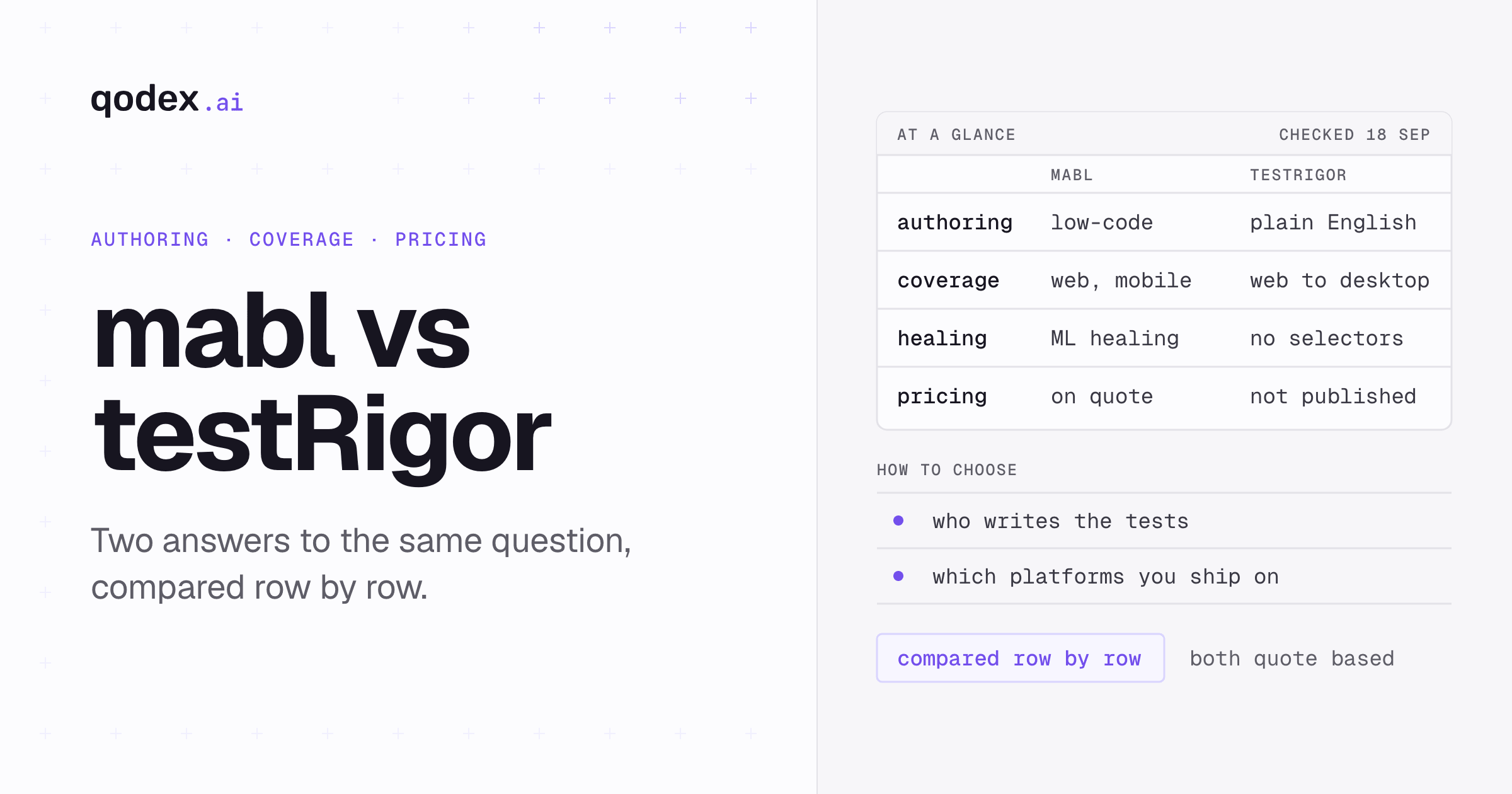
| mabl | Low-code platform with auto-healing, authored by a QA team | Web, mobile, API, accessibility, performance, AI apps | Credits on cloud runs, from 500 a month; local and CI runs free | Export not verified | Tailored quote; 14-day trial | No public price and no stated export path |
| Tricentis Testim | Smart locators plus agentic authoring, from a recorder or a description | Salesforce, web, native and hybrid mobile | Runs on Testim, your own grid, or any Selenium-compatible grid | Export not verified; branches sync with git | Quote only; free account and trial | Price is a sales conversation |
| testRigor | Plain-English authoring by manual testers, no code | Web, mobile, desktop, mainframe, API, email, SMS, 2FA | Executed in testRigor from your English steps | No code export documented on its site | Not published; free tier and 14-day trial reported by TestRail | Both official pricing URLs return 404 |
| Applitools | Visual AI, driven from your framework through SDKs or NLP authoring on higher tiers | Pages, components, Storybook, Figma, PDFs, mobile | Checkpoints, 1,000 pages or 100,000 components on Starter | Your test code stays yours; the checks are Applitools | $667 a month paid annually; free trial | A layer over a functional suite, priced like a platform |
| Testsigma | Natural-language, scriptless authoring by a QA team | Web, mobile web, Android, iOS, API, desktop, Salesforce | Unlimited automated testing minutes on Pro | Export not verified | Custom pricing; demo and trial | No public price at all |
| TestMu AI KaneAI (formerly LambdaTest) | Testing agent licensed per agent, driven in natural language | Web and mobile cloud, local runs through Kane CLI | Credits per agent: 2,000, 12,000, or 25,000 a month | Scripts generated for your framework | $17 per agent a month billed annually; no free KaneAI plan | Per-agent licensing adds up across a team |
| Momentic | Agent plus natural-language locators: you describe steps, it fills the gaps | Web in Chromium, iOS simulators, Android emulators | Credits: 1 per step, 2 per AI step, 100 per classification, 500 per triage | Tests run in Momentic | Free forever with 2,000 credits; $125 a month paid | Triage and classification are metered per run |
| QA Wolf | AI plus a managed QA team, working from your prompts | Web, Electron, Android, iOS | Deterministic Playwright and Appium, run in parallel on their infrastructure | Playwright and Appium code, exportable and yours to keep | Quote only; "Try for free" on the site | A service contract, not a tool you drive |
Read the table left to right and stop at the column that decides your purchase. The column that usually decides it is the meter: what you are billed for, and whether running the suite more often costs more. After that comes export, because a suite you cannot take with you is a suite you will rebuild. Each tool entry below also names who it is for.
Every price here is the vendor's own list price, read on 15 September 2026 (TestDino's on 5 October 2026, when it joined the list), with one exception: testRigor's free tier and trial come from TestRail's guide, because testRigor's own pricing pages are down. Five of the eleven publish no number at all. Where a plan is credit-based, the credit rate matters more than the headline number, so those rates are in the tool entries below.
What Is an AI Testing Tool?
An AI testing tool uses a model to do part of the testing work a person used to do. That means generating tests, authoring them from plain English, comparing what the screen looks like, healing a test when the UI moves, or deciding which tests to run. That definition comes from TestRail's 2026 guide, read 15 September 2026. Our AI QA guide goes further into how the technology works; this page is about which product to buy.
People search for this category under two labels. "AI testing tools" and "QA testing tools" are the same buyer asking the same question, and this page answers both. QA tools are the wider set: test management, bug trackers, device clouds, and load testing all sit under QA software and have nothing to do with AI. Everything below is the narrower slice where a model does the authoring, the healing, or the triage. Testing AI systems, meaning LLM evaluation and prompt regression, is a different job again, and this page does not cover it.
Six shapes turn up when you shop this slice, and the shape tells you who does the work and where the cost lands.
Agents explore your app and write the tests from a description. Qodex, Momentic, and Functionize Studio sit here.
Plain-English and low-code platforms let a person author the test and let the model keep it alive. testRigor, Testsigma, mabl, and Tricentis Testim sit here.
Visual engines assert on what the page looks like rather than what the DOM says. Applitools defined this one.
Managed services put engineers and AI behind the same contract. QA Wolf is the example in this list.
Result and triage layers sit after the run: they collect CI results, track flaky tests, and sort failures. TestDino sits here, on top of Playwright.
Code-level generators write unit tests and review diffs rather than driving a browser. Qodo is one example; it is out of this list because it works at the code level, not end to end. Source: Qodo pricing, read 15 September 2026.
How We Chose These Tools
Start with what this list is not. We have not run a controlled benchmark across all eleven products. Where a number appears below, it is a vendor list price or a vendor claim read on the date given, not a measurement we made. Healing rates, coverage percentages, customer counts, and device counts are vendor marketing until someone publishes a method, so they are either labelled as claims or left out. TestRail puts the same caveat on its own guide: "We have not independently tested all eight tools."
What we did check, tool by tool, on 15 September 2026: the live pricing page, the live product page, and the billing unit. Two tools failed that check. testRigor's two official pricing paths return 404, so its free tier and trial rest on TestRail's comparison rather than on testRigor's own page. Octomind did not respond at all across repeated requests, and no current top-ten guide lists it, so it is out of the list this year. TestDino was added on 5 October 2026 after the same check.
The ranking weighs seven things. The real testing surface, who can author a test, and how a test executes on replay. Then whether you can take the code with you, what the billing unit is, how it fits a pipeline, and which buyer it suits. Code review tools sit outside this list, since reviewing a diff is a different job from driving a browser; that field is covered in best AI code review tools. For wiring one into your own pull requests, see how to run AI code reviews step by step.
The 11 Best AI Testing Tools
1. Qodex
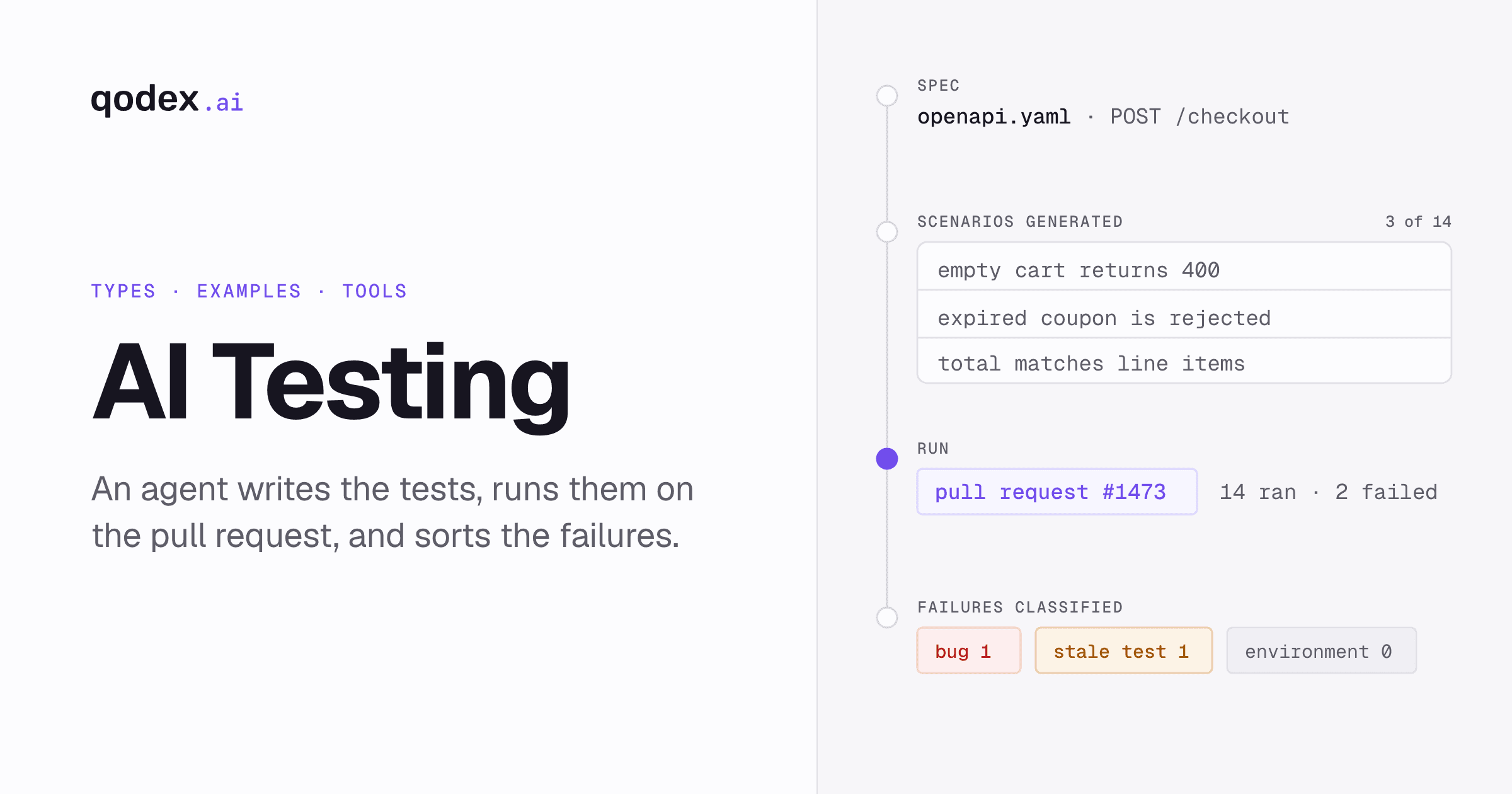
Qodex turns a sentence into a test. Describe the flow, and the agent drives the real app, brings back a screenshot of what broke, and saves the run as Playwright you own. The same agent runs your API, UI, and security scenarios against the pull request's preview deployment and attaches the evidence, so functional and security coverage land in one place instead of two products.
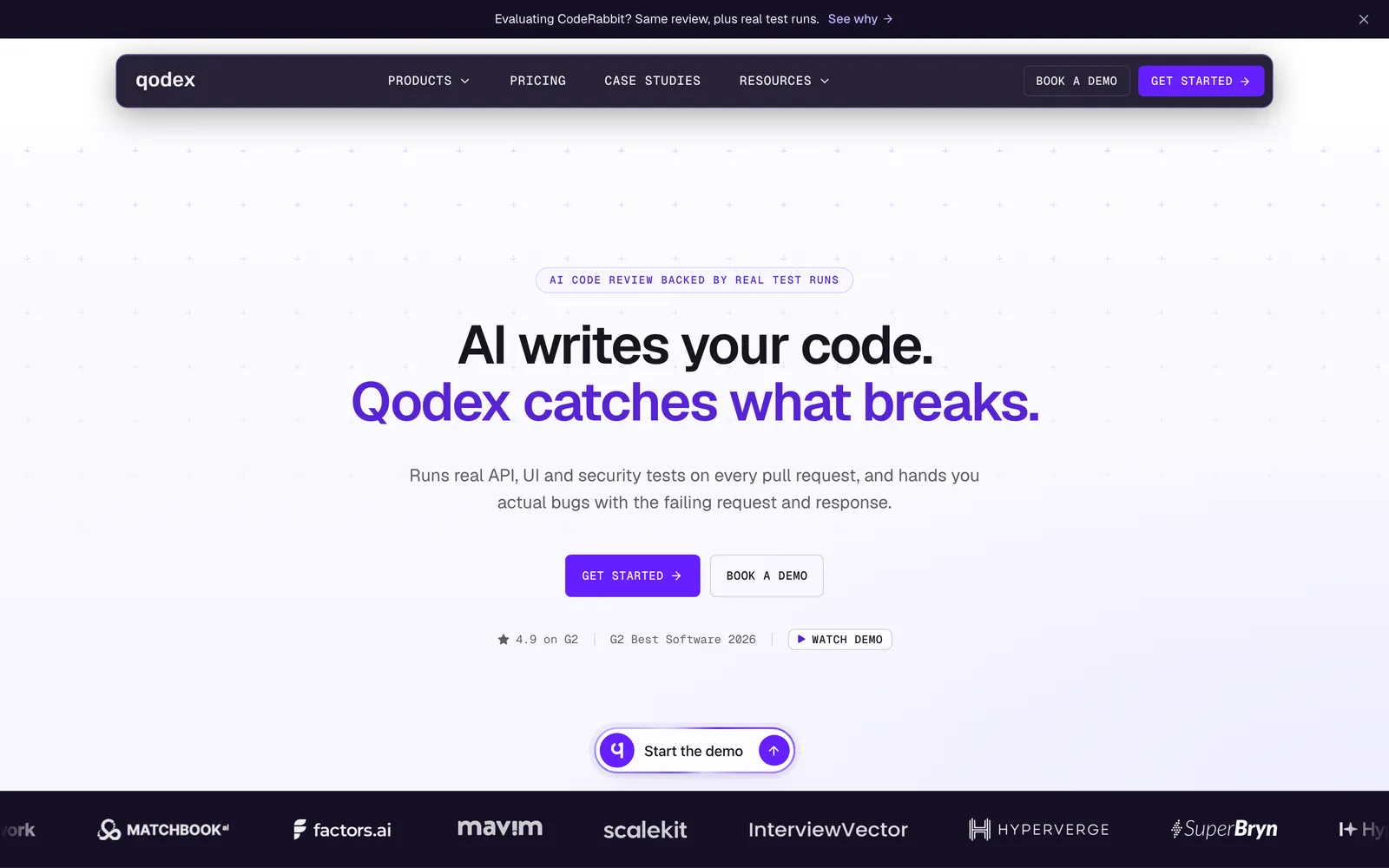
Replay is where the cost model shows. Authoring a scenario uses a model once; replaying it uses none, so a replay costs $0 in model spend whether it runs on every pull request, on a schedule, or from a webhook. When the UI changes, Qodex re-drives the flow, works out what moved, and proposes the updated scenario as a diff you approve or reject. Failures arrive sorted into three classes: a real bug, a stale test, or an environment problem such as a preview that did not boot.
What you keep is plain: each scenario is a standard Playwright spec, parameterized by environment variables, synced to your git repository and exportable at any time. Runs use Playwright browsers, Chromium first, with screenshots at desktop, tablet, and phone widths.
Price: Individual is $0 a project a month. Startup starts at $1,299 and Scale at $2,500, both per project per month and scoped to your usage. See pricing. Best for: engineering-led teams that want UI, API, and security coverage from one agent and want the tests in their own repository. Start a free trial and compare the first generated suite against what you run today, or read how the UI testing agent works first.
2. TestDino

TestDino is where Playwright results go after CI has finished running them. Every run from every branch lands in one dashboard with the trace, screenshots, video, and console logs attached. It does not write or drive tests the way the agents on this list do; it works on the results they produce. Playwright's own HTML report is fine for one run on one machine. It gets thin once 400 tests run on every pull request and the same six keep failing for reasons nobody has time to check.
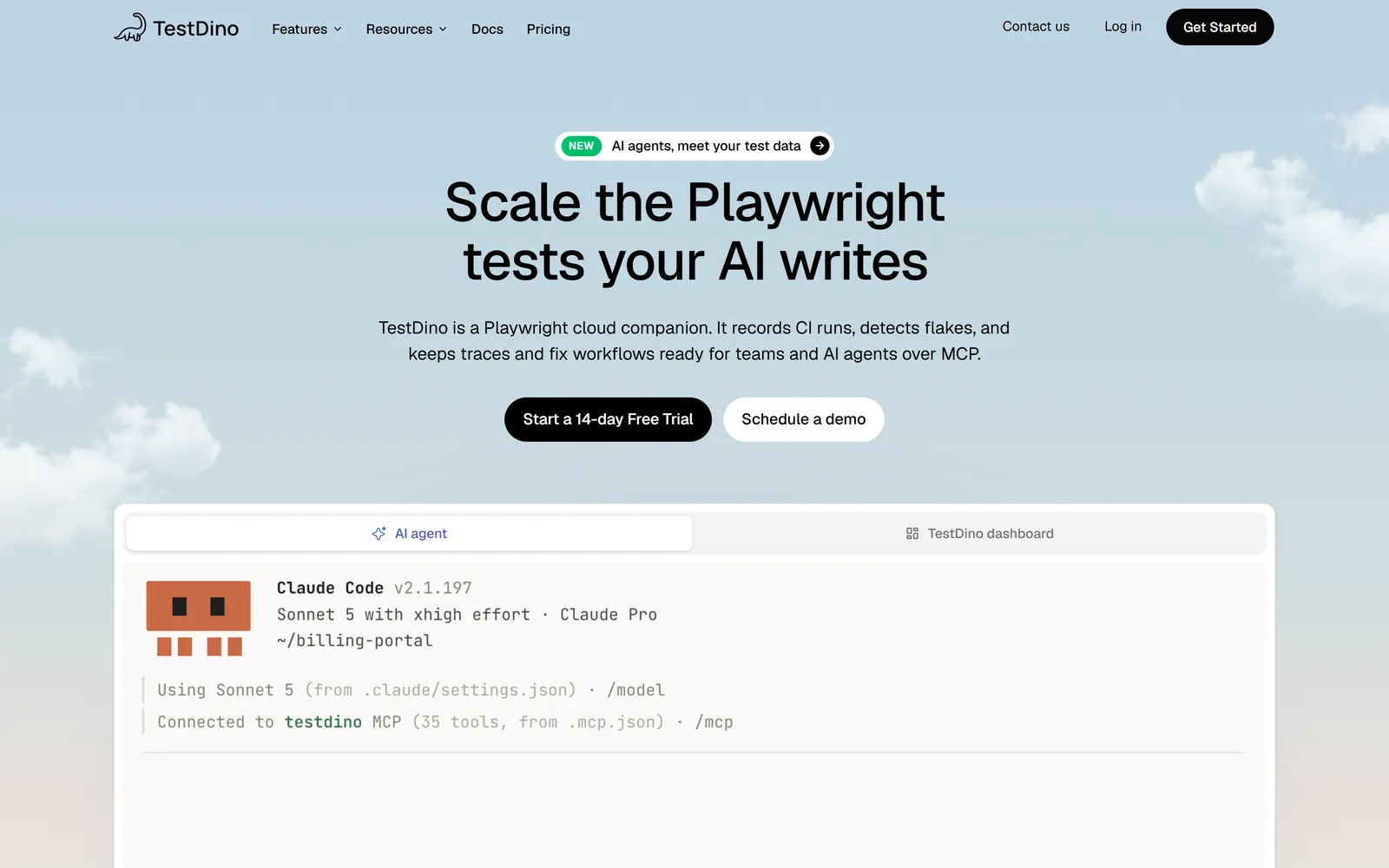
The AI work is in triage, and it starts with history. A test that passed 40 times and then failed twice after a deploy shows up as a regression, not as one more red row to rerun. Each test gets a stability percentage across CI runs, with the flake cause tagged as timing, environment, network, or assertion, so you fix the worst ones first. Each failure is filed as an actual bug, a UI change, an unstable test, or miscellaneous, and thirty tests failing on the same missing selector collapse into one error group. Those categories are TestDino's own description of the product, read 5 October 2026.
Results appear as each test finishes, so the first failure is visible before the pipeline ends, and the Playwright trace opens in one click next to that run's screenshot, video, and console output. A PR gate keeps the merge blocked until a run clears a pass-rate or flake threshold. Claude Code or Cursor can query failures and trigger reruns through its MCP server, and a REST API covers the rest. Setup is one package, @testdino/playwright, plus one reporter line in the Playwright config; tests are written the same way as before. It reads runs from GitHub Actions, GitLab CI, Jenkins, CircleCI, Azure DevOps, Bitbucket, and Buildkite, files issues in Jira, Linear, Asana, Azure DevOps, and monday.com, alerts in Slack, and keeps manual test cases in the same suite as the automated ones.
Plans are metered in test executions. Free is $0 with 5,000 a month, one user, and one project. Pro is $39 a month billed annually, or $49 month to month, with 10,000 executions and three users. Team is $79 a month billed annually, or $99 month to month, with 40,000 executions and 30 users. Pro and Team come with a 14-day trial. Enterprise is custom, with SSO, audit logs, and on-premises deployment. All figures read 5 October 2026 from testdino.com/pricing.
Main limit: it is Playwright only, and it reports on tests rather than writing them, so it pairs with an authoring tool instead of replacing one. Best for: teams that already run a large Playwright suite in CI and lose hours each week to flaky tests and red-build triage.
3. Functionize
Functionize now leads with Studio, an agent for web UI workflows. You set what good looks like, the agent builds the test, runs it, and keeps it green. That is a genuine change from the enterprise record-and-heal product this page described a year ago, and the pricing page changed with it.
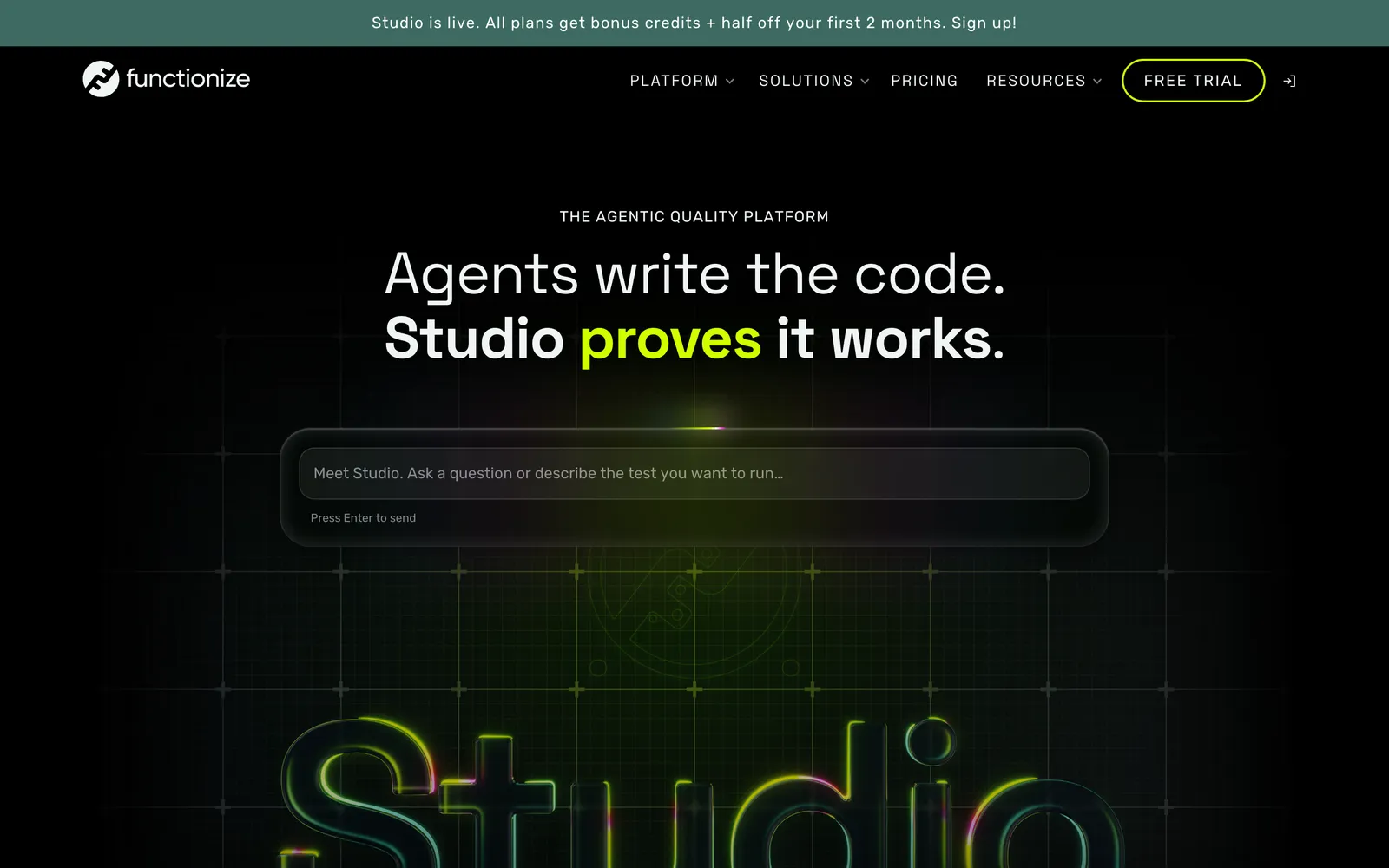
Plans are credit-based and public. Free is $0 with 200 credits a month and five parallel runs. Pro is $20 a month, or $18 billed annually, with 400 credits. Max is $100 a month, or $90 annually, with 2,000 credits and ten parallel runs. Team plans price per user: Growth at $40 per user a month with 400 credits each, Scale at $200 per user with 2,000. Enterprise is custom, with pooled credits and invoice billing on a twelve-month minimum. API and MCP access are on every tier; SMS and email testing for MFA and activation links arrive on Max and above. All figures read 15 September 2026 from functionize.com/pricing.
Main limit: published plans keep run data for one month, and the pricing page says nothing about exporting tests as code, so ask for an export sample before you commit a suite. Best for: an individual or a small team that wants an agent on a card, not a procurement cycle.
4. mabl
mabl is the mature managed platform in this list. One license covers web UI, mobile, API, accessibility, and performance testing, with auto-healing, agentic runtime recovery, visual assertions, and failure summaries built in. Authoring happens in a low-code editor, which suits a QA team that owns testing as a practice rather than developers writing specs.
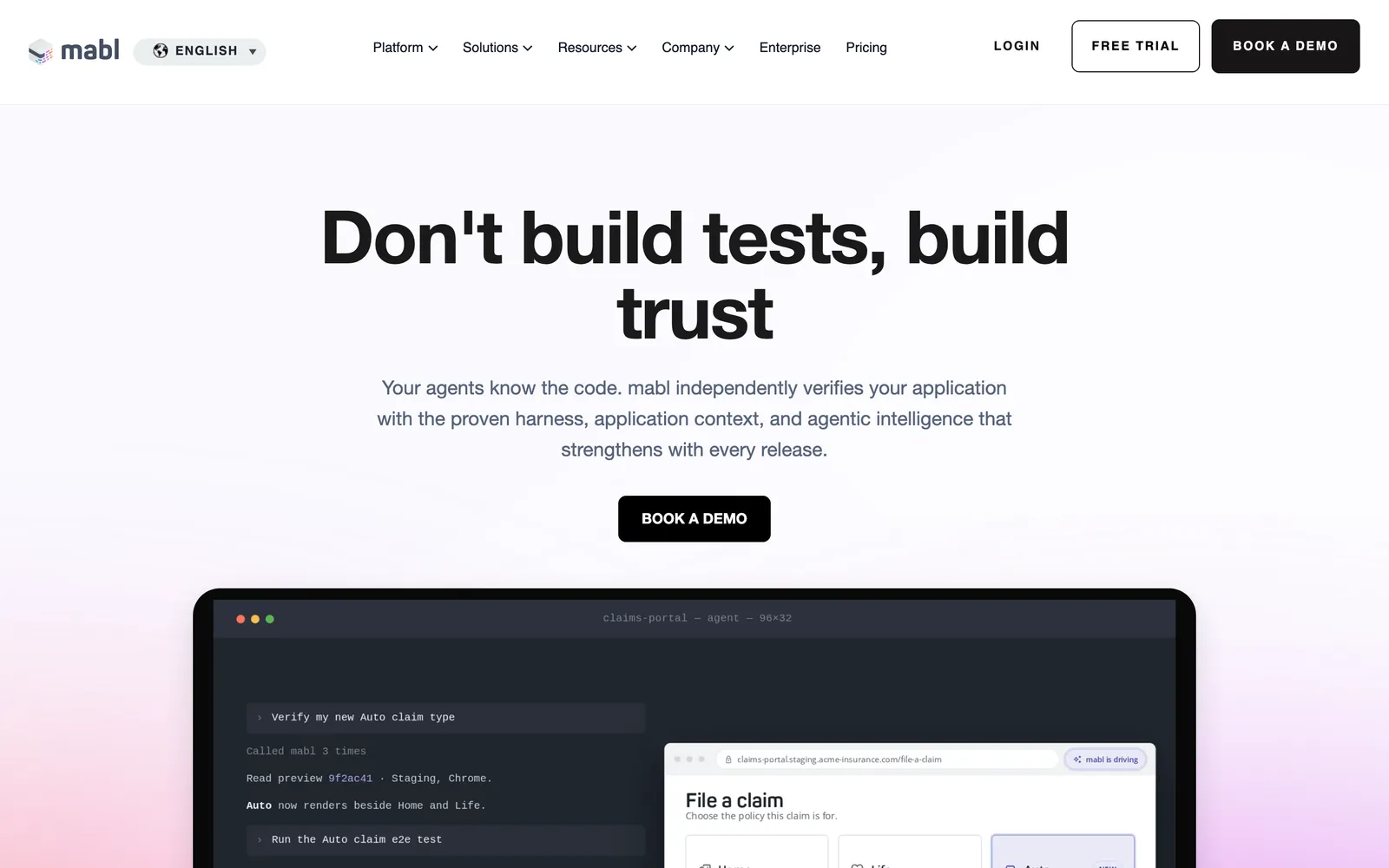
The billing unit is the credit, and only cloud runs consume it. mabl says it starts customers at 500 credits a month for cloud runs, shared across browser, mobile, API, performance, and accessibility work, while local and CI runs are unlimited and free. Cloud concurrency is unlimited, and unlimited apps, environments, and workspaces come with every plan. Pricing itself is tailored, so the number arrives after a conversation. A 14-day trial is available. Facts read 15 September 2026 from mabl.com/pricing.
Main limit: no public price, and nothing on the pricing page describes taking your tests out. Best for: mid-market and enterprise QA teams that want a vendor partner with a named success manager. Our mabl alternatives guide covers the field around it, and Qodex vs mabl puts the two side by side.
5. Tricentis Testim
Tricentis Testim is low-code automation for Salesforce, web, and mobile, sold as part of the wider Tricentis platform. Record a flow, tidy it in the visual editor, and reuse it as a component. The AI sits in the locators. They combine models, machine learning, and application metadata to keep finding an element after the page changes. That is the point of the product for teams shipping Lightning components every sprint.
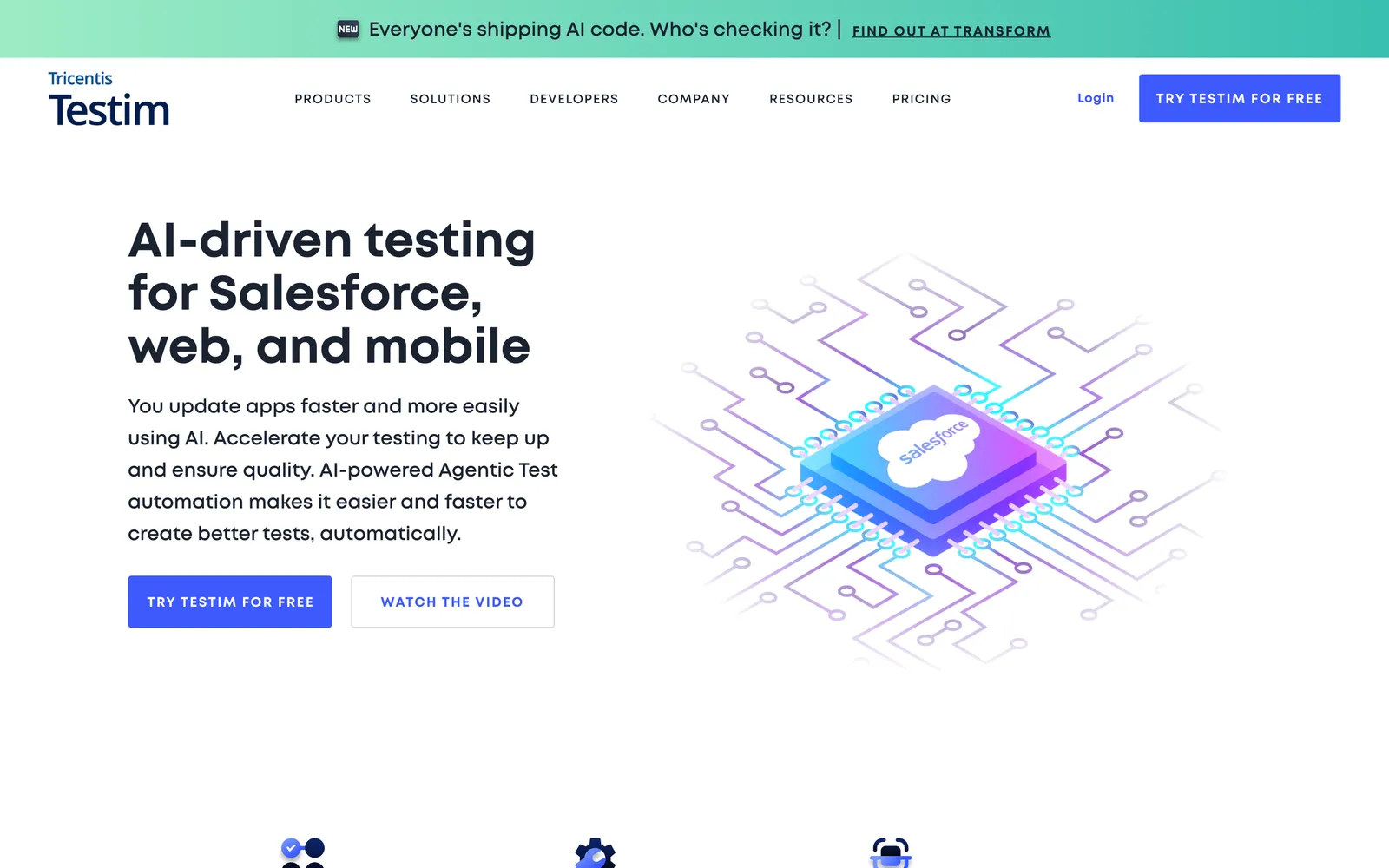
Agentic Test Automation is the newer layer, and Tricentis pitches it hardest at Salesforce: write a description of what needs testing and the agent builds the test. Mobile covers native, hybrid, React Native, and Flutter apps. Tests run on Testim's grid, locally, or on any Selenium-compatible grid, and test branches sync with your code branches on commits and merges. Root cause analysis pairs a failed run with screenshots, console logs, and network logs. Read 15 September 2026.
Main limit: no public price. You can create a free account and trial it, but a real number needs a sales call. Best for: small and mid-sized teams running frequent UI updates, especially on Salesforce.
6. testRigor
testRigor is the tool to reach for when nobody on the team writes code. Tests are free-flowing plain English, and the engine translates a line like "purchase a Kindle" into the clicks underneath. A manual tester can paste an existing test case in and refine the generated steps in the same language they already use.
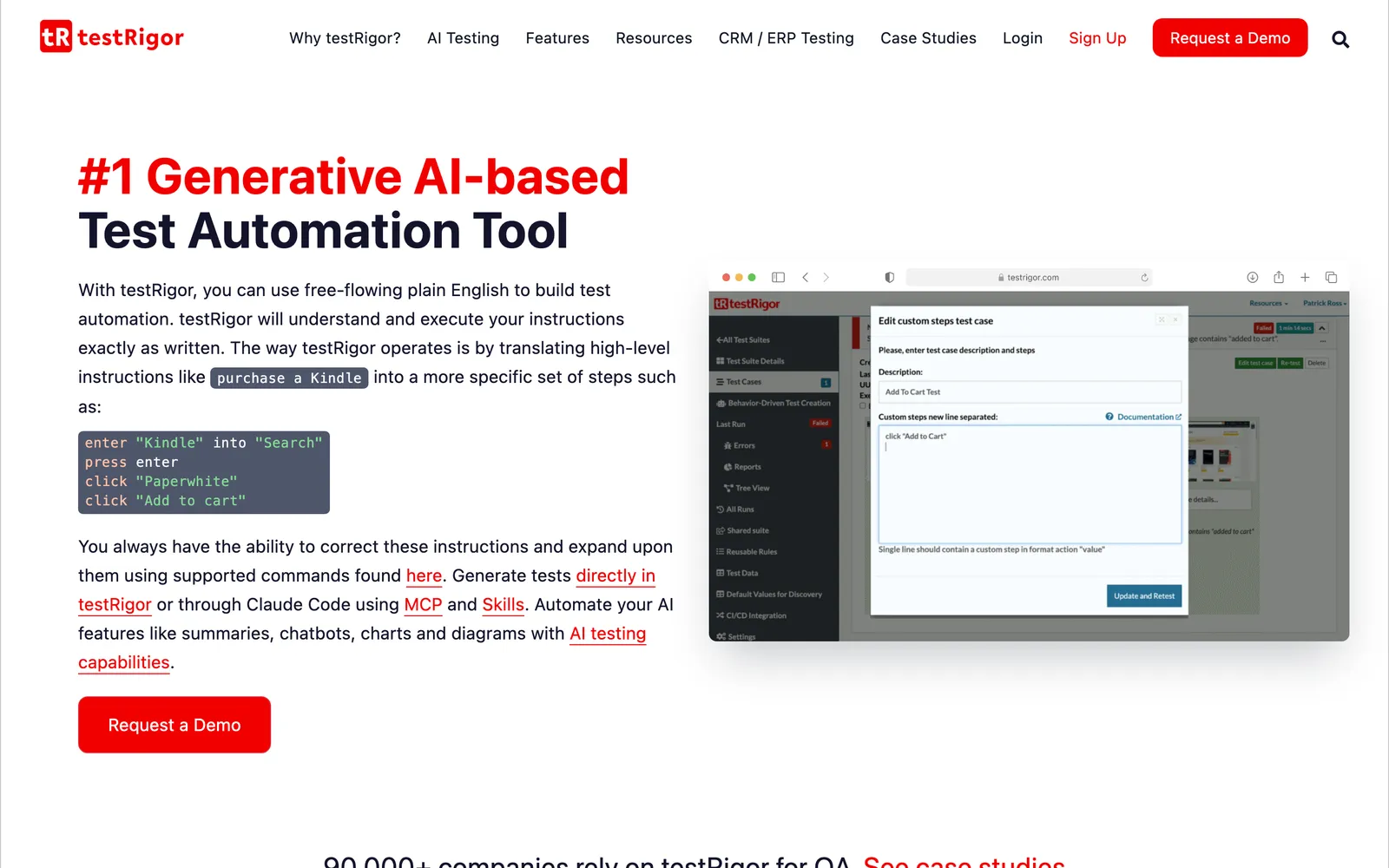
The surface is the widest here: web, native and hybrid mobile, Windows desktop, mainframe, API, email, SMS, and two-factor flows, plus accessibility and packaged applications such as Salesforce, SAP, Workday, and ServiceNow. Tests can also be generated through Claude Code over MCP. The homepage claims 100 times faster authoring and 200 times less maintenance, with no published method behind either number, so treat both as marketing. Desktop testing is paid-tier only. Read 15 September 2026.
Main limit: testRigor publishes no working pricing page. Both official pricing URLs returned 404 on 15 September 2026, and the free tier and 14-day trial are reported by TestRail rather than by testRigor. testRigor's own site documents no export of the tests as code. Best for: manual QA teams automating a regression checklist without engineering help. See testRigor alternatives for the near neighbours.
7. Applitools
Applitools answers a different question from functional checks: does the page look right? Its Eyes engine compares rendered states with models tuned to ignore rendering noise, and the Ultrafast Grid re-renders one captured run across many browsers and viewports instead of running the test again on each. Checks plug into Playwright, Storybook components, Figma designs, native mobile apps, and PDFs through SDKs, so authoring stays in the framework you already use.
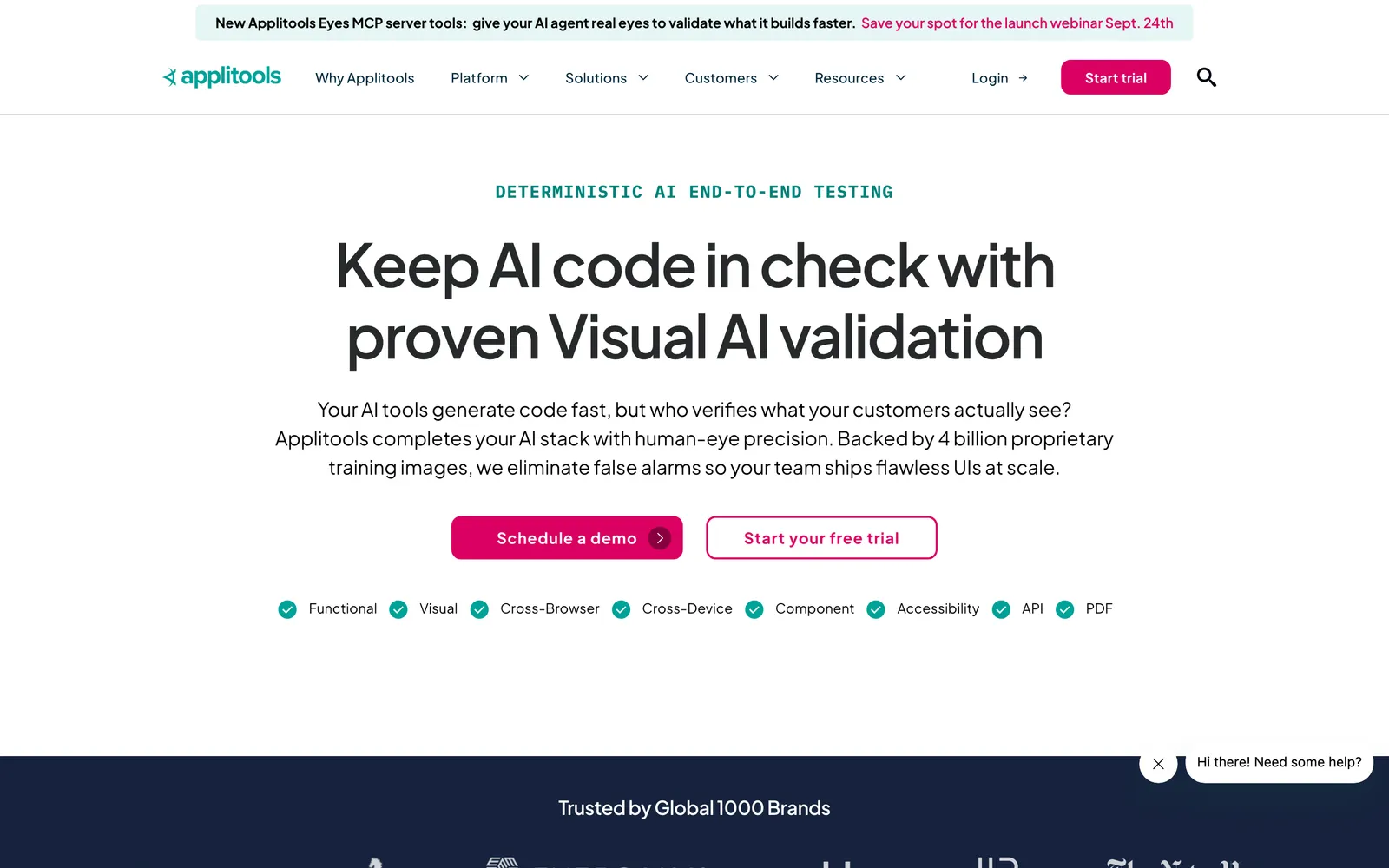
Pricing is now public at the entry tier. Starter is $667 a month paid annually, with unlimited users and either 100,000 component checkpoints or 1,000 page checkpoints, and it includes cross-browser testing, accessibility checks, automated maintenance, and root cause analysis. Professional is custom, starts at 150 active pages or 1,500 components, and adds unlimited executions, AI-driven functional testing, natural-language authoring, and codeless API testing. Enterprise adds private cloud, SSO, and a 99.99 percent uptime SLA. Read 15 September 2026 from applitools.com/pricing.
Main limit: the checkpoint is the meter, and at Starter you are buying a visual layer that still needs a functional suite under it. Best for: design systems, retail, and any product where a shifted layout costs money.
8. Testsigma
Testsigma sells breadth. One scriptless platform covers web, mobile web, Android, iOS, and API projects, with desktop and Salesforce testing alongside, and the Pro plan puts no limit on applications, projects, or automated testing minutes. Authoring is natural language with an AI companion, and auto-healing keeps scripts alive when the UI shifts.
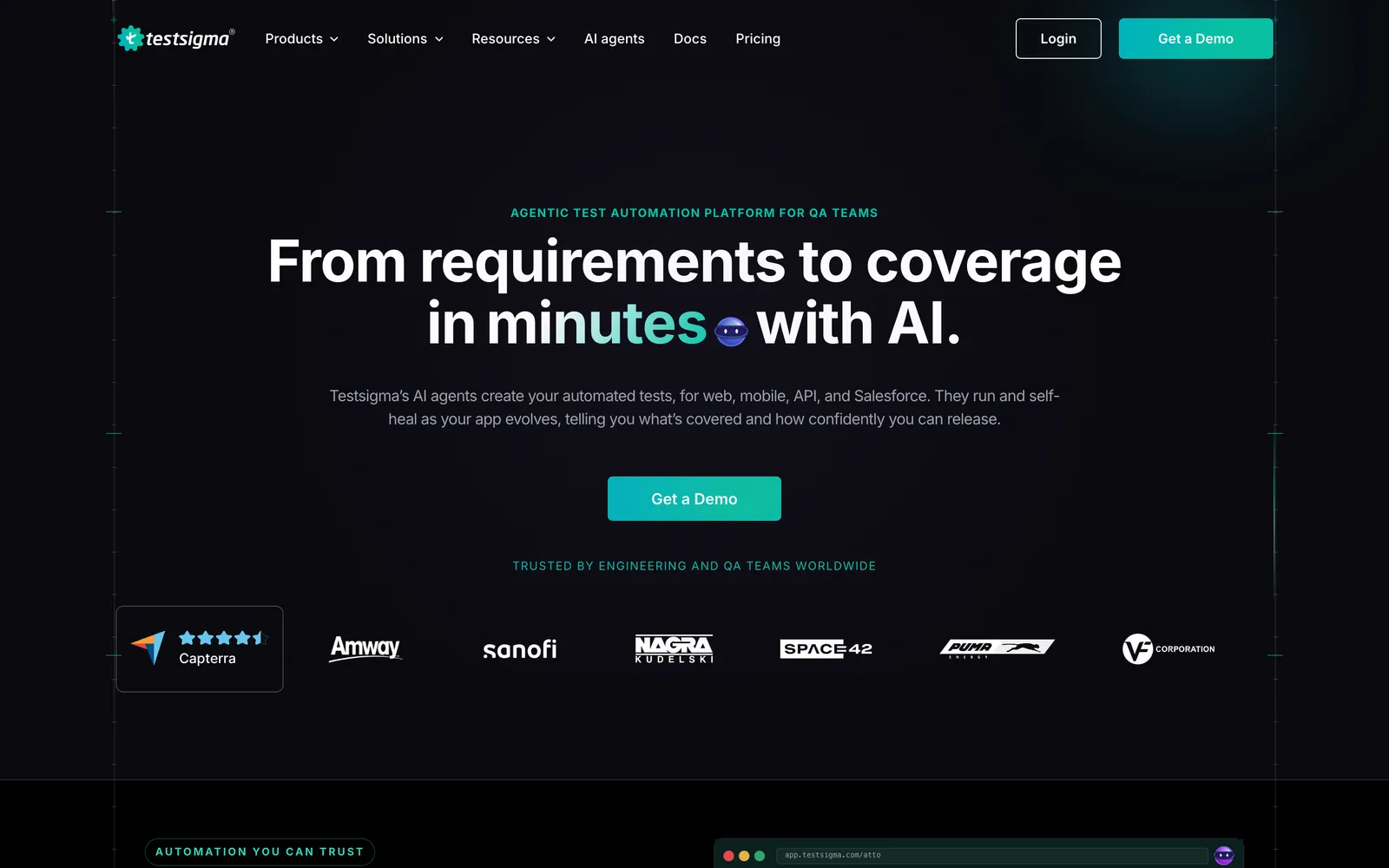
The vendor claims more than 800 browser and operating system combinations and more than 2,000 real mobile devices in its cloud. Both were read from the pricing page on 15 September 2026 and neither is verified by us. Enterprise adds accessibility testing, public, private, or on-premises deployment, SAML single sign-on, geo-based testing, IP allow-listing, and a private grid, which is the shape regulated buyers ask for.
Main limit: neither plan carries a public price. Both Pro and Enterprise say "Get Custom Pricing", so every evaluation starts with a demo, and unlimited testing minutes only mean something once you know the license cost. Best for: teams testing across many surfaces that would rather run one platform than four. Our Testsigma alternatives guide compares the options.
9. TestMu AI KaneAI (formerly LambdaTest)
KaneAI is a testing agent from TestMu AI, the company formerly called LambdaTest (lambdatest.com now redirects to testmuai.com, whose homepage reads "TestMu AI (formerly LambdaTest)", read 22 September 2026), sold per agent rather than per seat. An agent plans and authors a test case from natural language, then generates the automation script; Kane CLI does the same work from your terminal against a local browser. Cloud execution runs on TestMu AI's own web and mobile infrastructure, with HyperExecute minutes for the heavier suites.
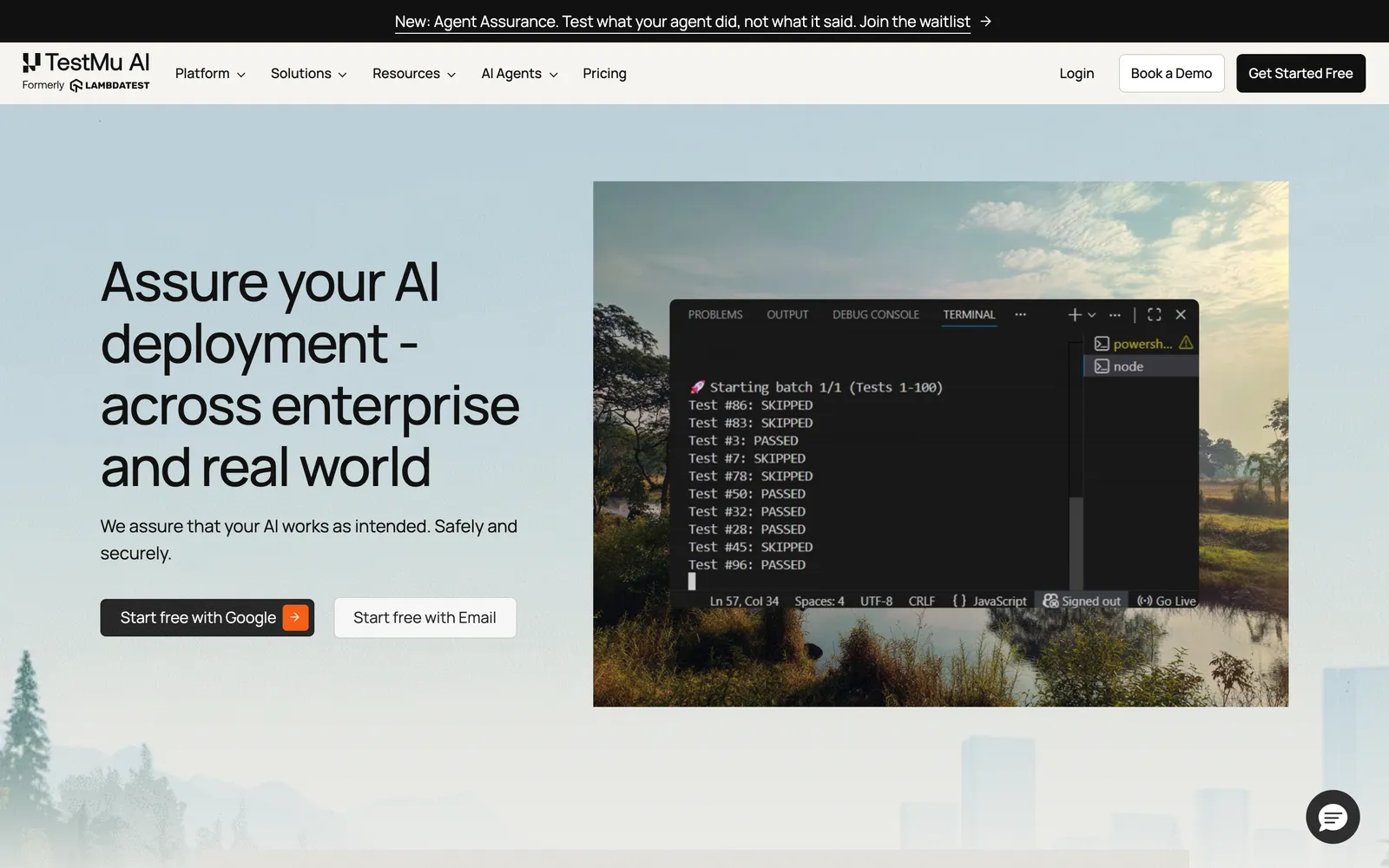
Billing is per agent per month, on credits. Starter is $17 an agent billed annually, with 2,000 credits and local authoring through Kane CLI. Pro is $89 with 12,000 credits and cloud web authoring. Max is $179 with 25,000 credits and cloud web plus mobile. Every plan includes one Test Manager seat per agent. Individual actions have credit rates, including 1.5 to 2.5 credits a step for vision validation or auto-heal and 12 credits for an AI root cause analysis. Enterprise brings unlimited credits and SSO. Read 15 September 2026.
Main limit: there is no free KaneAI plan, and per-agent licensing scales with the number of people authoring at once. Best for: teams already running on a device cloud who want the agent next to it.
10. Momentic
Momentic pairs an authoring agent with natural-language locators, so a step can target "the blue Sign up button" instead of a CSS path. Tests run in any Chromium browser, on iOS simulators, and on Android emulators, locally or on Momentic's infrastructure, driven from a CLI, from CI, or from your own coding agent over MCP. Auto-healing, failure recovery mid-run, and quarantine rules for flaky tests are all built in.
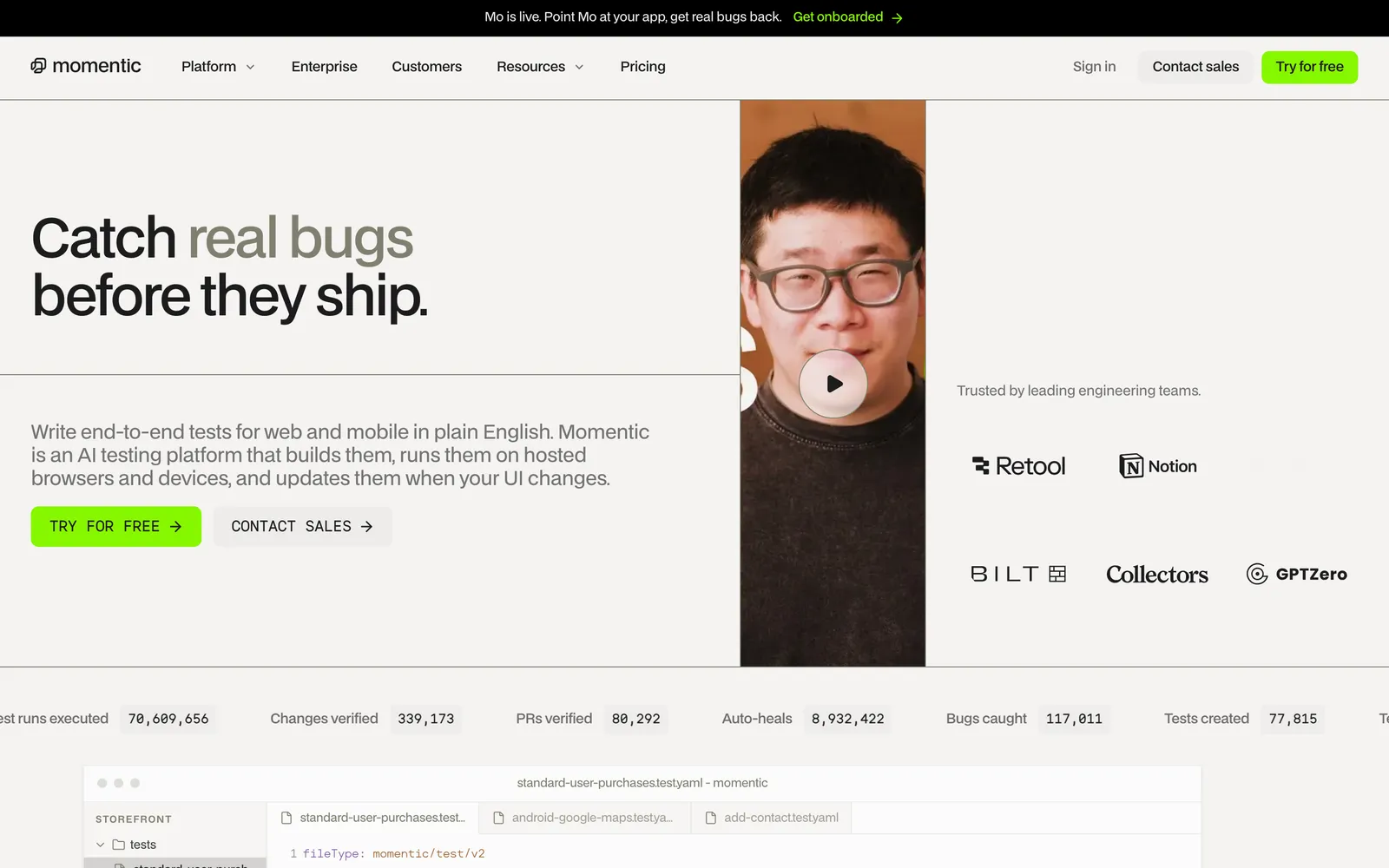
Everything is billed in credits, and the rate card is unusually specific. A normal step costs 1 credit, a step generated by an AI action or failure recovery costs 2, a hosted browser costs 1 credit a minute, an Android emulator 8 and an iOS simulator 15. Failure classification costs 100 credits per run, triage 500, and AI test selection 300. Free gives 2,000 credits a month, about 200 runs, and stops there. Pay-as-you-go is $125 a month with 10,000 credits, then $0.01875 a credit, with top-ups at 10,000 credits for $125. Read 15 September 2026 from momentic.ai/pricing.
Main limit: the features that save you time are the ones that cost most per run. Best for: product teams that want an agent, a CLI, and no per-seat math. See Momentic alternatives for the comparison set.
11. QA Wolf
QA Wolf is the answer for teams that do not want to run a testing platform at all. Its Mapping AI explores an app and documents the workflows, and its Automation AI turns prompts into deterministic Playwright and Appium code for web, Electron, Android, and iOS. Runs execute in parallel on QA Wolf's infrastructure, and the tricky cases are covered: canvas apps, injected camera and audio, email and SMS, phone calls, Salesforce, visual diffs, and LLM-as-a-judge assertions for AI outputs.
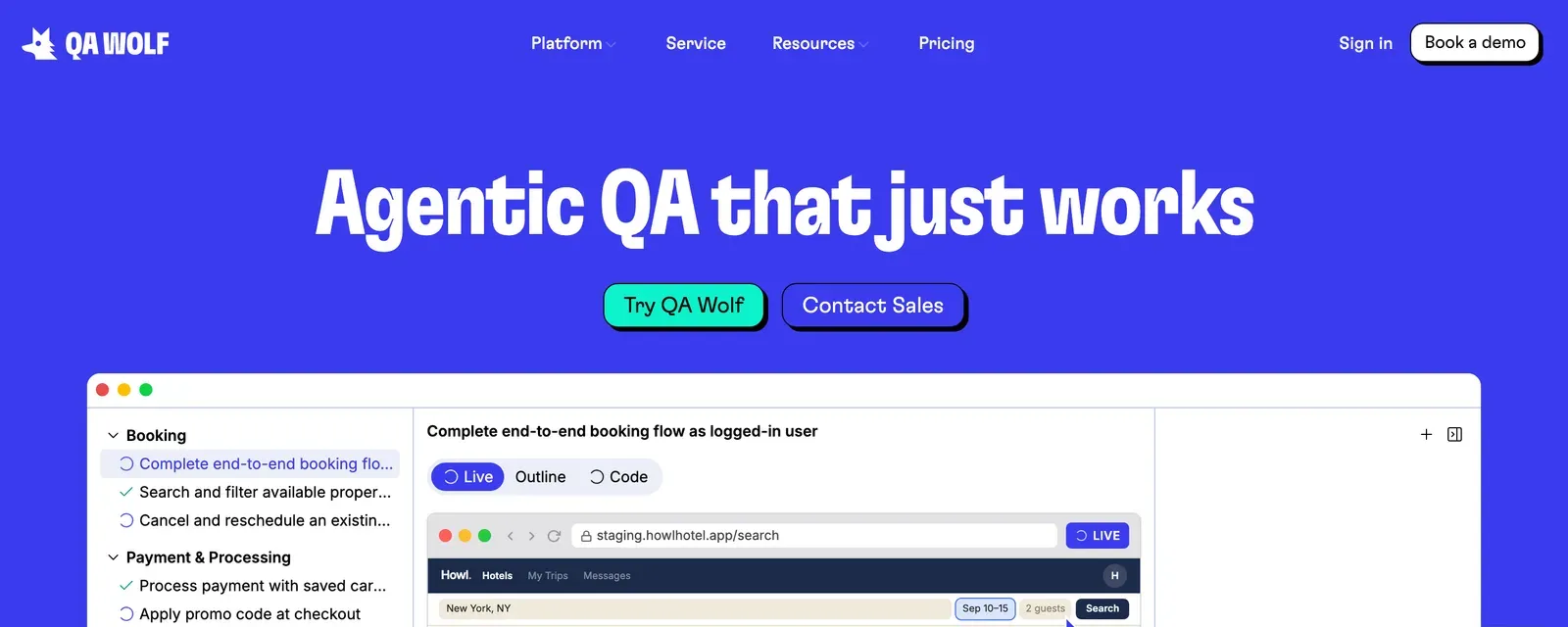
Ownership is the interesting part. The vendor states plainly that Playwright and Appium are open source, exportable, and yours to keep, and that code-based tests run without tokens. Coverage as a Service is the fully managed tier: a dedicated QA team, unlimited maintenance and runs, human investigation of every failure, and a coverage guarantee. Read 15 September 2026.
Main limit: no public price, and the managed model is a service contract with its own budget line. Your team also builds no automation practice of its own. Best for: funded teams with no QA function that want coverage without hiring. Our QA Wolf alternatives guide weighs the service model against the platforms.
Choose by Testing Job
Most shortlists get shorter once you name the job instead of the category.
These products use AI to test software; if the AI agent is the system under test, follow this AI agent testing framework instead.
Web UI regression. Compare the documented surfaces in the table, then pick on the meter and the export: Qodex and QA Wolf hand you Playwright, Functionize and Momentic meter in credits, mabl and Testsigma document no export path.
API testing. Qodex, mabl, and Testsigma cover APIs alongside the UI; Applitools adds codeless API testing on Professional. If the API is the product, start with our API testing tools roundup instead.
API security. Functional platforms check that a feature works, not that user A cannot read user B's data. Qodex runs security scenarios from the same agent; otherwise this is a second tool, and best API security testing tools covers that field.
Mobile. Real devices come from Testsigma and TestMu AI; Chromium, iOS simulators, and Android emulators from Momentic; native and hybrid apps from testRigor, Tricentis Testim, and QA Wolf.
Flaky Playwright suites. TestDino, on top of the suite you already run: flake detection, failure classification, and a merge gate on pass rate.
Visual correctness. Applitools, with a functional suite underneath it.
Packaged applications. Salesforce, SAP, Workday, and ServiceNow are first-class in testRigor and, for Salesforce, in Tricentis Testim.
Authoring without code. testRigor is built for it. Testsigma and mabl are close, with more platform around them.
No QA function at all. QA Wolf, as a service, or an agent that writes the first suite for you.
How to Evaluate an AI Testing Tool
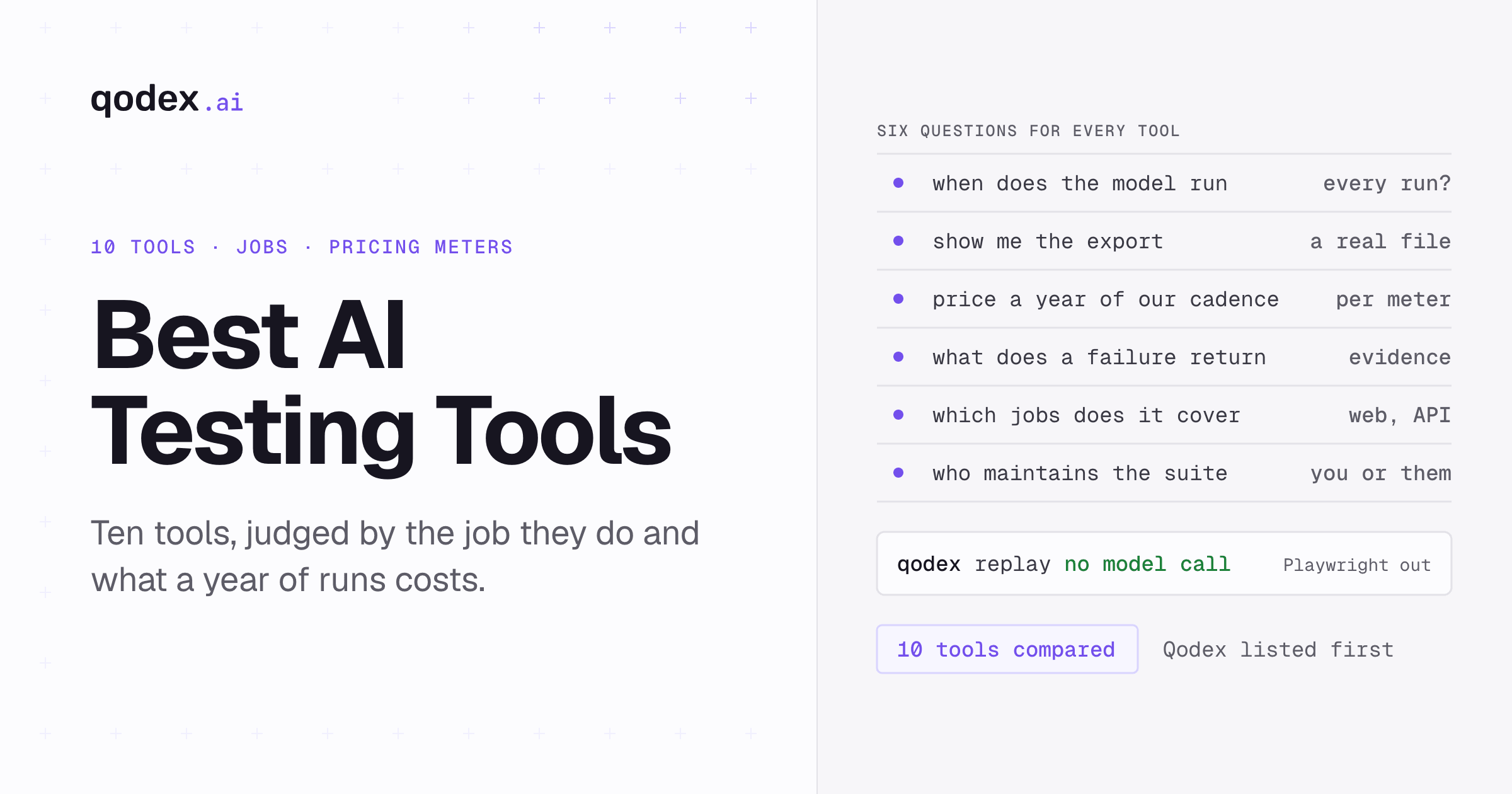
Six questions separate the tools that compound from the ones you migrate off in a year.
Ask when the model runs. If a model executes on every replay, your suite has a per-run cost that grows with deploy frequency. If the model authors once and replays are deterministic scripts, that cost stays flat. Momentic's rate card makes its answer explicit, QA Wolf says its code-based tests run token free, and Qodex charges $0 in model spend on replay. Ask the other seven directly.
Ask for the export before you sign. Request an actual file, not a feature-list answer. QA Wolf and Qodex give you Playwright. Functionize, mabl, testRigor, and Testsigma say nothing about export on the pages we read, which is itself an answer.
Price a year of your real cadence. Take your deploy frequency, multiply by suite size, and run it through each meter: credits per step, checkpoints per page, agents per author, minutes per run. Credit allowances look generous until you ship daily.
Scope security explicitly. "Do you test for broken object level authorization?" belongs on the first call. If the answer is no, add the cost of a second product to the comparison.
Ask what happens to a red build. Triage is where automation dies. Find out whether failures arrive sorted into real bugs, stale tests, and environment problems, and whether that sorting is free, metered, or done by a person. If your tool leaves that to you and the suite is Playwright, a triage layer such as TestDino covers it.
Pilot for one sprint on your own app. Pick five flows that break most often, have each shortlisted tool author them, then change the UI and watch what happens. One sprint of evidence beats a quarter of demos. As ToolRadar puts it, "AI-generated tests need review for relevance, completeness, and correctness", so count the review time in the pilot too.
Frequently Asked Questions
What are AI testing tools?
AI testing tools use a model to do part of the testing work: writing tests from a description, keeping them alive when the UI changes, comparing what the screen looks like, or sorting failures. They sit inside the wider set of QA testing tools, which also includes test management, bug tracking, device clouds, and load testing, none of which need AI at all.
What is the best AI testing tool for QA teams?
It depends on who authors and what you keep. Qodex suits engineering-led teams that want an agent to write portable Playwright covering UI, API, and security. mabl and Testsigma suit QA teams that want a managed low-code platform. testRigor suits manual testers with no engineering support. QA Wolf suits teams that would rather buy the outcome than run a tool.
Which AI testing tools work for manual testers without coding?
testRigor is the closest fit: tests are plain English, and existing manual test cases can be pasted in and refined. Testsigma and mabl also support scriptless authoring inside a low-code editor with more platform around it. Agent-first tools such as Qodex and QA Wolf author from a description instead, which suits a manual team differently: you write the flow, not the steps.
Which tools cover web, mobile, API, and desktop testing?
testRigor covers the widest surface on this list, including desktop and mainframe, though desktop is paid-tier only. Testsigma covers web, mobile web, Android, iOS, API, desktop, and Salesforce. mabl covers web, mobile, API, accessibility, and performance. Tricentis Testim covers Salesforce, web, and native and hybrid mobile. Qodex covers web UI, API, and API security.
Can AI testing tools replace Playwright or Selenium?
No, and the better ones do not try. Playwright and Selenium are execution frameworks; AI tools mostly sit on top, generating the tests, healing them, or triaging results. Qodex and QA Wolf output Playwright directly, so you get AI authoring with a framework you already know. mabl, testRigor, Testsigma, Momentic, and Testim run the tests in their own platform instead, which is the trade to weigh.
Are there free AI testing tools?
Three of the eleven publish a free plan on their own pricing page. Functionize Free gives 200 credits a month. TestDino Free gives 5,000 test executions a month for one user. Momentic Free gives 2,000 credits, about 200 runs, with no card. TestRail reports a free tier for testRigor, though testRigor's own pricing pages were unreachable on 15 September 2026. TestMu AI has no free KaneAI plan. The rest list a trial, a demo, or both.
How should teams compare credit-based pricing?
Convert credits into runs before comparing anything. Ask what a normal step costs, what an AI step costs, and what the extras cost: Momentic charges 100 credits to classify a failure and 500 to triage one, which can dwarf the run itself. Then multiply by your real weekly cadence, add overage rates, and compare monthly totals rather than headline prices.
What can AI testing tools not test reliably?
Anything that needs judgment about whether the product is right rather than working. A model can confirm a checkout completes; it cannot tell you the refund policy is wrong. Generated tests also drift toward the happy path and miss the edge cases a tester would try. Treat the output as a first draft and review it before you trust it.
Final Shortlist
One constraint decides it. Want an agent to write UI, API, and security tests and leave you the Playwright? Qodex. Want a managed platform with a person on call? mabl, or Testsigma for more surfaces. Automating without engineers? testRigor. Visual correctness is the risk? Applitools. No QA function at all? QA Wolf. Already on Playwright and losing days to flaky runs? Add TestDino. The rest of our head-to-head comparisons live at qodex.ai/alternatives.