mabl vs testRigor: An Honest Comparison for 2026
The Verdict in 50 Words
Choose mabl if you want an ML-mature, vendor-supported platform with web, API, performance, and accessibility testing under one license and a CSM on call. Choose testRigor if manual QA staff will own automation or you need desktop, mainframe, or ERP coverage. mabl shows no price, and testRigor shows a price only for its free Public plan, so budget for a sales call either way.
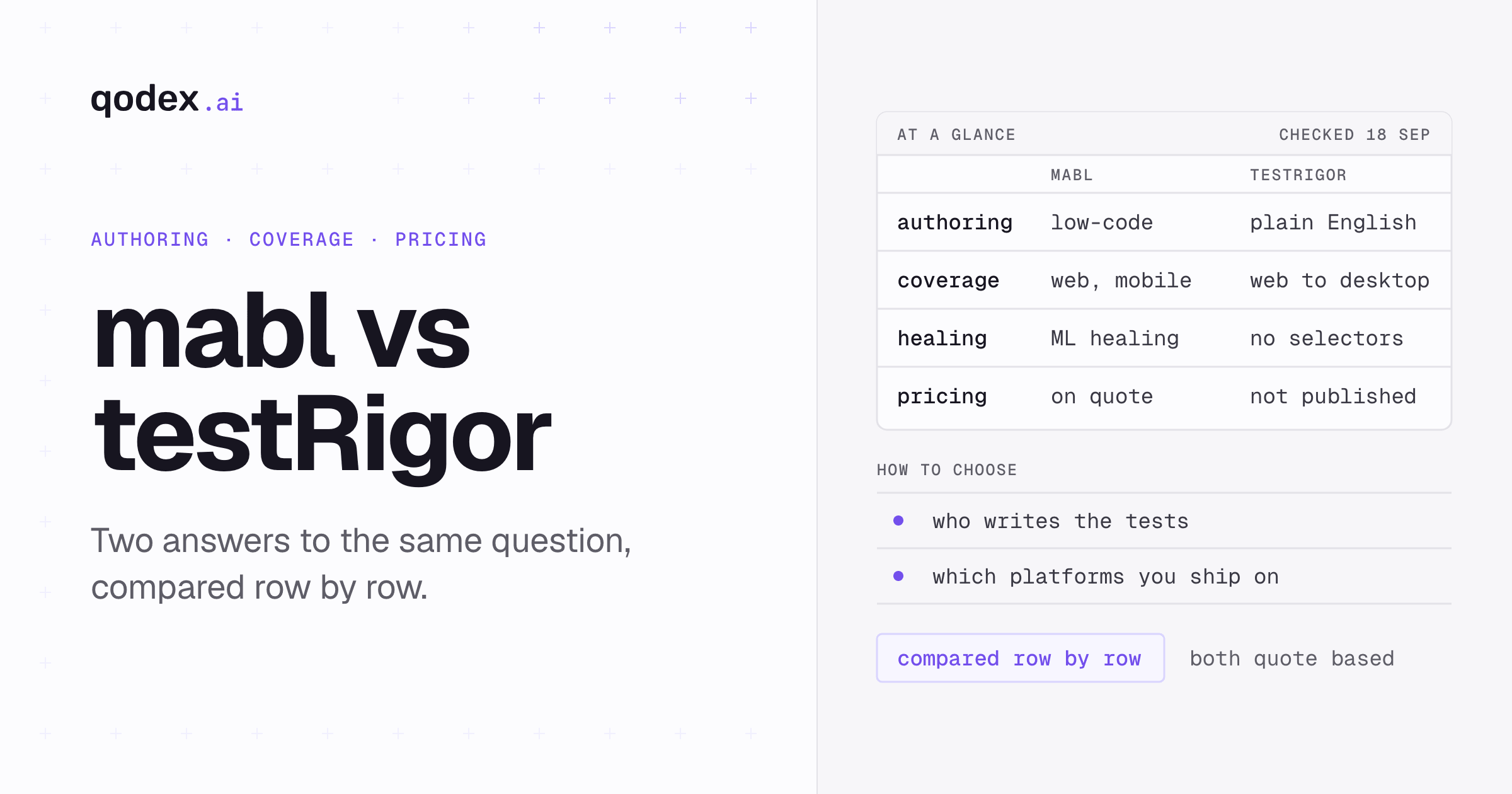
mabl vs testRigor at a Glance
Both vendors' sites were re-read on 4 October 2026:
| mabl | testRigor | |
|---|---|---|
| Authoring model | Low-code trainer plus GenAI test generation | Plain-English statements executed as tests, with generative AI drafting |
| Coverage | Web, native mobile (paid add-on), API, accessibility, performance, AI app validation | Web, mobile, desktop (Windows native), mainframe, and ERP/CRM (SAP, Salesforce, ServiceNow, Workday, Dynamics, Infor) |
| Pricing model | Quote-based; cloud runs metered by credits (500/month starting point); local and CI runs free | Free Public plan (tests are public); Private Complete and Enterprise priced by sales |
| Auto-healing | AI-based healing plus agentic runtime recovery | Elements targeted the way users see them, plus AI self-healing |
| Code ownership | Tests live in mabl; runs in the cloud, locally or in CI | Tests live in testRigor's English format; a Playwright plugin runs its commands |
| Target team | Mid-market and enterprise teams with budget for a supported platform | Manual QA teams automating without engineers |
Different Answers to the Same Question
Both tools exist because hand-written Selenium suites collapse under maintenance. They just attack the problem from opposite ends.
mabl is platform-first. AI-native since 2017, it wraps test creation, execution, healing, and analysis into a managed cloud. Its current positioning is agentic testing for teams whose coding agents ship faster than their test coverage can follow. One license covers web UI, API (with Postman collection import), accessibility, and performance testing, with native mobile as an add-on.
testRigor is authoring-first. Its bet is that the test itself should be plain English: "click on Sign In", "check that page contains Welcome". Statements execute directly against the application, elements are identified the way a human would describe them rather than via selectors, and generative AI drafts tests for you. The pitch is that your existing manual QA team becomes the automation team, no engineers required.
Authoring: Low-Code Editor vs Plain English
mabl gives you a structured low-code editor: flows, branching, data-driven tests, reusable snippets, and GenAI generation for web, mobile, and API tests, plus natural language flow search. It is more expressive for complex logic, and more of a tool to learn. mabl offers onboarding and mabl University training for that reason.
testRigor starts from English: if you can write a manual test case, you can write a testRigor test. Tests can also be AI-generated from descriptions, imported, or edited as English steps. The honest limit: a long English suite still has to be read and reviewed by people.
The right question is who authors tests at your company: automation-minded QA engineers, or manual testers who write in English.
Coverage: Modern Web Depth vs Legacy Breadth
This is the cleanest separation between the two products.
mabl goes deep on the modern stack: web UI, API, accessibility, performance under load, database testing, and validation of AI/LLM outputs inside your product. If your quality surface is a web application and its services, that is mabl's home ground.
testRigor goes wide across eras of software: web, native and hybrid mobile, Windows desktop applications, mainframe terminals, and packaged ERP/CRM systems with dedicated support for SAP, Salesforce, ServiceNow, Workday, Microsoft Dynamics, and Infor. It also supports 21 CFR Part 11 workflows for regulated industries. If your test estate includes a green-screen system or an ERP, testRigor documents those surfaces directly.
The pages we read show no mainframe testing from mabl. testRigor offers load testing too, so ask both for a demo on your hardest surface.
Pricing: Only testRigor's Free Plan Has a Number
mabl publishes no prices. Its pricing page (read 4 October 2026) asks you to request a quote. The underlying meter is credits: cloud test runs consume them, with a starting point of 500 credits per month shared across browser, mobile, API, performance, and accessibility testing. Local and CI runs are unlimited and free, participant licenses are unlimited, and there are no setup fees. Native mobile testing and a Technical Account Manager cost extra. Budgeting requires a sales conversation, and your bill scales with cloud run volume.
testRigor publishes no paid price either. Read on 4 October 2026, testrigor.com/pricing returns a 404, and the footer's Pricing link opens the sign-up page. That page lists a free-forever Public plan whose tests and results are public, Private Complete with a 14-day trial, and Enterprise, with no amount for either private plan.
So the pricing comparison is a wash. Neither vendor lets you size a year of private testing from its website, and any number you have seen quoted elsewhere is second-hand. Ask both for written pricing against the same run volume before you compare anything else.
Test Stability: ML Healing vs Selectorless Authoring
The two products represent different philosophies about why tests break.
mabl's answer: heal the breakage. Its AI-based auto-healing repairs tests when the UI changes, and its agentic runtime recovery can adapt mid-run when a flow goes sideways, then produce automatic failure summaries with root-cause insights.
testRigor's answer: remove the thing that breaks. testRigor promotes selectorless tests that reference elements by name, position and context, the way a user would describe them, though its docs still list deprecated CSS and XPath commands. It can also propose AI recoveries, and it labels healed steps so you can reject an unwanted one.
Both approaches aim to reduce maintenance. Try each on the screens your current suite breaks on most.
Compliance and Support
Certifications: mabl says it is SOC 2 compliant. testRigor publishes a SOC 2 Type II report, ISO/IEC 27001:2022 certification, HIPAA compliance, and 21 CFR Part 11 support, which matters if you are in healthcare, pharma, or life sciences.
Support model: mabl includes a designated Customer Success Manager, 24/5 live in-product support, and mabl University training. testRigor offers demo-led onboarding and support, plus an unusually current tooling story: it ships an MCP server and documents workflows for generating and maintaining tests with Claude Code.
Deployment: testRigor offers cloud and on-premise deployment. mabl is a cloud platform and documents cloud access to private networks.
A Third Option Worth Knowing: Qodex
Both mabl and testRigor now generate tests with AI, and both keep the resulting suite in their own format. If your team is engineering-led, there is a third shape worth seeing before you commit: Qodex, an autonomous AI QA agent. You describe what matters in chat; the agent explores your web app in a real Chromium browser and your API over direct HTTP calls, then drafts the suite itself. As a third column in the table above:
| Qodex | |
|---|---|
| Authoring model | Chat-first AI agent explores your app and drafts the tests |
| Coverage | Web UI, API, and security testing from one agent |
| Pricing model | Individual $0; Startup from $1,299 per project/month; replays cost nothing in model spend, within plan run limits |
| Auto-healing | Re-drives changed flows and proposes a repair diff for approval; failures triaged as real bug, stale test, or environment issue |
| Code ownership | Generated tests are standard Playwright and HTTP scripts, git-syncable and ejectable |
| Target team | Engineering-led teams that want agent authoring with code they own |
The two structural differences: generated tests are standard Playwright and HTTP code you can eject and run anywhere. And security testing (OWASP-aligned checks for IDOR, broken auth, and injection) runs on the same pull requests as functional tests. In fairness to both tools on this page: Qodex's published surfaces are web UI, API and security, not native mobile, desktop or mainframe. The direct comparisons live at Qodex vs mabl and Qodex vs testRigor, or start free and compare the first generated suite against either trial.
How to Choose Between mabl and testRigor
Decide who owns automation first. If the answer is manual QA staff without engineering support, testRigor is built for exactly that team, though mabl's natural-language and low-code authoring also serves non-developers. If the answer is QA engineers inside a funded quality org, mabl's depth pays off.
Map your application estate. Mainframe, Windows desktop, or ERP systems in scope? testRigor documents all three; check mabl's coverage for yours. Performance, accessibility, and AI-output testing on a web product? That is mabl's home turf.
Budget honestly. Both require a quote for private use, so neither can be priced from its website. mabl's credit meter means cloud run volume drives cost. Model a year of your regression cadence, then make both vendors quote against it.
Check the exit. Check each one's export options before you commit, because the suite you build is a switching cost either way. Our mabl alternatives guide covers the tools that hand you portable code if that changes your math.
Frequently Asked Questions
How much do mabl and testRigor cost?
Neither publishes a paid price. mabl is quote-based, with cloud runs metered by credits (500 per month as a starting point per its pricing FAQ) and unlimited local and CI runs. testRigor's sign-up page lists a free Public plan, whose tests are public, and quote-based Private Complete and Enterprise plans. Both read on their own sites on 4 October 2026.
Can manual testers really write testRigor tests without engineers?
Largely yes, and it is the product's core strength. Tests are plain-English statements, elements are referenced by visible text rather than selectors, and generative AI drafts tests from descriptions. The caveats: someone still needs to own suite structure and review, or you trade code maintenance for prose maintenance.
Which handles UI changes better, mabl or testRigor?
They take different routes to the same goal. mabl heals broken tests with AI-based auto-healing plus agentic recovery during execution. testRigor targets elements the way a user describes them, which reduces failures from locator changes, and adds AI self-healing. Trial both on the screens that break your current suite.
Is mabl or testRigor better for mobile app testing?
mabl offers iOS and Android testing as a paid add-on with unlimited parallel cloud runs, integrated with its web and API testing. testRigor covers mobile, but quotes it through sales like everything else. Neither includes real-device mobile testing at a published price, so this comes down to the quotes; if mobile is your primary surface, also evaluate platforms with large included device labs, like Testsigma.
Which is better for regulated industries?
testRigor publishes a SOC 2 Type II report, ISO/IEC 27001:2022 certification and HIPAA compliance, and supports 21 CFR Part 11 workflows. mabl says it is SOC 2 compliant, provides audit trails and sells into financial services and healthcare. For on-prem requirements, testRigor offers on-premise deployment; mabl is a cloud platform.
Do mabl or testRigor tests work outside their platforms?
Check before you commit. mabl tests are maintained in mabl and run in its cloud, locally or in CI. testRigor tests are English statements interpreted by testRigor's engine, and its Playwright plugin runs those commands inside Playwright tests. Ask each vendor what an export to Playwright or Selenium would carry. If code ownership matters to you, shortlist tools that generate standard scripts, such as Qodex, or build on open-source frameworks directly.