Geração Automatizada de Casos de Teste: GPT-5 vs O3 vs GPT-4.1 Comparados
Geração Automatizada de Casos de Teste: Comparando GPT-5, GPT-4.1 e o3
A geração automatizada de casos de teste usando modelos de IA está transformando a forma como as equipes constroem suítes de testes de integração. Testamos três modelos GPT - GPT-5, GPT-4.1 e o3 - para avaliar sua capacidade de gerar cenários de testes de integração para uma API multi-serviço (cobrindo organizações, projetos, convites de membros e perfis de usuários). Nós os avaliamos em:
Cobertura - Quantas categorias de integração eles abrangem
Especificidade / Acionabilidade - Quão claros e utilizáveis são os cenários
Segurança / Ética - Se o resultado pode ser compartilhado com segurança
Organização / Usabilidade - Clareza, agrupamento e ausência de redundância
Facilidade de Remediação - Com que facilidade os desenvolvedores podem agir sobre os resultados
Cobertura por Categoria
Categoria | GPT-5 (Qtd. / Qualidade) | GPT-4.1 (Qtd. / Qualidade) | o3 (Qtd. / Qualidade) |
|---|---|---|---|
Caminho Feliz de Ponta a Ponta | 3 / Alta | 2 / Alta | 1 / Alta |
Autenticação e Autorização | 6 / Alta | 3 / Média | 2 / Média |
Erros de Validação e Schema | 9 / Alta | 3 / Média | 4 / Alta |
Tratamento de Duplicatas e Conflitos | 5 / Alta | 2 / Média | 2 / Média |
Negociação de Cabeçalho e Conteúdo | 6 / Alta | 2 / Média | 2 / Média |
Limitação de Taxa / Concorrência | 3 / Média | 1 / Média | 1 / Média |
Isolamento entre Tenants / Acesso | 2 / Alta | 1 / Média | - |
Casos de Limite / Extremos | 7 / Alta | 1 / Baixa | 2 / Média |
Observabilidade / Mensagens de Erro | 3 / Alta | 1 / Média |
Cobertura Total
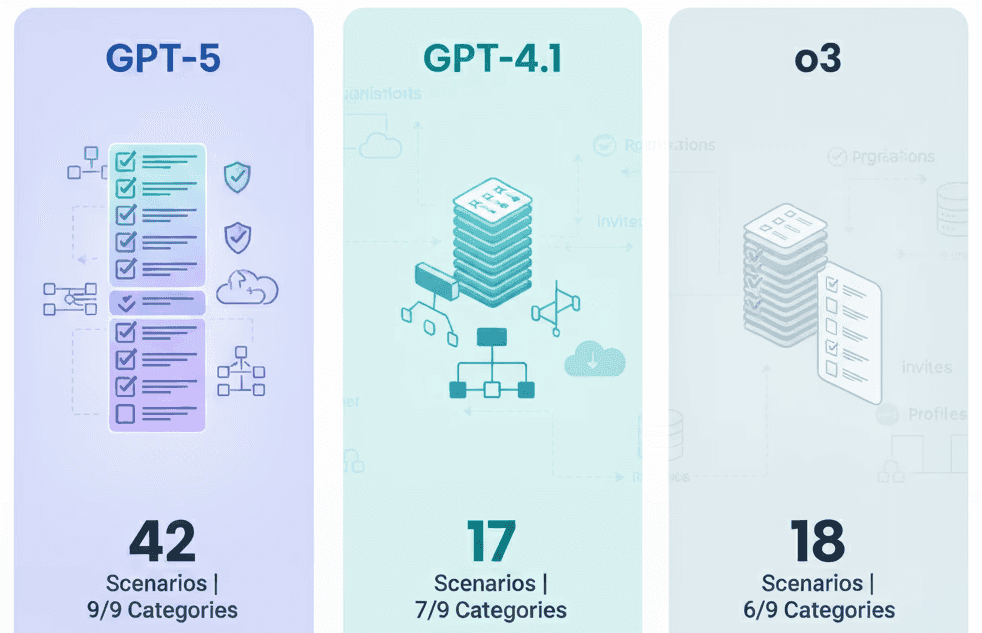
GPT-5: ~40 cenários, 9/9 categorias, qualidade Alta
GPT-4.1: 17 cenários, 7/9 categorias, qualidade Média-Alta
o3: 14 cenários, 6/9 categorias, qualidade Média
Análise Modelo a Modelo
Cenários do GPT-5
Visão Geral:
Cobertura: Gerou 42 cenários, abrangendo todas as categorias, incluindo limites, cabeçalhos, Unicode e isolamento entre tenants.
Pontos Fortes: Detalhes ricos, fluxos realistas de requisição/resposta de API, tratamento explícito de cabeçalho e content-type.
Pontos Fracos: Saídas verbosas; alguns cenários superprojetados para configurações simples.
Resultados Notáveis: Cobriu segurança contra injeção de script, codificação gzip e isolamento entre tenants: casos críticos para nível empresarial.
Melhor Para: Pipelines de CI/CD focados em segurança e suítes abrangentes de testes de integração.
Cenários Gerados:
Caminho Feliz de Ponta a Ponta
1. End-to-end happy path across services: POST /users/sign_in with valid credentials (Accept: application/json, Accept-Encoding: gzip, Connection: keep-alive) to obtain token -> POST /api/v1/organisations with {name: unique} using Authorization: Bearer to create org and capture id -> GET /api/v1/organisations/{id} to verify created name -> PUT /api/v1/organisations/{id} with {name: updated} to update -> GET /api/v1/organisations/{id} to assert updated name -> POST /api/v1/organisations/{id}/projects with {project:{name: unique, url: https://valid.example}} to create project and capture project_id -> POST /api/v1/projects/{project_id}/invite_by_email with {email: valid@domain.com, role: member} to invite; assert 200/201/202 responses, JSON content-type, and resource IDs returned in responses.Autenticação e Autorização
2. Authorization enforcement across critical operations: attempt POST /api/v1/organisations, PUT /api/v1/organisations/{id}, POST /api/v1/organisations/{id}/projects, and POST /api/v1/projects/{project_id}/invite_by_email without Authorization header; assert each returns 401/403 and no state change (verify by retrying with Authorization and confirming no duplicate or unintended resource exists).
3. Invalid token handling across protected endpoints: Use Authorization: Bearer invalid_or_expired_token on POST /api/v1/organisations and POST /api/v1/organisations/{id}/projects; assert 401 with consistent error schema.
4. Update profile user id mismatch: Login as User A, then PUT /api/v1/users/{UserB_id} with {name:'Hacked'}; assert 403/401 and no change to User B.
5. Update profile without Authorization: PUT /api/v1/users/{user_id} without Authorization; assert 401/403 and no change.
6. Cross-tenant isolation with two users: Login as User A, create Org A; Login as User B -> GET /api/v1/organisations/{OrgA_id} expect 403/404; PUT /api/v1/organisations/{OrgA_id} expect 403; POST /api/v1/organisations/{OrgA_id}/projects expect 403; verify User B cannot access or mutate User A's resources.
Erros de Validação e Schema
7. Create organisation validation error (missing name): POST /api/v1/organisations with {} (or null/empty name); assert 400/422 with validation error and no org created.
8. Create project invalid URL format: POST /api/v1/organisations/{org_id}/projects with {project:{name:'Proj Bad', url:'not-a-url'}}; assert 400/422 URL validation error.
9. Create project missing required fields: POST /api/v1/organisations/{org_id}/projects with {project:{url:'https://example.com'}} (no name) or with empty project object; assert 400/422 with field-level errors.
10. Invite member invalid email format: POST /api/v1/projects/{project_id}/invite_by_email with {email:'not-an-email', role:'member'}; assert 400/422 email validation error.
11. Invite member invalid role: POST /api/v1/projects/{project_id}/invite_by_email with {email:'user@domain.com', role:'invalid_role'}; assert 400/422 role validation error.
12. Update profile validation error (missing/empty name): PUT /api/v1/users/{user_id} with {} or name:""; assert 400/422.
13. Organisation with HTML/script injection string: POST /api/v1/organisations with name "alert('x')"; assert 201; GET /api/v1/organisations/{id} returns safe-encoded/plain text and no script execution in clients; name stored as inert text.
Tratamento de Duplicatas e Conflitos
14. Create organisation duplicate name handling: POST /api/v1/organisations 'Org Dup' twice with same authenticated user; assert second request returns 409/422 and no duplicate resource.
15. Create project duplicate name within same org: POST same {project:{name:'Proj Dup', url:'https://a.com'}} twice under same org; assert second returns 409/422.
16. Invite member idempotency/duplicate handling: Invite the same email to the same project twice; assert second response is idempotent (200 with no-op) or returns a clear 409/422 'already invited/member' error without sending a new invite.
Negociação de Cabeçalho e Conteúdo
17. Login request missing required header: POST /users/sign_in without Accept header; assert 4xx error.
18. Required header enforcement on project creation: POST /api/v1/organisations/{org_id}/projects omitting Accept header; assert 4xx error; retry with Accept to confirm success.
19. Required header enforcement on organisation update: PUT /api/v1/organisations/{id} omitting Accept header; assert 4xx and no update; retry with header to confirm update works.
20. Incorrect Content-Type handling on POST/PUT: Send Content-Type:text/plain (or missing) with JSON body; assert 415/400 and descriptive error.
21. Accept-Encoding gzip on fetch: Create an org -> GET /api/v1/organisations/{id} with Accept-Encoding:gzip; assert response includes Content-Encoding:gzip and body decompresses to valid JSON.
Limitação de Taxa / Concorrência
22. Submit multiple failed login attempts exceeding threshold; expect 429 Too Many Requests.
23. Update organisation idempotent same-name update: PUT /api/v1/organisations/{id} with same name; assert 200 and no unintended changes.
Casos de Limite e Extremos
24. Create organisation name length boundary: 255 chars - success; 256+ - 400/422.
25. Create organisation with Unicode/emoji: stored and retrieved intact.
26. Whitespace trimming on organisation name: " Trim Test " stored consistently.
27. Update profile name length boundary: 255 chars - success; 256+ - 400/422.
Existência de Recursos
28. Fetch organisation by unknown id: 404 Not Found.
29. Fetch organisation with invalid id format: 400/404 stable error.
30. Create project for non-existent organisation: 404 Not Found.
31. Invite member to non-existent project: 404 Not Found.
32. Update organisation invalid id: PUT with fake id - 404.Cenários do o3
Visão Geral
Cobertura: Gerou 14 cenários, cobrindo principalmente validação, duplicatas e verificações simples de autorização.
Pontos Fortes: Bom em validação de schema, tratamento de duplicatas e fluxo de caminho feliz simples.
Pontos Fracos: Perdeu categorias avançadas como testes de limite, tratamento gzip ou isolamento entre tenants.
Resultados Notáveis: Permitiu atualizações sem autorização, revelando uma lacuna crítica de autenticação.
Melhor Para: Verificações rápidas de validação e aplicação de regras básicas de negócio.
Cenários Gerados:
Caminho Feliz de Ponta a Ponta
1. Log in with valid credentials to obtain token, create a new organisation, fetch it by id, update its name, create a project inside it, and invite a member; verify each step's response codes (201/200) and that all returned objects reference the same organisation & project ids.Erros de Validação e Schema
2. Attempt to create an organisation while omitting the required "name" property in the JSON body; expect HTTP 400 Bad Request with validation detail for the missing field.
3. Create a project with the required name but missing the required "url" attribute; expect HTTP 422 Unprocessable Entity with validation feedback.
4. Invite a member to a project using an invalid email format (e.g., "not-an-email"); expect HTTP 422 with message indicating invalid email.
5. Update a user profile with a "name" value exceeding 255 characters; expect HTTP 422 validation error for field length.
6. Fetch an organisation using an invalid identifier format (e.g., "12345"); expect HTTP 400 Bad Request for malformed id.
7. Fetch an organisation while omitting the required Accept header; expect HTTP 406 Not Acceptable due to unsupported or missing media type.
Tratamento de Duplicatas e Conflitos
8. Attempt to create an organisation with a name that already exists in the tenant; expect HTTP 409 Conflict with an error message indicating duplicate organisation.
9. Invite the same user email to the same project twice: first invitation returns 200 Created, second attempt returns 409 Conflict (or business-rule error) indicating the user is already invited.
Autenticação e Autorização
10. Update an existing organisation WITHOUT supplying an Authorization header (header is optional); verify that the request still succeeds with HTTP 200 and the organisation record is updated correctly.
11. Try to update another user's profile with a valid token that belongs to a different user; expect HTTP 403 Forbidden due to lack of ownership.
Limitação de Taxa / Concorrência
12. Submit six consecutive failed login attempts with wrong password within one minute; after the configured threshold, expect HTTP 429 Too Many Requests (rate-limiting) on subsequent attempts.Existência de Recursos
13. Create a project under an organisation id that does not exist; expect HTTP 404 Not Found and an error saying the parent organisation cannot be located.
14. Attempt to invite a member to a non-existent project id; expect HTTP 404 Not Found.
Cenários do GPT-4.1
Visão Geral
Cobertura: Produziu 17 cenários, equilibrando CRUD, autenticação e convites.
Pontos Fortes: Casos de teste claros e seguros para compartilhar; incluiu um fluxo admin completo de ponta a ponta.
Pontos Fracos: Poucos casos extremos; mais fraco em cabeçalhos avançados e aplicação de content-type.
Resultados Notáveis: Testou atualizações de perfil bem-sucedidas e proibidas, útil para equipes de desenvolvimento.
Melhor Para: Checklists de desenvolvedores e testes rápidos de sanidade de integração.
Cenários Gerados:
Autenticação e Autorização
1.	Authenticate with valid credentials and verify that the response status is 200, a session token is returned, and response headers include the expected security tokens and content type.
2.	Attempt login with a valid email but wrong password and confirm a 401 status with an appropriate error message and no session token in the response.
3.	Update an existing organisation's name while including an Authorization token and verify that the update returns 200 and the organisation record reflects the new name.
4.	Attempt to update another user's profile using a valid token that does not belong to that user and confirm a 403 forbidden response with no data altered.
Caminho Feliz de Ponta a Ponta
5. Create a new organisation using a unique name without providing an Authorization header and ensure the organisation is created successfully (201) and returned object contains a generated organisation_id.
6. End-to-end flow: login as an admin, create an organisation, create a project in that organisation, invite a member, then login as the invited member with the invitation token to confirm access to the project.
Erros de Validação e Schema
7. Attempt to create an organisation while omitting the required Accept header and confirm that the API responds with a 400 (bad request) highlighting missing headers.
8. Attempt to create a project without providing the url field in the request body and validate that the API returns a 422 (unprocessable entity) or appropriate schema validation error.
9. Invite a member using an invalid email format and verify that the API returns a 400 validation error without sending any email.
Tratamento de Duplicatas e Conflitos
10. Create a second organisation with the same name as an existing one and validate that the API rejects the request with a 409 (conflict) or equivalent duplicate-resource error.
11. Attempt to invite the same email twice to the same project and confirm the second request is gracefully rejected with a 409 (conflict) or informs that the user is already invited.
Existência de Recursos
12. Attempt to update an organisation using an invalid/non-existent organisation_id and confirm that the response is 404 with a clear error message.
13. Fetch organisation details with a valid organisation_id and ensure that the response matches the latest state of the organisation after any updates.
14. Fetch organisation details for a deleted or non-existent organisation_id and verify a 404 error is returned.
Convites e Perfis
15. Invite a new member to an existing project by email with role "developer" and verify a 200/201 status, an invitation object is returned, and an email notification is queued (mocked).
16. Update the logged-in user's own profile name and verify a 200 status and that subsequent GETs or profile fetches return the updated information.
17. Attempt to update another user's profile using a valid token that does not belong to that user and confirm a 403 forbidden response with no data altered.
Pontuação
Modelo | Cobertura | Especificidade | Segurança | Organização | Remediação | Geral |
|---|---|---|---|---|---|---|
GPT-5 | 9,5/10 | 9/10 | 6,5/10 | 7,5/10 | 8,5/10 | 8,5/10 |
GPT-4.1 | 7/10 | 8/10 | 8,5/10 | 8/10 | 7/10 | 7,5/10 |
o3 | 6/10 | 7/10 | 7/10 | 6,5/10 | 6,5/10 | 6,7/10 |
Veredicto Final
Para cobertura exaustiva e red teams: O GPT-5 entrega a suíte de testes de integração mais profunda e realista.
Para checklists práticos e seguros de desenvolvedores: O GPT-4.1 equilibra clareza com abrangência.
Para validações básicas e verificações de conflito: O o3 é leve, mas limitado.
Como o qodex.ai Ajuda
No Qodex.ai, pegamos as ideias de teste geradas pela IA e as convertemos em testes de integração acionáveis e executáveis:
Gere suítes de teste automaticamente a partir de saídas do modelo
Mapeie casos com falha para guias claros de remediação
Aplique verificações de integração em pipelines de CI/CD
Forneça relatórios amigáveis para desenvolvedores com rastreabilidade
Da prova de conceito à confiabilidade em escala empresarial, o Qodex.ai garante que seus testes de integração sejam mais rápidos, mais inteligentes e mais acionáveis.