Sauce Labs Alternatives in 2026: A Review and 11 Tools Compared
Sauce Labs rents browsers, emulators and real Android and iOS devices (10,000+, by its own count) to run the tests you bring, metered by parallel sessions. Most Sauce Labs alternatives are other device clouds. Playwright on Docker replaces browser execution, not devices. Qodex is an AI QA agent that writes and runs tests, not a device cloud.
This guide is part of our UI testing guide. "Sauce Labs alternative" hides two different questions: do you want the same kind of cloud for a smaller bill, or no cloud at all, because the thing actually hurting was writing the tests? What follows is what Sauce Labs gives you for the price, eleven alternatives sorted by the job you have, and how to move if you decide to.
Quick answer: choose by constraint
Start from the thing blocking you, not from the tool list. The decision splits two ways: same category and a different bill, or a different category because the browsers were never the problem.
| Constraint | Pick | One line |
|---|---|---|
| Closest hosted real-device cloud | BrowserStack | Same category, with a published entry price; its capacity claims are not verified first-party. |
| Writing and maintaining UI, API and security tests | Qodex | A different category: an AI QA agent, not a device cloud. |
| Transparent budget or bursty usage | TestingBot | Public per-parallel, per-minute and pay-as-you-go prices; Automated is EUR 50 a month annual. |
| Device cloud plus AI test authoring | TestMu AI | KaneAI authoring, hosted browsers and devices, HyperExecute; priced per product. |
| Real-device mobile testing, published entry price | Kobiton | From $83 a month with 500 minutes; mobile only, desktop browsers not published. |
| Cloud devices now, on-premises later | HeadSpin | Lite starts at $49 a month; on-premises and air-gapped devices sit on the custom-priced Pro plan. |
| Like-for-like cloud with Playwright, quote only | pCloudy | 5,000+ real devices and 3,500+ browser combinations (pCloudy says); no public price. |
| Enterprise lab inside your own network | Digital.ai or Perfecto | Digital.ai publishes an air-gapped lab, Perfecto on-premises or hybrid. Neither publishes a price. |
| Self-managed browser testing | Playwright on Docker | Versioned browser images on machines you run; no device fleet. |
| Sauce works and the concurrency bill is acceptable | Stay with Sauce Labs | A move without a constraint to fix only creates work. |
One check tells you which half of that table you are in. Look at the last few failures that actually mattered. Did they depend on a physical handset, an OS build, a camera, a carrier network or one manufacturer's browser? That is hardware, and a device cloud is the answer. Or were they flows nobody had written a test for? Then a cheaper cloud changes the invoice and nothing else. Plenty of teams have both problems, and no single answer covers both.
Sauce Labs and 11 alternatives at a glance
Prices were checked on 2 September 2026 against each vendor's own page. Perfecto and Kobiton blocked a direct fetch and pCloudy returned an empty body, so their figures come from a reader-proxy copy of the same vendor URLs, read the same day. "Not published" means the vendor's page does not state it. "Not verified" means the page could not be read that day. Neither means the capability is missing. For a wider look at the same category, see our BrowserStack alternatives guide.
| Tool | Category | Paid start and unit | Free plan or trial | Usage meter | Real devices | Self-hosted | Main limit |
|---|---|---|---|---|---|---|---|
| Sauce Labs | Browser and device cloud | $39/mo annual (Live), $149 (Virtual), $199 (Real Device) | Trial, limits unpublished; free open-source accounts | Parallel tests | 10,000+ (Sauce Labs says) | Not publicly listed; Enterprise private device cloud | Concurrency is the bill; AI agents Enterprise only |
| BrowserStack | Browser and device cloud | From $12.50/mo annual (page title claim) | Not verified | Not verified | 30,000+ (Sauce Labs' claim about BrowserStack) | Not verified | Entry price is not the product you need |
| Qodex | AI QA agent, not a device cloud | Individual $0 per project/mo; Startup $1,299; Scale $2,500 | Individual $0, 25 scenarios, 100 runs a month | Project, scenarios, runs, concurrency | None; Playwright browsers, Chromium first | Not on the Automation Testing plans | No devices; needs a reachable app URL |
| TestMu AI | Device cloud plus AI authoring | KaneAI Starter $17 per agent/mo; HyperExecute $159/mo, both annual | Free Forever: 2-minute live sessions; 300 HyperExecute minutes | Agent, parallel test, seat, minute, credit | Yes; count not read | HyperExecute on-premises on Enterprise, not the devices | A single "starts at" hides the workload cost |
| TestingBot | Browser and device cloud | Live EUR 20/mo; Automated EUR 50/mo, 1 parallel, 1,000 minutes; annual | 14-day plan; free for open source on request | Parallel tests and minutes | 6,100+ browsers and devices (TestingBot says) | Not publicly listed; local testing is a tunnel | Base Automated is one parallel, 1,000 minutes |
| HeadSpin | Devices plus network and performance | Lite from $49/mo; Go from $100/mo; Pro custom | Trial, no published limit | Users and hours; Lite is one user, 40 hours | Yes; count not published | Pro: private, on-premises, air-gapped devices | Automation and CI/CD need add-ons |
| Kobiton | Mobile real-device testing | $83/mo, 500 minutes; $399/mo, 3,000; $9,000/yr, 7,500 a month | Trial, length not published | Minutes a month | Yes; count not published | Enterprise: dedicated, private slots, on-premises | Mobile only; browsers and emulators not published |
| pCloudy | Device and browser cloud | Not published; quote | Trial, no card; length not published | Parallel tests, meaning simultaneous sessions | 5,000+ (pCloudy says) | Private Cloud, On-Premise Cloud, air-gapping possible | No public price or parallel count |
| Perfecto | Enterprise device and browser cloud | Not published; quote builder | Not published | Parallel executions, minimum two | Yes; counts not published | Private cloud, on-premises or hybrid | No price; automated plans start at two parallels |
| BitBar | Browser and device cloud | Not published; contact sales | 14-day trial, no card | Tests in parallel; count not published | Thousands (SmartBear says) | Private cloud, dedicated devices; no on-premises | No price, no concurrency, no named frameworks |
| Digital.ai Continuous Testing | Enterprise continuous testing | Not published | Not published | Not published | Yes; counts not published | Air-gapped lab, private cloud, hybrid | Thinnest public buying information here |
| Playwright on Docker | Self-managed browser execution | No subscription; you pay for machines | Open source, no subscription; no hosted plan | Your own compute | None; Chromium, Firefox, WebKit | Yes, by definition | Browsers only, and you operate them |
Sauce Labs review: what you get for the price
What it is and what it runs
Sauce Labs now presents AURA as a release-assurance platform: AI-assisted authoring, virtual browser and mobile execution, real-device execution, visual testing, app distribution, failure analysis and error reporting. Underneath the framing, the core is still hosted test infrastructure. Sauce Labs says it holds 10,000+ real Android and iOS devices and 3,000+ operating-system and browser combinations, and runs thousands of concurrent sessions.
Two clouds sit behind that. The Virtual Device Cloud covers desktop browser and operating-system combinations plus mobile emulators and simulators, each virtual machine created on demand and used once. The Real Device Cloud covers real Android and iOS devices, and names Appium, Espresso and XCUITest for native mobile suites.
The split matters more than the inventory number. Keep real hardware when a failure depends on a physical phone, an OS build, a camera, a network or one manufacturer's behaviour. When a web app only needs rendering-engine coverage, a virtual browser or a self-managed Playwright run may do the job for less.
Parallelism, minutes and users
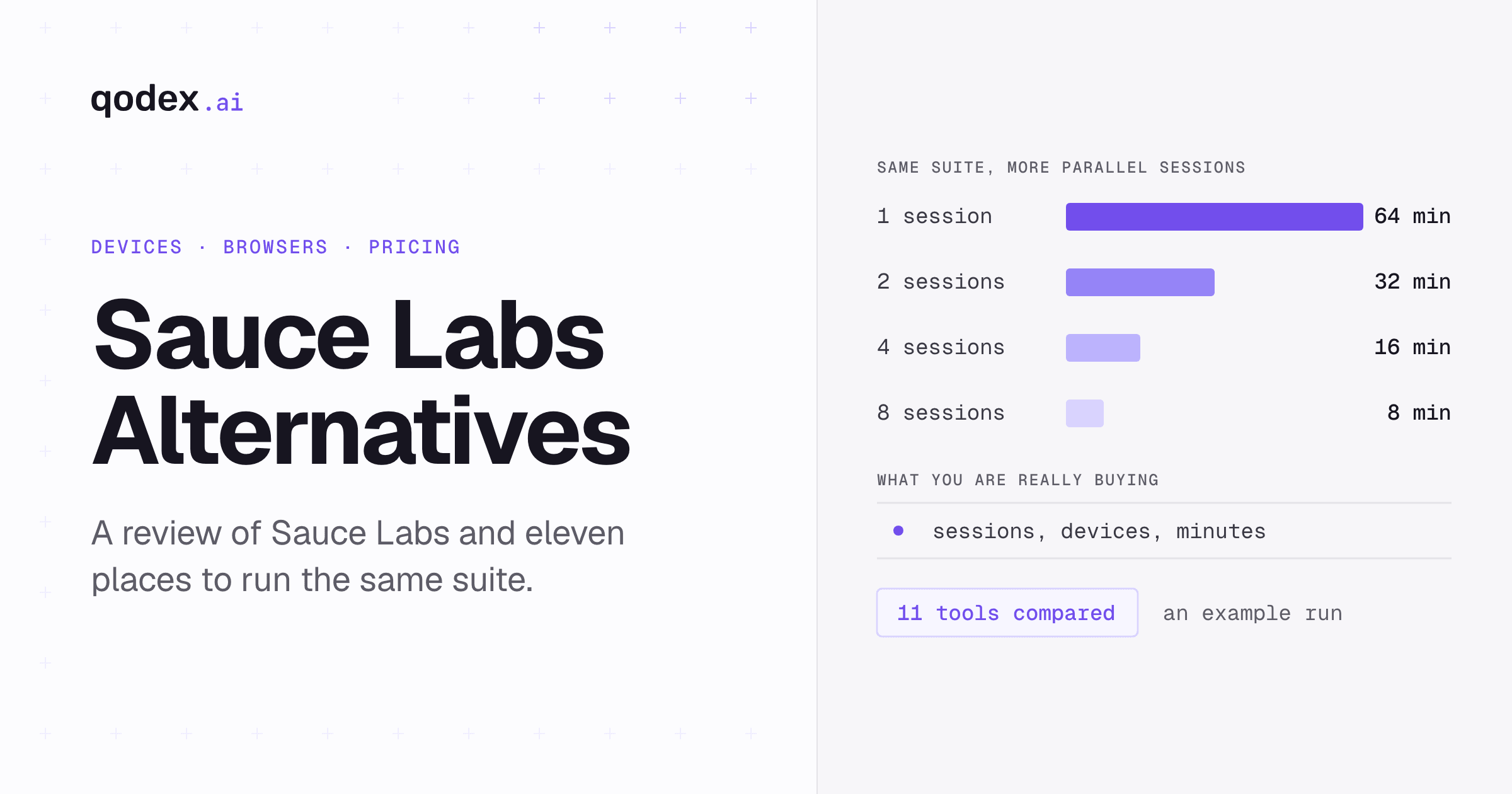
Every displayed self-serve plan starts at one parallel test, and the pricing selector runs from 1 to 24 concurrent sessions. Parallel sessions, not seats and not minutes, are the meter. Live Testing includes unlimited live minutes and users; Virtual and Real Device Cloud include unlimited live and automated minutes and unlimited users, per Sauce Labs' own page.
Which leads to the sentence worth writing down before you compare anything: unlimited minutes on one parallel test is not unlimited throughput. Price the concurrency your continuous integration peaks at, not a quiet Tuesday.
Sauce Connect, Sauce Visual and the API testing question
Sauce Connect 5 is a local client that opens an encrypted HTTP/2 tunnel from a private or staging network into Sauce Labs, for apps behind firewalls or IP allowlists. It exposes Prometheus-compatible metrics and ships Grafana dashboards. If your app under test is not on the public internet, this is the piece most likely to be load-bearing without anyone noticing.
Sauce Visual adds snapshot and baseline comparison to a suite you already have, and its docs name Cypress, WebdriverIO, Storybook, C#/.NET, Java, Nightwatch, Python and Robot Framework. The Virtual and Real Device Cloud plans include 500 monthly snapshots, and no separate Visual price is published. Our guide to automating visual regression testing covers what to compare that against.
On API testing, be careful what you assume. The obvious documentation route, docs.saucelabs.com/api-testing, returned 404 on 2 September 2026, and the integrations page lists only TIBCO under "API Management and Testing". "REST API Access" on the plan cards means access to Sauce Labs' own API, not testing yours. The same page does name Selenium, Espresso, Appium, XCUITest, Cypress, TestCafe and Playwright, plus GitLab, GitHub Actions, Azure DevOps, Jenkins, CircleCI, Codefresh, Travis CI, CloudBees, TeamCity and Harness.
Pricing, trial and compliance
List prices from the pricing page, read on 2 September 2026. Dollars are USD.
| Plan | Annual billing | Month to month | Starting capacity | Included |
|---|---|---|---|---|
| Live Testing | $39/mo | $49/mo | 1 parallel test | Unlimited users and live minutes |
| Virtual Device Cloud | $149/mo | $199/mo | 1 parallel test | Unlimited users, live and automated minutes; 500 visual snapshots a month |
| Real Device Cloud | $199/mo | $249/mo | 1 parallel test | Unlimited users, live and automated minutes; 500 visual snapshots a month |
| Enterprise | Custom | Custom | Custom | AI Test Authoring Agent, AI Insights Agent, SSO, private device cloud, team controls, support |
There is a free-trial call to action, but the page publishes no duration, minute cap or parallel limit, so treat any specific trial length you read elsewhere as unverified. Qualifying open-source projects can get free accounts. On compliance, Sauce Labs lists ISO/IEC 42001, ISO/IEC 27001, ISO/IEC 27701, SOC 2 Type II, GDPR and CCPA on its homepage. Its pricing page links ISO 27001, ISO 27701, SOC 2 Type II and SOC 3 material. Those are its own claims, worth reading in full if procurement is involved.
Limits, and who should stay or switch
The documented limits are short. Concurrency is the bill, from one parallel test to 24. The public Virtual and Real Device Cloud plans include 500 visual snapshots a month. The AI authoring and insight agents are Enterprise features. No self-hosted full platform is publicly listed.
Two open saucectl issues are worth knowing about, and neither is a platform-wide reliability rate. Issue 982 asks for a working Playwright example on a real mobile browser, and says the docs claim Playwright support but not on a mobile device. Issue 1065 reports a GitHub Actions install failure specific to saucectl 0.198.2. Both were open on 2 September 2026, and both are one user's report. No customer review is quoted on this page: G2 and Reddit blocked the research fetch, so what you get instead is Sauce Labs' own documented constraints.
Stay if the device fleet or the Sauce Connect tunnel is load-bearing, the parallel count you need fits the bill, and your Appium or Selenium suite runs green. Nothing below beats a working setup with no specific complaint.
Switch if the invoice is driven by parallel lanes the team rarely uses at once. Switch if you need devices inside your own network, or if your engineers can run browser containers. Switch too if the real gap is tests nobody has written. That last one is not a device-cloud problem, and swapping clouds will not touch it.
The 11 best Sauce Labs alternatives in 2026
The closest like-for-like cloud first, then the agent that writes the tests, then the rest of the hosted clouds with a published price, then quote-only enterprise clouds ordered by how much they publish, then the do-it-yourself baseline.
1. BrowserStack
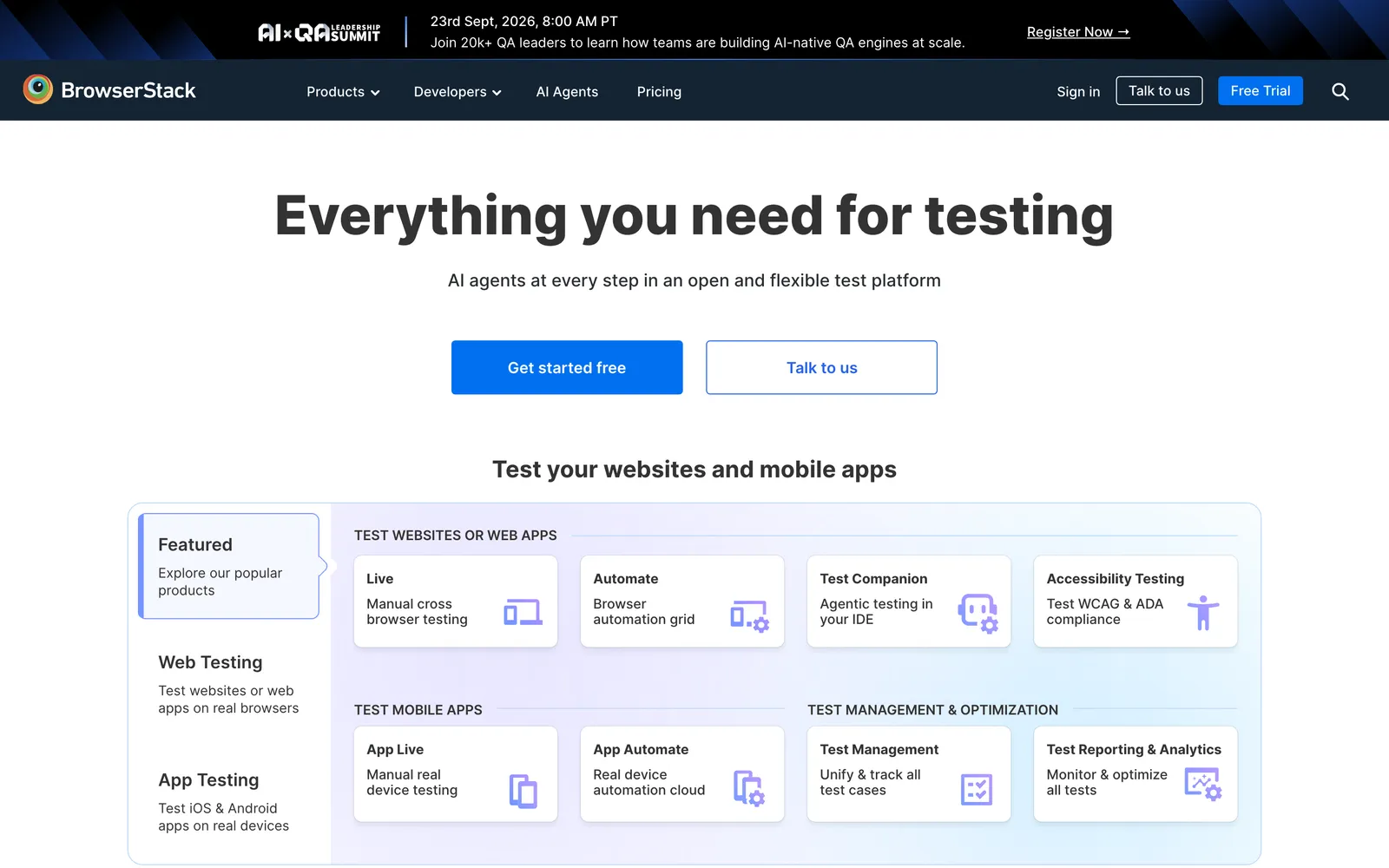
BrowserStack is the closest like-for-like cloud, and it is first for that reason. It replaces the hosted browser and real-device job, and writes nothing for you.
Price, 2 Sep 2026: the pricing page title says plans start at $12.50 a month billed annually. The page body rendered in the browser, so the product attached to that entry price could not be read.
Free: not verified; no free-plan statement was readable on the pricing page.
Meter: not verified. The pricing page did not expose the billing unit to this research.
Devices: Sauce Labs' comparison says BrowserStack has 30,000+ real devices. That is a competitor's claim about BrowserStack, not verified first-party here.
Frameworks: not verified first-party. Testsigma rates its CI/CD integration "Strong" without naming tools.
Self-hosting: no self-hosted edition was verified in this research.
Migration: confirm the frameworks your suite needs first; this research verified no list on BrowserStack's own pages.
Best for: a hosted real-device fleet from a different vendor.
Watch out for: $12.50 is a page-level "starting from" figure, not the product you need. Sauce Labs also claims BrowserStack has no emulators, which is a competitor's claim, unverified here.
2. Qodex
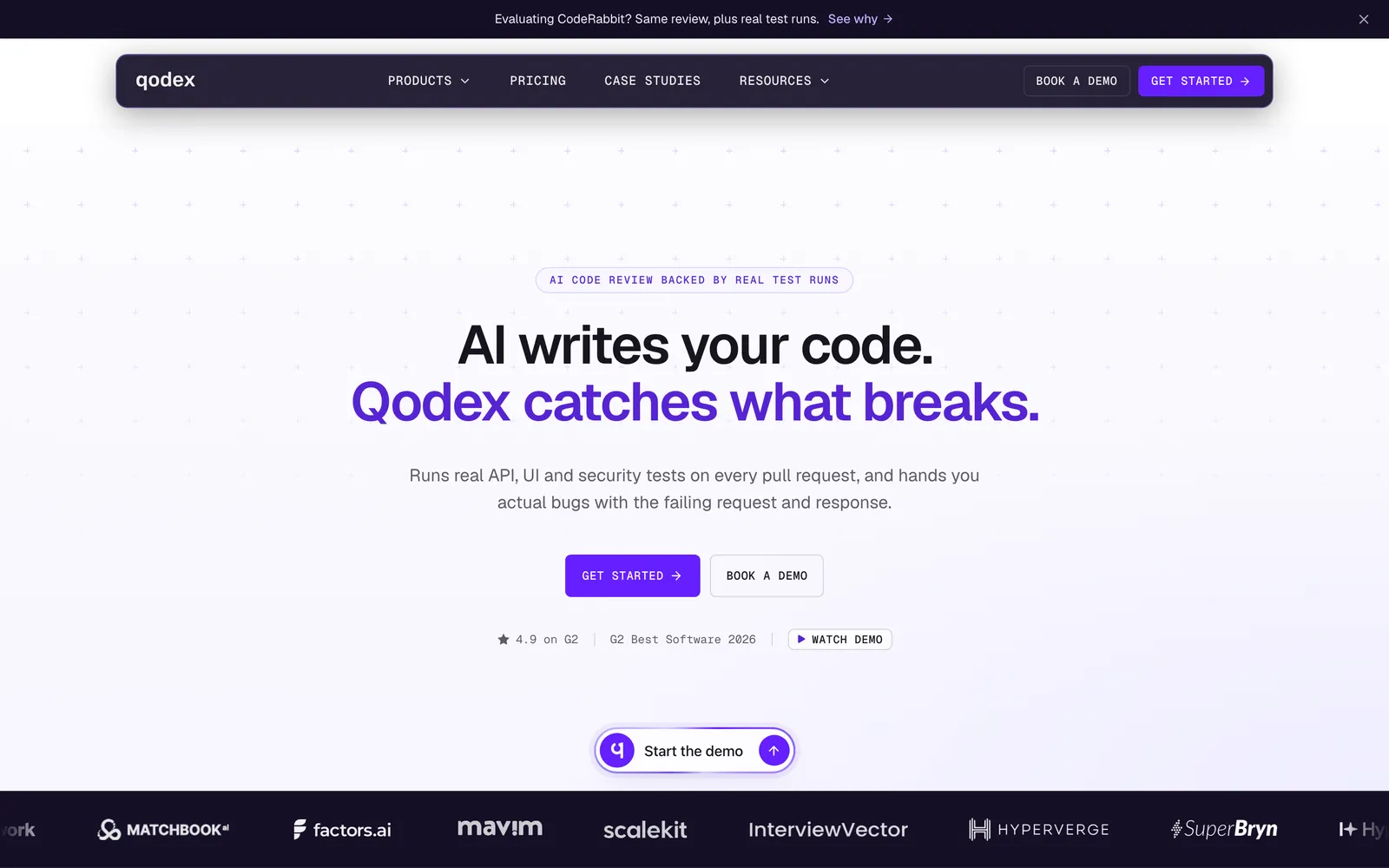
Qodex is an AI QA agent, not a device cloud. It holds no real-device inventory and does not replace Sauce Labs when a failure needs a physical phone. What it replaces is the work of writing and maintaining the tests that run on one. You describe a UI flow in a sentence, a deterministic crawl finds every page, a real browser drives the flow, and every step is logged with a screenshot. A failure arrives with the failing step, the failing request and a screenshot, so nobody reproduces it by hand. The run is saved as standard Playwright, parameterized per environment, synced to git and exportable. When the UI moves, a stale test comes back as a proposed diff you approve, not a silent rewrite.
Price, 2 Sep 2026: Individual is $0 per project a month: one GitHub repository, 25 scenarios and 100 runs a month, one chat session at a time, synchronous runs and core OWASP-aligned probes. Startup starts at $1,299 per project a month: 10 repositories, 200 scenarios, 10,000 runs, 2 concurrent runs, CI/CD, Slack, Jira and Cursor (MCP) integrations, scheduled and webhook-triggered runs. Scale starts at $2,500 per project a month with unlimited scenarios, runs and environments.
Free: Individual is $0 rather than a trial, with 25 scenarios and 100 runs a month.
Meter: project, scenarios, runs and concurrency, not parallel lanes or device minutes.
Devices: none. Runs use Playwright browsers, Chromium first, with screenshots at desktop, tablet and phone widths.
Frameworks: the output is standard Playwright, synced to git and exportable. Runs trigger on every pull request, on a schedule, from CI, a deploy hook or a webhook, and a replay is generated code with no model call, so it costs $0 in model spend. The same agent covers API scenarios imported from OpenAPI, Postman and existing tests, and OWASP-aligned security probes.
Self-hosting: not on the Automation Testing plans. There is nothing to install either: the agent needs a URL and read access.
Migration: layer it rather than swap. Keep a device cloud where hardware decides the bug, add the agent where missing or stale tests decide it, and note that the Playwright it writes runs anywhere Playwright runs.
Best for: teams whose real gap is the tests nobody has written, not the browsers they run on. Here is how Qodex runs UI tests.
Watch out for: the obvious limit. No devices, and the execution half needs a reachable app URL.
3. TestMu AI (formerly LambdaTest)
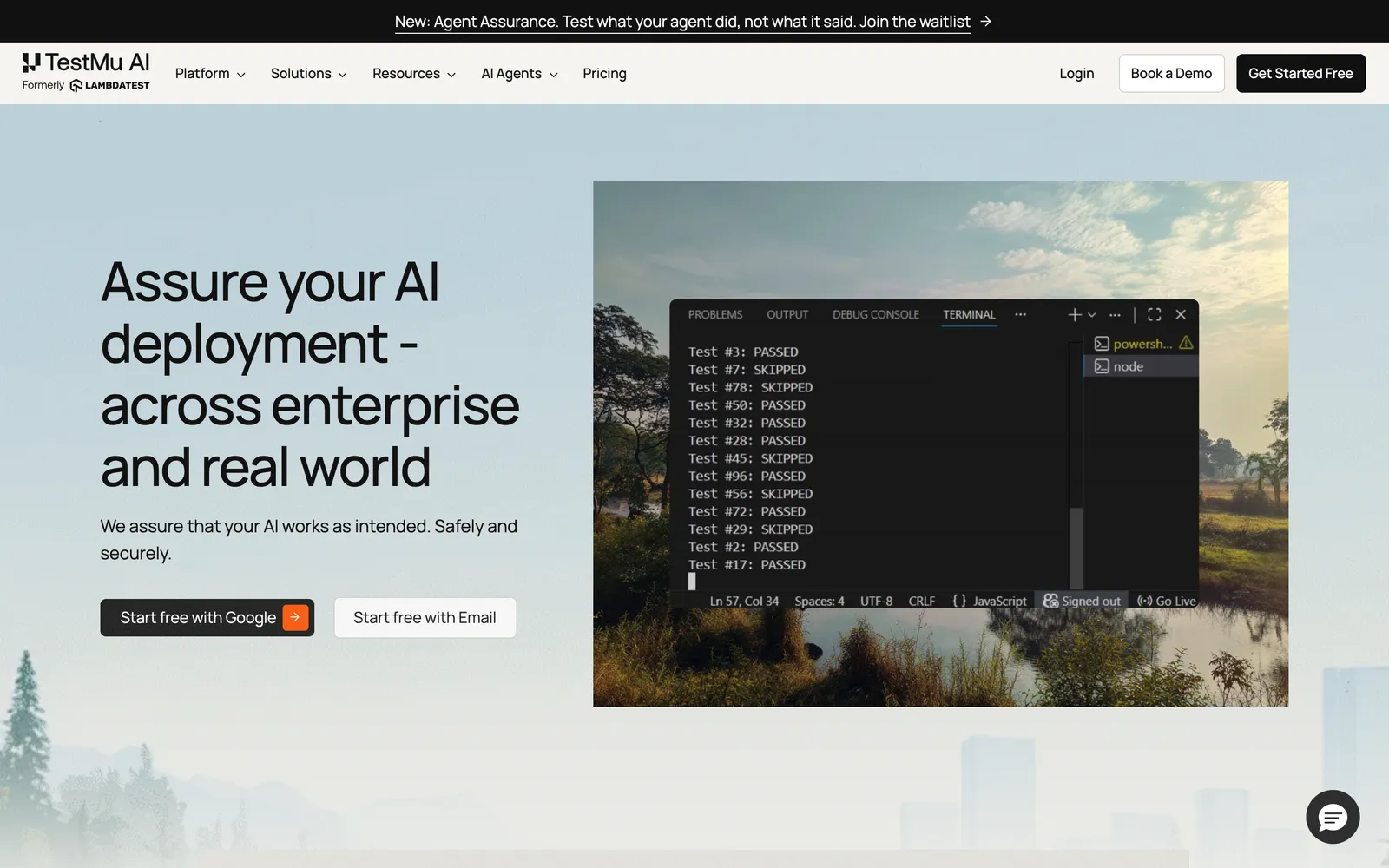
TestMu AI is an agentic quality-engineering platform: live browser and device testing, cloud automation, HyperExecute orchestration, visual testing and KaneAI authoring. It replaces execution and adds authoring. The on-premises option covers HyperExecute, not the device cloud.
Price, 2 Sep 2026: KaneAI Starter $17 per agent a month billed annually; HyperExecute $159 a month billed annually.
Free: "Free Forever" cards with limited two-minute live sessions renewed monthly, plus 300 HyperExecute minutes and up to two concurrent sessions.
Meter: agent, parallel test, seat, minute and credit, depending on the product.
Devices: real devices, yes. No count was read on 2 September.
Frameworks: Selenium, Playwright, Cypress, Jira, Azure DevOps.
Self-hosting: on-premises or private-cloud HyperExecute on Enterprise.
Migration: framework code carries. Model the agent price and the device-cloud price separately.
Best for: a team that wants execution and authoring from one vendor. Our LambdaTest alternatives guide covers the rebrand.
Watch out for: the products are priced apart, so no "starts at" number tells you the workload cost. Sauce Labs quotes a $15 a month platform price that is not on TestMu's cards.
4. TestingBot
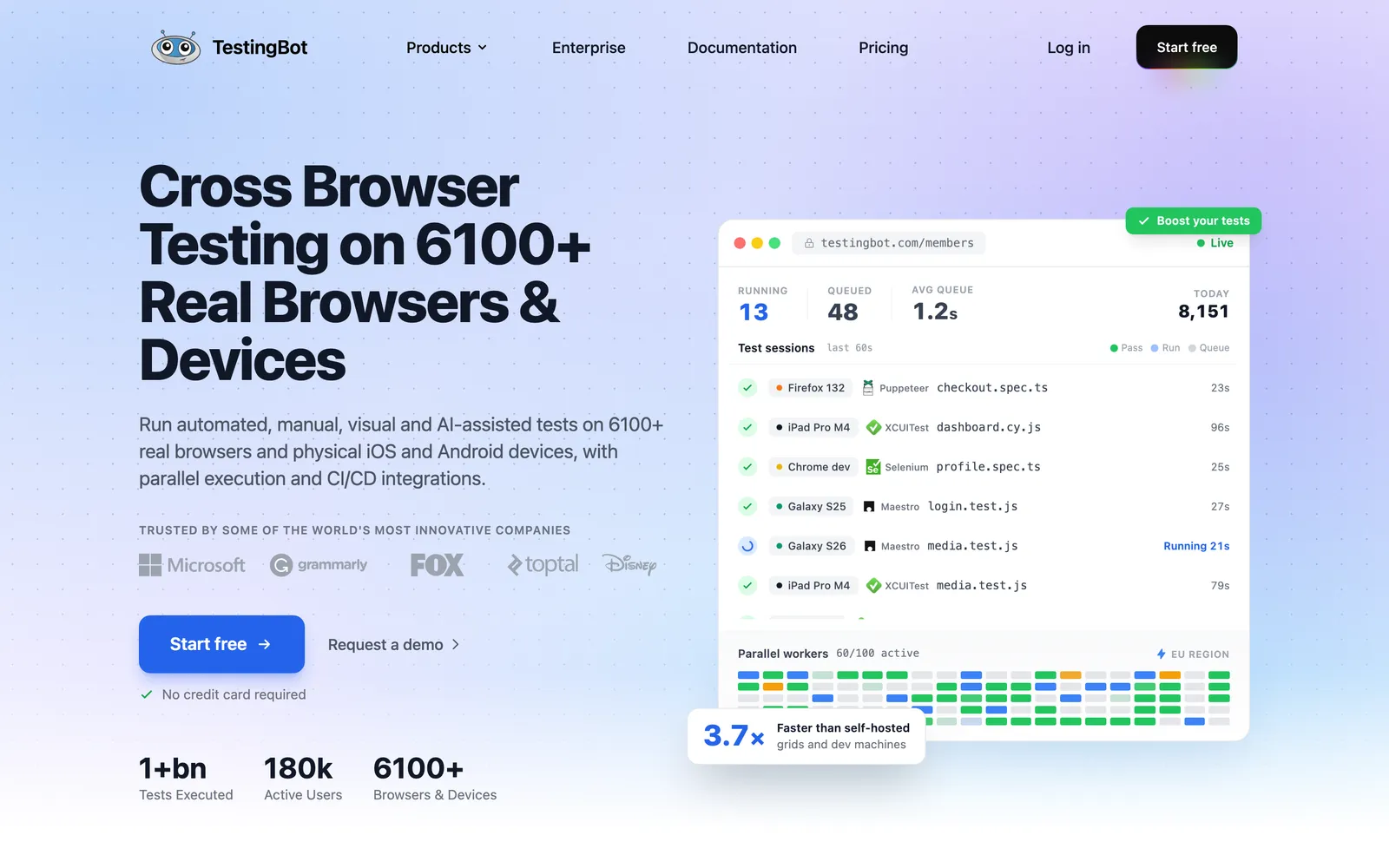
TestingBot is a hosted manual and automated browser and real-device cloud with the clearest public unit economics here. Smaller fleet, same job.
Price, 2 Sep 2026, in euros as published: Live EUR 20 a month annual or EUR 30 monthly. Automated EUR 50 annual or EUR 70 monthly, for one parallel test and 1,000 automated minutes. Automated Pro EUR 90 annual or EUR 120 monthly. Pay as you go EUR 60 for 1,000 minutes, one time.
Free: a 14-day free plan, and open-source projects can request free testing.
Meter: parallel tests and minutes. Pay-as-you-go minutes never expire.
Devices: 6,100+ real browsers and devices as one combined figure (TestingBot says).
Frameworks: Selenium, Playwright, Appium, Cypress, GitHub, Jira, Slack, CI/CD. Local testing included.
Self-hosting: no self-hosted full platform is listed. "Local testing" is a tunnel from the hosted service to your app.
Migration: endpoint swap, then model the 1,000-minute cap against a real month.
Best for: small teams, agencies, and anyone whose usage arrives in bursts.
Watch out for: base Automated is one parallel and 1,000 minutes, and the GitHub, Jira, Slack and CI/CD integrations sit on higher columns.
5. HeadSpin
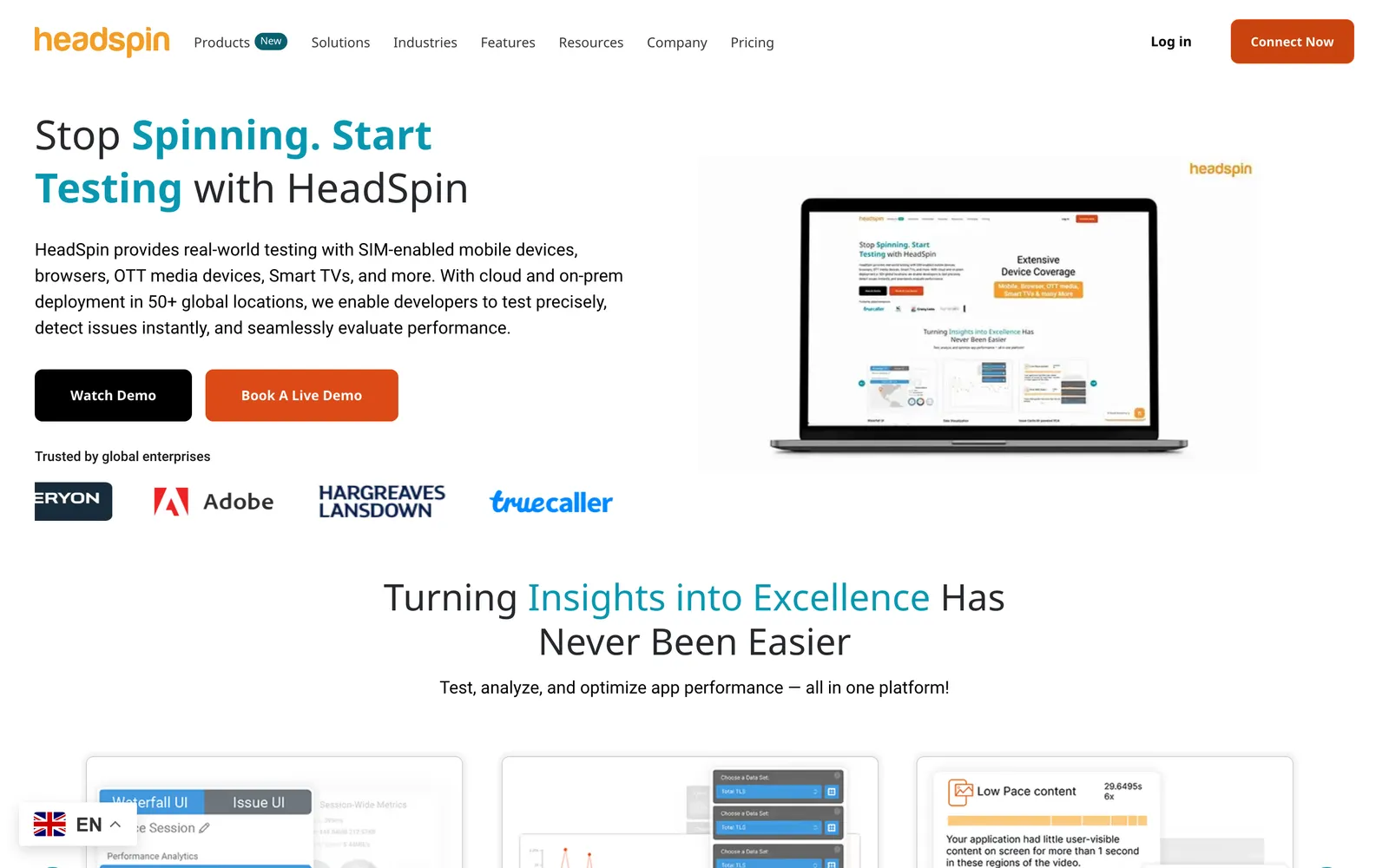
HeadSpin is a real-device, network, location and performance-testing platform. It replaces real-device execution and adds network and performance measurement on top.
Price, 2 Sep 2026: Cloud Test Lite from $49 a month and Cloud Test Go from $100 a month, both cloud plans. Cloud Test Pro, which carries the on-premises option, is custom priced.
Free: a trial call to action with no published duration or limit. No permanent free plan is shown on the page.
Meter: users and hours. Lite is one user and 40 hours of device testing a month.
Devices: real devices with global device and network coverage, 130+ performance measures, up to 50+ locations on Pro (HeadSpin says).
Frameworks: Appium and Selenium named; HeadSpin says Go and Pro support 60+ frameworks. CI/CD is an Automation+ add-on lower down.
Self-hosting: Cloud Test Pro supports private cloud, on-premises and air-gapped dedicated devices.
Migration: Appium suites carry. Budget the add-ons before comparing the headline price.
Best for: on-premises or air-gapped device needs and network-sensitive apps, with a published cloud price to start from.
Watch out for: automation, performance, experience and CI/CD need add-ons or higher plans, so $49 is a floor, not a forecast.
6. Kobiton
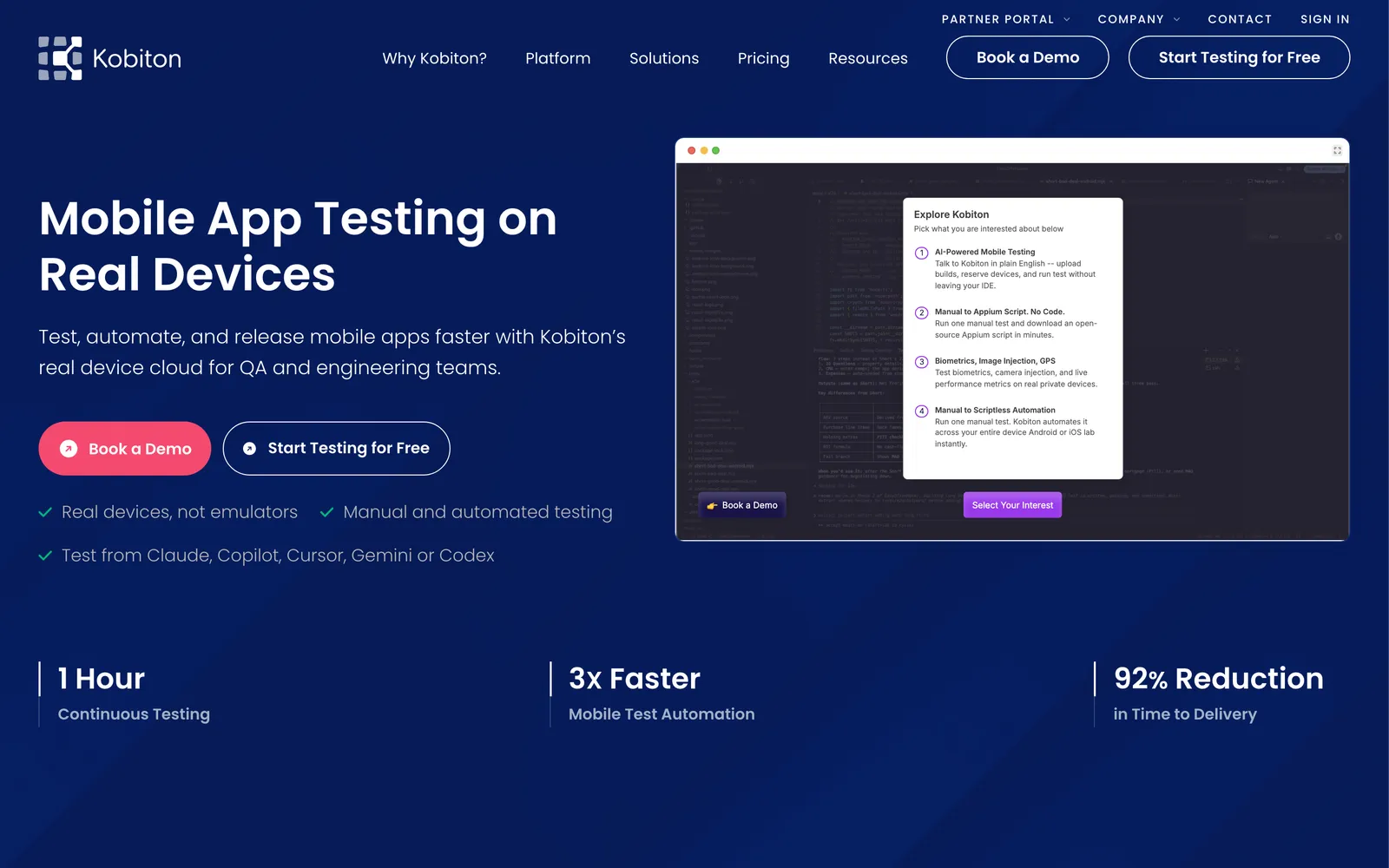
Kobiton is a mobile testing platform for manual, scripted and no-code testing on real devices. It replaces the Real Device Cloud job for mobile apps, not the desktop-browser, emulator and simulator coverage, none of which it publishes.
Price, 2 Sep 2026: Startup from $83 a month with 500 minutes. Accelerate from $399 with 3,000 minutes. Scale is annual only, from $9,000 a year with 7,500 minutes a month. Enterprise by request.
Free: paid plans offer a free trial, length not published. No permanent free plan.
Meter: minutes a month. The starting parallel count is not published; Scale is the plan described as being for more parallel devices.
Devices: public-cloud real devices, count not published.
Frameworks: Appium, Selenium, Espresso, XCUITest; TeamCity, Jenkins and Azure DevOps on the pricing comparison, GitHub Actions, GitLab, CircleCI, Bitrise and Buildkite in the docs. No Playwright.
Self-hosting: Enterprise adds dedicated devices, Kobiton-hosted private device slots and fully on-premises devices.
Migration: Appium suites carry. Model the minute cap first, because that is what runs out.
Best for: mobile-app teams that want a published entry price on real hardware. Kobiton also generates Appium scripts and self-heals Appium execution while runs stay on real devices.
Watch out for: $83 buys 500 minutes, and neither emulator coverage nor the parallel allowance is published.
7. pCloudy
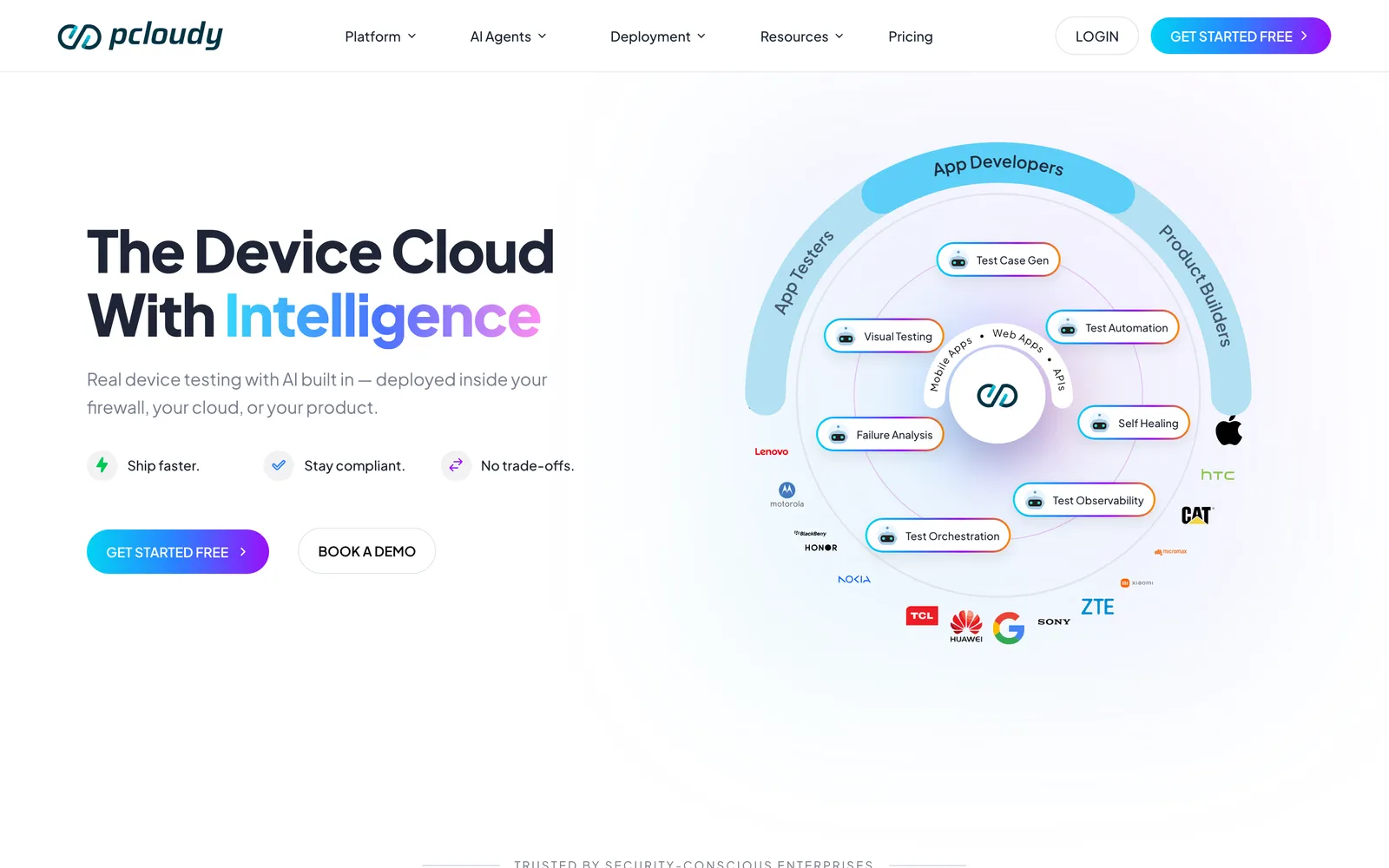
pCloudy is a hosted device and browser cloud for manual and automated testing, and the most like-for-like of the quote-only options, Playwright suites included.
Price, 2 Sep 2026: not published for the main Device Cloud or Browser Cloud. Private cloud, on-premises and larger plans say "Request a Quote".
Free: the pricing FAQ says every plan has a free trial with no credit card. Length not published.
Meter: parallel tests, meaning simultaneous device or browser sessions. More than 20 goes to sales; the starting count is not published.
Devices: 5,000+ real Android and iOS devices and 3,500+ desktop and mobile browser combinations across Chrome, Firefox, Safari and Edge (pCloudy says). Emulator inventory not published.
Frameworks: Appium, Selenium, Espresso, XCUITest, Playwright, plus unnamed CI/CD integrations.
Self-hosting: Private Cloud is single-tenant; On-Premise Cloud runs the full real-device cloud in your data center and can be air-gapped.
Migration: Appium, Selenium and Playwright suites carry. Get the parallel count and the price in writing before comparing capacity.
Best for: like-for-like device and browser coverage with a private or on-premises option behind it.
Watch out for: no public price and no public parallel count, so any real comparison starts with a sales call.
8. Perfecto by Perforce
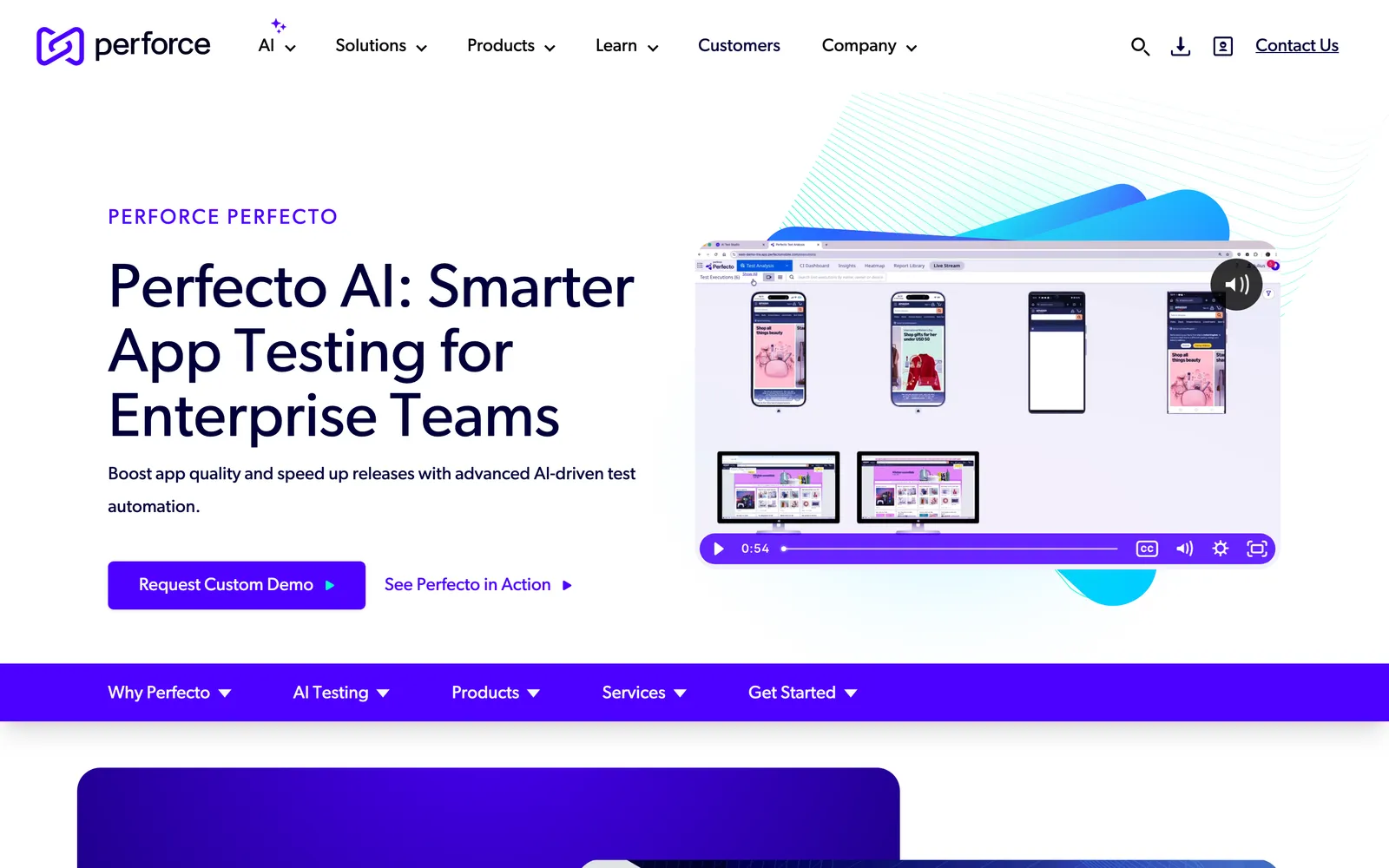
Perfecto is an enterprise platform for testing web, mobile and desktop applications on cloud devices and browsers. It runs existing Selenium and Appium scripts and offers AI-assisted testing.
Price, 2 Sep 2026: not published. The page offers "Build Your Quote".
Free: not published.
Meter: automated plans are licensed by parallel executions, minimum two. Manual packages go by simultaneous users.
Devices: real devices and virtual machines. The quote builder lists virtual devices or simulators, public shared devices and private dedicated devices. Counts not published.
Frameworks: Selenium and Appium. CI/CD is mentioned without naming products; Playwright not published.
Self-hosting: public cloud with shared devices, private cloud with dedicated devices, on-premises or hybrid.
Migration: Selenium and Appium suites carry. Price the two-parallel minimum in from the start.
Best for: enterprises that want real and virtual devices with a public, private or on-premises deployment choice in one contract.
Watch out for: no public price, and automated plans begin at two parallel executions rather than one.
9. BitBar by SmartBear
BitBar is a hosted browser and real-device cloud for web, native and hybrid applications. It replaces the hosted job in category, but framework compatibility is unconfirmed on the public pages.
Price, 2 Sep 2026: not published. The pricing page says "Contact us".
Free: a 14-day free trial, no credit card.
Meter: automated tests run in parallel. The starting count is not published.
Devices: thousands of real devices and browsers in the public cloud (SmartBear says), with dedicated devices and private cloud available. Emulators not published.
Frameworks: the overview says BitBar fits an existing stack or CI/CD pipeline and offers APIs for launching browser and device tests. Selenium, Appium, Playwright and CI products are not named.
Self-hosting: a private cloud with dedicated infrastructure and dedicated devices. No on-premises edition published.
Migration: confirm the frameworks on a sales call before you move a single test.
Best for: teams that want a dedicated-device option inside the SmartBear catalog, described as exclusive to the buyer with unmetered usage.
Watch out for: no price, no concurrency and no named frameworks on the public pages.
10. Digital.ai Continuous Testing
Digital.ai Continuous Testing, formerly Experitest, is an enterprise continuous-testing platform with cloud, private, hybrid and on-premises device and browser deployment. It publishes the least of any tool here.
Price, 2 Sep 2026: not published.
Free: no plan or trial published. The product page offers "Demo now".
Meter: not published.
Devices: dedicated and shared devices, emulators and simulators, cross-browser testing. Counts not published.
Frameworks: Selenium, Appium, Playwright and CI products are not published on the fetched pages.
Self-hosting: a fully air-gapped on-premises lab, a private real-device cloud, shared cloud and hybrid.
Migration: nothing to plan from the public pages. Confirm the frameworks first.
Best for: enterprises whose requirement is an air-gapped lab, where deployment beats price transparency.
Watch out for: the thinnest public buying information here. The pricing page publishes no price, no billing unit and no trial.
11. Playwright on Docker
Playwright on Docker is the do-it-yourself baseline. Microsoft publishes container images carrying the Playwright browsers and their system dependencies; the test package is installed separately. It replaces web-browser execution on infrastructure you control, not a physical-device fleet.
Price, 2 Sep 2026: no subscription. You pay for CI machines, containers, storage and maintenance.
Free: open source, with no subscription and no hosted plan. This research did not verify the licence text, so read the repository licence file before you make a licensing decision.
Meter: your own compute, which is a different budgeting problem, not the absence of one.
Devices: none. Chromium, Firefox and WebKit engines.
Frameworks: local containers, CI, a remote Playwright server, WebSocket connection, GitHub Codespaces, access to local servers.
Self-hosting: yes, by definition.
Migration: Playwright suites run unchanged. Selenium and Appium suites do not.
Best for: web teams with the engineering time to own their runners. See our Playwright alternatives and Selenium alternatives guides for the framework decision underneath.
Watch out for: the image version and the test version must match, and the docs say untrusted sites need a separate user and a sandbox profile.
How to migrate from Sauce Labs
Inventory what you actually use. Live Testing, Virtual Device Cloud, Real Device Cloud, Sauce Connect tunnels, Visual snapshots, framework, region, concurrency peak, minutes, artifact retention and private devices. You cannot price a replacement against a guess.
Sort every test into three buckets: needs a real device, needs an emulator, or needs only engine coverage. Never move a native-mobile or hardware test into a browser container and call it equivalent. If you are adding an AI QA agent, it takes the fourth bucket, the flows nobody covered, not the ones that need a phone.
Keep the portable code. Selenium, Appium, Cypress and Playwright tests survive the move where the replacement accepts them, which several of the quote-only clouds do not publish. Change endpoints, credentials, capability names and tunnel configuration in a branch, not on main. Our Playwright vs Selenium comparison is useful if you are also changing framework.
Replace Sauce Connect deliberately. Test private DNS, IP allowlists, proxies, WebSockets and certificates against the candidate's tunnel or an in-network runner. This is the step that quietly fails last.
Export or recreate the visual baselines and keep enough history to compare old and new results. Model the 500-snapshot allowance against whatever unit the replacement uses.
Run both for one sprint. The same five business-critical flows on Sauce Labs and the candidate. Compare pass rate, duration at equal parallelism, flaky reruns, device availability, screenshots, video, logs and time to diagnose.
Price the peak, not the quiet hour. Parallels, minutes, users, agents, add-ons, storage, and the engineering time for self-managed Docker. For the quote-only clouds, get the parallel count and the unit in writing before you compare anything.
Cut over in stages. Rotate access keys, update CI secrets, keep a rollback window, and remove the old tunnel and the old account last.
See also
Frequently Asked Questions
What is the best Sauce Labs alternative for real-device testing?
A device cloud, because real hardware is the job. BrowserStack is the closest category match, and TestingBot has the clearest published unit prices. Kobiton covers mobile apps from $83 a month, and pCloudy is a like-for-like fleet that also takes Playwright. HeadSpin Cloud Test Pro and Digital.ai are the options when the devices must sit inside your own network. Keep real devices whenever the bug depends on a physical phone, an OS build, a camera, a network or manufacturer behaviour.
Is there a free Sauce Labs alternative?
Sauce Labs publishes no permanent free plan. TestMu AI's free cards give two-minute live sessions and 300 HyperExecute minutes. TestingBot and BitBar give 14 days. pCloudy and Kobiton offer trials with no published length. Qodex Individual is $0 with 25 scenarios and 100 runs a month. Playwright on Docker has no licence fee, though you still pay for the machines.
What is the best open-source or self-managed Sauce Labs alternative?
Playwright on Docker. Microsoft's images carry Chromium, Firefox and WebKit, and a remote Playwright server runs on machines you own. There is no subscription, and this research did not verify the licence text, so read the repository licence file for the terms. It replaces browser execution, not real devices, and the image and test versions have to match or runs break in ways that look like flakiness.
Can Sauce Labs or its alternatives be self-hosted?
The full public Sauce Labs platform is not publicly listed as self-hosted. Enterprise adds a private device cloud, and Sauce Connect is a tunnel in rather than an edition you run. On-premises devices are published by HeadSpin Cloud Test Pro, pCloudy On-Premise Cloud with air-gapping possible, Perfecto on-premises or hybrid, Kobiton Enterprise and Digital.ai's air-gapped lab. BitBar publishes a private cloud only, and TestMu AI's on-premises option is HyperExecute, not its device cloud.
BrowserStack vs Sauce Labs: which should you choose?
Same category, so decide on physical devices required, emulator coverage, parallel peak, support and total annual cost. Sauce Labs publishes its plans and parallel counts clearly, from $39 a month annual. BrowserStack's pricing page title says plans start at $12.50 a month billed annually. The 30,000+ device figure is Sauce Labs' claim about BrowserStack, not a first-party one, and neither the product behind that entry price nor the billing unit could be read from BrowserStack's own page. Get both in writing before you compare.
LambdaTest, now TestMu AI, vs Sauce Labs: what is different?
Both rent browsers and devices. TestMu AI adds KaneAI authoring priced per agent, $17 a month annual on Starter, and HyperExecute at $159 a month annual, with free cards underneath. Sauce Labs meters parallel tests from $39 (Live) to $199 (Real Device Cloud) annual, includes unlimited minutes and users, and keeps its AI agents on Enterprise.
How much does Sauce Labs cost, and what does "one parallel test" mean?
Live Testing $39 a month annual ($49 monthly), Virtual Device Cloud $149 ($199), Real Device Cloud $199 ($249), Enterprise custom. Prices read 2 September 2026. Each starts with one parallel test: one session at a time, however many minutes it runs. Twenty-four lanes is a different invoice from one, and Perfecto's automated plans start at two.
How is Qodex different from Sauce Labs?
Sauce Labs runs the tests you bring on browsers and devices it owns. Qodex writes the tests instead. A UI flow becomes standard Playwright that runs in Playwright browsers, API scenarios come from an imported spec, collection or existing test, and the security work runs as OWASP-aligned probes. Every finding carries the failing step and a screenshot. It holds no devices. Need a phone rack, use a device cloud. Need tests written and kept current, use the agent, beside the cloud when hardware still matters.
The short version
Stay on Sauce Labs if real devices or Sauce Connect are load-bearing and the parallel bill fits. Move to BrowserStack, TestingBot, Kobiton or pCloudy for the same job under a different constraint. Move to HeadSpin, Perfecto or Digital.ai when the devices have to live in your own network. Move to Playwright on Docker if your team can run its own browsers. And if the tests themselves are the gap, Qodex writes and runs them without replacing the device cloud: see how Qodex runs UI tests.