Testim AI Test Automation: Features, Pricing, Limits, and 12 Alternatives
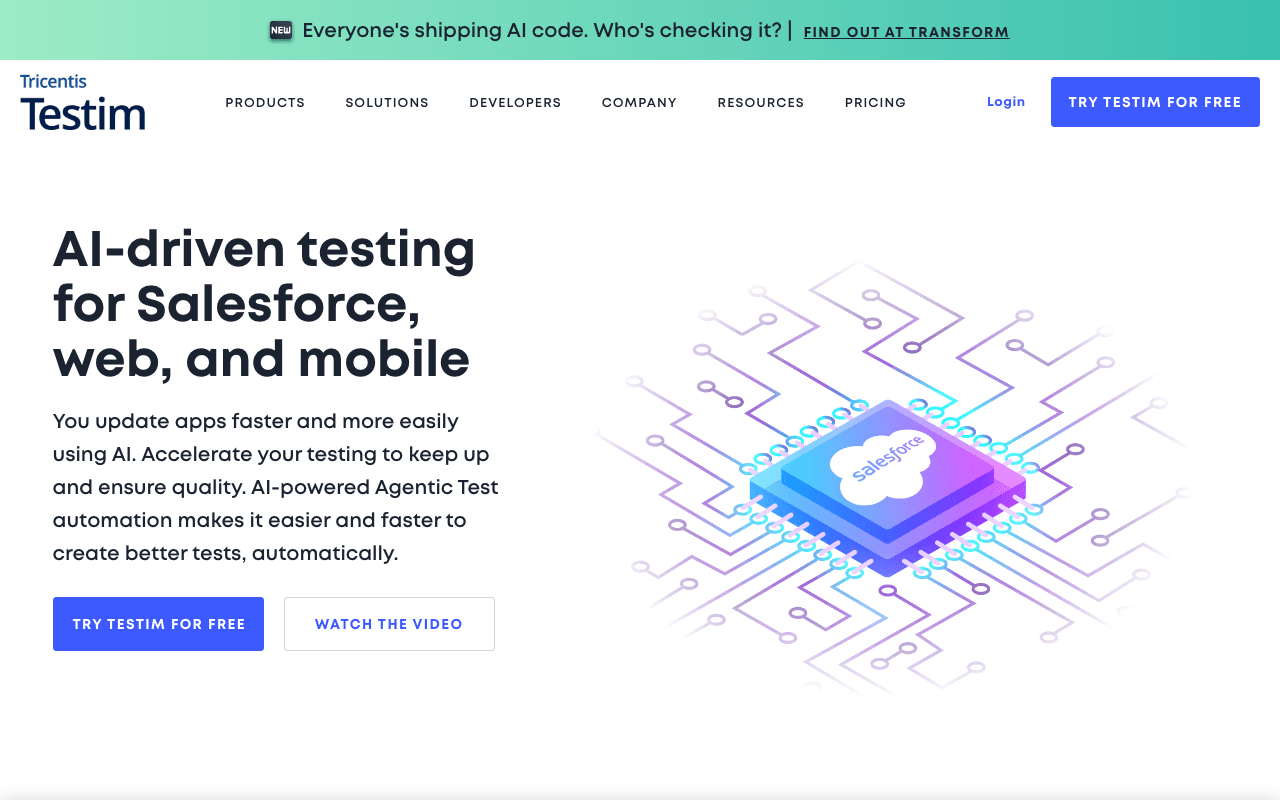
Tricentis Testim is a low-code test recorder for web, mobile and Salesforce apps. Tricentis says its AI strengthens element locators, self-heals tests when pages change, writes JavaScript custom steps through Copilot and, in the Salesforce edition, builds whole tests from plain-language instructions. Those four capabilities are what Tricentis documents as Testim AI test automation. Public pricing is request-only. Every price below was read on 2 September 2026.
This page sits inside our AI testing guide. The pages ranking for this query today are Testim's own site, a Tricentis 404 and a blog index. So this one reviews the product first and lists alternatives second: what the AI does, what it costs, where a recorder stops, and 12 alternatives by the job you have.
Quick answer: choose by constraint
For most teams the question is not whether to replace Testim, but whether to keep it for the surface it covers and add or replace by surface. Replacing it outright earns its cost when the real ask is code ownership, a budgetable price, or a wider QA job.
| Constraint | Pick | One line |
|---|---|---|
| A mature recorder with Salesforce and mobile editions | Stay with Testim | Smart locators, self-healing, Copilot steps; price on request. |
| API, UI, security and pull-request review, web only | Qodex | An AI QA agent, not a recorder; Individual $0. |
| Free, open-source, engineering-owned browser tests | Playwright | $0; you own authoring, infrastructure and triage. |
| Manual QA writing tests in plain English | testRigor | Private plans from $300 a month, Linux Chrome only. |
| A Playwright or TypeScript team wanting AI authoring | Playwright first | Then Momentic, QA Wolf, Qodex or Autify Nexus. |
| Broad hosted low-code suite | mabl | Web, mobile, API, accessibility, performance; quote-based. |
| Agentic web UI testing with a public price | Functionize | Free with 200 credits a month; Pro $20 a month. |
| Enterprise natural language across UI, API and database | Virtuoso | Custom quote, 12-month standard term. |
| Web, mobile, API and Windows desktop, one suite | Katalon | Studio $84 per seat a month annual, first 3 seats. |
| Engineering-led AI authoring, private free tier | Momentic | Free with 2,000 credits a month; then $125 a month. |
| An autonomous agent or Playwright automation, one page | Autify | Aximo Core $99 a month; Nexus Professional $3,600 a year. |
| One cloud recorder across web, mobile, API and SAP | Reflect | Contact sales; 14-day trial. |
| Non-engineers wanting visual no-code tests | Rainforest QA | Free trial; pricing not verifiable from this region. |
| Exportable Playwright, or QA as a service | QA Wolf | 1 cent per AI credit, 15 cents per runner minute. |
Sibling reviews: mabl alternatives, testRigor alternatives, Katalon alternatives.
Testim and 12 alternatives at a glance
Prices checked 2 September 2026. "Not published" means the vendor's page carries no figure. "Local run" means tests can execute on your machines or CI, which is not hosting the vendor's platform; conflating the two is the usual error here. Wider category: AI testing tools.
| Tool | Authoring model | Platforms | Paid start and unit | Free plan or trial | Local run vs self-host | Best for | Main limit |
|---|---|---|---|---|---|---|---|
| Testim (baseline) | Recording; Copilot JavaScript steps | Web, mobile, Salesforce | Not published; request pricing | "Get started free", "Try it free"; no duration | Local, Testim grid or Selenium grid; self-host not published | Recorded tests, Salesforce | No public price; no documented export |
| mabl | Low-code, AI generation, auto-healing | Web, mobile, API, accessibility, performance | Quote-based; from 500 cloud credits a month | Free trial, no duration | Local and CI unlimited; self-host not stated | Breadth on one platform | Cloud runs spend credits |
| Qodex | Describe the flow in a sentence | Web only, Chromium first; not for native-mobile teams | Individual $0; Startup from $1,299; Scale from $2,500 | Individual $0: 1 repo, 25 scenarios | Nothing to install in the app, no runner in CI; self-hosting not stated on these plans | API, UI, security, PR review | Web only, not a recorder |
| Functionize | An agent builds and maintains | Web UI | Pro $20 a month, 400 credits; Growth $40 per user | Free $0, 200 credits a month | Not stated | A public agent price | Credit caps; web UI only |
| testRigor | Free-form plain English | Web, mobile, desktop, mainframe, packaged apps | Private Linux Chrome from $300 a month | Free forever if public; 14-day private trial | Not stated | Manual QA without code | $300 tier: Linux Chrome |
| Autify | Aximo agent, or Nexus on Playwright | Web, mobile | Aximo Core $99 a month annual; Nexus Professional $3,600 a year | Aximo Individual $0; Nexus 14-day trial | Nexus local; no self-hosted control plane | Agent versus framework | Two billing models |
| Virtuoso | Natural language, composable modules | UI, API, database, packaged apps | Custom quote; executions and users, or 5 to 100 cloud lanes | Free trial, no duration | Not stated | Enterprise journeys | No dollars; 12-month term |
| Katalon | No-code, low-code and full code | Web, mobile, API, Windows desktop | Studio $84 per seat a month annual, first 3 seats | Free trial; no free plan | Runtime Engine local; Enterprise private SaaS, hybrid | Widest conventional suite | Charges stack |
| Momentic | AI authoring, repair and maintenance | Web (Chromium), iOS, Android | $125 a month plus usage, 10,000 credits | Free forever, 2,000 credits a month | Your machines or CI; self-host not stated | Engineering-led authoring | Chromium; credit-metered |
| Reflect | Cloud recorder | Web, mobile, visual, API, SAP | Every tier Contact Sales; 5,000 to 40,000 credits a month | 14-day unlimited trial | No self-hosted control plane stated | Types under one recorder | No dollars; all metered |
| Rainforest QA | Visual no-code | Web UI | Not verifiable; pricing URL redirects regionally | Free trial; no duration visible | Not stated | Non-engineers | Price not visible here |
| QA Wolf | Agent producing Playwright and Appium, plus a service | Web, mobile | 1 cent per AI credit, 15 cents per runner minute, no seats | Free to try; no allowance | Not stated | Exportable code, or outsourcing | Service dollars private |
| Playwright | You write the code | Chromium, Firefox, WebKit | $0 | Free and open source | Nothing to host; your machines | Owning the suite | You own the maintenance |
What Testim AI test automation actually does
What Testim is and who it is for
The current product name is Tricentis Testim, sold as AI-powered test automation for custom web, mobile and Salesforce applications. For web it is low-code and record-based: modular tests, reusable components, test management, visual validation, browser-grid execution and failure diagnostics. Testim Enterprise bundles web and mobile testing with Salesforce testing and qTest. It fits teams that want recorded tests with a vendor behind them, Salesforce teams especially. Sources: the product page and Testim Enterprise, read 2 September 2026.
What the AI does, in four parts
Locators. Tricentis says its locator technology combines AI, machine learning and element metadata to find each web, mobile and Salesforce element, and that they self-heal as the app changes.
Copilot. Describe a complex custom step and Tricentis says Copilot returns a JavaScript custom step. A separate Help Assistant answers product questions with generative AI. The web product page does not say Copilot writes a complete web test from one prompt.
Salesforce generation. Tricentis says Agentic Test Automation builds complete Salesforce tests from natural-language instructions. That claim is scoped to the Salesforce edition, not web.
Diagnostics. Failed tests come back with highlighted screenshots, console logs, network logs and failure information. There is no autonomous fix loop on the page. Sources: the product page and Testim Salesforce, read 2 September 2026.
What it records and what it writes
| Surface | What you do | What comes out |
|---|---|---|
| Web | Record a journey, assemble pre-built steps | A modular test; Copilot can add a JavaScript custom step |
| Mobile | Record while clicking through the app | A Testim Mobile test built on the app structure and its locators |
| Salesforce | Record no-code steps, use pre-built steps, or describe the test | A Salesforce test optimised for Lightning metadata |
One sentence worth keeping: no first-party page says Testim exports a recorded suite as Playwright or Selenium code. Custom JavaScript steps and Selenium-grid execution are real, and are different claims. Sources: the web, mobile and Salesforce product pages plus Testim Enterprise, read 2 September 2026.
Platforms, execution and integrations
Web tests run locally, on Testim's grid or on any compatible Selenium grid, on demand, on a schedule or from CI. Mobile covers native and hybrid apps with embedded web views plus Flutter and React Native, and the Virtual Mobile Grid names virtual iOS simulators and Android emulators; real-device execution is not claimed. Salesforce gets no-code authoring, pre-built steps, Lightning metadata-aware locators and testing against upcoming releases, all vendor claims. Integrations: CI triggers, bug reports in Jira, Trello or GitHub, results to Slack, email or webhooks, branch sync, third-party Selenium grids, qTest. Testim Mobile can gate a release. Sources: the web, mobile and Salesforce pages, read 2 September 2026.
Pricing, free access, hosting and compliance
The pricing page publishes no dollar amount, tier name, billing unit, seat allowance or run allowance. It asks you to request pricing. The product page carries "Get started free" and "Try it free", and no page says whether that is a permanent plan or a trial, or what its limits are, so the free-access answer stops there. Local execution and third-party Selenium grids are supported, and no page publishes a self-hosted control plane, so self-hosting is not stated either way. The enterprise page links to Tricentis Trust and Security without naming a Testim certification, so SOC 2, ISO 27001, HIPAA and GDPR are unanswered. Read 2 September 2026.
One thing you will not find below: user complaints. G2 blocked the fetch, a GitHub issue search surfaced none, Reddit was not read. The limits here are Tricentis's own documented constraints, not user sentiment.
Why teams look beyond Testim
You cannot budget without a sales call. The pricing page carries no number. Several tools below do.
Web, mobile and Salesforce are separate editions. Deciding one surface does not settle the others, and a web replacement will not cover Salesforce automatically.
There is no documented code export. The suite lives in Testim until Tricentis shows an export path in writing.
The mobile page describes virtual devices. Simulators and emulators are named, real hardware is not.
The job got wider. Some teams want engineering-owned Playwright. Others want one agent covering API and security too, not a UI tool plus two more contracts.
None of that makes a recorder a defect. The Salesforce and mobile editions are the part no web-only replacement covers, which is why the common move is to keep Testim for those surfaces and change only web.
The 12 best Testim alternatives in 2026
After the AI QA agent at number 2, a different category rather than a better recorder, the order runs from the closest hosted low-code platforms to the open-source baseline.
1. mabl

mabl is hosted low-code testing across web, mobile, API, accessibility and performance.
Best for: teams wanting more test types on one platform than Testim's editions give. Accessibility and performance checks sit in the same product as the functional tests.
How it differs from Testim: breadth in one product, not three editions, and cloud runs metered in credits.
Price and unit, checked 2 September 2026: quote-based. mabl claims a starting allowance of 500 cloud credits a month, local and CI runs unlimited. The dollar figure comes from a quote.
Free plan or trial: a free trial; the pricing page publishes no duration or allowance for it.
Integrations and hosting: Jira, Slack, Microsoft Teams, a CLI, CI and Playwright. Local and CI execution work; the control plane is not stated as self-hosted.
The catch: no public dollars, and the bill moves with cloud usage. mabl says its AI generates tests, auto-heals them and recovers at runtime. Local and CI runs are unlimited, so the meter only bites on cloud execution.
More: mabl alternatives.
2. Qodex

Qodex is an AI QA agent for web apps. It is not a recorder and not a drop-in Testim replacement, and it is web only, so Testim Mobile and Testim Salesforce stay where they are.
Best for: teams whose web-testing job has widened into API checks, security probes and pull-request review, rather than teams shopping for a better recorder.
How it differs from Testim: the flow starts with a sentence, so there is no recorder, no locators and no script. A deterministic crawl finds every page, a real browser drives the flow, and every step is logged with a screenshot. The run is saved as standard Playwright, parameterised per environment, synced to git and exportable, which is the export path Testim does not document.
Price and unit, checked 2 September 2026: Individual $0 per project a month, Startup from $1,299 per project a month, Scale from $2,500 per project a month.
Free plan or trial: Individual is $0 with 1 GitHub repository, 25 scenarios, 100 runs and core OWASP-aligned security probes.
Integrations and hosting: Startup adds 10 repositories, 200 scenarios, 10,000 runs, CI/CD, Slack, Jira, a CLI and Cursor (MCP), plus scheduled and webhook runs. Nothing installs in the app and no runner sits in CI; the continuous-testing pricing page does not state whether self-hosting is available.
The catch: web only, Playwright browsers, Chromium first, and no visual recorder. It needs a URL and read access to the app under test. A failure arrives with the failing step, the failing request and a screenshot, classified as a real bug, a stale test or an environment issue, and a stale test comes back as a diff you approve rather than a silent rewrite.
Treat the two as layers, not rivals: keep Testim for Salesforce or mobile. Here is how Qodex tests a UI.
3. Functionize

Functionize Studio is an agent for testing complete web UI workflows.
Best for: a team that wants an agentic tool it can price and start now.
How it differs from Testim: Functionize says an agent builds, runs and maintains the tests rather than a person recording them. The public offer is web UI only.
Price and unit, checked 2 September 2026: Pro $20 a month for an individual builder with 400 credits; Growth $40 per user a month.
Free plan or trial: $0 with 200 credits a month and 5 parallel runs.
Integrations and hosting: the pricing page labels integrations "Coming soon", so there is no list. Treat any integration you need as unconfirmed until the page names it. Self-hosting is not stated.
The catch: credits cap the month, and web UI is the whole scope. Pro's 400 credits and the free tier's 200 are the whole allowance, so the ceiling is the plan rather than the seat count. Salesforce and native mobile are unanswered.
4. testRigor

testRigor turns plain English into web, mobile, desktop, mainframe and packaged-app tests.
Best for: manual QA who should author tests and will never open an editor. It carries the widest surface list here: web, mobile, desktop, mainframe and packaged apps.
How it differs from Testim: tests are written, not recorded, so a tester maintains a sentence, not a step tree. Nothing in the suite asks for an editor or a selector.
Price and unit, checked 2 September 2026: Private Linux Chrome from $300 a month. Private Complete and Enterprise are quote-based.
Free plan or trial: Public Open Source is free forever, but every test and result is public, which rules it out for most commercial apps. Private plans get 14 days.
Integrations and hosting: GitLab, GitHub Actions, Jenkins, Zephyr, Jira, TestRail, Spinnaker, Azure DevOps, CircleCI. Self-hosting not stated.
The catch: the $300 tier is Linux Chrome only. Wider OS and mobile coverage moves you back to a quote, and so do the desktop, mainframe and packaged-app surfaces.
More: testRigor alternatives.
5. Autify

Autify puts two offers on one price page: Aximo, an autonomous AI tester, and Nexus, Playwright-based automation.
Best for: a team still arguing agent versus framework, with both priced side by side.
How it differs from Testim: you pick a product, not an edition, and one of the two is built on Playwright. Autify says Nexus combines no-code and code steps on that framework, while Aximo is the agentic side.
Price and unit, checked 2 September 2026: Aximo Core from $99 a month annual or $120 monthly. Nexus Professional from $3,600 a year or $400 monthly.
Free plan or trial: Aximo Individual $0 with 2,000 one-time credits. Nexus, a 14-day trial with unlimited local tests.
Integrations and hosting: CI is listed, with no full list in the pricing copy. Nexus supports local execution; no self-hosted control plane.
The catch: two products, two billing models. Aximo meters credits; Nexus prices users and parallelism separately. Comparing the two against each other is as much work as comparing either against Testim.
6. Virtuoso

Virtuoso is enterprise natural-language automation across UI, API, database and packaged-app journeys.
Best for: an enterprise whose journey crosses UI, API and database in one test. Packaged applications are covered too.
How it differs from Testim: Virtuoso says it generates tests agentically, composes them from reusable modules and self-heals them, on an enterprise contract.
Price and unit, checked 2 September 2026: custom quote. Consumption pricing combines executions and users; capacity pricing starts at 5 to 100 parallel cloud lanes. Standard term 12 months.
Free plan or trial: a free trial, with no published duration or allowance, so its shape has to be settled in the sales conversation.
Integrations and hosting: GitHub, GitLab, Azure DevOps, Jenkins, Jira, CI triggers, an API and webhooks. Self-hosting not stated.
The catch: no public dollar figure and a 12-month term, so this is not a quiet trial. Executions and users sit on one meter and cloud lanes on the other, so the shape of the bill depends on which model you sign.
7. Katalon

Katalon is one suite for no-code, low-code and coded web, mobile, API and Windows desktop testing, with test management and cloud execution.
Best for: a team needing Windows desktop alongside web, mobile and API, and one that already runs Pytest, Jest or Robot beside it.
How it differs from Testim: the broadest conventional suite here, priced by seat with separate add-ons.
Price and unit, checked 2 September 2026: Studio at $84 per seat a month on the annual offer for the first 3 seats, or $180 monthly. Runtime Engine and TestCloud are priced separately.
Free plan or trial: a trial; the plan cards show no permanent free plan.
Integrations and hosting: GitHub, GitLab, Bitbucket, Azure, Jira, Azure DevOps, Jenkins, GitHub Actions, CircleCI, email, Slack, Playwright reporting, Pytest, Jest and Robot. Runtime Engine runs on your machines; Enterprise lists private SaaS and hybrid licensing, not a self-hosted control plane.
The catch: seat, runtime and cloud-session charges stack, so the usable setup costs more than the headline. Enterprise adds private SaaS and hybrid licensing, which is the closest thing here to self-hosting without being it.
More: Katalon alternatives.
8. Momentic

Momentic is an AI QA platform for web, iOS and Android that authors, repairs and maintains tests.
Best for: an engineering team that wants AI authoring but keeps the CLI, repo and run. iOS and Android are covered alongside web.
How it differs from Testim: the entry price is public, the free tier is private rather than open, and tests run on your machines.
Price and unit, checked 2 September 2026: pay-as-you-go $125 a month plus usage, with 10,000 credits Momentic estimates at about 1,000 runs.
Free plan or trial: $0 forever, 2,000 credits a month, about 200 runs, 30-day retention.
Integrations and hosting: GitHub Actions, GitLab, any CI provider, a CLI and Model Context Protocol. Tests run on your machines or in CI; the control plane is not stated as self-hosted.
The catch: web support is Chromium, and everything is credit-metered. Momentic says it asserts across text, visuals and the DOM, and that it classifies failures and recovers from them.
More: Momentic alternatives.
9. Reflect

Reflect is SmartBear's cloud platform for web, mobile, visual, API, SAP and cross-browser testing.
Best for: a team wanting one cloud recorder across several test types, private environments too. SAP and cross-browser runs sit in the same recorder.
How it differs from Testim: the recorder spans more test types in one place, SAP included. Testim needs separate editions to reach a comparable spread.
Price and unit, checked 2 September 2026: Premium, Advanced and Enterprise are all Contact Sales, said to include 5,000, 20,000 and 40,000 credits a month.
Free plan or trial: a 14-day trial, which Reflect describes as unlimited functionality for those two weeks.
Integrations and hosting: CI, an API, the cloud recorder, a scheduler, a static IP and private-environment testing. No self-hosted control plane stated.
The catch: no public dollars, and every tier is credit-metered, so quote and usage both need work. The three tiers differ by credit allowance, 5,000 to 40,000 a month, not by any capability you can read off the page.
10. Rainforest QA
Rainforest QA is no-code, AI-accelerated UI testing with API and CLI controls.
Best for: non-engineers who own the suite and want to build it visually. AI-accelerated authoring is the vendor's framing; the visual builder is the product.
How it differs from Testim: built around people who do not write code, not a low-code editor with a JavaScript escape hatch.
Price and unit, checked 2 September 2026: not verifiable. The pricing URL redirected to a regional unavailability page, so no figure should be trusted.
Free plan or trial: a free trial; no duration or allowance visible.
Integrations and hosting: an API, a CLI, CircleCI, GitHub, Jira, Slack and Microsoft Teams. That list comes from the live site, not the pricing page, which did not load from this region. Self-hosting not stated.
The catch: you cannot see the price, so an honest side-by-side waits on sales. The trial is the only way to learn what a month costs, and the API and CLI are the parts an engineer would wire into CI.
11. QA Wolf

QA Wolf is a self-service agentic platform with an optional managed coverage service, producing Playwright for web and Appium for mobile.
Best for: a team that wants code it can take away, or wants QA handled. Web goes to Playwright, mobile to Appium.
How it differs from Testim: exportable standard code, plus a service option. Testim publishes neither. QA Wolf says the managed service investigates failures and maintains the tests for you.
Price and unit, checked 2 September 2026: 1 cent per AI credit and 15 cents per runner minute, no seat charge. The managed service is quoted per test under management.
Free plan or trial: the platform can be tried free, with no allowance or end date published.
Integrations and hosting: direct CI pipeline integration, with API or webhook triggers. Self-hosting not stated.
The catch: cost moves with credits and minutes, not seats, so a heavy suite is hard to forecast. Headcount does not change the bill; run volume does.
More: QA Wolf alternatives.
12. Playwright

Playwright is Microsoft's open-source browser automation and end-to-end test framework for TypeScript, Python, .NET and Java.
Best for: engineering teams that would rather own the suite than rent one.
How it differs from Testim: a framework, not a platform. No recorder to leave behind, no export to ask for.
Price and unit, checked 2 September 2026: $0, free and open source.
Free plan or trial: not applicable; it is all free.
Integrations and hosting: CLI tools, a Model Context Protocol server, GitHub Copilot workflows and your own test infrastructure. The MCP server is the part that lets an agent drive the browser. It runs on your own machines or infrastructure, so there is no vendor control plane to host.
The catch: you own authoring, infrastructure, maintenance and triage. Everything a platform sells, hosting, dashboards and someone to call, is work your team absorbs, and that is the trade for $0. One API drives Chromium, Firefox and WebKit with auto-waiting, assertions, tracing, parallelism and a test generator.
More: Playwright alternatives and test automation frameworks.
Migrating off Testim, surface by surface
Inventory everything, not just the tests. Web flows, mobile tests, Salesforce tests, shared groups, custom JavaScript steps, datasets, environments, secrets, schedules, branch rules, visual baselines, grids and qTest reporting.
Separate the suite by surface. A web replacement does not replace Testim Mobile or Testim Salesforce, and an agent like Qodex covers web only.
Ask Tricentis to demonstrate the export path. The pages promise no Playwright or Selenium export, so budget for rebuilding until a contract or support answer proves otherwise.
Rebuild 15 to 20 representative journeys first. Login, payments, file upload, iframes, new tabs, dynamic elements, private environments, visual checks and one custom JavaScript step. Our guide to choosing a UI test automation framework covers what to watch.
Run both for two release cycles. Compare authoring time, false failures, repair work, runtime, concurrency and failure evidence, using our test automation frameworks guide.
Price the real unit. Seats, credits, runner minutes, cloud lanes, devices, retained results. The tools above use materially different units, so a headline price comparison means nothing.
Move CI gates and schedules last. Only after the suite reaches parity, and keep screenshots, logs and ownership of any generated code.
Decommission by surface, not all at once. Salesforce or mobile tests can stay on Testim while web moves.
See also
UI testing and Selenium alternatives, which carries a Testim profile
If scope widens past the UI: API testing and API security testing
Frequently Asked Questions
Is Testim an AI tool, and what does its AI actually do?
It is a low-code recorder whose AI does four bounded things. Tricentis says its locators combine AI, machine learning and element metadata, and that they self-heal as the app changes. It also says Copilot writes a JavaScript custom step from a description, and that whole-test generation from natural language exists only in the Salesforce edition. All vendor claims, read 2 September 2026.
Does Testim write test code or record tests?
It records, on all three surfaces. Copilot writes one custom JavaScript step from a description, which is a step, not a suite. No first-party page says Testim exports a suite as Playwright or Selenium code, so assume no documented export until Tricentis shows one. Selenium-grid execution is supported, which is where the confusion starts: running tests on a grid is not the same as owning the code that runs there.
Is Testim free, and how much does it cost?
The product page offers "Get started free" and "Try it free" with no published duration or allowance. The pricing page publishes no dollars, tiers, units or allowances; it asks you to request pricing. Both read 2 September 2026. Any Testim price you find elsewhere is not from Tricentis's current pages. Third-party posts still quote old Essentials and Pro figures, and none of those appear on the pricing page today.
Is there an open-source Testim alternative?
Testim is a commercial Tricentis product. Playwright is the open-source route: $0, one API across Chromium, Firefox and WebKit, and code you own. The trade is that your team owns maintenance, infrastructure and triage, the work a platform charges to absorb. If the goal is code you own without owning everything, QA Wolf produces Playwright for web and Appium for mobile, and Autify Nexus is built on Playwright too.
Can Testim run locally or be self-hosted?
Local execution and third-party Selenium-compatible grids are supported, so tests run on your machines. That is not self-hosting. A self-hosted Testim control plane is not published on the product, pricing or enterprise pages, so treat it as unanswered. The same distinction applies to most tools here: mabl, Katalon Runtime Engine, Momentic and Autify Nexus all run on machines you control, and none of their pages offers a self-hosted control plane.
What is the best free Testim alternative?
Playwright, if your team writes code. Momentic, for a private free allowance of 2,000 credits a month, about 200 runs by its estimate. testRigor's free tier only works if public tests and results are acceptable. Qodex Individual is $0 per project for web tests plus API and security probes. Functionize also publishes a $0 tier, with 200 credits a month and up to 5 parallel runs.
Which Testim alternative is best for Salesforce or native mobile?
For Salesforce, Testim Salesforce is the most directly evidenced specialist; testRigor, Virtuoso and QA Wolf also name Salesforce. For native mobile: Testim Mobile, Autify, Katalon, Momentic, QA Wolf, testRigor. Qodex is web only, so it is not the pick for either. Testim Enterprise bundles web and mobile testing with Salesforce testing and qTest, which is usually why those two surfaces move last.
How do you migrate Testim tests to Playwright or another platform?
Inventory by surface, get the export path in writing, rebuild 15 to 20 representative journeys, run both suites for two release cycles, price the real billing unit, move CI gates last. If only web moves, leave mobile and Salesforce on Testim. Put the visual baselines, datasets, secrets and schedules in the inventory too, because those are the parts teams forget until the new suite is already half built.
The short version
Keep Testim if the job is a mature recorder, or a Salesforce or mobile suite; those editions are its strongest asset. Move to Playwright if the team wants to own the code for free, testRigor if manual QA should author in English, mabl or Katalon for a broad hosted suite. If the web-testing job has grown into API, security and pull-request review, that is not a recorder question: Qodex is a web-only AI QA agent for that work. Here is how it tests a UI.