10 SonarQube Alternatives Compared for 2026
The best SonarQube alternative depends on the job you are replacing. CodeAnt AI covers a consolidated quality and security workflow. Codacy and DeepSource are managed code-quality gates. Semgrep suits customizable SAST. Snyk and Aikido go wider on application security.
SonarQube alternatives at a glance
One row per tool. Every price and limit below was read on the vendor's own page on 20 September 2026, and each tool section links to the page it came from.
| Tool | Closest SonarQube job | Deployment | Paid start | Free route |
|---|---|---|---|---|
| CodeAnt AI | Quality, SAST, SCA, secrets and AI PR review in one place | Cloud, on-prem claimed | Pricing on request | 14-day trial |
| Qodex | AI PR review with your API, UI and security scenarios executed | Cloud, self-hosting on Enterprise | $30 per developer monthly | 20 reviewed pull requests per developer a month, up to 2 developers |
| Codacy | Managed quality, coverage, SAST, SCA and merge gates | Cloud for GitHub, GitLab, Bitbucket | $18 per dev monthly, billed yearly | Free IDE plan, free for public repos |
| DeepSource | Managed static analysis with autofix and metered AI review | Cloud; self-hosted on Enterprise | $24 per user monthly, billed yearly | 14-day trial; Open Source plan for public repos |
| Snyk | Developer-first AppSec across code, dependencies, IaC, containers | Cloud | Team from $25 monthly, up to 10 developers | Free, 100 Snyk Code tests a month |
| Aikido | Broad AppSec bundle including DAST, cloud and containers | Cloud; on-prem scanning from Pro | $300 monthly including 10 users | Free forever for 2 users, 10 repos |
| Semgrep | Customizable SAST with an open-source engine | Cloud; on-prem SCM on Enterprise | $30 per contributor monthly | Free for 10 repos and 10 contributors |
| Qodana | JetBrains inspections in CI | Cloud or self-hosted | $60 a year for Ultimate | Community edition is free |
| GitHub Code Security | GitHub-native SAST and SCA with Copilot Autofix | GitHub only | $30 per active committer monthly | None listed on the page |
| Veracode | Enterprise SAST, DAST, SCA and risk management | Cloud | Pricing on request | Demo on request |
Read that table as a shortlist, not a ranking. Three questions settle most of it. Do you need the analysis to run inside your own network? Does your bill scale with lines of code, developers, or repositories? And is the gap you are filling code quality, application security, or review of what a change actually does at runtime?
What SonarQube is and what it costs in 2026
SonarQube is automated static analysis. It reads source code without running it, then reports maintainability, reliability and security issues, and can block a pull request through a quality gate. Sonar describes SonarQube Server as an "on-premises automated code review and static analysis tool" (SonarQube Server documentation, read 20 September 2026). The same documentation labels the current Server release 2026.4 and points long-term adopters at the 2026.1 LTA.
There are three delivery routes, and they are easy to confuse. Community Build is the free, open-source edition you run yourself. SonarQube Cloud is the hosted service. SonarQube Server is the commercial self-managed product, sold in Developer, Enterprise and Data Center editions.
Pricing on the live Sonar plans and pricing page (read 20 September 2026) works out like this:
Free tier. "SonarQube Team Plan, free for your private projects up to 50k LOC. No card, no expiry." Public, OSI-licensed repositories are listed as free forever.
Team. The plan card shows $34 monthly, next to a struck-through $68, for teams under 50 developers. The billing FAQ on the same page says pricing "starts at $34 monthly for analysis of up to 100k LOC".
The price conflict. A second FAQ block further down that same page says prices "start at $32 per month (previously listed at $65)". Two figures, one page. Check the number at checkout before you budget.
Enterprise. Custom pricing, positioned at over 50 developers, with 40+ languages, SSO, SCIM, portfolios and MISRA reporting listed as inclusions. These are Sonar's claims.
Server. Developer, Enterprise and Data Center are each "priced per instance, per year, based on your lines of code (LOC)". No dollar amount was published on the pricing page when we read it, so self-managed costs need a quote.
Gitar AI Code Review. Sonar now sells this alongside SonarQube at $20 per user per month billed annually, shown next to a struck-through $30, with unlimited public and private repositories.
The billing unit matters more than the headline number. Sonar counts lines, not seats: "Only LOCs from your private projects are counted toward your maximum number of LOCs." Branches do not multiply the count, because only the largest branch of each private project counts, and scanning the same project 100 times in a month still counts once. A monorepo with a large legacy tree can therefore cost more than a bigger team with a smaller codebase.
Why teams look for a SonarQube alternative
Six reasons come up in the vendor comparisons and in the pricing structure itself.
Operating cost. Self-managed SonarQube Server is a database, a JVM service, upgrades and plugin compatibility. A team without a platform group may prefer to hand that to a vendor.
The LOC unit. Paying by lines of code punishes large or old codebases. Per-developer and per-repository pricing moves the cost to something a manager can forecast.
AppSec breadth. SonarQube sells SCA, CVE checks and SBOM visibility as Advanced Security. On the pricing page read 22 September 2026, the Team card lists Advanced Security as included, while an FAQ on the same page says SCA comes with Advanced Security for Enterprise plan users, so confirm which tier you get before you buy. A team that needs dependency, container and IaC scanning may buy that elsewhere in one bundle.
Rule control. Semgrep's pattern syntax and open-source engine suit a team that wants its own rules in version control.
AI review. Static analysis answers whether code matches a rule. It does not answer whether the change does what the pull request says. Sonar now sells Gitar for that job, and the rest of this list has its own approaches.
Runtime evidence. Reading source code cannot show what a deployed build returns. That gap is filled by DAST, by executed tests, or by probes against a preview environment, not by a static analyzer.
Our automated code review guide explains where deterministic analyzers and AI reviewers differ.
The 10 best SonarQube alternatives
Feature descriptions below are each vendor's own. Prices and limits were read on the linked page on 20 September 2026. Nothing here is an independent benchmark, because none of the vendors publishes one that a reader can reproduce.
1. CodeAnt AI
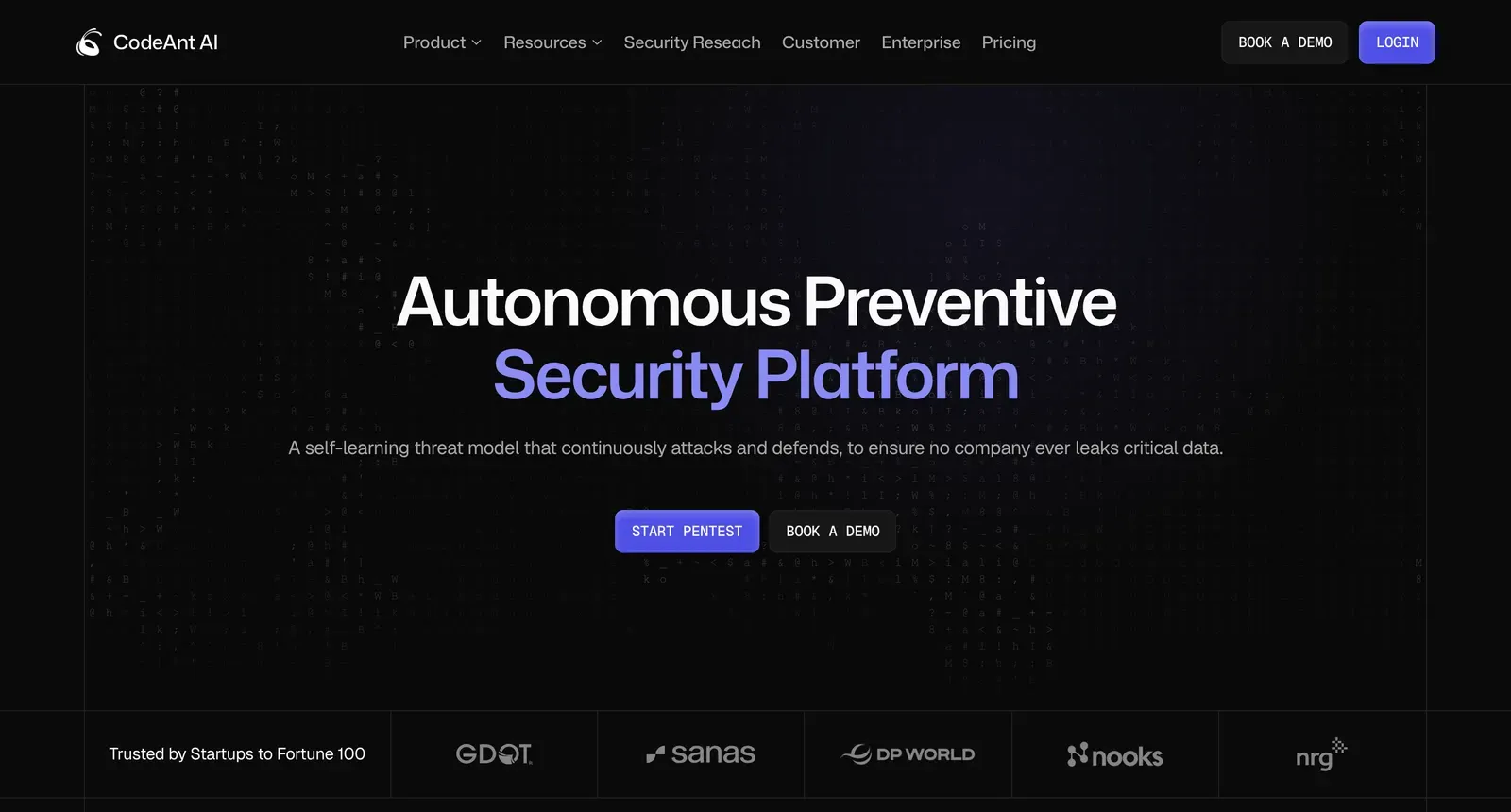
CodeAnt AI bundles code quality, SAST, SCA, secrets, infrastructure-as-code checks and AI pull-request review into one product, which makes it the closest single-vendor swap for a SonarQube plus AppSec stack. Its pricing page did not show plan amounts when we read it on 20 September 2026, so treat the price as available on request. The page does list a 14-day free trial, no card required, open-source projects free, and separate products for AI pentesting, code review, code security, quality and developer metrics. Start here if consolidation is the goal and you are willing to run a trial before a quote.
2. Qodex
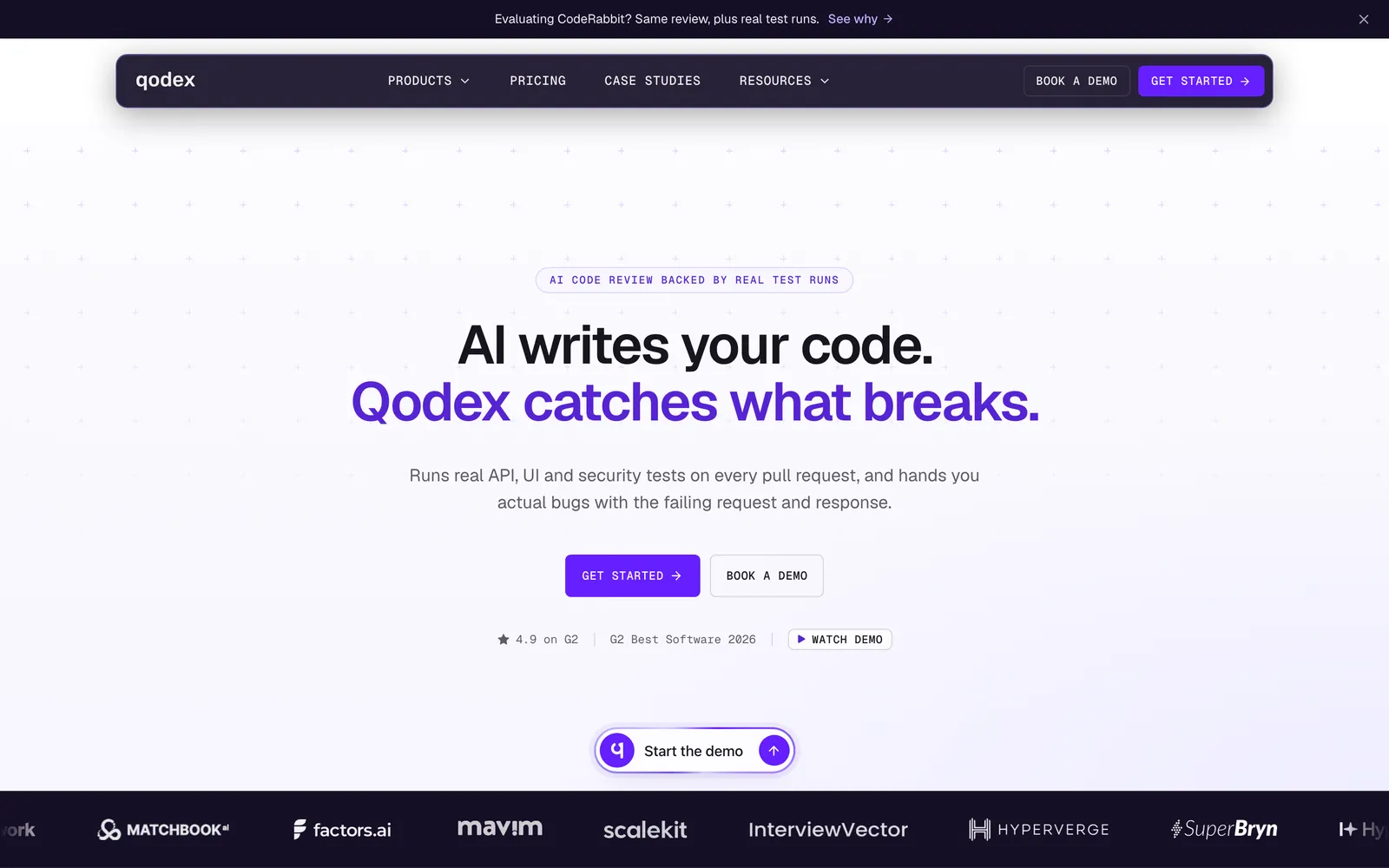
Qodex is not a like-for-like SonarQube replacement. It is the branch to consider when the missing layer is AI pull-request review plus executed API, UI and security checks. Qodex calls itself "AI code review that runs your tests on every pull request". It lists "more than a dozen static analyzers, a full read of every changed file, a blast-radius pass, two frontier models, and live probes against the preview. Six passes before a single comment is posted." Qodex says it "probes what the models claim against the pull request's own preview deployment before it posts". The same agent "runs your API, UI and security scenarios against the preview and attaches the evidence." See Qodex AI code review.
3. Codacy
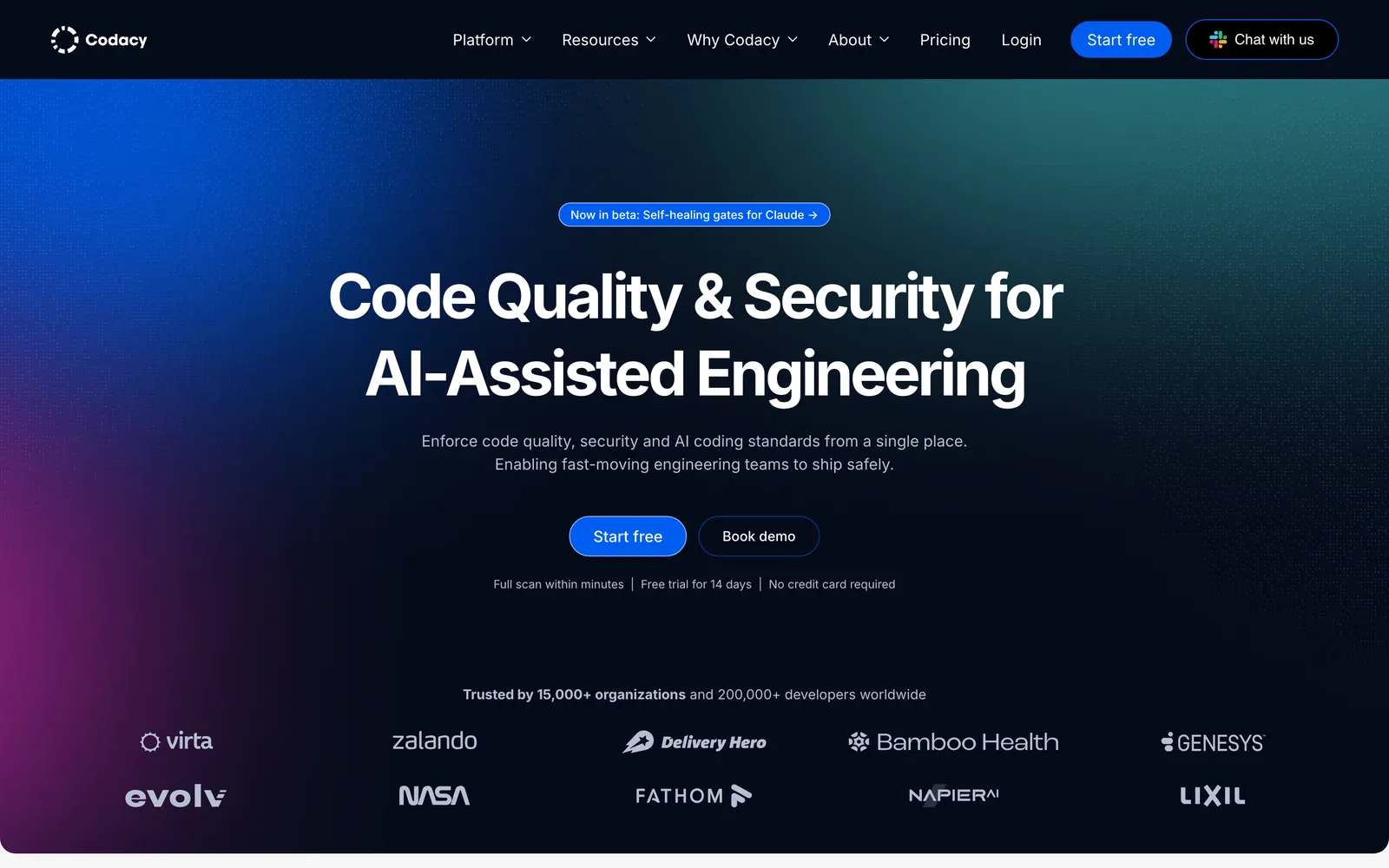
Codacy is the managed version of the job SonarQube does: code quality, coverage, SAST, SCA, secrets and merge gates, hosted for GitHub, GitLab and Bitbucket. Its pricing page (read 20 September 2026) lists three plans. Developer is free forever at $0 for the IDE plugin. Team starts at $18 per developer per month billed yearly, or $21 monthly. Business is custom priced. Team is scoped for up to 30 developers with up to 100 private repositories and unlimited lines of code, which removes the LOC ceiling that drives some SonarQube migrations. There is a 14-day trial, and public open-source projects are free.
4. DeepSource
DeepSource covers static analysis, quality, IaC checks, coverage and autofix, with AI review sold as a metered add-on. The pricing page (read 20 September 2026) lists Team at $24 per user per month billed yearly, with unlimited repositories and unlimited pull-request reviews. AI Review includes $100 of annual credit per user, then bills at $8 per 10,000 processed lines of code on Standard and $15 on Advanced. Dependency scanning includes three targets, with extra targets at $8 each per month. Enterprise adds self-hosted deployment, SSO and bring-your-own-key AI review. Budget the AI review credit separately, because it is metered rather than included without limit.
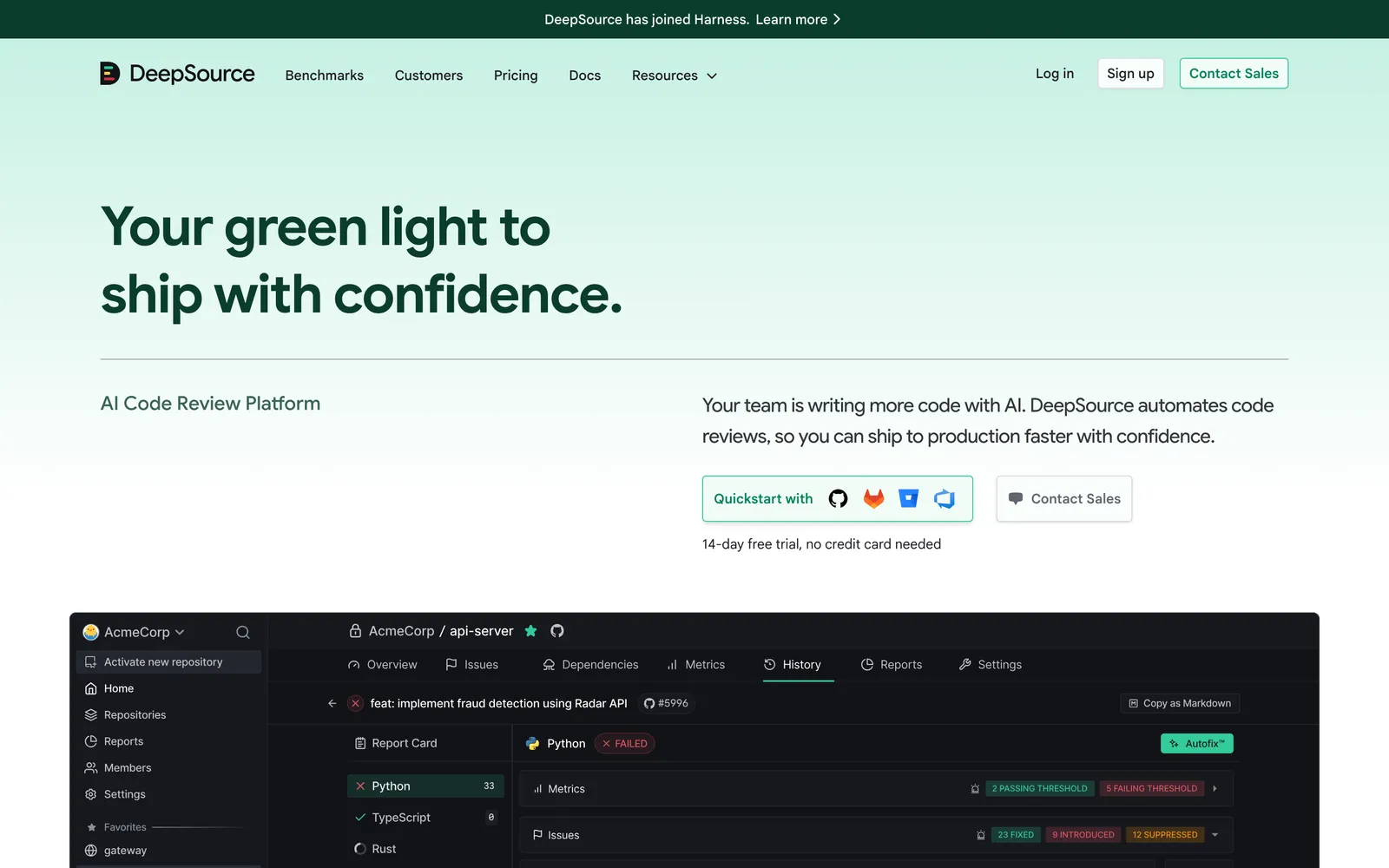
Harness acquired DeepSource on 9 September 2026. The announcement says existing workspaces keep working and that DeepSource's capabilities will move into the Harness platform over time, and the homepage banner reads "DeepSource has joined Harness" (read 22 September 2026).
5. Snyk
Snyk is application security first: code, open-source dependencies, infrastructure as code and containers, with fixes pushed into developer workflows. The plans page (read 22 September 2026) lists Free at $0 a month with 100 Snyk Code tests a month. Team starts at $25 a month for teams of up to 10 developers, with 1,000 Code tests a month. Enterprise is a credit-based subscription priced through sales. See the Snyk AI code review guide for Snyk's current pricing, limits, and product boundaries.
6. Aikido
Aikido sells one bundle across SAST, SCA, secrets, IaC, DAST, cloud posture and container scanning, which suits a small team that wants one bill instead of four. Its pricing page (read 20 September 2026) lists a free forever Developer plan for 2 users and 10 repositories. Basic is $300 a month including 10 users and 100 repositories. Pro is $600 a month including 10 users and 200 repositories. On-prem scanning, malware detection and attack surface monitoring start at Pro, and Pro includes 100 monthly credits for advanced AI features such as AI pentesting and deep pull-request reviews. If maintainability reporting matters, compare it against Sonar or Codacy in a trial.
7. Semgrep
Semgrep is the choice when you want to own your rules. Patterns look like the code they match, live in your repository, and the community engine is open source. The pricing page (read 20 September 2026) lists a Free Edition for up to 10 repositories and 10 contributors. Teams starts at $30 per contributor per month for Code or Supply Chain, and $15 for Secrets, with 20 AI credits per developer per month. Enterprise removes the repository and contributor limits, adds 50 AI credits, and supports self-managed source control. Semgrep Community Edition is narrower than the paid products, which add cross-file analysis and the managed scan service.
8. Qodana
Qodana runs JetBrains IDE inspections in continuous integration, so a team already standardised on IntelliJ, PyCharm or Rider gets the same findings in the pipeline that developers see while typing. The Qodana plans page (read 20 September 2026) lists three plans: Community, which is free, Ultimate at $60 a year, and Ultimate Plus at $180 a year. The plan comparison did not render in the page source we read, so confirm language coverage and limits in the live buying interface. Qodana is an ecosystem fit rather than a consolidation play, and it does not carry the SCA and cloud coverage of the AppSec bundles above.
9. GitHub Code Security
If every repository is on GitHub, the native option removes an integration. GitHub Code Security covers static analysis and dependency scanning with Copilot Autofix, and the Advanced Security page (read 20 September 2026) prices it at $30 per active committer per month. GitHub Secret Protection is sold separately at $19 per active committer per month. Both bill per active committer, so a large repository with few contributors is cheap compared with LOC pricing. The limit is the obvious one: a team with repositories on GitLab or Bitbucket needs a second tool, so the saving disappears.
10. Veracode
Veracode is the enterprise end of the market: SAST, DAST, SCA, container and IaC scanning with risk management and reporting on top. The platform page (read 20 September 2026) describes code-to-cloud scanning integrated into IDEs and claims coverage of "100s" of languages and frameworks. No price is published, so the route in is a demo and a quote. This fits an organisation that needs policy, audit reporting and a vendor relationship more than it needs a card-swipe signup, and it is a heavy choice for a team of ten.
For the broader AI-review market, compare our best AI code review tools. If the pull-request reviewer is the part you are replacing, see our CodeRabbit alternatives.
How to choose between them
Write the shortlist against your own constraints before you read another vendor page. Nine questions do the work.
Code quality or security? Maintainability findings, duplication and coverage gates are a different product from vulnerability scanning. Check which one your gap actually is before you compare prices.
Which security layer? SAST reads your code. SCA reads your dependencies. Secrets scanning reads your history. IaC reads your Terraform. DAST tests a running build. No single checkbox called "security" covers those five.
Where does analysis run? If source code cannot leave your network, the shortlist is Community Build, Semgrep, Qodana self-hosted, Aikido on-prem scanning from Pro, and DeepSource Enterprise.
Which Git hosts? A GitHub-only estate can take the native option. A mixed estate cannot without paying twice.
What is the billing unit? Lines of code, developers, active committers, repositories and processed lines all appear above. Model each against your actual numbers, because the rankings change.
Who writes rules? If your team wants rules in version control and reviewed like code, look at Semgrep, whose rules are patterns that look like the code they match.
What gates a merge? Check the tool can post a required status check, and that you can set a threshold on new code rather than the whole backlog.
Does it prove anything at runtime? Static analysis cannot. Executed tests and probes against a deployed preview can.
What does migration cost? Custom rules, quality profiles and historical baselines are the parts that do not export cleanly.
One boundary is worth stating plainly. A tool that maps findings to the OWASP Top 10 is mapping to a risk list, not certifying anything. OWASP calls the Top 10 "a standard awareness document for developers and web application security" (OWASP Top 10, read 20 September 2026). Scanner coverage supports a security case, it does not prove compliance with any framework.
Migration checklist: swap the gate without losing coverage
The risk in a migration is not the new tool. It is the week when neither tool is trusted and merges go through unchecked. Run these seven steps in order.
Inventory what you actually use. Export your active quality profiles, custom rules, plugins and quality gate conditions. Rules nobody has triggered in a year are not requirements.
Record the baseline. Capture current issue counts by severity, coverage percentage and the gate conditions that block a merge today. Without this you cannot tell whether the new tool is quieter or just blinder.
Map rule to rule. Take your top twenty triggered rules and find the equivalent in the candidate. Anything without an equivalent is either a custom rule to rewrite or a requirement to drop on purpose.
Separate old debt from new code. Set the new gate on changed lines first. Importing a backlog of ten thousand findings into a blocking gate ends with the gate switched off.
Run both tools for one release cycle. Keep the old gate required and the new one advisory. One cycle gives you real pull requests rather than a demo repository.
Compare valid unique findings. Count what each tool found that the other missed, then triage a sample of both for false positives. Raw finding counts favour whichever tool is noisier.
Switch the required check, then decommission. Make the new check required, watch one more cycle, then cancel the old licence and archive its history somewhere readable.
Executed API checks belong in a continuous API testing pipeline, not only a static-analysis gate. Runtime security is a separate layer, covered in our security testing tools guide.
Run a free static scan in five minutes
Before you book a demo, it is worth seeing what an open-source scanner reports on code you control. This is the Semgrep Community Edition quickstart, run exactly as printed on 20 September 2026 (Semgrep CE quickstart).
python3 -m venv .venv
./.venv/bin/pip install semgrep
./.venv/bin/semgrep --version
That printed 1.176.0. Now create the quickstart's sample file, which builds a shell command out of whatever the user typed:
# app.py
import os

user_input = input("Enter a Directory: ")
os.system("ls " + user_input)
Then scan it with a registry rule pack:
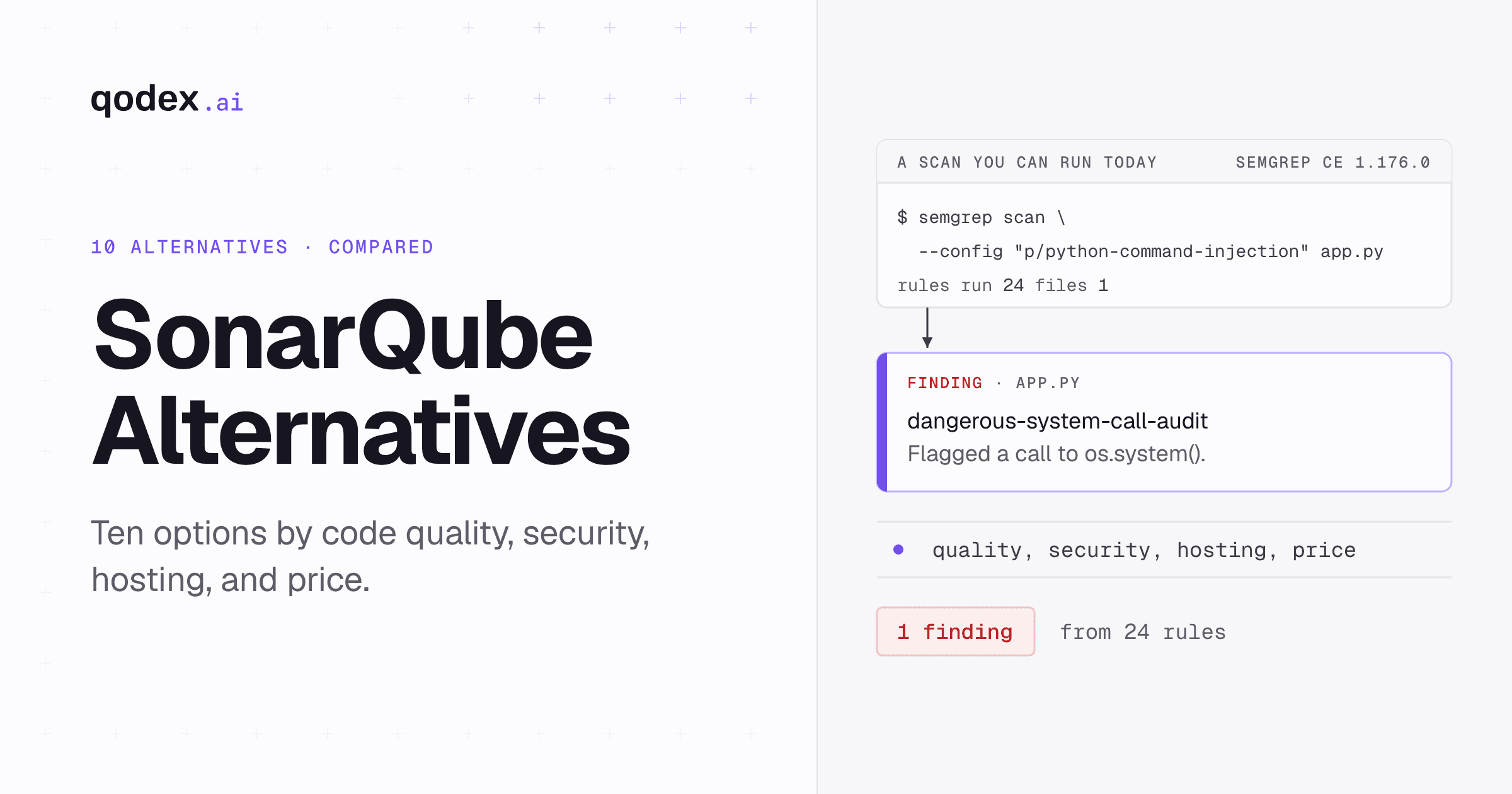
./.venv/bin/semgrep scan --config "p/python-command-injection" app.py
The run reported 1 finding from 24 rules on 1 file. The rule was dangerous-system-call-audit, and the message read: "Found dynamic content used in a system call. This is dangerous if external data can reach this function call because it allows a malicious actor to execute commands." It points at line 5 and suggests the subprocess module instead.
Note what that five-minute run did not do. It checked one file, not a repository. It ran one rule pack, not the full registry. It said nothing about dependencies, secrets, infrastructure or a deployed build, and it did not gate a merge. Those are the jobs you are comparing the paid products on.
The short version
Pick by constraint, not by brand. If analysis has to stay inside your network, look at Community Build, Semgrep, Qodana or DeepSource Enterprise. If the LOC bill is the problem, move to a per-developer or per-repository tool such as Codacy or DeepSource. If the gap is dependency, container and cloud coverage, look at Snyk or Aikido. If the gap is knowing whether the change works, add executed checks against a preview rather than a second static analyzer.
Frequently Asked Questions
What is the best SonarQube alternative?
There is no single winner. CodeAnt AI fits a consolidated quality and security workflow. Codacy and DeepSource are the closest managed equivalents of a SonarQube quality gate. Semgrep suits teams that want to own their rules. Snyk and Aikido fit application security breadth. Choose against your deployment, billing unit and Git host first.
What is the best free and open-source SonarQube alternative?
For self-managed quality gates, SonarQube Community Build is the free open-source edition from Sonar itself. For security rules you can write and version, Semgrep Community Edition is the open-source engine, and the hosted free tier covers 10 repositories and 10 contributors. Qodana Community is free and suits JetBrains-centric teams. None of the three matches the paid products in scope.
How much does SonarQube cost in 2026?
The plan card on Sonar's pricing page shows Team starting at $34 a month, and the billing FAQ ties that to analysis of up to 100,000 lines of code. A second FAQ block on the same page says $32. The free tier covers private projects up to 50,000 lines. Enterprise and self-managed Server editions are quoted. Read 20 September 2026.
What is the difference between Community Build, SonarQube Cloud and SonarQube Server?
Community Build is the free, open-source edition you host and operate yourself. SonarQube Cloud is Sonar's hosted service, billed against private lines of code. SonarQube Server is the commercial self-managed product, sold in Developer, Enterprise and Data Center editions, each priced per instance per year by lines of code. Source: Sonar plans and pricing, read 20 September 2026.
Is Snyk or SonarQube better for application security?
They cover different layers. SonarQube leads on code quality and maintainability, and sells SCA and SBOM visibility as Advanced Security, which its pricing page lists on the Team card and, in an FAQ, for Enterprise users. Snyk starts from application security and covers dependencies, containers and infrastructure as code in one platform. Shortlist Snyk when the buying trigger is vulnerability management, and Sonar when it is maintainability.
Is Codacy or DeepSource closer to SonarQube?
Both are managed static analysis with quality gates, so both are close. Codacy leans toward coverage reporting, shared standards and merge policies across GitHub, GitLab and Bitbucket. DeepSource leans toward autofix, unlimited repositories and metered AI review, with self-hosting on Enterprise. If you need on-prem analysis, DeepSource Enterprise is the shorter route.
Which SonarQube alternatives can be self-hosted?
From the list above: Semgrep supports self-managed source control on Enterprise, Aikido offers on-prem scanning from Pro, DeepSource offers self-hosted deployment on Enterprise, and Qodana can be self-hosted. CodeAnt AI describes cloud and on-prem options. Confirm the deployment terms in writing before signing, because they sit on the top plans.
Can Semgrep replace SonarQube?
For security rules, it can. For code quality and coverage gates, it is a partial swap. Semgrep is a pattern-matching engine with an open-source core, strong custom rules and paid cross-file analysis, SCA and secrets. It does not aim at maintainability metrics, duplication reports and coverage dashboards the way Sonar does. Running Semgrep for security and keeping a quality tool alongside it is a workable split.
Is GitHub Code Security enough for a GitHub-only team?
It can be, for SAST and dependency scanning inside GitHub, at $30 per active committer per month with Copilot Autofix. Secret Protection is a separate $19 per active committer per month. It gives you no coverage of repositories on other hosts, and the maintainability reporting is thinner than a dedicated quality tool. Prices read 20 September 2026.