Snyk AI Code Review: Features, Pricing, Limits, and Alternatives
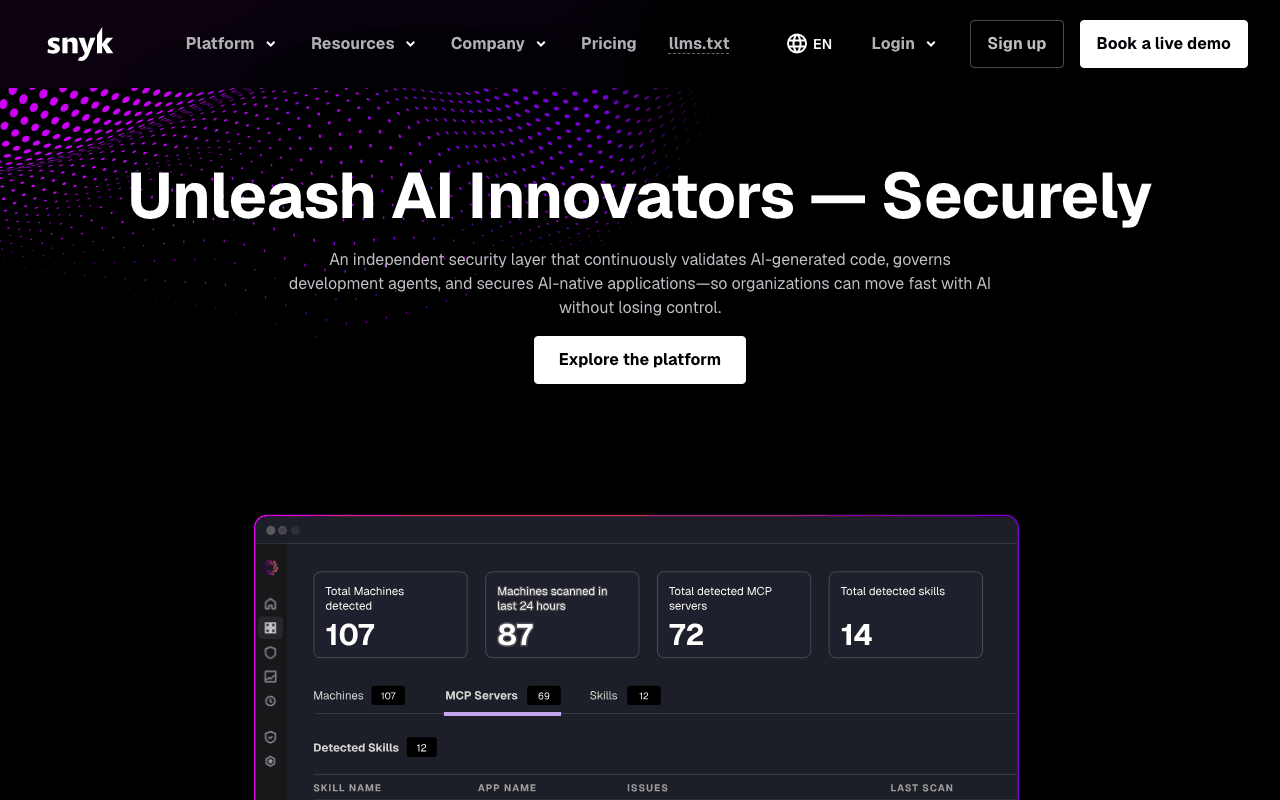
Snyk's AI-powered code review is Snyk Code: static application security testing, or SAST, with DeepCode AI as the detection engine and fix suggester. It finds vulnerabilities and some coding defects, compares findings before and after a pull request, and does not run your application or review product logic. Every price below was read on 2 September 2026.
This page is part of our AI testing guide. One naming note, because search results mix these up: Qodo (qodo.ai) is not Qodex (qodex.ai). Different companies, similar names, both below. The rest covers the Snyk AI-powered code review features, what Snyk costs, where static review stops, and 12 alternatives.
Quick answer: choose by constraint
The decision here is not usually Snyk or something else. Keep Snyk for security, add a reviewer for the rest, and replace it outright only when the ask was never security.
| Constraint | Pick | One line |
|---|---|---|
| Security-first gate on source code | Snyk Code | SAST with AI fixes; keep it for vulnerabilities. |
| Review plus executed API, UI and security checks | Qodex | A QA agent, not a scanner; GitHub only. |
| Closest general AI PR reviewer | CodeRabbit | Summaries, inline comments and chat, four major hosts. |
| Multi-host governance or air-gapped enterprise | Qodo | Broadest host list; on-premises and air-gapped. |
| Self-managed or open-source quality gate | SonarQube | Server and Community Build run on your hardware. |
| Monorepo with analyzers first | DeepSource | Monorepo support; AI review metered by lines. |
| One dashboard for quality, SAST, secrets and coverage | Codacy | Cloud only; the free plan is an IDE plugin. |
| Free for one developer on private repos | Greptile Starter | $0, unlimited repos, 50 credits a month. |
| Lowest published reviewer seat price | Bito | $12 a seat annual, plus a $5 self-host add-on. |
| Already paying for Copilot | GitHub Copilot code review | No new vendor; reviews spend AI credits. |
| Team lives in Cursor | Cursor Bugbot | Finding-to-fix handoff; no rate card. |
| Stacked pull requests and a merge queue | Graphite | GitHub only; unlimited AI review from $40. |
| Simple GitHub-only budget bot | CodeReviewBot | 10 free private reviews a month; unit unclear. |
Korbit is not on the list. Boost Security announced its acquisition of Korbit in a post dated 6 May 2026. Korbit’s signup and documentation hosts did not resolve and its get-started page returned 404 when we checked on 22 September 2026. If a Korbit review stopped appearing on your pull requests, read our Korbit alternatives guide.
Snyk and 12 alternatives at a glance
Prices checked 2 September 2026. "Not offered" means the page does not sell it. For the wider category, see the best AI code review tools.
| Tool | Review approach | Git hosts | Paid start and unit | Free plan or trial | Self-hosted | Best for | Main limit |
|---|---|---|---|---|---|---|---|
| Snyk Code (baseline) | Security-first static analysis, AI fixes | GitHub, GitLab, Bitbucket, Azure Repos | Team from $25 a month for up to 10 developers | Free $0, 100 Snyk Code tests a month, 5 projects | No. Broker for private Git; Local Engine avoids upload | A security gate on every pull request | Not a reviewer for logic or intent |
| CodeRabbit | Agentic diff review, repo context | Four majors | Essentials $24 per developer per month, annual | 14-day trial, no card; public repos free | Enterprise | The closest general reviewer | 5 reviews per developer per hour; security from $72 |
| Qodex | Six passes plus test runs against the preview | GitHub only | Pro $30 per developer per month, 50 reviewed PRs per seat | Free $0, 20 reviewed PRs per developer a month for up to 2 developers, no card | Enterprise | A check meaning a reproduced failure | GitHub only; needs a preview and scenarios |
| Qodo | Review plus organization rules | Four majors, Gerrit on Enterprise | Pro Team $30 for 2,500 pooled credits, $0.012 after | 14-day unlimited trial; qualified open source can apply | On-premises, air-gapped | Rules enforced org-wide | Credits expire monthly, vary with PR size |
| SonarQube | Deterministic rules and gates | Four majors | Cloud Team from $32 a month per instance | Cloud free tier; Community Build free | Yes: Server, Community Build | A gate you run yourself | Not conversational; cost scales with lines |
| DeepSource | Analyzers plus a metered AI review | Four majors | Team $24 per user per month yearly; AI Review $8 per 10,000 lines | 14-day trial, $50 credit; Open Source plan free | Enterprise, air-gapped, own key | Monorepos, analyzers first | "Unlimited reviews" excludes the AI review |
| Codacy | Quality and security scanning, AI reviewer | Cloud GitHub, GitLab, Bitbucket | Team from $18 per developer per month yearly, $21 monthly | Developer plan free but IDE only; 14-day trial | Not offered | Quality, SAST, secrets and coverage in one place | Cloud Git only; no PR review when free |
| Greptile | Repository-graph review; TREX beta | GitHub, GitLab | Pro $30 per seat with 50 credits, $1 after | Starter free for 1 developer, 50 credits | Enterprise: Docker, Kubernetes | Whole-repo context; solo private repos | Metered credits; no official Bitbucket support found |
| Bito | Codebase-indexed review in Git, IDE, CLI | GitHub, GitLab, Bitbucket | Team $12 per seat annual; 5,000 lines, then $5 per 1,000 | 14-day Professional trial; no free plan | $5 per seat on Professional | A priced self-host route | Lines metered; cross-repo is Enterprise |
| GitHub Copilot code review | Native review in the PR panel | GitHub; Azure DevOps preview | Copilot Pro $10 per user per month, $15 in AI credits | Copilot Free excludes code review | Not offered | Teams already on Copilot | Comment reviews cannot block a merge |
| Cursor Bugbot | Diff review, handoff into Cursor | Four majors, Azure limited | Usage-based; Individual Pro $20, Teams $40 per user | Hobby free but does not list Bugbot | Not offered | Teams writing code in Cursor | No published rate card |
| Graphite | AI review inside a stacked PR workflow | GitHub only | Starter $20 per user annual; Team $40 unlimited reviews | Hobby $0, limited reviews; Team trial | Not offered | Teams working in stacks | Unlimited review starts at $40 |
| CodeReviewBot | GitHub bot with style guides | GitHub only | Team from $25 a month; per user or workspace unstated | Public repos free; private personal 10 a month | Enterprise self-hosted or private cloud | A small budget bot | Unclear unit; no language list |
What Snyk's AI code review actually does

What it checks
Snyk Code is SAST for your own source code, and DeepCode AI is the technology behind it, not a second reviewer. The wider platform covers dependencies, containers, infrastructure as code, secrets, APIs and web apps.
The documented checks are narrower than "code review" suggests, and more specific. API misuse, null dereferences and type mismatches. Insecure functions. Dead code, and branches that are predefined or identical on both sides. Control flow, where race conditions surface. Source-to-sink data flow, which makes taint analysis work. Buffer overruns. Type inference. Off-by-one errors and division by zero. Hardcoded-secret rules run during a scan, but Snyk says they are not a standalone secrets scanner.
Snyk calls the approach hybrid AI: symbolic analysis, machine learning, and curated security knowledge. Snyk says fixes are pre-screened and 80 percent accurate in the IDE and in pull requests. That is a vendor claim, unbenchmarked.
What the pull request check does, and does not do
Snyk PR Checks run when a pull request opens. They test the before and after branches and fail only when the new branch has more issues, which stops existing debt blocking every change. The scan covers the entire repository, so a check can surface problems introduced since the last Snyk scan rather than by your diff. Snyk posts Passed or Failed, and that blocks a merge only when branch protection requires it; otherwise it is informational.
The docs call these "live tests" of the before and after branch. The phrase means two static scans, not a running application: Snyk Code does not drive browser journeys, exercise API scenarios or probe tenant boundaries in a pull request check. Dynamic API and web testing is a separate product, and the plans page points at Evo Continuous Offensive Security for architectural flaws and business-logic abuse.
The Remediation Agent is the current home of what was Agent Fix. It scans a project, builds a fix plan, applies dependency or SAST fixes, then rescans and can run existing application tests such as unit tests. It runs in the Snyk CLI with a model-provider key, or in Cursor, Claude, Gemini, Kiro, Codex, Windsurf and GitHub Copilot. Keep the distinction straight: the check is static analysis, and the agent can run tests you already wrote. Neither means Snyk writes and runs API or UI tests for you.
Pricing and free limits
Published list prices, not measured costs, read on the Snyk plans page on 22 September 2026.
| Plan | Published price and unit | Snyk Code allowance | Other limits |
|---|---|---|---|
| Free | $0 a month | 100 tests a month | 5 projects |
| Team | From $25 a month, for teams of up to 10 developers | 1,000 tests a month | 100 projects |
| Enterprise | Credit-based: prepaid credits at 1 credit = $1, priced through sales | Snyk Code draws 1 credit per active contributor per day | Any Snyk capability from the same credit pool |
The number to plan around on the free tier is 100 Snyk Code tests a month, read from Snyk's plans page on 22 September 2026. Check your own usage page before you rely on it.
Languages, hosts, and deployment
Snyk Code supports Apex, C and C++, COBOL, Dart and Flutter, Go, Groovy, Java and Kotlin, JavaScript, C# and VB.NET, PHP, Python, Ruby, Rust, Scala, Swift and Objective-C, and TypeScript. Interfile analysis lets the engine follow a data flow across files rather than inside one. It is available for all of those supported languages except COBOL.
It runs in the Snyk web app, JetBrains, VS Code and Visual Studio, repository monitoring and pull request checks, the CLI and CI/CD, the REST API and Jira, across GitHub, GitLab, Bitbucket and Azure Repos. Deployment is SaaS by default. Broker connects a self-hosted Git server Snyk cannot reach, and Local Engine analyses without uploading code. Neither is a self-hosted platform, and Snyk's docs say Local Engine "requires more maintenance and receives slower updates than the SaaS options". Two more limits: files over 4 MB are not bundled for cloud analysis, and .gitignore and .dcignore are honoured.
Snyk's Trust Center claims ISO 27001, SOC 2 Type II and GDPR, encryption, regional residency, and that customer code is never used for AI training. Those are Snyk's claims, so pull the reports and check the scope. Every limit above is from Snyk's own documentation, not user sentiment: no usable independent complaint evidence turned up, so none is quoted.
Why teams look beyond Snyk for code review
The first reason is scope. A team wants comments about logic, design and intent, and Snyk Code does not do that job. It catches security defects and some control-flow bugs, and says so. A third-party review reaches the same boundary: Snyk is strongest as a developer-facing security layer, and threat modelling, abuse-case tests, runtime monitoring and human ownership of risk sit outside it.
The second is the pricing model: Snyk meters tests and counts contributing developers across the whole platform, so teams wanting a flat seat price for review, or a free plan for private repositories, look elsewhere. The third is deployment, since Local Engine is not a self-hosted platform and teams that want the analyser on their own hardware go to SonarQube.
The fourth is coverage, since a reviewer has to exist on the host and editor your team already uses. The fifth is evidence: some teams want a red check to mean a reproduced failure, which is a change of category, not of vendor. None of this makes Snyk bad at its job. Staying inside the security remit is the product, not a defect, and the setups below keep Snyk and add a reviewer beside it.
The 12 best Snyk alternatives for code review in 2026
Ordered from the closest general reviewers to the workflow-specific picks, with the tester's agent at number 2 because it is a different category.
1. CodeRabbit

The dedicated pull request reviewer: summaries, inline comments, one-click fixes, thread chat, learned team rules, linters and SAST tooling. The closest general reviewer to put beside Snyk.
Price and unit (checked 2 September 2026): Essentials $24 per developer per month annual, $30 monthly, the tier previously called Pro; Advanced $72. Public repositories are free, the 14-day trial needs no card, and there is no free private plan.
Four major hosts, plus IDE, CLI and MCP, with self-hosting on Enterprise. Two catches: 5 reviews per developer per hour on Essentials, and per-pull-request security review only from $72. More in our CodeRabbit alternatives guide.
2. Qodex

The pick when a red check should mean a reproduced failure. Qodex is an AI QA agent, not an application-security platform: it does not replace Snyk's dependency, container, infrastructure or source-code scanning, and is not a like-for-like swap.
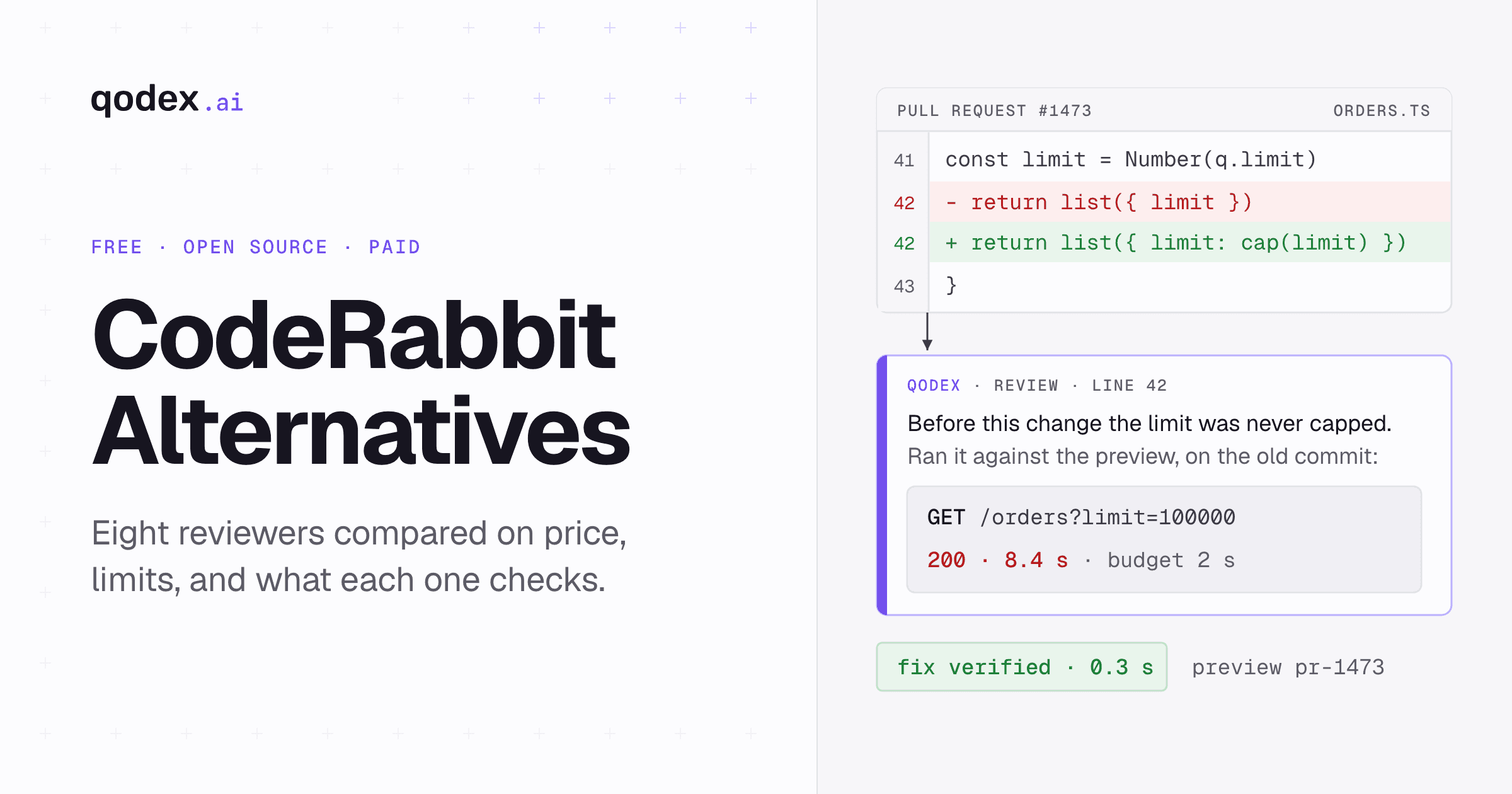
It runs six passes before a comment posts. More than a dozen deterministic analyzers per language, semgrep, gitleaks and osv-scanner among them. A full read of every changed file, with no size gate. A blast-radius pass over the code graph. Two frontier models from different labs, merged and tagged with which found what. Read-only, SSRF-guarded live probes against the preview. And a Check Run that can block the merge, set per repository in .qodex.yaml. Reviews are incremental, and the same agent can run your API, UI and security scenarios against that preview and attach the failing request, the response or a screenshot.
Price and unit (checked 5 October 2026): Free is $0 with 20 reviewed pull requests per developer a month for up to 2 developers, 2 automatic reviews each, unlimited repositories and no card. Pro is $30 per developer per month with 50 reviewed pull requests per seat pooled and $1 per extra. A seat is a developer with 3 or more reviewed pull requests that month, Pro has a 14-day free trial with no card, and self-hosting is on Enterprise.
It installs as a GitHub App and works alongside Cursor, Claude Code, Codex, Copilot, Devin, the CLI and Slack. The limits are real: GitHub only, and the execution half needs a reachable preview and saved scenarios. Keep Snyk for scanning, add a reviewer for the rest, and see how Qodex reviews pull requests.
3. Qodo

The pick when review has to be governed, not just performed: organization-wide rules with context across repositories and pull request history.
Price and unit (checked 2 September 2026): Pro Team $30 a month for 2,500 pooled credits, which Qodo estimates at about 18 reviews, then $0.012 per extra credit, up to 30 users. Bigger pull requests draw more credits, so treat 18 as a vendor estimate. The 14-day trial is unlimited, and qualified open-source projects can apply.
It adds Gerrit on Enterprise and deploys on-premises or air-gapped. Qodo is not open source, though its product descends from PR-Agent, and unused credits expire monthly. See our Qodo alternatives guide.
4. SonarQube

The answer when you want deterministic, auditable rules. It is quality and security analysis with gates on branches and pull requests, sold as Cloud, a self-managed Server, or the open-source Community Build.
Price and unit (checked 2 September 2026): Cloud Team starts at $32 a month per instance, and Server is priced by lines of code annually. SonarQube Cloud has a free tier, Community Build is free and open source, and paid plans have a 14-day trial.
Four hosts plus SonarQube for IDE, with rules across more than 30 languages. It is not a conversational reviewer, and cost scales with the codebase, not headcount.
5. DeepSource

Harness acquired DeepSource on 9 September 2026. The announcement says existing workspaces keep working and that DeepSource's capabilities will move into the Harness platform over time, and the homepage banner reads "DeepSource has joined Harness" (read 22 September 2026).
The monorepo and analyzers-first choice, pairing static analysis, security scanning and Autofix with a metered AI review.
Price and unit (checked 2 September 2026): Team $24 per user per month yearly. AI Review sits on top, at $8 per 10,000 processed lines standard or $15 advanced, after a $100 annual credit per user. The 14-day trial includes $50 in AI credits, and the Open Source plan is free for public repositories.
All four major hosts, plus an API, webhooks, Slack and Jira, with self-hosted and air-gapped Enterprise, and a bring-your-own model key. DeepSource claims more than 5,000 deterministic rules behind the analyzers, its own number rather than a benchmark. Read the plan wording: "unlimited pull request reviews" covers the analyzers, not the metered AI review.
6. Codacy

The single-dashboard option: code quality, SAST, dependency scanning, secrets and coverage in one cloud product, with an AI reviewer, merge gates and guardrails.
Price and unit (checked 2 September 2026): Team starts at $18 per developer per month yearly, $21 monthly. A seat is a developer committing to a connected private repository, the trial runs 14 days, and open-source projects are free.
Codacy's own claim for the dashboard is quality, SAST, dependencies, secrets and coverage across 49 languages. The free Developer plan is the thing to read twice: free forever, but an IDE plugin, not pull request review. Codacy is cloud Git only, so a self-hosted Git server rules it out.
7. Greptile

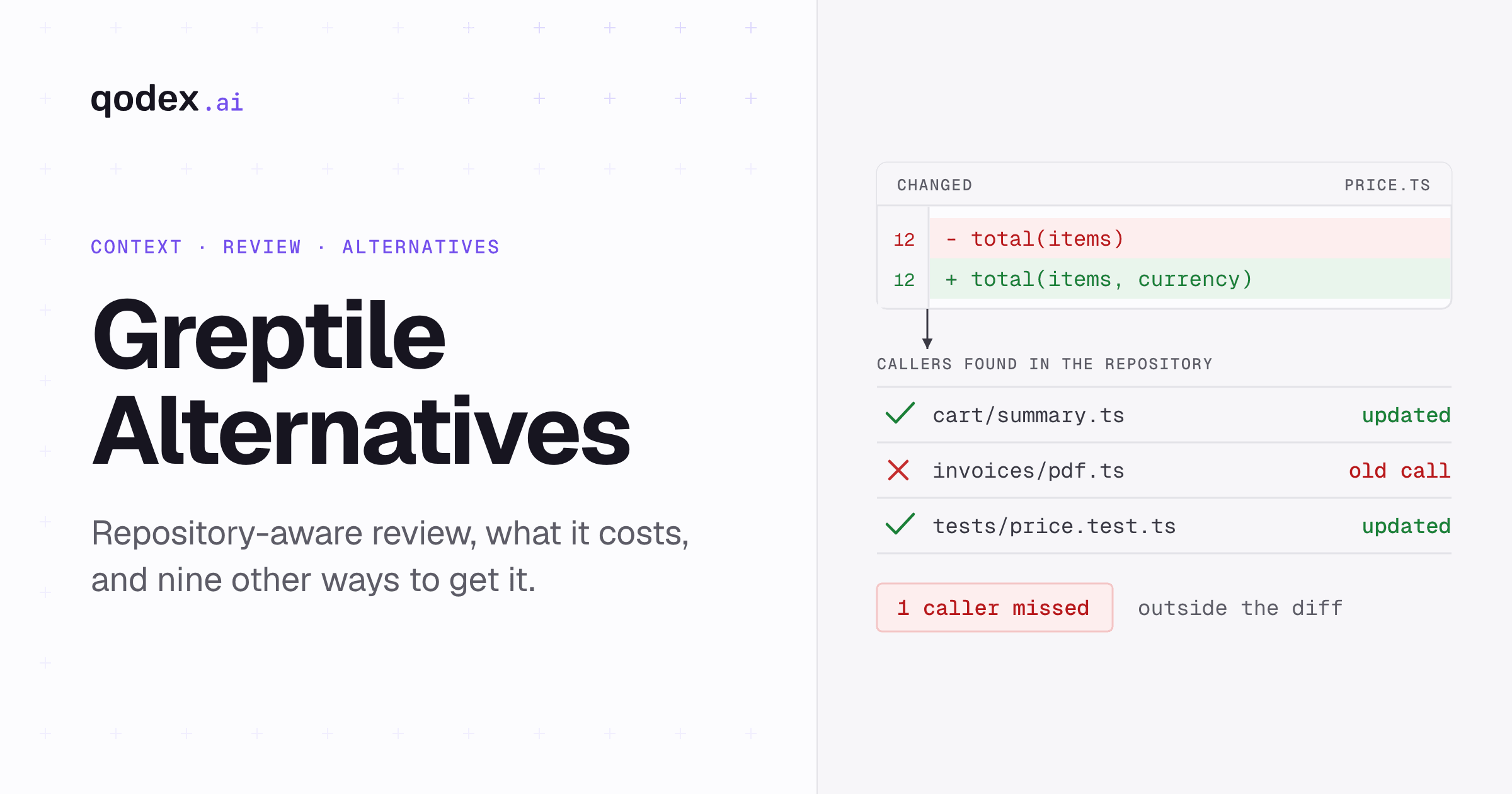
The whole-repo context pick, and a free plan that works on a private repository for one developer. Greptile indexes the codebase into a graph and reviews each pull request against that, not the diff alone. TREX, its runtime validation mode, is in beta.
Price and unit (checked 2 September 2026): Pro $30 per seat per month with 50 credits per seat, then $1 each; a standard review costs 1 credit, a TREX review 3. Starter is free for one active developer with unlimited repositories and 50 credits a month, qualified open-source projects are free, and there is a 14-day Pro trial.
GitHub and GitLab only, no official Bitbucket, and findings hand off to a coding agent. Enterprise self-hosts on Docker or Kubernetes. See our Greptile alternatives guide.
8. Bito

The cheapest published seat among the dedicated reviewers here: a codebase-aware review agent for Git hosts, IDEs and the CLI, with custom rules.
Price and unit (checked 2 September 2026): Team $12 per seat per month annual, $15 monthly, including 5,000 reviewed lines per seat, then $5 per additional 1,000. The 14-day Professional trial needs no card, and there is no free plan.
Three hosts, plus VS Code, JetBrains, Cursor, Windsurf and the CLI. Self-hosting is a $5 per seat per month add-on on Professional, the clearest published self-host price here, with on-premises deployment on Enterprise. Model the line meter first. See our Bito alternatives guide.
9. GitHub Copilot code review

The no-new-vendor option for a GitHub team already paying for Copilot. You request the reviewer from the pull request panel or run it automatically, and it suggests fixes.
Price and unit (checked 2 September 2026): Copilot Pro is $10 per user per month, including code review and $15 in monthly GitHub AI Credits. Copilot Free excludes code review, reviews spend credits, and from 1 June 2026 review workflows on private repositories also consume GitHub Actions minutes.
GitHub only, Azure DevOps in preview, no self-hosting. The limit that catches teams out: Copilot posts Comment reviews, so it can never approve or block a merge.
10. Cursor Bugbot

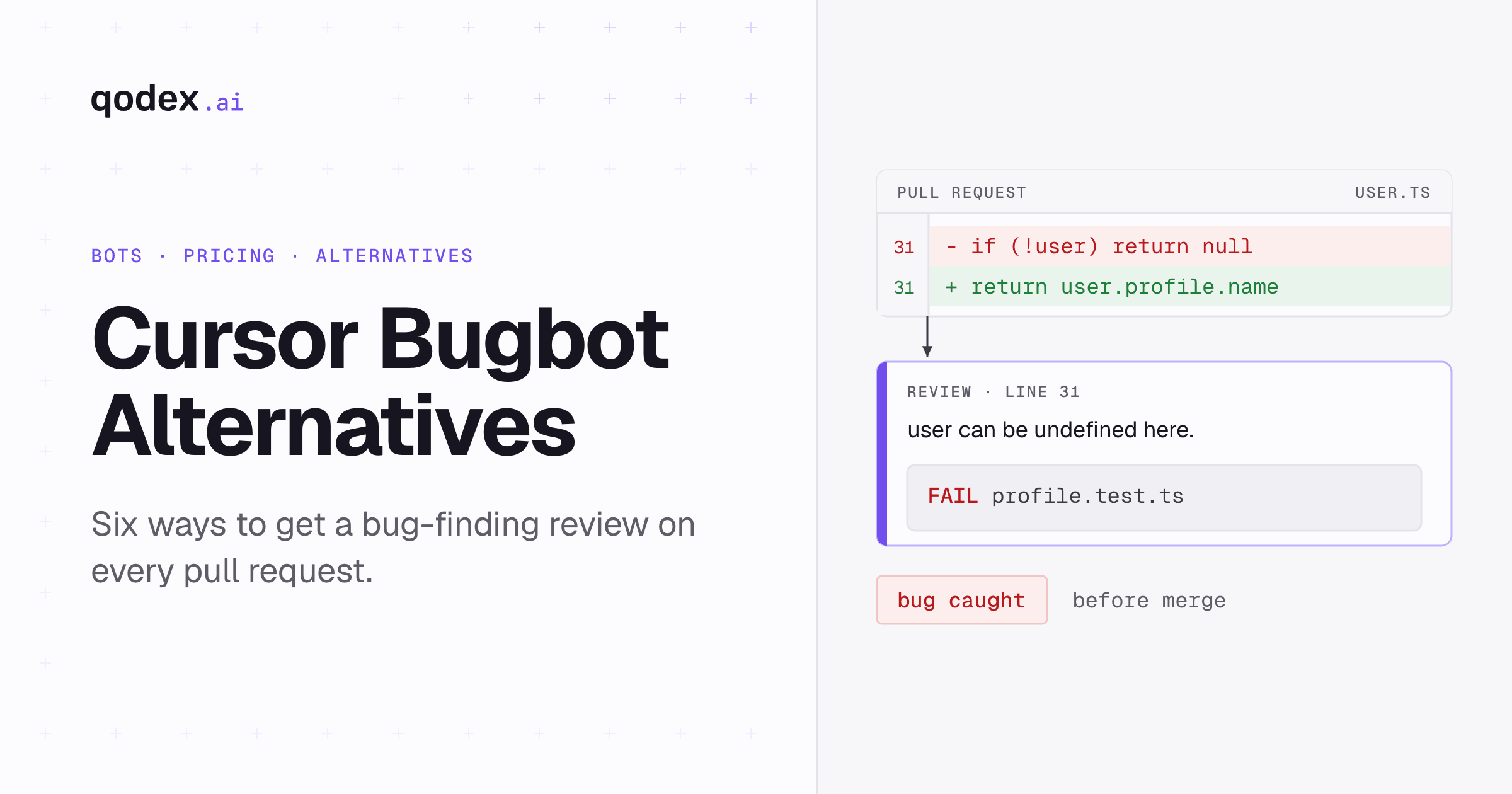
For teams already writing code in Cursor. Bugbot reviews pull requests for bugs, security issues and quality, then hands each finding to the editor for the fix.
Price and unit (checked 2 September 2026): Bugbot is billed on usage. That billing is available with Individual Pro at $20 a month and with Teams Standard at $40 per user per month. Hobby is free, but the pricing page does not list Bugbot in it.
Four hosts, Azure DevOps in limited availability, no self-hosting. The catch is budgeting: no fixed tariff for a review is published, so spend is measured after the fact. See our Cursor Bugbot alternatives comparison.
11. Graphite

A different workflow rather than a deeper reviewer: a GitHub platform for stacked pull requests, with a review inbox, merge queue, CLI and AI Reviews inside it.
Price and unit (checked 2 September 2026): Starter $20 per user per month annual with limited AI Reviews; Team $40 with unlimited AI Reviews, automations and the merge queue. Hobby is free for personal repositories, also limited, and a Team trial exists with no published duration.
GitHub only, no self-hosting. Judge it on the stack workflow: without stacks, $40 a seat is more than cheaper reviewers charge. See our Graphite alternatives guide.
12. CodeReviewBot

The small-budget bot, reviewing GitHub pull requests for bugs, security, performance and quality with configurable style guides.
Price and unit (checked 2 September 2026): Team starts at $25 a month. The page still does not say whether that is per user or per workspace, which is the first question for a sales email. Public repositories are free, private personal ones get 10 reviews a month, and the trial runs 30 days or 40 reviews.
GitHub only, with self-hosted or private-cloud Enterprise deployment. There is no published language list, so test it on your own stack during the trial. See our CodeReviewBot alternatives guide.
Migrating off Snyk Code, or adding a reviewer beside it
Inventory which Snyk products you actually use. Replacing Snyk Code does not replace Snyk Open Source, Container, Infrastructure as Code, Secrets or API and Web.
Record the current configuration first: severity thresholds, ignored issues and their reasons, policies, project scope, and how much baseline debt is suppressed.
Run the old and new checks together for one release cycle. Compare unique valid findings, noise, added delay, and whether developers act on the comments. Never compare raw comment counts. Our guide on how to do code reviews using AI covers what to measure.
Map the new status check into branch protection before removing Snyk's. A Snyk failure blocks a merge only when branch protection requires it, so this is a branch-protection change as much as a tooling one. See automated code review for how the gate should behave.
Confirm every language and Git host on the new tool, then test the awkward cases: monorepos, files over 4 MB, generated code, ignored paths.
Separate old debt from new issues so day one does not block every pull request. Gate on what the change introduces and work the backlog separately.
If you are adding rather than replacing, keep Snyk where scanning is the job and scope the new tool to review only.
Preserve an audit path: the finding, who suppressed it and why, the fix, the rescan, the merge status. Whoever asks about a vulnerability in six months wants that chain.
See also
Frequently Asked Questions
What is Snyk's AI-powered code review, and is DeepCode AI the same thing?
Snyk Code is the product you buy, and DeepCode AI is the technology behind it, not a second reviewer. Snyk Code is security-first static application security testing that reads source code without running it. DeepCode AI supplies the hybrid symbolic and machine-learning analysis and the fix suggestions.
What does Snyk Code detect, and can it find logic bugs?
API misuse, null dereferences, type mismatches, insecure functions, dead code, predefined or identical branches, race conditions from control-flow modelling, source-to-sink data flow, buffer overruns, off-by-one errors and division by zero. Real coding defects, in other words. It does not review product intent, architecture or business rules, and does not claim to.
Does Snyk run tests on pull requests?
Not in the way "tests" usually means. A pull request check runs two static security scans, before and after, and fails when the new branch has more issues. The separate Remediation Agent runs unit tests that already exist, after a fix. Dynamic testing of running APIs and web apps is a different product.
How much does Snyk Code cost, and what does the free plan include?
Free is $0 a month, with 100 Snyk Code tests a month and 5 projects. Team starts at $25 a month for teams of up to 10 developers, with 1,000 tests and 100 projects. Enterprise is a credit-based subscription priced through sales. Prices read on the Snyk plans page on 22 September 2026.
Which languages and Git hosts does Snyk Code support?
Apex, C and C++, COBOL, Dart and Flutter, Go, Groovy, Java and Kotlin, JavaScript, C# and VB.NET, PHP, Python, Ruby, Rust, Scala, Swift and Objective-C, and TypeScript. Hosts are GitHub, GitLab, Bitbucket and Azure Repos, and it runs in JetBrains, VS Code, Visual Studio, the CLI, CI/CD, the REST API and Jira.
Can Snyk Code be self-hosted or run without uploading code?
Not fully. Snyk Broker connects a self-hosted Git server Snyk cannot reach from the internet, and Local Engine analyses without uploading your code, the option for strict upload policies. Neither is a self-hosted Snyk platform, and Snyk's docs warn Local Engine needs more maintenance and gets slower updates than SaaS.
Snyk or SonarQube?
Snyk if the job is developer-first application security across code, dependencies, containers and infrastructure. SonarQube if it is deterministic quality gates with auditable rules, or a self-managed or open-source route you control. They overlap on SAST and diverge elsewhere, which is why running both is a reasonable setup rather than a contradiction.
What is the best Snyk alternative for general pull request review, open source, or runtime testing?
CodeRabbit for a general reviewer across every major host. SonarQube Community Build if it has to be open source and self-managed. Greptile Starter for a free reviewer on a solo private repository. Qodex when the ask is review plus executed API, UI and security checks, kept beside Snyk rather than instead.
The short version
Keep Snyk if the job is vulnerabilities in source code. SonarQube, DeepSource and Codacy overlap Snyk Code on SAST, but nothing here replaces the wider Snyk platform: dependencies, containers, infrastructure as code and secrets. Add CodeRabbit or Qodo if the job is review comments about logic and design, or SonarQube if you want a deterministic gate you run yourself. If the missing layer is proof rather than opinion, Qodex reviews pull requests and runs tests against the preview, alongside Snyk's scanning rather than in place of it.