Graphite Review and Alternatives (2026)
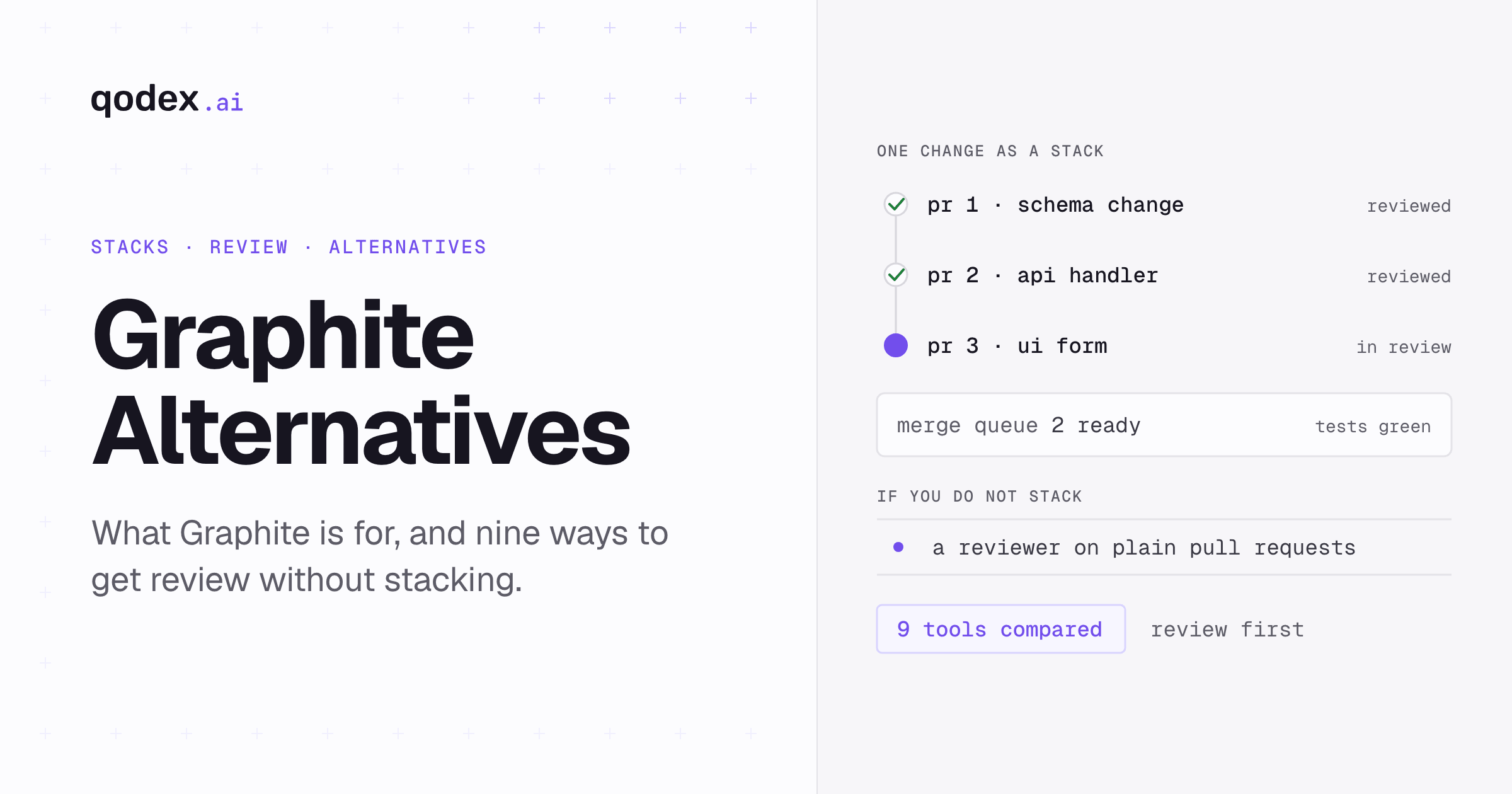
Graphite is two products sold as one: a stacked-pull-request workflow and an AI reviewer that lives inside it. If your team already breaks work into stacks, that combination is the reason to stay, and nothing else on this page replaces both halves. The reason to switch is narrower than people expect: Graphite is GitHub only, with no GitLab or Bitbucket at any tier, and unlimited AI review starts at a $40 seat. Prices below were read off each vendor's page on 30 August 2026.
If you are evaluating review tools as part of a wider testing stack, you can also see how Qodex reviews pull requests by running your tests against the change rather than only reading the diff. One disambiguation before the list: Qodo (qodo.ai) is not Qodex (qodex.ai). Different companies, both below under their full names.
What Graphite is
Graphite now calls itself "the AI code review platform", which understates the other half. The workflow side gives you stacks, a pull request page and inbox, a merge queue, a CLI and a VS Code extension. You break a large change into small sequenced pull requests, and the tooling restacks them when an earlier branch moves.
The reviewer is called AI Reviews, run by Graphite Agent, and was earlier marketed as Diamond. By Graphite's own description it reviews every pull request with full-codebase context, looks for logic issues, edge cases and performance problems, suggests fixes and learns from comment feedback. Notably it is not aimed at style or best-practice nits, so you still want a linter in CI. For background on the category, see automated code review.
Graphite is built on GitHub's APIs, which is why it is GitHub only rather than GitHub first. GitHub Enterprise Server is available on the Enterprise tier. There is no GitLab or Bitbucket support. Editor coverage is a VS Code extension and the CLI; we found no JetBrains plugin. Graphite publishes no language list, so do not assume every language is handled equally. Security claims are SOC 2 Type II, continuous penetration testing, encryption in transit and at rest, tokens held in encrypted Postgres, and AI features that do not train on customer data while sending minimal context to Anthropic and OpenAI. Sources: get started, AI reviews and privacy and security, read 30 August 2026.
Graphite pricing, checked 30 August 2026
| Tier | Price and unit | Included | Trial or free |
|---|---|---|---|
| Hobby | $0 | Personal-account repos, inbox, CLI, MCP, VS Code extension, limited Graphite Chat, limited AI Reviews (no numeric cap published) | Permanent |
| Starter | $20 per user per month billed annually | All GitHub organisation repos, Slack notifications, team insights; AI Chat and AI Reviews still limited | 30 days, no card |
| Team | $40 per user per month billed annually | Unlimited Chat and AI Reviews, AI review customisation, automations, basic merge queue | 30 days, no card |
| Enterprise | Custom | Advanced merge queue, access controls, SAML, SIEM audit log, GitHub Enterprise Server, support agreements | Talk to sales |
Sources: graphite.com/pricing and the homepage, read 30 August 2026. Two things are worth saying plainly. Unlimited AI review is a $40 seat, the same price as CodeRabbit Pro Plus and $10 more than a Qodex Pro seat, and you are buying the workflow platform along with it. And the Hobby and Starter caps on AI Reviews are not published as numbers anywhere, so a team on a cheaper tier cannot predict when it will hit the wall.
Where Graphite falls short
GitHub only. No GitLab, no Bitbucket, no Azure DevOps, at any tier. If any repository lives elsewhere, the evaluation ends here.
Full value needs the whole model. The stack, the CLI, the pull request page and the queue work together, and adopting half of it is worse than adopting none. SoftVerdict calls the workflow opinionated and rates a Sapling migration as high difficulty; ReviewAITool treats migration difficulty as a first-class field when comparing Graphite. Those are third-party editorial judgments, not vendor statements. Sources: SoftVerdict, ReviewAITool.
Graphite's own security page records a past failure: "a repository with a very high number of branches would cause the CLI to hang". Source: privacy and security. Worth knowing if you run a repository with many branches.
A competitor alleges shallow analysis. Aikido claims Graphite does "surface-level analysis" with branch drift and weak security coverage. That is a competitor's marketing, so weigh it accordingly. Source: Aikido.
Unpublished caps and unreachable reviews. Unlimited AI review starts at $40 and the free and Starter caps are unpublished. Independent reviews were not reachable either: Reddit returned 403, old CLI issues 404, and the G2 profile has zero reviews.
Who Graphite fits, and who should look elsewhere
Graphite fits GitHub teams that already work in stacks, or will commit to stacks together, and want AI review and a stack-aware merge queue inside that flow.
Look elsewhere if your repositories are on GitLab or Bitbucket, if you want a reviewer without changing how your team branches, or if you want findings verified by running tests rather than by reading the diff.
Before you compare anything, decide which job you are replacing: the AI reviewer, the stack workflow, or both. Every recommendation below says which one it does, and most of them do only the first.
Quick answer: choose a Graphite alternative by constraint
| Constraint | Pick | One line |
|---|---|---|
| Closest dedicated AI reviewer | CodeRabbit | Replaces the reviewer, not the stacks; four hosts. |
| GitLab, Bitbucket or air-gapped | Qodo | Replaces the reviewer; widest host list. |
| Deepest static codebase context | Greptile | Replaces the reviewer; free for one developer. |
| Findings proven against a running preview | Qodex | Replaces the reviewer; runs API, UI and security tests; GitHub only; does not do stacks. |
| Lowest seat price | Bito | Replaces the reviewer; three hosts. |
| Team lives in Cursor | Cursor Bugbot | Replaces the reviewer; four hosts. |
| Already on Copilot, minimal change | GitHub Copilot code review | Replaces the reviewer; GitHub only. |
| Security gate | Snyk Code | Adds a gate; not a general reviewer. |
| Self-managed quality gates | SonarQube | Adds a gate; Community Build is free. |
| Open-source stacked-change workflow | Sapling with ReviewStack | Replaces the stacks, not the reviewer. |
| Lowest-change stack option | GitHub native stacked PRs | Replaces the stacks with what GitHub already has. |
Graphite alternatives at a glance
Prices checked 30 August 2026. "Not offered" means the vendor's page does not sell it, not that it cannot be negotiated. The last two columns are the ones that matter most on this page. For a wider survey of the category, see the best AI code review tools.
| Tool | Review approach | Git hosts | Paid start and unit | Free plan or trial | Self-hosted | Best for | Main limit | Replaces the reviewer? | Replaces stacked PRs? |
|---|---|---|---|---|---|---|---|---|---|
| Graphite (baseline) | AI review inside a stacked-PR workflow | GitHub only (GitHub Enterprise Server on Enterprise) | Starter $20/user/mo annual (limited AI reviews); Team $40/user/mo annual (unlimited AI reviews, automations, merge queue) | Hobby $0 for personal repos with limited AI reviews; 30-day trial, no card | Not offered | GitHub teams that already work in stacks and want review inside that flow | GitHub only; unlimited AI review starts at the $40 Team tier; full value needs the stack workflow | Is the reviewer | Is the stack workflow |
| CodeRabbit | Agentic diff review with repo context | GitHub (cloud, Enterprise Server), GitLab (.com, self-managed), Bitbucket (Cloud, Data Center), Azure DevOps | Pro $24/user/mo billed annually; Pro Plus $48/user/mo annual; Security add-on $40/user/mo | 14-day trial, no card; free for public repos; no permanent free private plan | Enterprise only (also EU SaaS) | The closest like-for-like reviewer across every major Git host | Rate limits: 5 PR reviews per developer per hour on Pro, 10 on Pro Plus, 12 on Enterprise (fair use) | Yes | No |
| Qodo | Context-aware diff review plus governance rules | GitHub (cloud, Enterprise Server), GitLab (cloud, self-managed), Bitbucket (Cloud, Data Center), Azure DevOps, Gerrit (Enterprise) | Pro Team $30/mo for 2,500 pooled credits (vendor estimate: about 18 reviews), $0.012 per extra credit, up to 30 users | 14-day unlimited trial, no card; no permanent free tier; free for qualified open-source repos | Enterprise: single-tenant SaaS, on-premises, air-gapped | GitLab, Bitbucket, Azure DevOps or air-gapped teams that want rules enforced org-wide | Credits vary by PR size and expire monthly, so cost per review is not fixed | Yes | No |
| Greptile | Codebase-graph diff review; TREX runtime validation (beta) | GitHub (Cloud, Enterprise Server), GitLab (Cloud, Self-Managed); no official Bitbucket support found | Pro $30/seat/mo with 50 credits per seat; $1 per extra credit; 1 credit per standard review, 3 per TREX review | Starter $0: one active developer, unlimited repos, 50 credits a month; 14-day Pro trial; free for qualified open-source projects | Enterprise: Docker Compose or Kubernetes (Helm), air-gapped supported | Large, interconnected codebases and solo developers who want a free reviewer | Credit meter: heavy PR volume or TREX reviews (3 credits each) make the bill variable; no Bitbucket | Yes | No |
| Qodex | Six-pass review plus real test runs and live probes against the preview | GitHub only (GitHub App) | Free $0; Pro $30/developer/mo, a seat only for developers with 3 or more reviewed PRs that month; Enterprise custom | Free: 20 reviewed PRs per developer a month for up to 2 developers, 2 automatic reviews per PR, unlimited public and private repos, no card; 14-day trial on Pro | Enterprise: self-hosting option | Teams that want a red check to mean a reproduced bug, not a guess | GitHub only; the execution value needs a preview deployment and test scenarios | Yes | No |
| Bito | Codebase-indexed diff review in Git, IDE and CLI | GitHub (Cloud, Enterprise Server), GitLab (Cloud, self-hosted), Bitbucket (Cloud, self-hosted) | Team $12/seat/mo annual ($15 monthly); Professional $20/seat/mo annual ($25 monthly); 5,000 reviewed lines per seat per month included, then $5 per 1,000 lines | 14-day Professional trial, no card; no permanent free plan | Professional: self-hosted for a $5/seat/mo add-on; Enterprise: on-premises | Cost-sensitive teams that want review in Git, IDE and CLI, or a priced self-host option | Reviewed lines are metered: a big formatting PR costs extra; cross-repo impact analysis is Enterprise only | Yes | No |
| Cursor Bugbot | Diff review with adjustable effort, fixes in Cursor | GitHub (incl. Enterprise Server), GitLab (incl. self-hosted), Bitbucket (incl. Data Center), Azure DevOps (limited availability) | Usage-based: vendor says an average run costs $1.00 to $1.50 depending on PR size; Cursor Individual Pro $20/mo, Teams $40/user/mo | 14-day trial; no permanent free Bugbot allowance | Not offered | Teams already writing code in Cursor | Spend varies per PR and effort level; no fixed rate card | Yes | No |
| GitHub Copilot code review | Native diff review inside GitHub | GitHub only (Azure DevOps in public preview) | Copilot Pro $10/mo (individual); Copilot Business $19/user/mo; each review also spends GitHub AI credits (GitHub's estimate $0.05 to $1 per Lite review, $0.25 to $5 per Balanced review) plus Actions minutes on private repos | Copilot Free ($0) does not include code review | Not offered | GitHub teams already on Copilot who want a basic pass at no extra vendor | Copilot only posts Comment reviews, so it cannot approve or block a merge; credit spend is variable | Yes | No |
| Snyk Code | Security-only static analysis | GitHub, GitLab, Bitbucket, Azure Repos | Team from $25/mo for up to 10 developers; Enterprise credit-based (read 22 Sep) | Free $0 with 100 Snyk Code tests a month | Not offered (Snyk Broker connects private Git servers; the analysis runs in Snyk's cloud) | Teams whose real ask is a security gate on every PR | A security scanner, not a general reviewer for logic, design or style | Adds a security gate | No |
| SonarQube | Rules-based static analysis with quality gates | GitHub, GitLab, Bitbucket Cloud, Azure DevOps | Cloud Team from $34/mo per instance up to 100,000 lines of code; Server priced per instance per year by lines of code | Cloud free tier up to 50,000 private lines, never expires; Community Build free and open source; 14-day trial on paid plans | Yes: SonarQube Server and Community Build | Teams that want auditable rules and a self-managed gate | Not a conversational reviewer; price scales with lines of code, not people | Adds a quality gate | No |
The 9 best Graphite alternatives in 2026
1. CodeRabbit
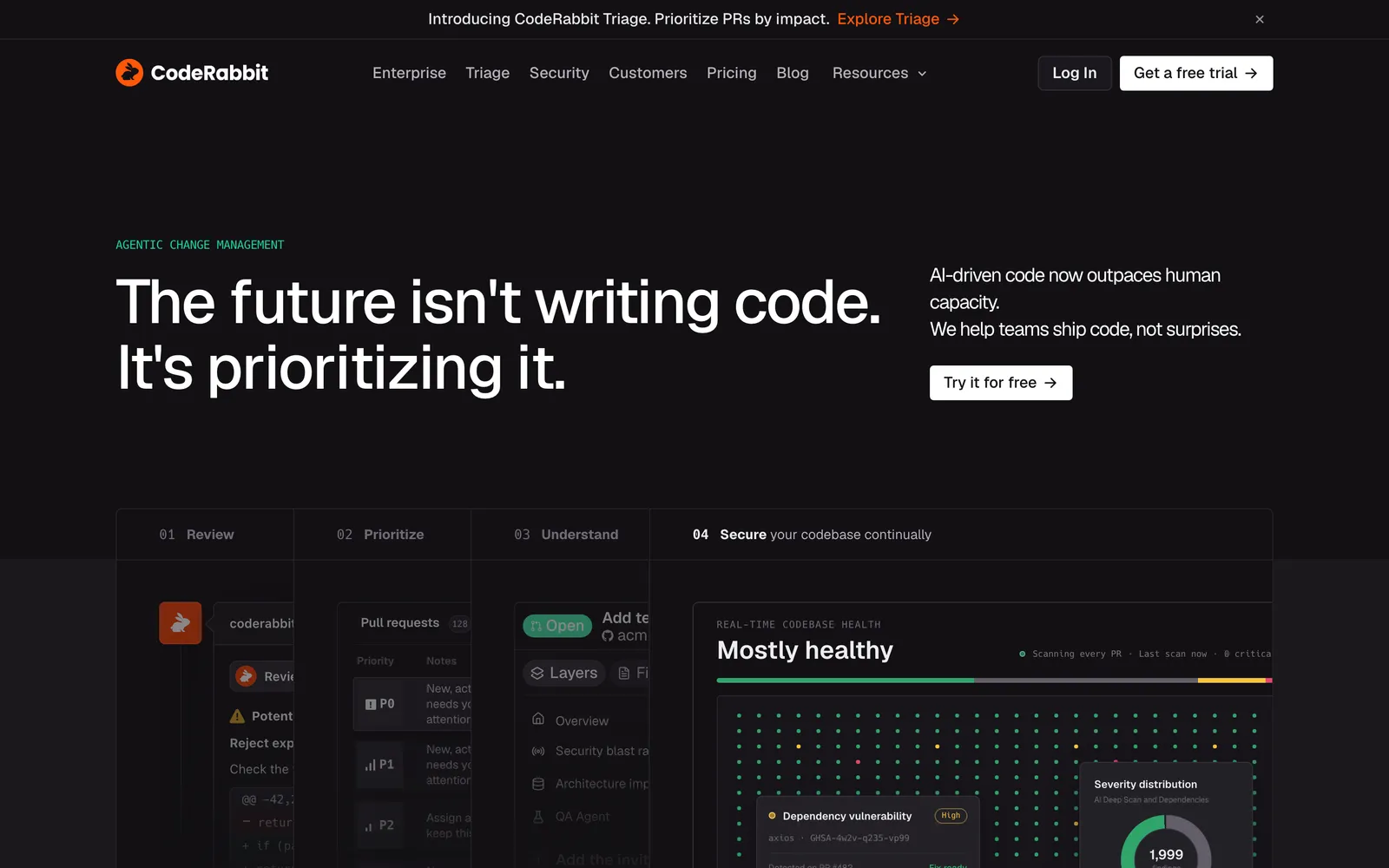
The closest dedicated reviewer, and the one every Graphite roundup names first. A dedicated AI pull request reviewer: summary, inline comments, one-click fixes, chat in the thread, learned team rules, linters and a static application security testing pass, including the style ground Graphite skips.
Price and unit, checked 30 August 2026: Pro $24/user/mo billed annually; Pro Plus $48/user/mo annual; Security add-on $40/user/mo. Unit: per user who opens pull requests.
Free plan or trial: 14-day trial, no card; free for public repos; no permanent free private plan.
Git hosts: GitHub cloud and Enterprise Server, GitLab.com and self-managed, Bitbucket Cloud and Data Center, Azure DevOps. IDE and CLI: VS Code, Cursor, Windsurf, CLI, MCP. Self-hosted: Enterprise only, plus EU SaaS.
Standout: broadest Git host coverage of the dedicated reviewers; Pro Plus adds multi-repo analysis and custom pre-merge checks.
Main limit: rate limits of 5 pull request reviews per developer per hour on Pro, 10 on Pro Plus and 12 on Enterprise, as fair use. Worth checking if you stack, because a stack of five is five reviews.
Migration note: keep Graphite stacks if you like them. Turn off AI Reviews on pilot repositories and let CodeRabbit comment alongside.
Sources: coderabbit.ai/pricing, quickstart. More in our CodeRabbit alternatives guide.
2. Qodo
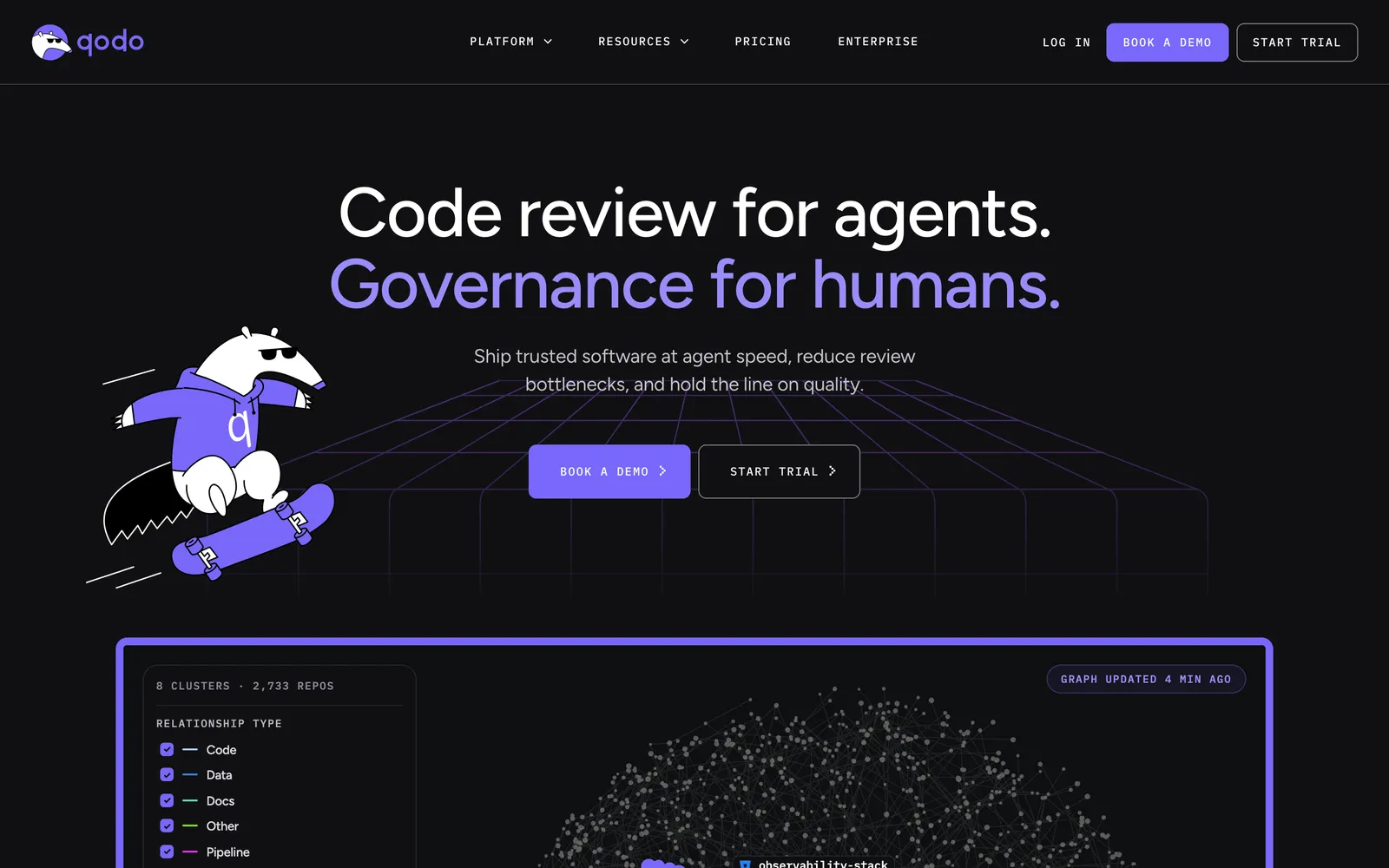
For anyone leaving because Graphite is GitHub only. Qodo (formerly CodiumAI, and not Qodex) is an AI code review and governance platform: pull request review, organisation rules, a context engine across repositories and pull request history, plus IDE and CLI surfaces.
Price and unit, checked 30 August 2026: Pro Team $30/mo for 2,500 pooled credits, a vendor estimate of about 18 reviews, then $0.012 per extra credit, up to 30 users. Unit: pooled credits, and a bigger pull request costs more of them.
Free plan or trial: 14-day unlimited trial, no card; no permanent free tier; free for qualified open-source repos.
Git hosts: GitHub cloud and Enterprise Server, GitLab cloud and self-managed, Bitbucket Cloud and Data Center, Azure DevOps, Gerrit on Enterprise. IDE and CLI: VS Code, Visual Studio, JetBrains, CLI. Self-hosted: single-tenant SaaS, on-premises and air-gapped on Enterprise.
Standout: widest host list in this set plus governance rules, with open-source PR-Agent lineage.
Main limit: credits vary by pull request size and expire monthly, so cost per review is not fixed.
Migration note: same job, credits instead of seats. If you stack, remember many small pull requests means many reviews.
Sources: qodo.ai/pricing, deployment models. More in our Qodo alternatives guide.
3. Greptile
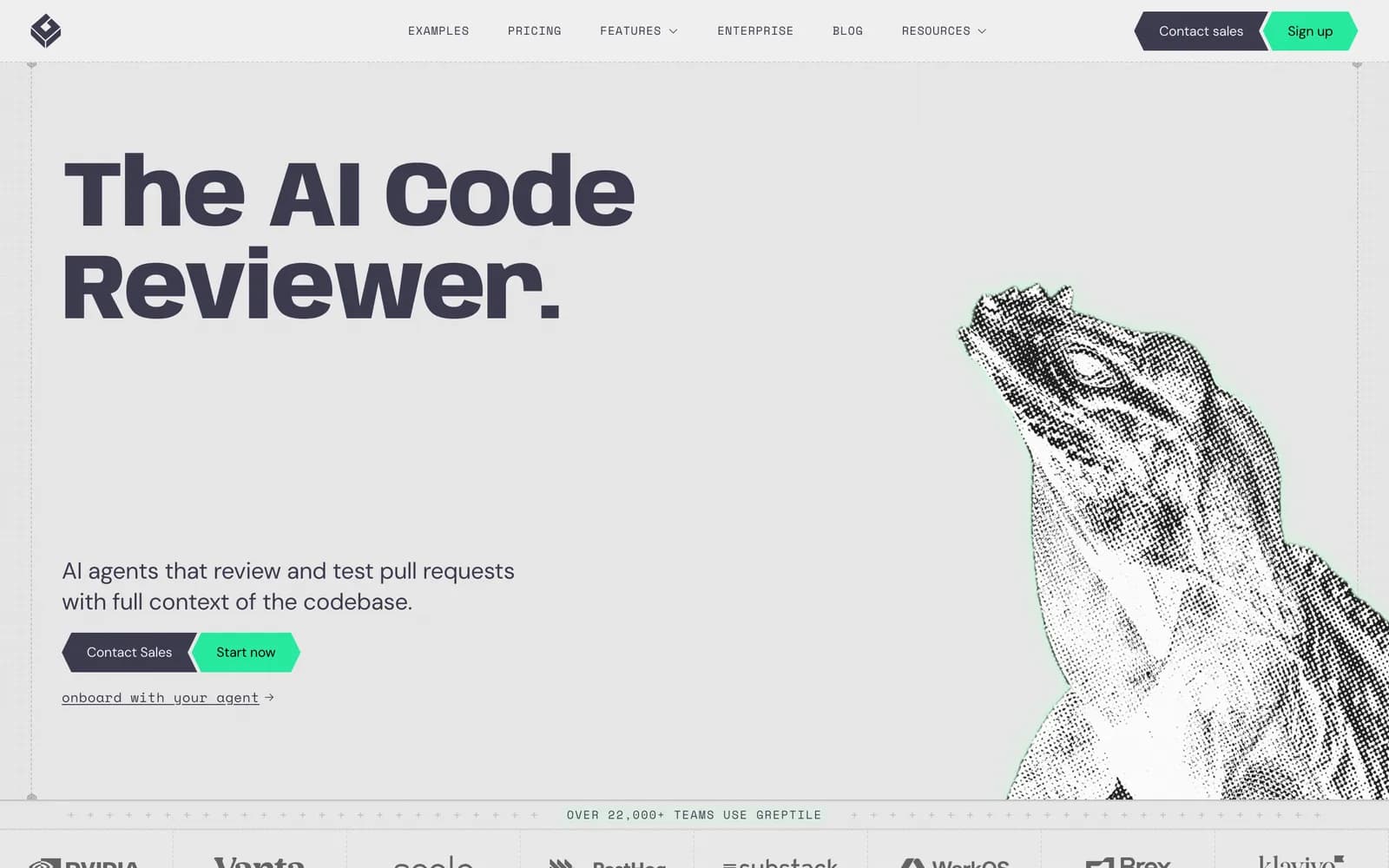
The deepest static context and a free solo tier. Greptile builds a graph of the repository, files, functions and dependencies, and reviews each pull request against that whole-repo context. TREX runtime validation is in beta.
Price and unit, checked 30 August 2026: Pro $30/seat/mo with 50 credits per seat; $1 per extra credit; 1 credit per standard review, 3 per TREX review. Unit: per seat plus credits.
Free plan or trial: Starter $0 for one active developer, unlimited repos, 50 credits a month; 14-day Pro trial; free for qualified open-source projects.
Git hosts: GitHub Cloud and Enterprise Server, GitLab Cloud and Self-Managed; no official Bitbucket support found. Sends findings to Claude Code, Codex, Cursor, Devin and Conductor. Self-hosted: Enterprise, Docker Compose or Kubernetes with Helm, air-gapped supported.
Standout: deepest static whole-repo context, and the only free tier here for a solo developer on private repos.
Main limit: the credit meter makes heavy volume variable, and TREX reviews cost three credits each. No Bitbucket.
Migration note: same job, credits per seat. A stacking team generates far more reviews per engineer, so count reviews rather than people.
Sources: greptile.com/pricing, Greptile docs.
4. Qodex
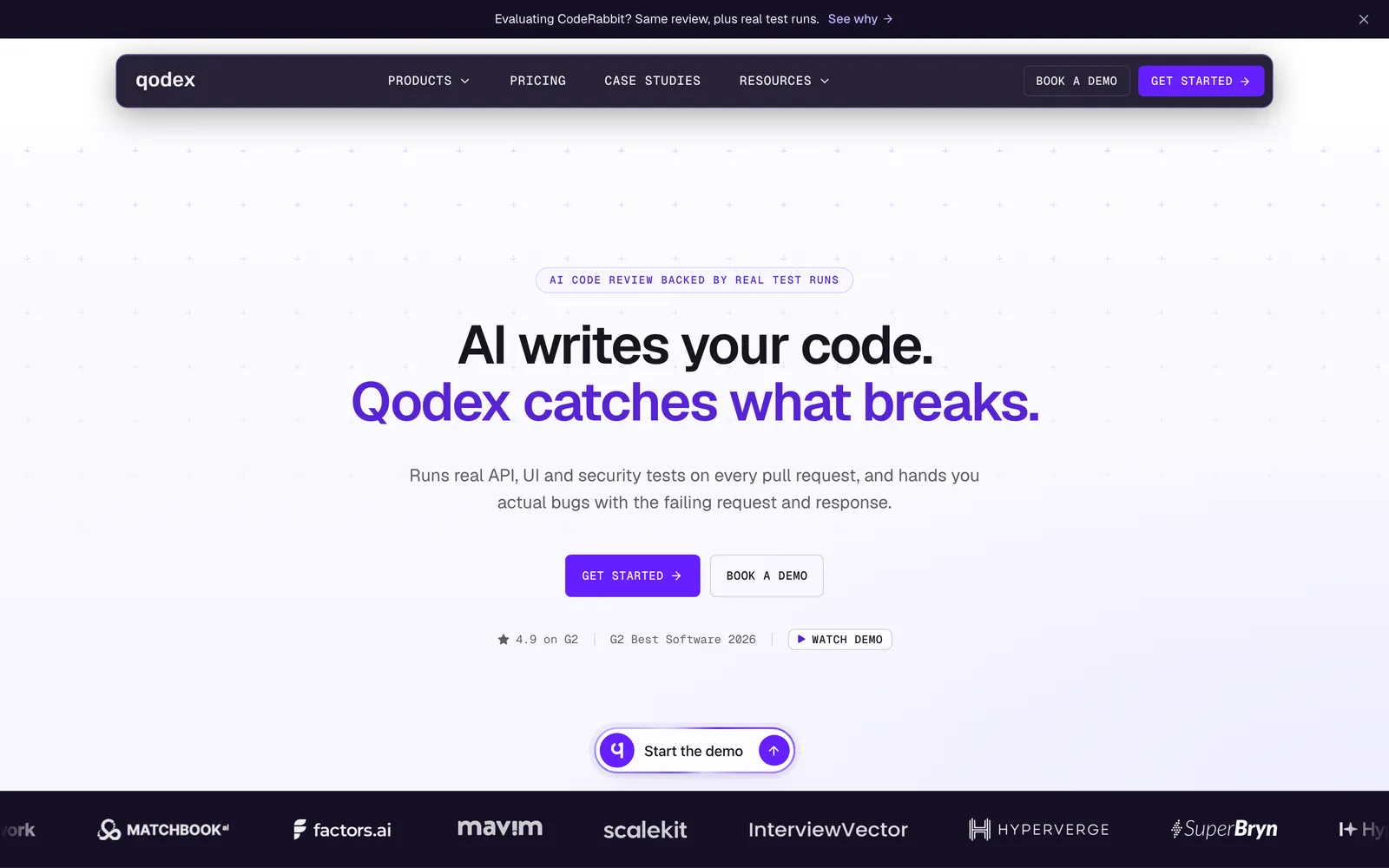
The execution-backed reviewer. Qodex is an AI QA agent whose pull request review runs six passes before a comment posts: static analysers, a full read of every changed file, a blast-radius pass over the code graph, two frontier models from different labs, read-only probes against the preview deployment, then a Check Run that can block the merge. It is not a pure code review tool, it is GitHub only, and it does not manage stacks.
Price and unit, checked 5 October 2026: Free $0 for 20 reviewed pull requests per developer a month, for up to 2 developers; Pro $30 per developer per month, 50 reviewed pull requests per seat pooled across the team, $1 per additional pull request; Enterprise custom. Unit: a developer who opens 3 or more reviewed pull requests in the month; everyone else is free.
Free plan or trial: 20 reviewed pull requests per developer a month, for up to 2 developers, with 2 automatic reviews each, unlimited public and private repos including organisation repos, the GitHub App and status check, no card; 14-day free trial on Pro with no card, for up to 100 reviewed pull requests.
Git hosts: GitHub only, through a GitHub App. Works alongside Cursor, Claude Code, Codex, Copilot, Devin, the GitHub CLI and Slack. Self-hosted: Enterprise.
Standout: findings are probed against the running preview before they post, and can carry the failing request, response or screenshot.
Main limit: GitHub only, so it does not fix Graphite's host problem, and it replaces none of the stack workflow. The execution value needs a preview deployment and test scenarios.
Migration note: small stacked pull requests suit it, because each has a narrow blast radius to probe. Prepare a preview and scenarios for the execution part.
Prices are on the Qodex pricing page. Connect a repository free to compare it against Graphite on the same code.
5. Bito
The cheap seat with three hosts. A codebase-aware review agent that works in Git hosts, IDEs and the CLI, with custom rules, incremental reviews and analytics. Bito also sells Governor and AI Architect.
Price and unit, checked 30 August 2026: Team $12/seat/mo annual ($15 monthly); Professional $20/seat/mo annual ($25 monthly); 5,000 reviewed lines per seat per month included, then $5 per 1,000 lines. Unit: per seat plus reviewed lines.
Free plan or trial: 14-day Professional trial, no card; no permanent free plan.
Git hosts: GitHub Cloud and Enterprise Server, GitLab Cloud and self-hosted, Bitbucket Cloud and self-hosted. IDE and CLI: VS Code, JetBrains, Cursor, Windsurf, CLI. Self-hosted: $5/seat/mo add-on on Professional; on-premises on Enterprise.
Standout: lowest published seat price of the dedicated reviewers, and the only one with a published self-host price.
Main limit: reviewed lines are metered, so a big formatting pull request costs extra, and cross-repo impact analysis is Enterprise only.
Migration note: same job at less than a third of Graphite Team. Stacking helps here, because small sequenced pull requests stay well inside the line quota.
Sources: bito.ai/pricing, the review agent page. More in our Bito alternatives guide.
6. Cursor Bugbot
For Cursor teams, on four hosts. Cursor's automated reviewer for bugs, security issues and code quality, with repository rules, selectable effort and a handoff into Cursor for the fix.
Price and unit, checked 30 August 2026: usage-based; the vendor says an average run costs $1.00 to $1.50 depending on pull request size. Cursor Individual Pro $20/mo, Teams $40/user/mo. Unit: per review run.
Free plan or trial: 14-day trial; no permanent free Bugbot allowance.
Git hosts: GitHub including Enterprise Server, GitLab including self-hosted, Bitbucket including Data Center, Azure DevOps in limited availability. IDE: Cursor. Self-hosted: not offered.
Standout: tight loop from a finding to a fix in the editor, with effort levels and learned rules.
Main limit: spend varies per pull request and effort level, with no fixed rate card. Per-run pricing is the worst fit for a stacking team, which opens many more pull requests.
Migration note: same job; move rules to
.cursor/BUGBOT.mdand budget per run against your real pull request count.
Sources: Bugbot docs, cursor.com/pricing. More in our Cursor Bugbot alternatives guide.
7. GitHub Copilot code review
No new vendor and no workflow change for a GitHub team. GitHub's native reviewer, requested from the pull request reviewer panel or run automatically, with suggested fixes, custom instructions and standard or deep effort.
Price and unit, checked 30 August 2026: Copilot Pro $10/mo for individuals; Copilot Business $19/user/mo. Each review also spends GitHub AI credits, which GitHub estimates at $0.05 to $1 per Lite review and $0.25 to $5 per Balanced review, plus Actions minutes on private repos.
Free plan or trial: Copilot Free at $0 does not include code review.
Git hosts: GitHub only, Azure DevOps in public preview. IDE and CLI: VS Code, Visual Studio, JetBrains, Xcode, GitHub CLI and Mobile. Self-hosted: not offered.
Standout: nothing to install for a team already paying for Copilot, at half the Graphite Team seat.
Main limit: Copilot only posts Comment reviews, so it cannot approve or block a merge, and credit spend is variable.
Migration note: same job; keep a required human approval. If you drop Graphite entirely you also drop the merge queue, so plan how trunk stays green.
Sources: Copilot plans, code review docs.
8. Snyk Code
The security-only branch. Static application security testing that finds vulnerabilities in source code and suggests fixes, inside Snyk's dependency, container and infrastructure-as-code platform.
Price and unit, read 22 September 2026 on snyk.io/plans: Team from $25 a month for up to 10 developers, with 1,000 Snyk Code tests a month; Enterprise is credit-based through sales.
Free plan or trial: Free $0 a month with 100 Snyk Code tests a month.
Git hosts: GitHub, GitLab, Bitbucket, Azure Repos. IDE, CLI and CI. Self-hosted: not offered; Snyk Broker connects private Git servers but the analysis runs in Snyk's cloud.
Standout: security depth with data-flow analysis and fix suggestions, and it can genuinely block a merge.
Main limit: a security scanner, not a general reviewer for logic, design or style.
Migration note: it runs beside whatever reviewer you keep, and has nothing to say about your branching workflow.
Sources: snyk.io/plans, Snyk Code.
9. SonarQube
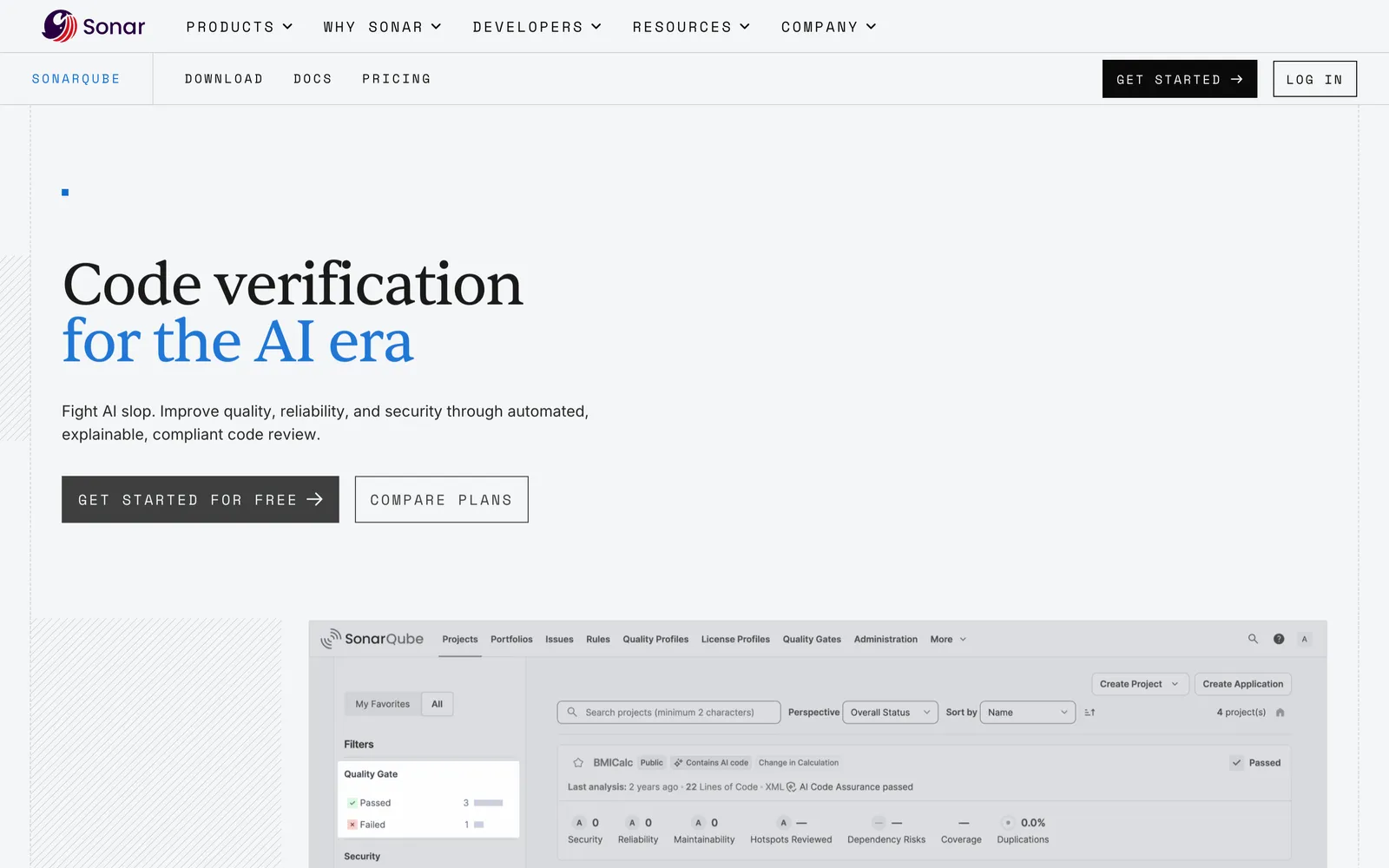
The rules-based gate. Deterministic code quality and security analysis with quality gates on branches and pull requests, as SonarQube Cloud, a self-managed Server, or the open-source Community Build.
Price and unit, checked 30 August 2026: Cloud Team from $34/mo per instance up to 100,000 lines of code; Server priced per instance per year by lines of code. Pricing by instance means a stacking team pays nothing extra for volume.
Free plan or trial: Cloud free tier up to 50,000 private lines that never expires; Community Build free and open source; 14-day trial on paid plans.
Git hosts: GitHub, GitLab, Bitbucket Cloud, Azure DevOps. SonarQube for IDE is free. Self-hosted: yes, Server and Community Build, where Graphite offers none.
Standout: enforceable quality gates across 30-plus languages, and the mature self-hosted option.
Main limit: not a conversational reviewer, and price scales with lines of code rather than people.
Migration note: configure the gate before wiring it into branch protection, and sequence that separately from removing Graphite's merge queue.
Sources: plans and pricing, SonarQube.
Replacing Graphite stacked pull requests
Every tool above replaces the reviewer. None of them replaces the stack workflow. If that is the half you need, the options are narrower and none of them is a like-for-like swap.
Sapling with ReviewStack is the open-source stacked-change workflow, and the closest thing to Graphite's model in spirit. SoftVerdict rates the migration as high difficulty, which matches the shape of the problem: you are changing the version-control layer, not installing an app.
GitHub native features are the lowest-change option. You can build stacks by hand with base branches, reviewing each in turn. What you do not get is the restacking automation, the stack-aware inbox, or a queue that understands the order of a stack.
Aviator and Mergify are named by ReviewAITool for queue automation, which covers the merge-queue half rather than the stacking half. We could not verify prices for either, so none are quoted here.
GitLab appears on both SoftVerdict's and ReviewAITool's lists, but it only makes sense when the real goal is consolidating the toolchain rather than replacing a feature.
State it plainly: none of these gives you the stack, the inbox, the queue and an AI review as one package. That combination is what Graphite actually sells, and it is why "Graphite alternative" usually means "Graphite reviewer alternative". Sources: SoftVerdict and ReviewAITool, read 30 August 2026.
Migrating off Graphite
Start with one question: are you replacing the AI reviewer, the stack workflow, or both?
Reviewer only.
Keep stacks and the merge queue. Nothing else here provides them.
Disable AI Reviews on the pilot repositories so you are not reading two sets of comments.
Run the new reviewer on at least 20 representative pull requests: small fixes, cross-file changes, security-sensitive work and one large refactor. The method is in our guide to AI code review.
Track accepted comments, false positives, duplicates, misses found by humans, and price per active contributor.
Move the required check only once you understand the replacement's severity levels and how it behaves when it fails.
Stack workflow.
Inventory open stacks, branch dependencies, queue rules, required checks, Slack notifications, CLI aliases and team documentation.
Land, flatten or carry over every open stack before removing the Graphite GitHub App.
Map stack merge and queue rules onto GitHub, Sapling and ReviewStack, Aviator, Mergify or GitLab.
Test conflict handling, base-branch updates, partial-stack merges and rollback on a non-critical repository first.
Remove Graphite access only when no open stack and no required check depends on it.
If you are replacing both, do the reviewer first and the branches second, so review-quality problems stay separate from branch-management problems.
See also
Frequently Asked Questions
What is Graphite used for?
Stacked pull requests on GitHub. It gives you a stack CLI, a pull request inbox, a stack-aware merge queue, and AI Reviews run by Graphite Agent. The idea is to break a large change into small sequenced pull requests so review never blocks on a huge diff.
Is Graphite only for GitHub?
Yes. Graphite is built on GitHub APIs, so there is no GitLab or Bitbucket support at any tier. GitHub Enterprise Server is supported on the Enterprise plan. If any repository lives outside GitHub, Graphite cannot cover it.
How much does Graphite cost?
Hobby is free for personal-account repositories with limited AI reviews. Starter is $20 a user a month billed annually and Team is $40 with unlimited AI reviews, automations and the basic merge queue. Enterprise is custom. All paid plans have a 30-day trial.
What was Graphite Diamond?
Diamond was the earlier name for Graphite's AI reviewer. The current vendor name is AI Reviews, run by Graphite Agent. If you see Diamond in a comparison article, it is describing the same product under its old branding.
What is the best free Graphite alternative?
For the reviewer: Greptile Starter, which is free for one active developer, or Qodex Free, which reviews 20 pull requests per developer a month for up to 2 developers, across unlimited repositories, with no card. For the stacks: GitHub's native branching or Sapling with ReviewStack, both free.
What is the best open-source Graphite alternative?
Qodo's PR-Agent for the review half, and Sapling with ReviewStack for the stacked-change half. They answer different halves of Graphite, and no single open-source project replaces both.
Can I self-host a Graphite alternative?
Graphite itself cannot be self-hosted at any tier. Bito publishes a self-host price of $5 a seat a month on Professional. Qodo, Greptile and CodeRabbit offer self-hosting on Enterprise. SonarQube Server and Community Build are self-managed outright.
What is the best alternative for stacked pull requests?
Sapling with ReviewStack if you want an open-source stack workflow, though the migration is rated high difficulty. GitHub native features if you want the least change and can live without restacking automation. Aviator or Mergify cover queue automation rather than stacking.
How does Graphite compare with CodeRabbit and Qodo?
CodeRabbit and Qodo are reviewers only, on four or more Git hosts, at $24 a seat and $30 a credit pack respectively. Graphite is a GitHub workflow platform with a reviewer inside it, and unlimited review costs $40 a seat. You are comparing a feature against a platform.
Does Qodex replace Graphite?
It can replace the AI review, especially when you also want API, UI and security tests run against the pull request. It does not replace stacked branches, the pull request page or the stack-aware merge queue, and like Graphite it is GitHub only.
The short version
Graphite is a workflow bet, not a reviewer purchase, and that is the fork. If the team will stack together, the inbox, the queue and an AI review in one place are worth the $40 seat, and nothing here replaces the package. If not, or if any repository sits outside GitHub, you are paying for parts you cannot use, and CodeRabbit does the review half for $24. And if the thing that bothers you is that a review comment is still a prediction, Qodex takes the other route: run the code, then let the check mean something.