Qodo Review and Alternatives (2026)
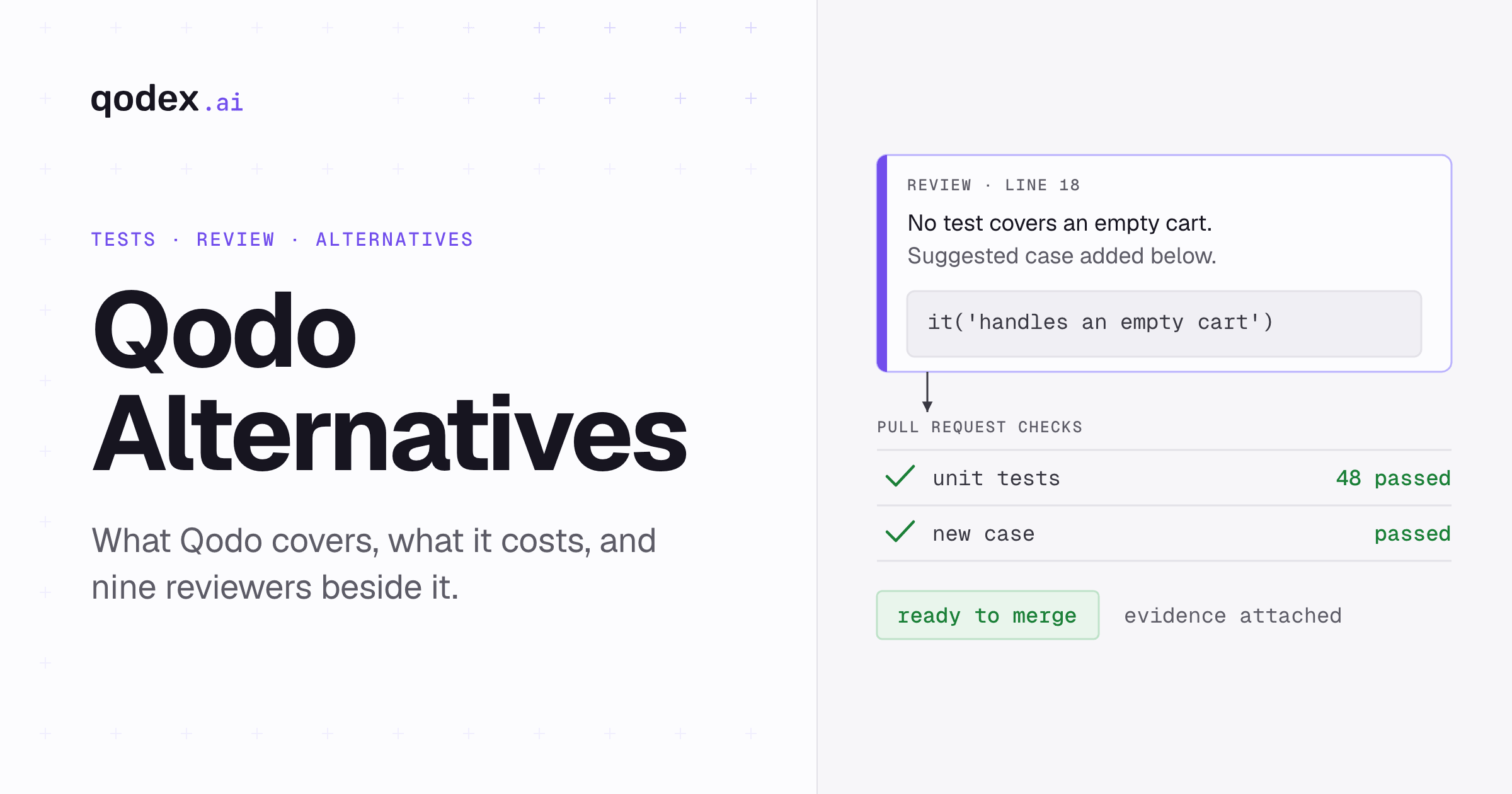
The main Qodo alternatives in 2026 are CodeRabbit for seat-priced review on GitHub, GitLab, Bitbucket and Azure DevOps, Greptile for whole-repo context, and Qodex if you want findings proven by running tests. Qodo itself is an AI code review and governance platform for GitHub, GitLab, Bitbucket, Azure DevOps and Gerrit, with on-premises deployment on Enterprise. That host list is the reason to stay. The reason teams leave is the meter: Pro Team is $30 a month for a pool of credits, a bigger pull request spends more of them, and unused credits expire at the end of the cycle. Prices below were read off each vendor's page on 4 October 2026.
If you are evaluating review tools as part of a wider testing stack, you can also see how Qodex reviews pull requests by running your tests against the change rather than only reading the diff. One disambiguation before the list: Qodo (qodo.ai, formerly CodiumAI) is not Qodex (qodex.ai, this site). Different companies, similar names. Both appear below under their full names.
What Qodo is and how it reviews code
Qodo sells pull request review, organisation-wide rules, a context engine over multiple repositories and pull request history, and IDE, CLI and portal surfaces. It was CodiumAI before the rebrand. The review reads the repository around the change rather than the diff alone, ranks findings by severity and attaches a suggested fix. For background on the category, see automated code review.
Git hosts are the strong point: GitHub Cloud and Enterprise Server, GitLab cloud and self-managed, Bitbucket Cloud and Data Center, Azure DevOps, and Gerrit on Enterprise. IDE coverage is VS Code, Visual Studio and JetBrains, plus a CLI. Qodo describes language support as "all major programming languages", naming Python, Java, JavaScript, TypeScript, Go, C#, .NET, Swift, Kotlin, Ruby, PHP and C++, with a full list on its language support page.
Deployment is multi-tenant by default, with single-tenant and on-premises on Enterprise, described by Qodo as suitable for air-gapped or regulated environments. Security claims are SOC 2 Type II, zero data retention and bring-your-own model keys. Its lineage is PR-Agent, the open-source reviewer that is now community-maintained. Sources: docs.qodo.ai, deployment models and PR-Agent, read 4 October 2026. The pricing facts below come from the live pricing page.
Qodo pricing, read 4 October 2026
| Tier | Price and unit | Included | Trial or free |
|---|---|---|---|
| Trial | $0 for 14 days | Unlimited usage and reviews, no card; reviews stop after the trial unless billing is active | Every workspace |
| Pro Team | $30 a month for 2,500 pooled credits; $0.012 per credit for overage; no annual commitment; up to 30 users | Qodo estimates about 18 reviews from 2,500 credits; the 5,000 and 20,000-credit packs (about 36 and 144 reviews, vendor estimates) work out to $60 and $240 at the published rate | No permanent free tier |
| Open source | $0 | Hosted review for qualified open-source projects | Apply |
| Enterprise | Custom | Cross-repo context, SSO and SAML, audit logs, bring your own keys, single-tenant or on-premises, SLA | Talk to sales |
Source: qodo.ai/pricing, read 4 October 2026. The unit matters more than the headline price. A bigger or more complex pull request costs more credits, unused credits expire monthly, and overage continues at the same rate until the workspace cap you set. Dividing $30 by Qodo's own estimate of 18 reviews puts a review near $1.67, but that is our arithmetic on a vendor average, not a published rate card.
Where Qodo falls short
The limit is a credit pool, not a review count. "About 18 reviews" is Qodo's estimate. Two teams paying $30 can get very different review counts, and credits do not roll over.
There is no lasting free tier after the trial. Qodo says it does not offer a permanent free tier; qualified open-source projects can apply for free access.
Single-tenant and on-premises are Enterprise only. If air-gapped deployment is the reason you are looking at Qodo, the self-serve tier does not reach it.
It reads the change. Qodo's pages describe review from repository context; they do not describe running the change against a live build.
Who Qodo fits, and who should look elsewhere
Qodo fits teams whose repositories live on GitLab, Bitbucket, Azure DevOps or Gerrit, regulated teams that need on-premises deployment, and organisations that want one set of review rules enforced everywhere rather than per-repo conventions.
Look elsewhere if you want a fixed seat price you can forecast, if you are a solo developer who wants a permanent free tier, or if your real complaint is that review findings are predictions you still have to verify by hand.
Quick answer: choose a Qodo alternative by constraint
| Constraint | Pick | One line |
|---|---|---|
| Closest direct replacement | CodeRabbit | Seat pricing on GitHub, GitLab, Bitbucket and Azure DevOps. |
| Whole-repo context, free for one developer | Greptile | Repo graph; Starter is free. |
| Findings proven against a running preview | Qodex | Reviews the pull request and runs API, UI and security tests on GitHub. |
| Low seat price, priced self-host add-on | Bito | $12 a seat annual; self-host $5 a seat. |
| Stacked pull requests | Graphite | GitHub, with Enterprise Server on Enterprise. |
| Team lives in Cursor | Cursor Bugbot | Four hosts; usage-based. |
| Already on Copilot | GitHub Copilot code review | No new vendor. |
| Security gate | Snyk Code | Static application security testing. |
| Deterministic quality gates, self-managed | SonarQube | Community Build is free. |
| Monorepo, analysers first | DeepSource | Explicit monorepo support. |
Qodo alternatives at a glance
Prices read 4 October 2026. Review approach, self-hosting and best fit sit in each tool's section below. For a wider survey of the category, see the best AI code review tools.
| Tool | Git hosts | Paid start and unit | Free plan or trial | Main limit |
|---|---|---|---|---|
| Qodo (baseline) | GitHub (cloud, Enterprise Server), GitLab (cloud, self-managed), Bitbucket (Cloud, Data Center), Azure DevOps, Gerrit (Enterprise) | Pro Team $30/mo for 2,500 pooled credits (vendor estimate: about 18 reviews), $0.012 per extra credit, up to 30 users | 14-day unlimited trial, no card; no permanent free tier; free for qualified open-source repos | Credits vary by PR size and expire monthly, so cost per review is not fixed |
| CodeRabbit | GitHub (cloud, Enterprise Server), GitLab (.com, self-managed), Bitbucket (Cloud, Data Center), Azure DevOps | Essentials (formerly Pro) $24/developer/mo annual; Team (formerly Pro Plus) $48; Advanced $72 with security; $0.25 per reviewed file beyond allowances | Free plan and free IDE reviews; 14-day trial, no card | Rate limits: 5 PR reviews per developer per hour on Essentials, 8 on Team, 10 on Advanced (fair use) |
| Greptile | GitHub (Cloud, Enterprise Server), GitLab (Cloud, Self-Managed), Bitbucket Cloud; Bitbucket Data Center on Enterprise | Pro $30/seat/mo with 50 credits per seat; $1 per extra credit; Base, Plus and Apex reviews cost 1, 3 and 10 credits | Starter $0: one active developer, unlimited repos, 50 credits a month; 14-day Pro trial; free for qualified open-source projects | Credit meter: heavy PR volume or Plus and Apex reviews make the bill variable |
| Qodex | GitHub (GitHub App) | Free $0; Pro $30/developer/mo, a seat only for developers with 3 or more reviewed PRs that month; Enterprise custom | Free: 20 reviewed PRs per developer a month for up to 2 developers, 2 automatic reviews per PR, unlimited repositories, no card; 14-day trial on Pro | GitHub-based; the execution value needs a preview deployment and test scenarios |
| Bito | GitHub (Cloud, Enterprise Server), GitLab (Cloud, self-hosted), Bitbucket (Cloud, self-hosted) | Team $12/seat/mo annual ($15 monthly); Professional $20/seat/mo annual ($25 monthly); 5,000 reviewed lines per seat per month included, then $5 per 1,000 lines | 14-day Professional trial, no card | Reviewed lines are metered: a big formatting PR costs extra; cross-repo impact analysis is Enterprise only |
| Graphite | GitHub (GitHub Enterprise Server on Enterprise) | Starter $20/user/mo annual (limited AI reviews); Team $40/user/mo annual (unlimited AI reviews, automations, merge queue) | Hobby $0 for personal repos with limited AI reviews; 30-day trial | Unlimited AI review starts at the $40 Team tier |
| Cursor Bugbot | GitHub (incl. Enterprise Server), GitLab (incl. self-hosted), Bitbucket (incl. Data Center), Azure DevOps Services | Usage-based; Cursor Individual Pro $20/mo, Teams $40/user/mo | Check Cursor's pricing page | Spend varies per PR and effort level |
| GitHub Copilot code review | GitHub, plus Azure DevOps in public preview | Copilot Pro $10/mo (individual); each review also spends GitHub AI credits (GitHub's estimate $0.05 to $1 per Lite review, $0.25 to $5 per Balanced review) plus Actions minutes on private repos | Copilot Free ($0) does not include code review | Approvals are in public preview; credit spend is variable |
| Snyk Code | Check Snyk's integration list | Team from $25/mo for up to 10 developers; Enterprise credit-based (read 22 Sep) | Free $0 with 100 Snyk Code tests a month | Pair it with a general reviewer |
| SonarQube | GitHub, GitLab, Bitbucket, Azure DevOps | Cloud Team from $34/mo, billed on the organisation's private lines of code up to 100,000; Server priced per instance per year by lines of code | Cloud free tier up to 50,000 private lines, never expires; Community Build free and open source; 14-day trial on paid plans | Price scales with lines of code, not people |
| DeepSource | GitHub, GitLab, Bitbucket, Azure DevOps | Team $24 per active contributor/mo annual ($30 monthly); AI Review $8 per 10,000 processed lines (standard) or $15 (advanced) after $100 of AI credits per contributor a year on annual Team, pooled | Open Source plan free for public repos (AI review pay as you go); 14-day trial with up to $50 in AI credits | "Unlimited PR reviews" does not cover the AI review, which is metered by lines |
The 10 best Qodo alternatives in 2026
1. CodeRabbit
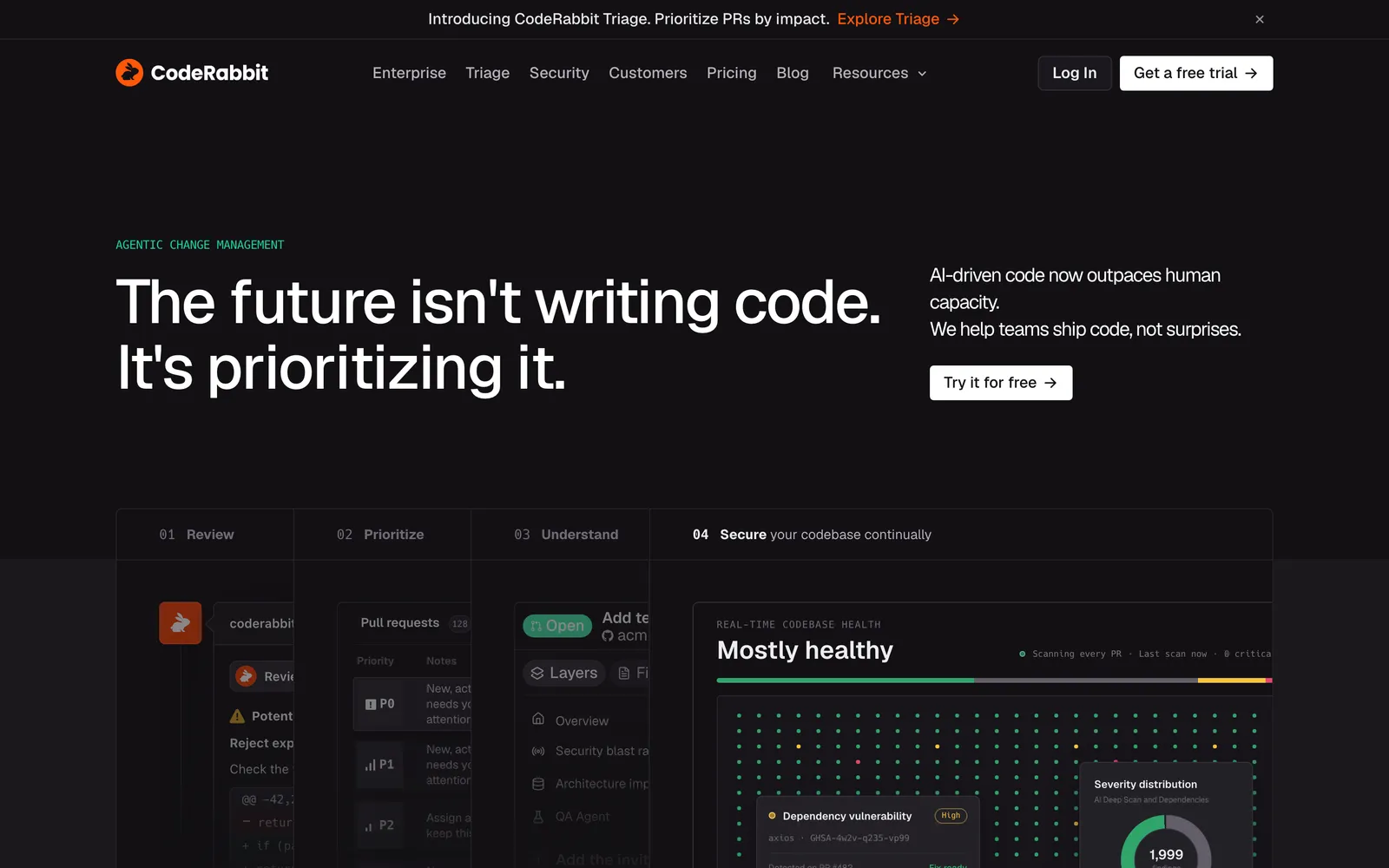
A seat-priced reviewer on GitHub, GitLab, Bitbucket and Azure DevOps. A dedicated AI pull request reviewer: summary, one-click fixes, chat in the thread, learned team rules, linters and a static application security testing pass.
Price and unit, read 4 October 2026: Essentials, formerly Pro, is $24 per developer a month billed annually; Team, formerly Pro Plus, is $48; Advanced, which includes security, is $72. Reviews beyond allowances can cost $0.25 per reviewed file. Unit: per developer.
Free plan or trial: a Free plan and free IDE reviews; 14-day trial, no card.
Git hosts: GitHub cloud and Enterprise Server, GitLab.com and self-managed, Bitbucket Cloud and Data Center, Azure DevOps. IDE and CLI: VS Code, Cursor, Windsurf, CLI, MCP. Self-hosted: Enterprise only, plus EU SaaS.
Standout: Team adds expanded multi-repo analysis and custom pre-merge checks; Essentials has limited multi-repo context.
Main limit: rate limits of 5 pull request reviews per developer per hour on Essentials, 8 on Team and 10 on Advanced, as fair use.
Migration note: rewrite Qodo org rules as path instructions; compare last month's credit spend against $24 a seat.
Sources: coderabbit.ai/pricing, quickstart. More in our CodeRabbit alternatives guide.
2. Greptile
For teams that bought Qodo for context. Greptile builds a graph of the repository, files, functions and dependencies, and reviews each pull request against that whole-repo context. TREX runtime validation is in beta.
Price and unit, read 4 October 2026: Pro $30/seat/mo with 50 credits per seat; $1 per extra credit. Since 25 September 2026, Base, Plus and Apex reviews cost 1, 3 and 10 credits. Unit: per seat plus credits.
Free plan or trial: Starter $0 for one active developer, unlimited repos, 50 credits a month; 14-day Pro trial; free for qualified open-source projects.
Git hosts: GitHub Cloud and Enterprise Server, GitLab Cloud and Self-Managed, Bitbucket Cloud on all plans and Bitbucket Data Center on Enterprise. Sends findings to Claude Code, Codex, Cursor, Devin and Conductor. Self-hosted: Enterprise, Docker Compose or Kubernetes with Helm, air-gapped supported.
Standout: whole-repo graph context, and a free tier for a solo developer on private repos.
Main limit: the credit meter makes heavy volume variable, and Plus and Apex reviews cost 3 and 10 credits.
Migration note: GitLab and Bitbucket both supported; credits again, but priced per seat rather than pooled.
Sources: greptile.com/pricing, Greptile docs.
3. Qodex
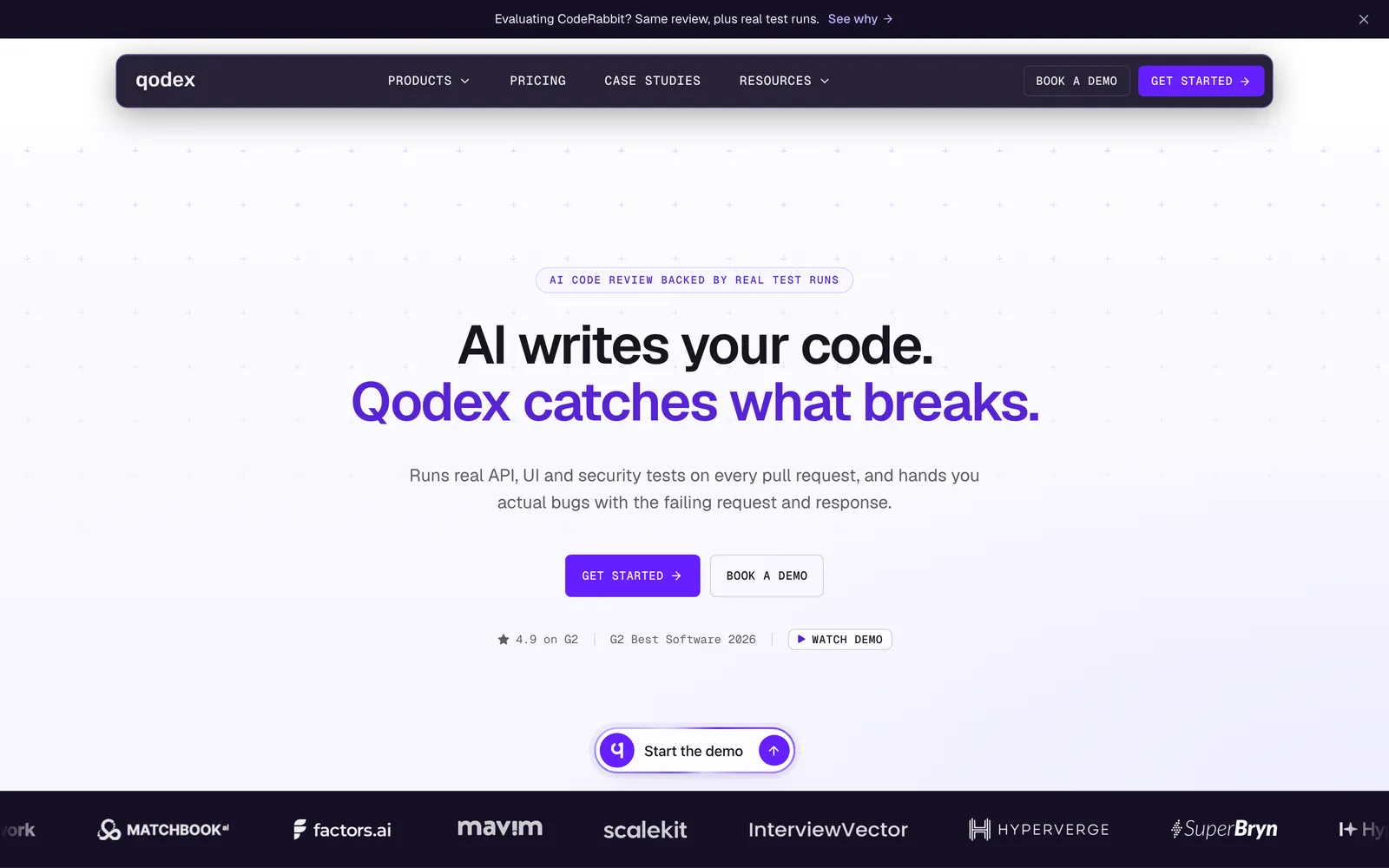
The structural alternative: execution instead of more context. To repeat the disambiguation, Qodex is not Qodo. It is an AI QA agent whose pull request review runs six passes before a comment posts: static analysers, a full read of every changed file, a blast-radius pass over the code graph, two frontier models from different labs, read-only probes against the preview deployment, then a Check Run that can block the merge. It is not a pure code review tool, and it runs as a GitHub App.
Price and unit, read 5 October 2026: Free $0 for 20 reviewed pull requests per developer a month, for up to 2 developers. Pro $30 per developer per month, with 50 reviewed pull requests per seat pooled across the team and $1 per additional pull request. Enterprise custom. Unit: a developer who opens 3 or more reviewed pull requests in the month; everyone else is free.
Free plan or trial: 20 reviewed pull requests per developer a month, for up to 2 developers, with 2 automatic reviews each, unlimited repositories, the GitHub App and status check, no card; 14-day free trial on Pro with no card, for up to 100 reviewed pull requests.
Git hosts: GitHub, through a GitHub App. Works alongside Cursor, Claude Code, Codex, Copilot, Devin, the GitHub CLI and Slack. Self-hosted: Enterprise.
Standout: findings are probed against the running preview before they post, and can carry the failing request, response or screenshot.
Main limit: it runs on GitHub through a GitHub App, so check your Git host first. The execution value needs a preview deployment and test scenarios.
Migration note: no credit pack to size. Prepare a preview and existing API or UI scenarios, or compare the static pass only.
Prices are on the Qodex pricing page. Connect a repository free to compare it against Qodo on the same code.
4. Bito
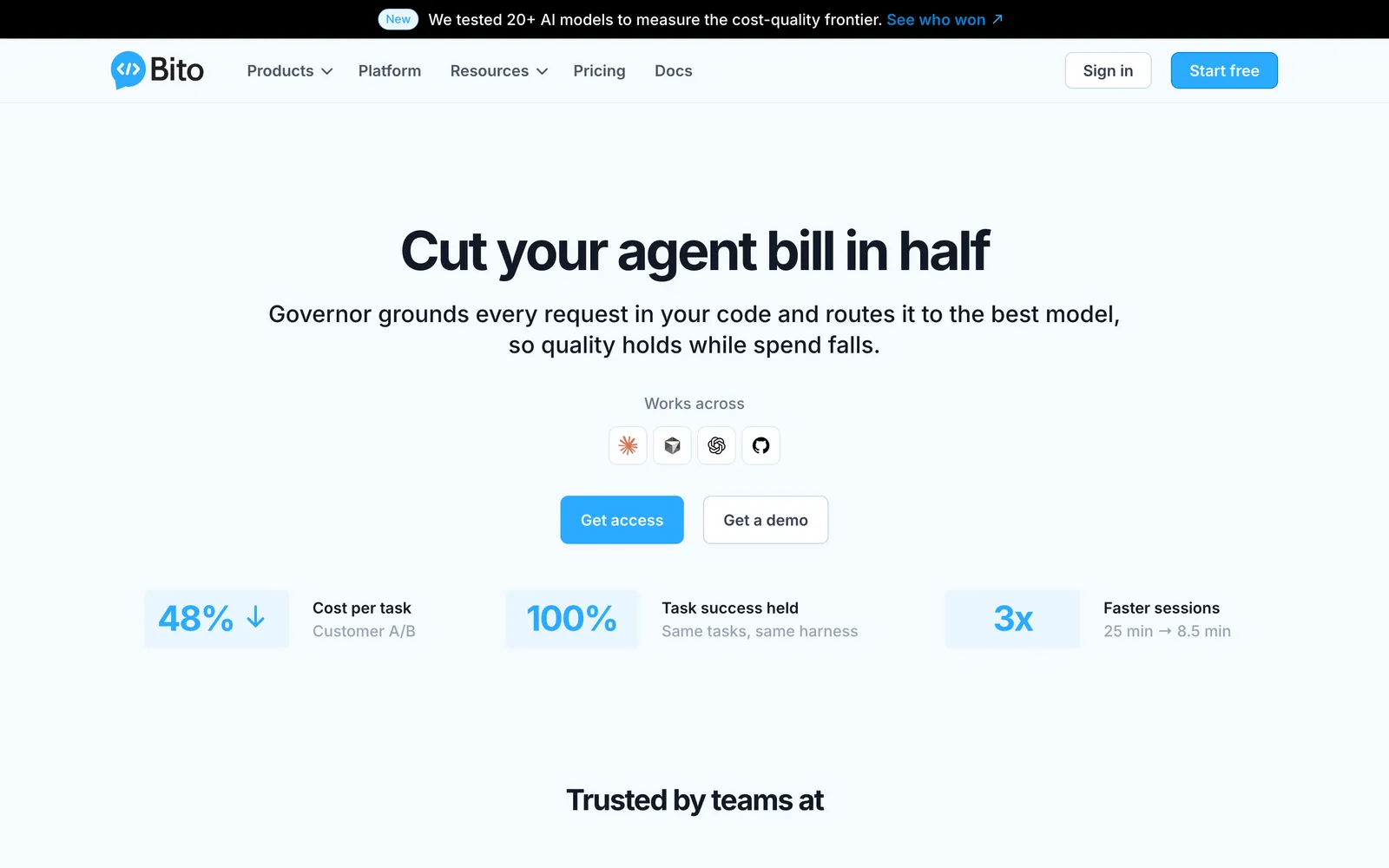
The cheap seat with three hosts and a published self-host price. A codebase-aware review agent that works in Git hosts, IDEs and the CLI, with custom rules, incremental reviews and analytics. Bito also sells Governor and AI Architect.
Price and unit, read 4 October 2026: Team $12/seat/mo annual ($15 monthly); Professional $20/seat/mo annual ($25 monthly); 5,000 reviewed lines per seat per month included, then $5 per 1,000 lines. Unit: per seat plus reviewed lines.
Free plan or trial: 14-day Professional trial, no card.
Git hosts: GitHub Cloud and Enterprise Server, GitLab Cloud and self-hosted, Bitbucket Cloud and self-hosted. IDE and CLI: VS Code, JetBrains, Cursor, Windsurf, CLI. Self-hosted: $5/seat/mo add-on on Professional; on-premises on Enterprise.
Standout: a $12 seat on annual Team, and a published price for self-hosting.
Main limit: reviewed lines are metered, so a big formatting pull request costs extra, and cross-repo impact analysis is Enterprise only.
Migration note: count reviewed lines, not reviews. You are swapping one meter for another.
Sources: bito.ai/pricing, the review agent page. More in our Bito alternatives guide.
5. Graphite
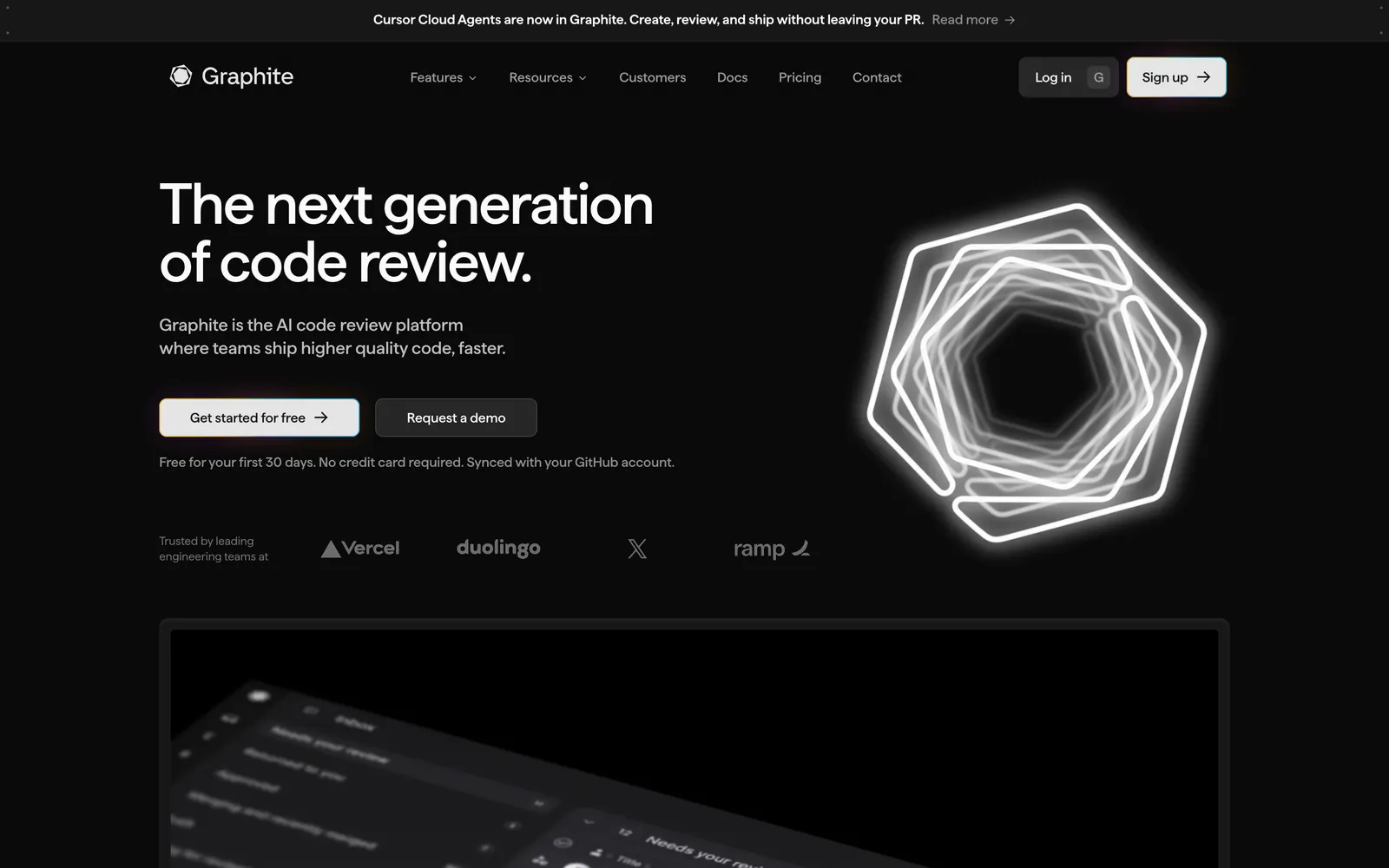
A workflow choice, not a deeper reviewer. Graphite is a GitHub platform for stacked pull requests, a pull request inbox, a merge queue, a CLI and a VS Code extension, with AI Reviews run by Graphite Agent.
Price and unit, read 4 October 2026: Starter $20/user/mo annual with limited AI reviews; Team $40/user/mo annual with unlimited AI reviews, automations and the merge queue. Unit: per user.
Free plan or trial: Hobby $0 for personal repos with limited AI reviews; 30-day trial.
Git hosts: GitHub, with GitHub Enterprise Server on Enterprise. CLI, VS Code, Slack and MCP.
Standout: stacked pull requests and a merge queue around the reviewer, the strongest fit for teams already stacking.
Main limit: unlimited AI review starts at the $40 Team tier, and the reviewer sits inside a stacked-PR workflow.
Migration note: only if the team adopts stacks. Otherwise it is an expensive way to buy review.
Sources: graphite.com/pricing, AI reviews docs. More in our Graphite alternatives guide.
6. Cursor Bugbot
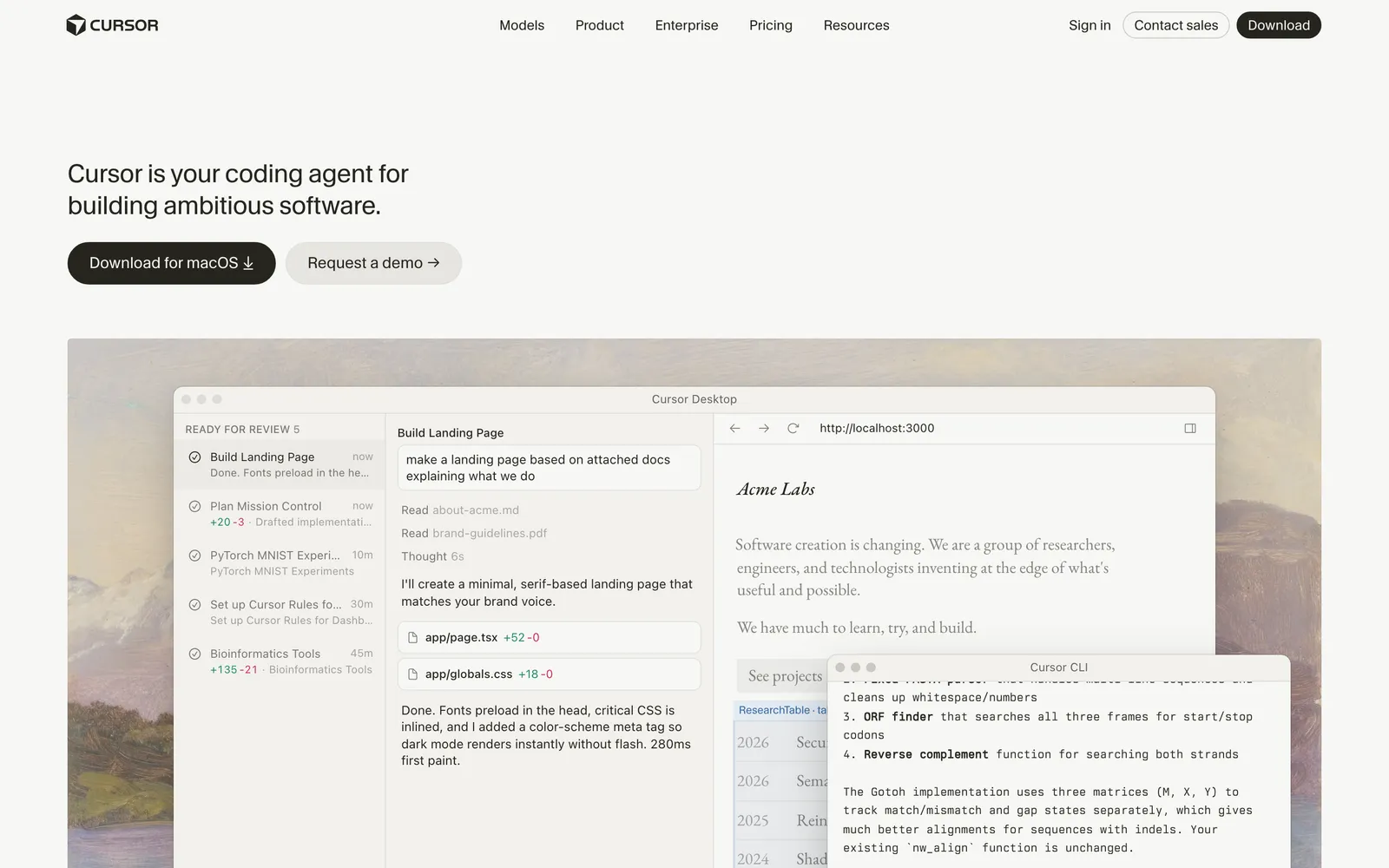
For Cursor teams, with the same usage-shaped bill as Qodo credits. Cursor's automated reviewer for bugs, security issues and code quality, with repository rules, selectable effort and a handoff into Cursor for the fix.
Price and unit, read 4 October 2026: usage-based. Cursor Individual Pro $20/mo, Teams $40/user/mo. Unit: per review run.
Git hosts: GitHub including Enterprise Server, GitLab including self-hosted, Bitbucket including Data Center, and Azure DevOps Services. IDE: Cursor.
Standout: tight loop from a finding to a fix in the editor, with effort levels and learned rules.
Main limit: spend varies per pull request and effort level.
Migration note: move rules to
.cursor/BUGBOT.mdand budget per run against last month's pull request count.
Sources: Bugbot docs, cursor.com/pricing. More in our Cursor Bugbot alternatives guide.
7. GitHub Copilot code review
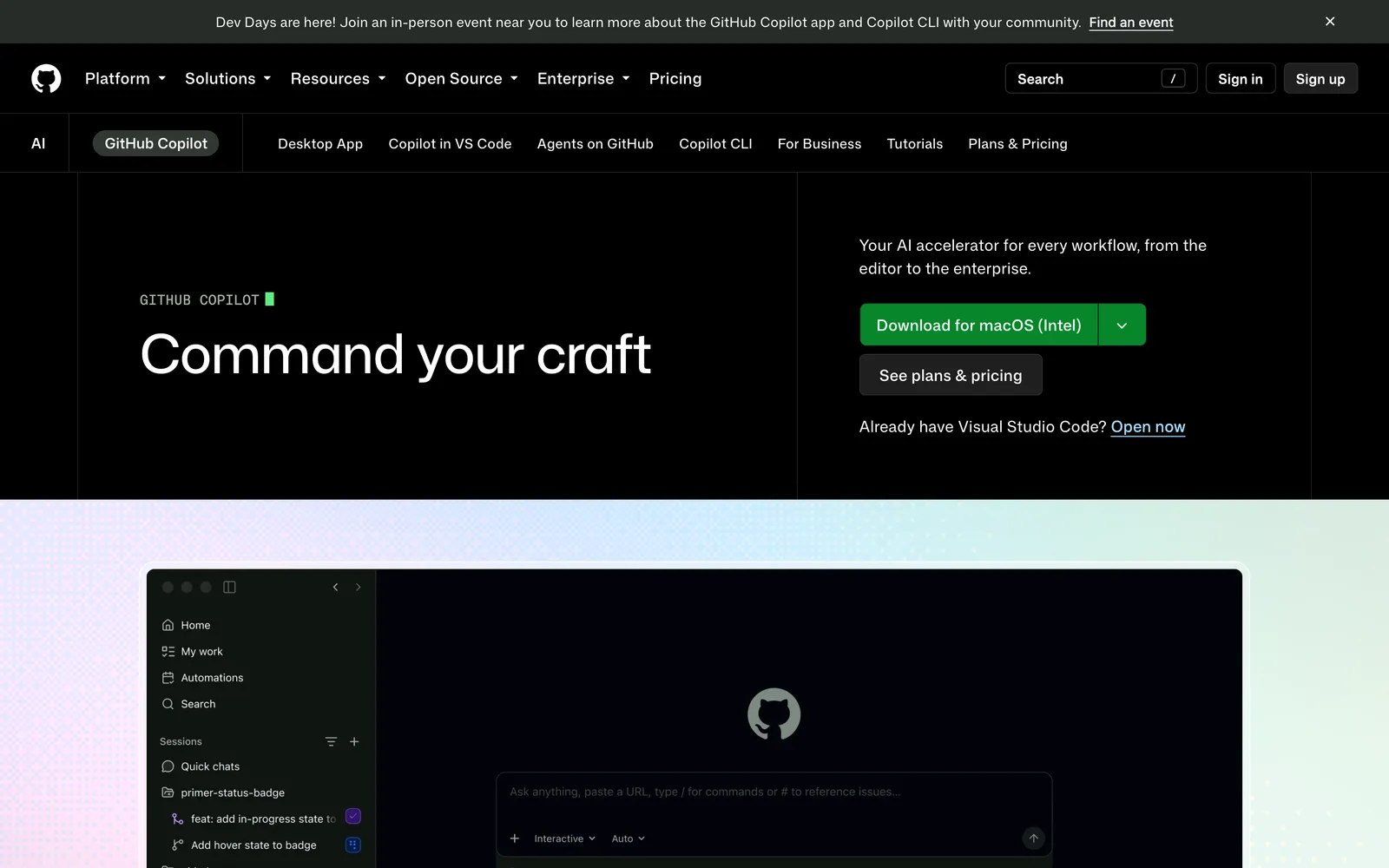
No new vendor for a GitHub team. GitHub's native reviewer, requested from the pull request reviewer panel or run automatically, with suggested fixes, custom instructions and Lite or Balanced effort.
Price and unit, read 4 October 2026: Copilot Pro $10/mo for individuals. Each review also spends GitHub AI credits, which GitHub estimates at $0.05 to $1 per Lite review and $0.25 to $5 per Balanced review, plus Actions minutes on private repos.
Free plan or trial: Copilot Free at $0 does not include code review.
Git hosts: GitHub, plus Azure DevOps in public preview. IDE and CLI: VS Code, Visual Studio, JetBrains, Xcode, GitHub CLI and Mobile.
Standout: no new vendor for a team already paying for Copilot.
Main limit: credit spend is variable. Copilot approvals are in public preview; once enabled, they can satisfy required approval rules.
Migration note: keep a required human approval until you have tested Copilot approvals on your own rules.
Sources: Copilot plans, code review docs.
8. Snyk Code
The security-only branch of the decision. Static application security testing that finds vulnerabilities in source code and suggests fixes, inside Snyk's dependency, container and infrastructure-as-code platform.
Price and unit, read 22 September 2026 on snyk.io/plans: Team from $25 a month for up to 10 developers, with 1,000 Snyk Code tests a month; Enterprise is credit-based through sales.
Free plan or trial: Free $0 a month with 100 Snyk Code tests a month.
Where it runs: IDE, CLI and CI. Snyk Broker connects private Git servers, and the analysis runs in Snyk's cloud.
Standout: security depth with data-flow analysis and fix suggestions.
Main limit: it is a security scanner, so pair it with a general reviewer.
Migration note: pair it with a general reviewer. It does not replace one.
Sources: snyk.io/plans, Snyk Code.
9. SonarQube
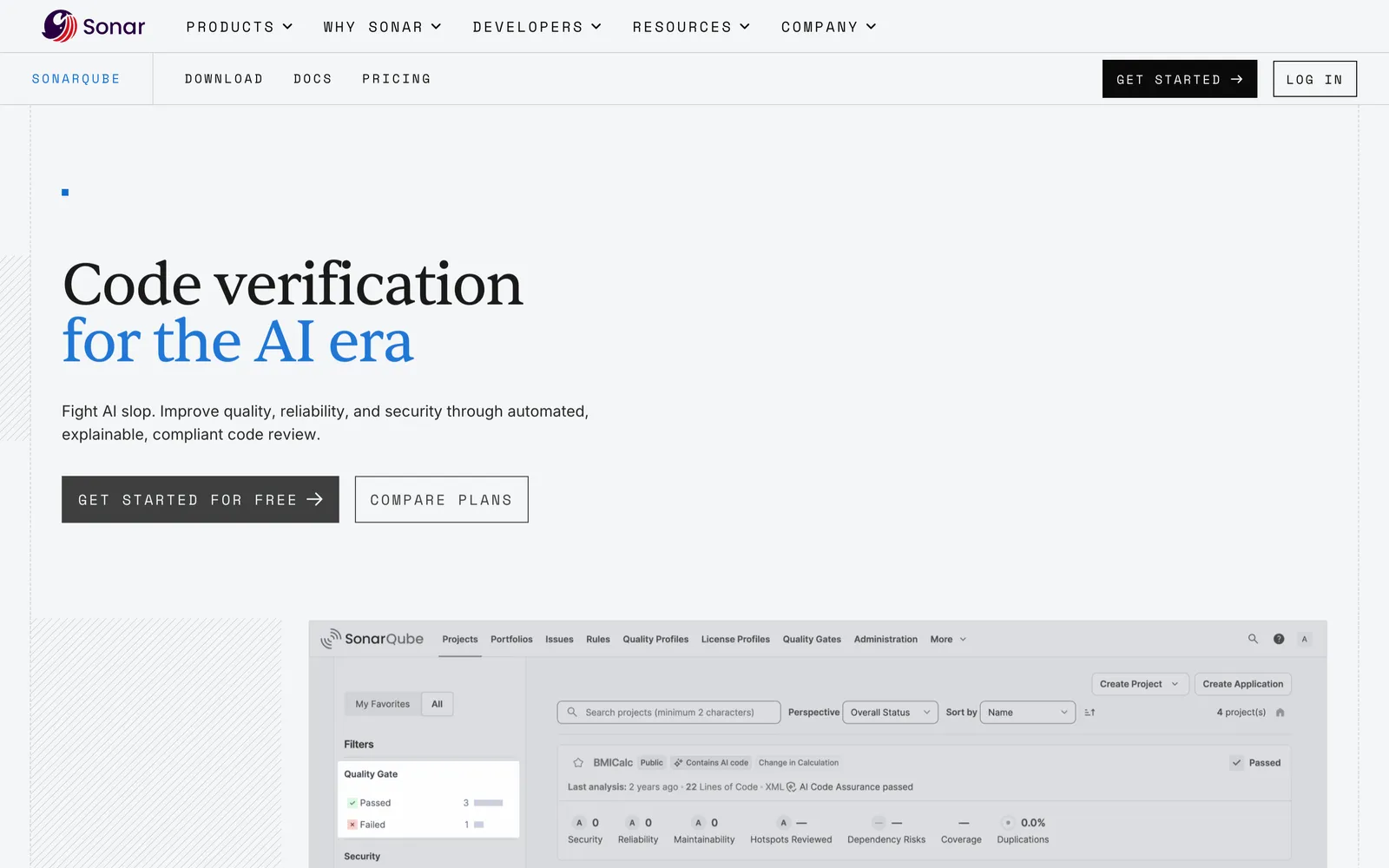
The rules-based, self-managed gate. Deterministic code quality and security analysis with quality gates on branches and pull requests, as SonarQube Cloud, a self-managed Server, or the open-source Community Build.
Price and unit, read 4 October 2026: Cloud Team from $34/mo, billed on the organisation's private lines of code up to 100,000; Server priced per instance per year by lines of code.
Free plan or trial: Cloud free tier up to 50,000 private lines that never expires; Community Build free and open source; 14-day trial on paid plans.
Git hosts: GitHub, GitLab, Bitbucket, Azure DevOps. SonarQube for IDE is free. Self-hosted: yes, Server and Community Build.
Standout: enforceable quality gates across 30-plus languages, and the mature self-hosted option.
Main limit: price scales with lines of code rather than people.
Migration note: set the quality gate first, then wire it into branch protection.
Sources: plans and pricing, SonarQube.
10. DeepSource
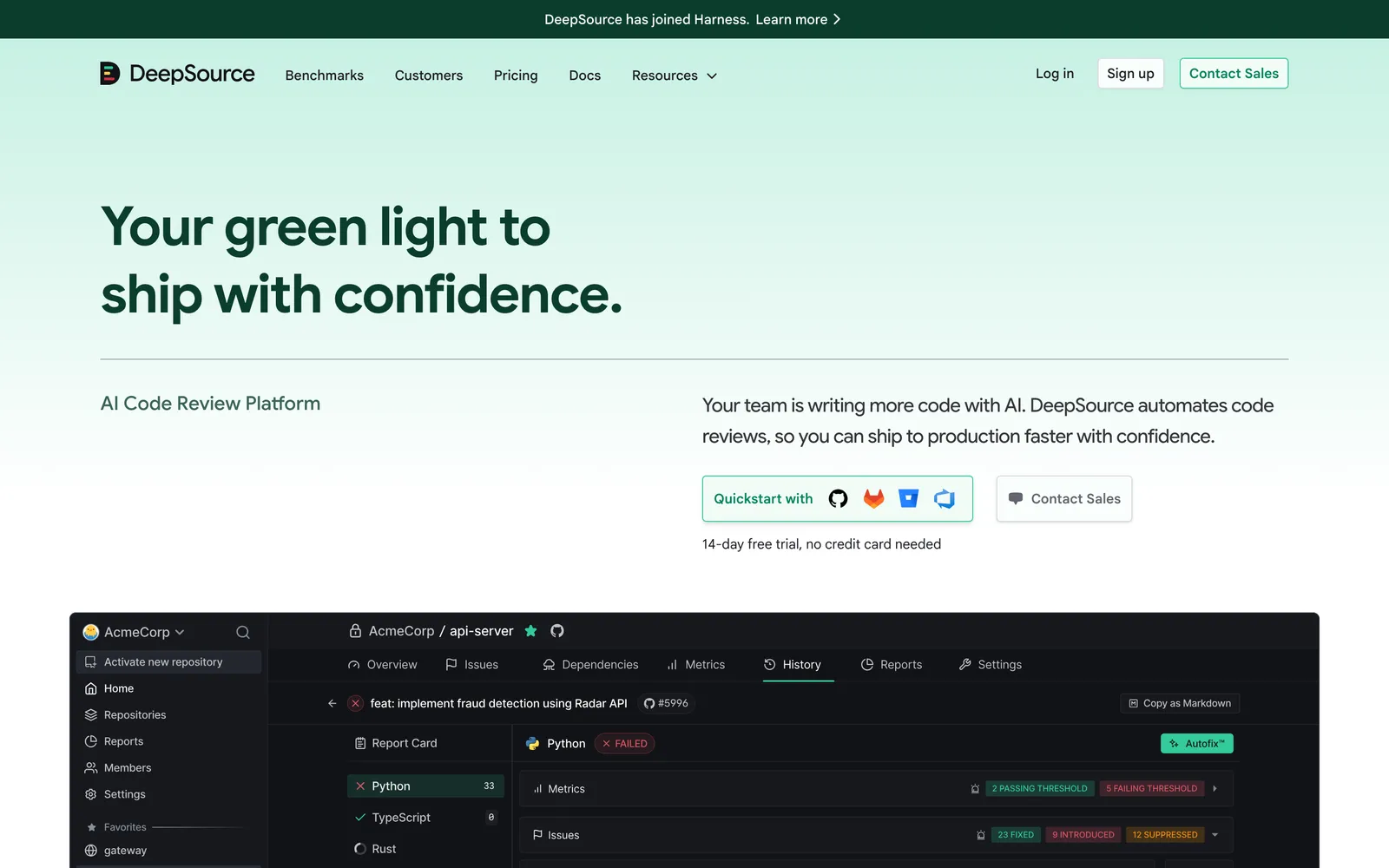
Harness acquired DeepSource on 9 September 2026. The announcement says existing workspaces keep working and that DeepSource's capabilities will move into the Harness platform over time, and the homepage banner reads "DeepSource has joined Harness" (read 22 September 2026).
Monorepos and four hosts. Static analysis, security scanning, Autofix and a metered AI review on pull requests, with explicit monorepo support.
Price and unit, read 4 October 2026: Team $24 per active contributor a month annual ($30 monthly). AI Review is $8 per 10,000 processed lines on standard or $15 on advanced, after $100 of AI credits per contributor a year on annual Team, pooled.
Free plan or trial: Open Source plan free for public repos with AI review pay as you go; 14-day trial with up to $50 in AI credits.
Git hosts: GitHub, GitLab, Bitbucket, Azure DevOps. API and webhooks. Self-hosted: Enterprise, bring your own model key.
Standout: monorepo support and Autofix.
Main limit: "unlimited PR reviews" does not cover the AI review, which is metered by lines.
Migration note: analysers first, then AI review with a spend cap.
Sources: deepsource.com/pricing, billing docs.
Migrating off Qodo
Name the job you are replacing. Pull request review, IDE feedback, org rules, test generation, multi-repo context. One tool rarely replaces all five, and pretending otherwise is how migrations stall.
Export the policy. Rules, ignored paths, severity thresholds, required check names, commands, repository scope and branch-protection dependencies. Uninstall the IDE extension last.
Normalise the cost. Monthly pull request count, the share that are large, and credits used last month. Do not compare a pooled credit pack with a seat price as if they were the same unit.
Shadow-run 30 pull requests covering small fixes, large refactors, security-sensitive changes and monorepo changes, with the contender in comment-only mode. Count actions taken, not comments posted. The method is in our guide to AI code review.
Do not run two merge blockers. Keep Qodo as the required check until the pilot has a winner.
For Qodex, prepare a reachable preview and useful API or UI scenarios first. Without them you are comparing the static review only.
Cut over. Rename required checks, remove old webhooks, apps and tokens, keep the review history you need for audit, and watch the first week of merges closely.
See also
Frequently Asked Questions
What is the difference between Qodo and Qodex?
Different companies. Qodo (qodo.ai, formerly CodiumAI) is a code review and governance platform priced in credits. Qodex (qodex.ai) is an AI QA agent whose pull request review also runs API, UI and security tests against the preview deployment, priced per developer.
How much does Qodo cost?
Pro Team is $30 a month for 2,500 pooled credits, which Qodo estimates at about 18 reviews, then $0.012 a credit for overage, for up to 30 users. Larger packs of 5,000 and 20,000 credits work out to $60 and $240. Enterprise is custom.
Is there a free Qodo plan?
There is a 14-day unlimited trial with no card, and free hosted review for qualified open-source repositories. There is no permanent free tier.
Is Qodo open source?
Its lineage, PR-Agent, is open source and community-maintained, so you can run a review bot locally with your own model key. PR-Agent is a separate project from Qodo's main hosted review product.
What is the best Qodo alternative?
CodeRabbit for a like-for-like reviewer priced per seat, with usage charges past its allowances. Greptile if you bought Qodo for repository context and want more of it. Qodex when you want findings checked against a running preview instead of ranked by confidence.
Which Qodo alternatives support GitLab and Bitbucket?
CodeRabbit, Bito, Cursor Bugbot and Greptile all document both, and CodeRabbit and Bugbot add Azure DevOps. Qodex and Graphite are GitHub-based, and GitHub Copilot code review adds Azure DevOps in public preview.
Which Qodo alternative can be self-hosted?
Bito publishes a price, $5 per seat per month on Professional. Greptile, CodeRabbit and DeepSource offer it on Enterprise. SonarQube Server and Community Build are self-managed outright. Qodex lists self-hosting on PR Review Enterprise.
Which alternative is best for monorepos?
Greptile for static context across the whole repository, DeepSource for analysers with explicit monorepo support, and Qodex, whose review is scoped to the directory that changed.
How do Qodo credits compare with seat and usage pricing?
Credits scale with pull request size and expire monthly. Seats set a base price per person, and some seat plans add usage charges past their allowances. Cursor Bugbot and Copilot charge per run. Model all three against last month's actual pull request list, because the ranking flips depending on your diff sizes.
Can I migrate Qodo rules to another tool?
Plan to rewrite them as the new tool's repository file: CodeRabbit path instructions, Greptile rules, .cursor/BUGBOT.md for Bugbot, or .qodex.yaml for Qodex. Export them to plain text before you cancel.
The short version
The choice splits two ways. Either you want static review at a different depth or price, in which case CodeRabbit trades Qodo's credits for a seat price and Greptile trades them for deeper repository context, or you want review that runs the code rather than reading it, which is what Qodex does on GitHub. Model your real pull request volume before you pick, because credits, seats, lines and per-run charges rank differently at every team size.