CodeReviewBot AI Code Review: Cost, Fit, Alternatives
CodeReviewBot AI code review is a pull request reviewer for GitHub. It comments on new pull requests with vendor-claimed bug, security, performance and code-quality findings. The free Hobby plan covers public open-source repositories and up to 10 monthly reviews on private personal repositories. Team starts at $25 a month, but the vendor does not publish the billing unit. It fits solo developers and small GitHub-only teams. Source: codereviewbot.ai, read 20 September 2026.
What is CodeReviewBot AI code review?
CodeReviewBot is a GitHub App. The published setup is three steps: sign in with GitHub, authorise the app for your repositories, then open a pull request to trigger a review. The bot posts its feedback in the pull request thread, the way a human reviewer would. Source: CodeReviewBot homepage, read 20 September 2026.
The vendor says the bot finds bugs, spots security and performance problems, and gives improvement suggestions on every pull request. Read those as vendor claims. No benchmark, no published detection rate and no independent evaluation appears anywhere on the public site. Source: CodeReviewBot homepage, read 20 September 2026.
By default the bot describes a proposed change in prose rather than handing you replacement code. The vendor's stated reason is intellectual property: it leaves the implementation to the developer. A repository option in the dashboard switches code snippets on. Check that setting before you judge the output, because the default hides half of what the tool can do. Source: CodeReviewBot FAQ, read 20 September 2026.
One naming trap is worth clearing up before you search further. A 2024 study of automated code review at Beko uses the name "CodeReviewBot" for an internal deployment of a customised Qodo PR-Agent running on GPT-4-32K. That paper is evidence about the category, not about this vendor. If you found a research result for "CodeReviewBot" and it looked rigorous, check which tool it measured. Source: Automated Code Review In Practice, arXiv v2 dated 28 December 2024, read 20 September 2026.
What does CodeReviewBot cost?
There is no separate pricing page. The navigation points at an anchor on the homepage, and these are the plan cards it shows. Every figure below is a vendor claim from CodeReviewBot pricing, read 20 September 2026.
| Plan | Published price | Included | Limit or ambiguity |
|---|---|---|---|
| Free / Hobby | $0 a month | Public open-source repositories; standard review logic; email support | Up to 10 reviews a month on private personal repositories; the unit behind that wording is undefined |
| Team (Pro) | Starting at $25 a month | Unlimited private-repository reviews; custom style guides and rules; context-aware models; priority email support | The site does not state the billing unit; the card offers a 30-day trial, the FAQ says 30 days or 40 reviews |
| Enterprise | Contact sales | Self-hosted or VPC deployment on AWS or Google Cloud; custom fine-tuned models; dedicated hardware; offline runs; 24/7 priority support SLA | No price, no capacity limits, no published trial |
The arithmetic that matters here is the arithmetic you cannot do. A per-seat price multiplies by your headcount and lands in a budget. "Starting at $25 a month" with no stated subject multiplies by nothing, so you cannot set it beside a $24 seat and call that a comparison. Ask sales whether $25 buys a user, a repository or an organisation before you shortlist it.
The trial wording contradicts itself on one page. The Team card reads "Free 30-day trial (no credit card required)". The FAQ below it answers the same question with "free for 30 days or 40 reviews". Neither explains how the trial relates to the Hobby plan's 10 private reviews a month.
Who is CodeReviewBot for?
The fit is narrow and the vendor's own pages draw the boundary. CodeReviewBot suits a solo developer or a small team whose code already lives on GitHub and who wants pull request comments without running any infrastructure. The private-repository volume has to stay inside 10 reviews a month, or be large enough to justify the Team plan.
It suits one more group with no competition on this page: teams whose reviewers read faster in a language other than English. The browser tool offers review output in 16 human languages. Source: CodeReviewBot AI Code Review Tool, read 20 September 2026.
Look elsewhere in four cases. If your code is on GitLab, Bitbucket or Azure DevOps, no public page says CodeReviewBot reaches it. If procurement needs a billing unit, the price cannot be modelled. If your security team needs a published list of supported programming languages, none exists. If an auditor wants compliance evidence, the Enterprise card offers "SOC2 compliance support", which is a support offer rather than a completed examination, and no trust centre or report appears in the public sitemap. Sources: pricing and public sitemap, read 20 September 2026.
Features, models, integrations and limits
Four things are documented clearly, and the rest is absence. Start with what is there.
Output languages. The browser tool lets you pick from 16 human languages: American English, German, French, Spanish, Italian, Dutch, Polish, Portuguese, Russian, Turkish, Japanese, Chinese, Korean, Arabic, Hebrew and Hindi. These are the languages the review is written in, not the languages it can read.
Review styles. The same tool offers Formal, Educational, Friendly and Concise, plus a toggle for code snippets.
Models. The FAQ names GPT-4, GPT-4o and Google Gemini. No snapshot, version ID or routing rule is published, so do not plan around a fixed model release. If your security review asks which provider sees a diff, you have three names and no split.
Training. The vendor states: "We never use private code to train models." The sentence after it says reactions to bot review messages and review-thread messages may be used to improve models. Those are two different promises, and only the first covers your source.
Sources for the four points above: CodeReviewBot AI Code Review Tool and CodeReviewBot FAQ, read 20 September 2026.
Now the absences, which matter more when you are comparing. GitHub is the only source host named anywhere on the public site. The public sitemap lists six URLs: the homepage, the code-review tool, terms, privacy, cookies and contact. There is no product documentation page in it, so GitLab, Bitbucket, Azure DevOps, IDE and API support are unverified rather than supported. Source: public sitemap, read 20 September 2026.
No public page states a maximum pull request size, a file count, a repository count, a context-window size, a supported programming-language list or a review rate limit. The one number you can measure sits in the anonymous browser demo. Paste more than 2,000 characters and it answers "The code fragment is too long to process.", then asks you to sign in with GitHub for a higher limit. That higher limit is not published. A Java example sits on the homepage, and one example is not coverage.
On data retention, the privacy notice says personal information is kept as long as needed for the purposes it describes, and normally no longer than the life of the account. It does not publish a retention period for source code specifically. Source: CodeReviewBot privacy notice, read 20 September 2026.
CodeReviewBot alternatives at a glance
Every price in this table was read on the vendor's own page, on the date in its last column (2026). Where a page names no host list, the cell says so rather than guessing. Never compare bare dollar figures without their units. For the wider field, see our guide to the best AI code review tools, and for free tiers specifically, free AI code review.
| Tool | Git hosts named | Paid price and unit | Free plan or trial | Best for | Read |
|---|---|---|---|---|---|
| CodeReviewBot | GitHub | Team from $25/mo, unit not stated | Public repos free; 10 private reviews/mo | Solo and small GitHub teams | 20 Sep |
| CodeRabbit | GitHub, GitLab | Essentials $24/developer/mo annual | 14-day trial, no card; public repos free | The closest like-for-like upgrade | 20 Sep |
| Qodex | GitHub | See Qodex AI code review | See the product page | Findings checked on a running preview | Not priced here |
| Qodo | Not on the pricing page | Pro Team $30/mo, 2,500 pooled credits | 14-day trial, no card | Credit pools and org-wide rules | 20 Sep |
| Greptile | GitHub, GitLab | Pro $30/seat/mo, 50 credits per seat | Starter $0, 1 developer, 50 credits/mo | The better free tier | 20 Sep |
| Bito | GitHub, GitLab, Bitbucket | Team $12/seat/mo annual, 5K lines | 14-day trial, no card | Cheapest published seat | 20 Sep |
| Graphite | GitHub | Team $40/user/mo annual | Hobby $0, personal repos, limited AI | Teams that work in stacks | 20 Sep |
| Cursor Bugbot | GitHub | Usage-based on a Cursor plan from $20/mo | No published free Bugbot allowance | Teams already in Cursor | 22 Sep |
| GitHub Copilot | GitHub | Pro $10/user/mo plus AI credits | Free plan excludes code review | No new vendor | 20 Sep |
| DeepSource | Not on the pricing page | Team $24/user/mo billed yearly | Open Source plan free, 1,000 PRs/mo | Monorepos and fixed rules | 20 Sep |
| Snyk Code | Not on the pricing page | Team from $25/mo, up to 10 developers | Free $0, 100 Code tests/mo | A security gate, not a reviewer | 22 Sep |
| SonarQube | GitHub, GitLab, Bitbucket, Azure DevOps | Team from $34/mo up to 100k lines | Free tier to 50k private lines | Auditable rules you self-manage | 22 Sep |
The best CodeReviewBot alternatives
1. CodeRabbit
The straight upgrade path: the same shape of product with a published per-developer price. CodeRabbit renamed its plans since our last check. Essentials is $24 per developer per month billed annually, Team is $48, Advanced is $72, and Enterprise is custom. Public repositories are free forever, and every plan starts with a 14-day trial without a card. The throughput cap is published too: 5 pull request reviews per developer per hour on Essentials, rising to 12 on Enterprise, under a fair use policy. Reviews beyond the included allowance cost $0.25 per reviewed file. Source: CodeRabbit pricing, read 20 September 2026. More in our CodeRabbit alternatives guide.
2. Qodex
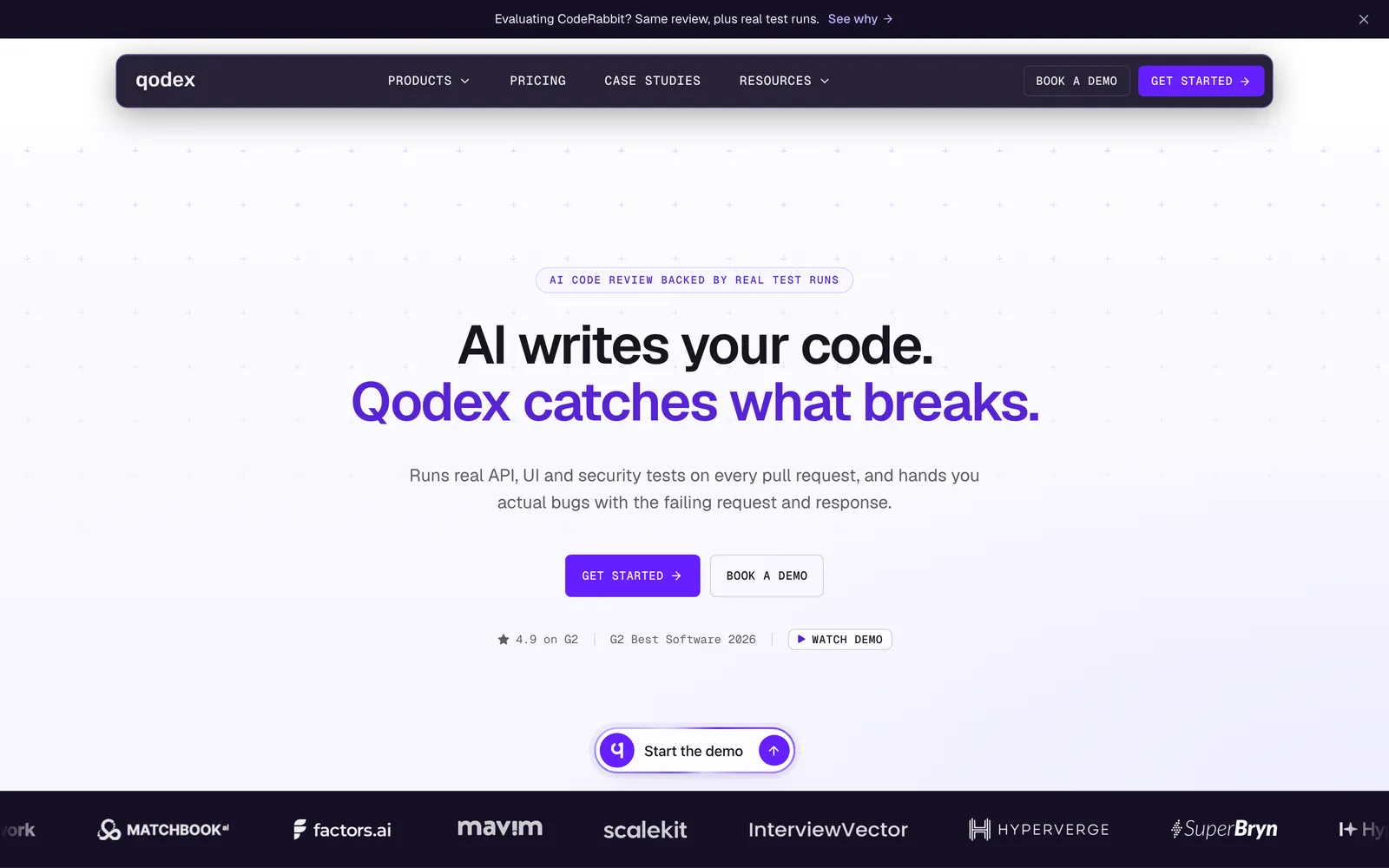
Qodex is "AI code review that runs your tests on every pull request." Six passes run before a single comment is posted. They are more than a dozen static analyzers, a full read of every changed file, a blast-radius pass over the code graph, two frontier models, and live probes against the preview. That last pass is what separates it from a diff reader. A tenant id read from the request body instead of the session looks like a clean diff, and a live probe against the preview returns another organisation's invoices, so the finding arrives verified. Setup is the GitHub app, which takes minutes. Nothing goes into your application and no runner goes into your CI. Merge gating is configured per repository in a .qodex.yaml file.
3. Qodo

The answer when you want a credit pool and rules enforced across an organisation. Pro Team is $30 a month for 2,500 pooled credits, which Qodo estimates at about 18 reviews, with larger packs at 5,000 and 20,000 credits and extra credits at $0.012 each. The plan is designed for up to 30 users, bills monthly with no commitment, and includes a 14-day trial with no card. Credits expire at the end of each monthly cycle and do not roll over, so size the pack against last month's pull request count. Enterprise adds Gerrit support, single-tenant SaaS and on-premises or air-gapped deployment. Source: Qodo pricing, read 20 September 2026, with the $0.012 credit price re-read on 22 September 2026.
4. Greptile
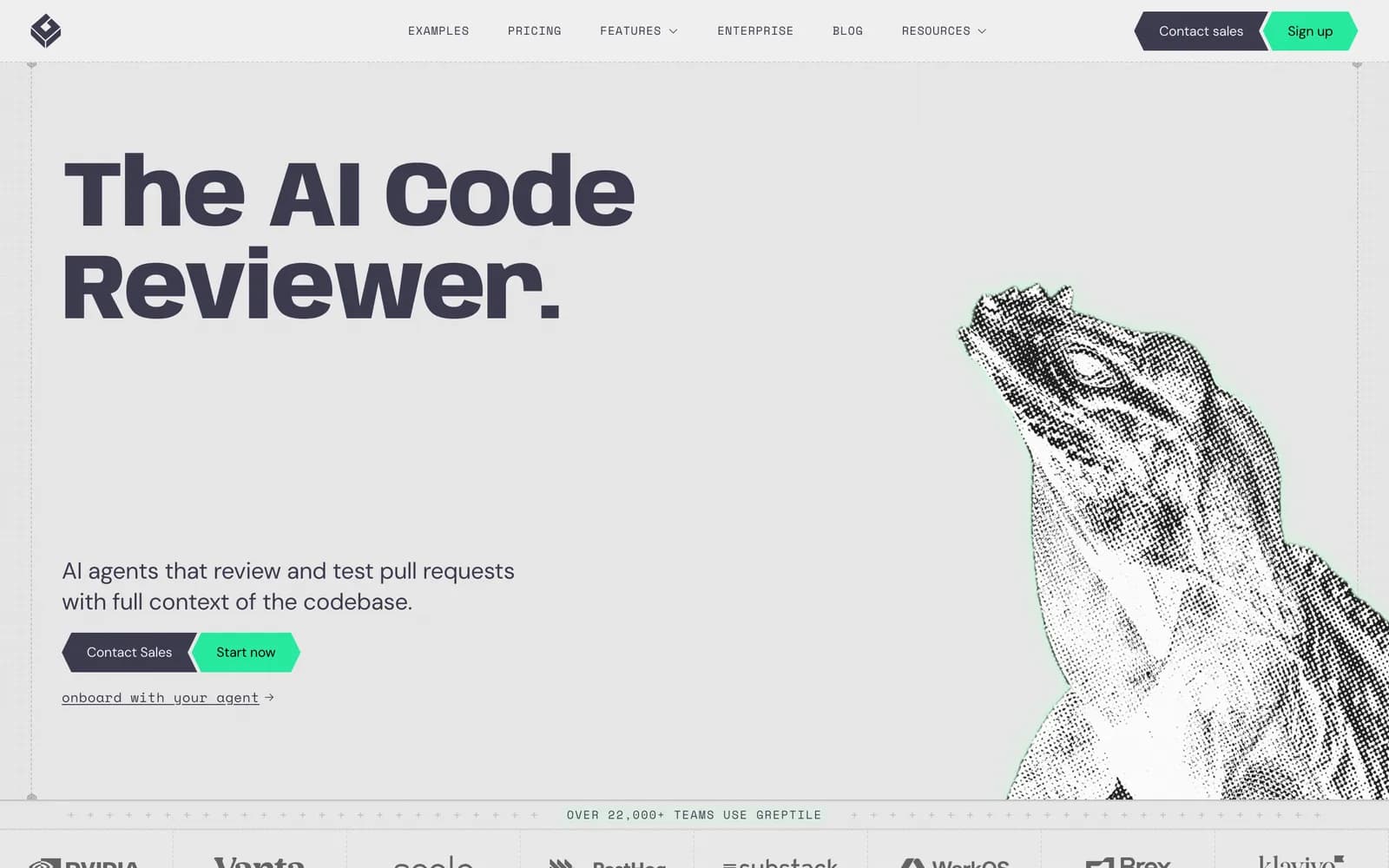
The better free plan, if free is the reason you are on CodeReviewBot. Greptile indexes a repository into a graph and reviews each pull request against that whole-repo context. Starter is $0 for one active developer with unlimited repositories and 50 credits a month, which is 50 reviews against CodeReviewBot's 10 on private repositories. Pro is $30 per seat per month with 50 credits per seat and extra credits at $1. A standard review costs one credit and a TREX review, which writes and runs targeted tests in a sandbox, costs three. Credits reset monthly and do not roll over. Source: Greptile pricing, read 20 September 2026. See our Greptile review and alternatives.
5. Bito
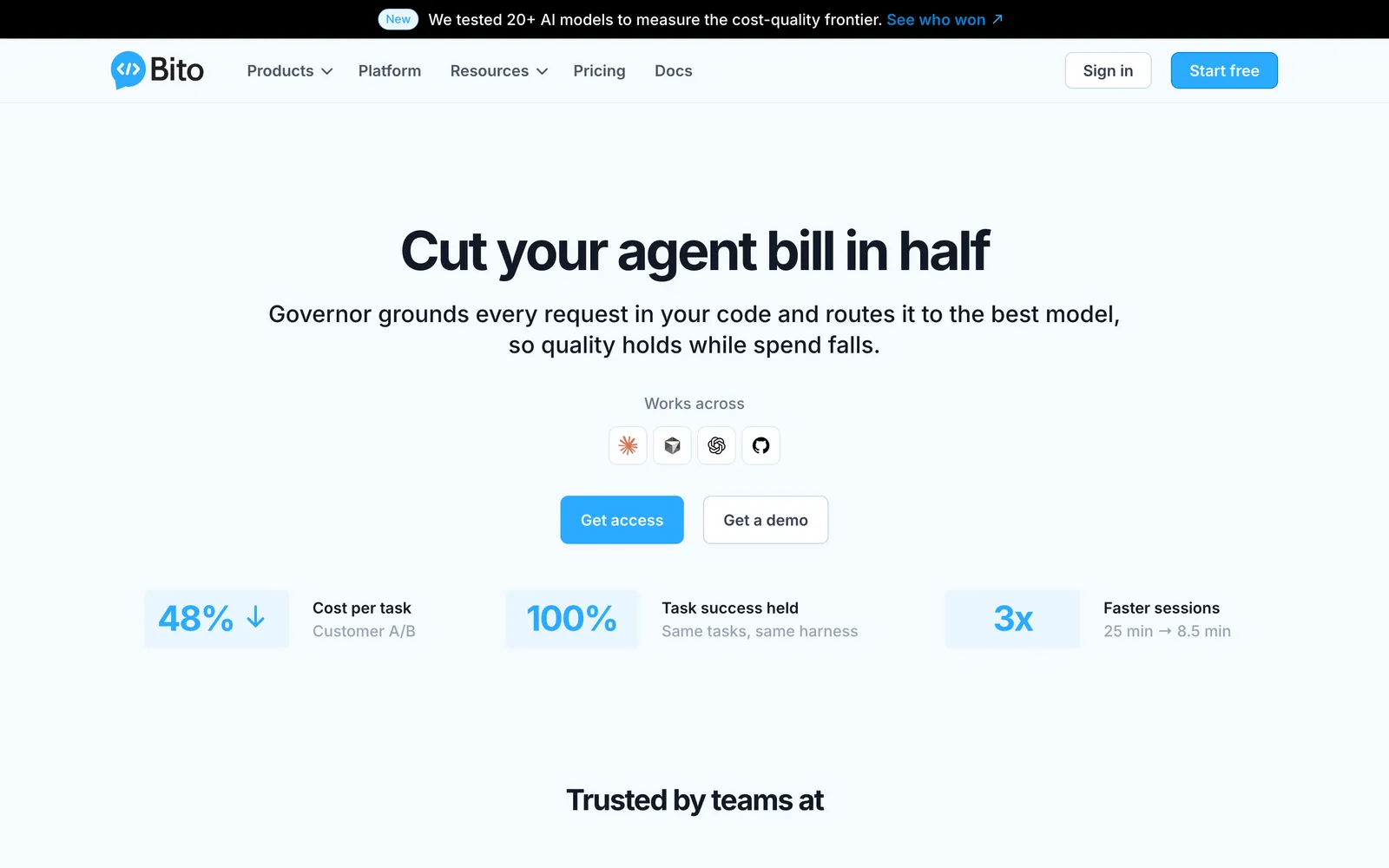
The cheapest published seat here, and the one vendor on this page that prints a self-host price instead of routing you to sales. Team is $12 per seat per month billed annually, $15 monthly. Professional is $20 annually, $25 monthly, and adds self-hosting as a $5 per seat per month option. Both include 5,000 reviewed lines per seat per month, then $5 per additional 1,000 lines. The 14-day Professional trial needs no card. Bito names GitHub, GitLab and Bitbucket, plus VS Code, JetBrains, Cursor and Windsurf. Count your reviewed lines first, because a refactor-heavy month bills extra. Source: Bito pricing, read 20 September 2026. Detail in our Bito review and alternatives.
6. Graphite

A different workflow rather than a better reviewer, and it earns its price only if your team wants stacked pull requests. Hobby is free on personal-account repositories with limited AI reviews. Starter is $20 per user per month billed annually and adds all organisation repositories. Team is $40 per user per month billed annually and is the tier where AI reviews become unlimited, alongside automations and the merge queue. Enterprise adds GitHub Enterprise Server, SAML, ACLs and audit logs. Graphite is GitHub only and offers no self-hosting outside Enterprise, so it fixes none of CodeReviewBot's host problem. Source: Graphite pricing, read 20 September 2026. See our Graphite review and alternatives.
7. Cursor Bugbot
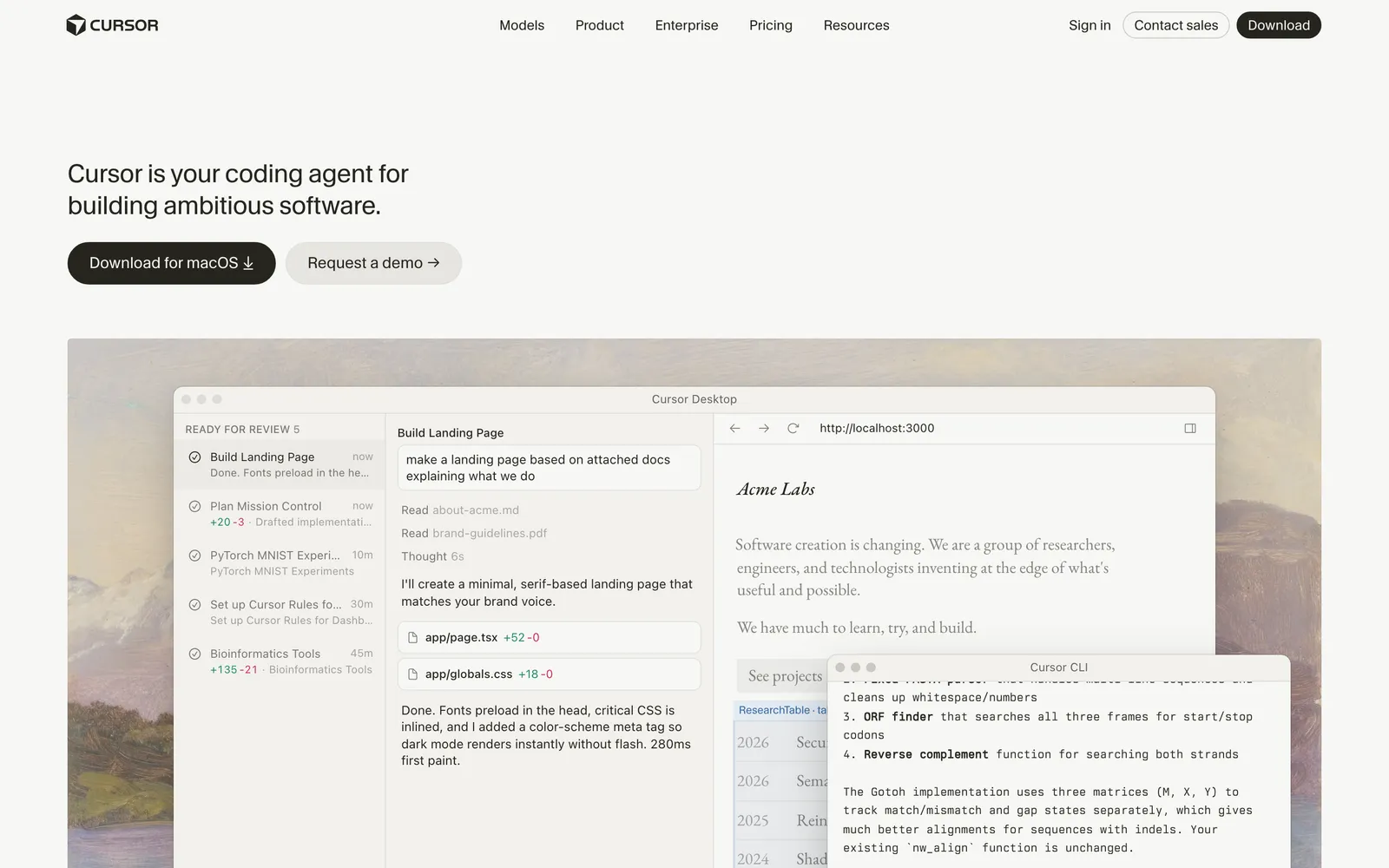
For teams already writing code in Cursor, where the step from finding to fix stays inside the editor. Bugbot reviews pull requests in GitHub, comments on issues and hands fixes to Cursor or a background agent, with custom rules you keep in the repository. Pricing is usage-based and rides on a Cursor plan: Hobby is free, Pro is $20 a month, Pro+ is $60 and Ultra is $200, with Bugbot billed on usage on each paid tier. The vendor publishes no per-run rate card, so model the spend before you switch. Sources: Cursor pricing and Bugbot, read 22 September 2026. See our Cursor Bugbot alternatives.
8. GitHub Copilot code review
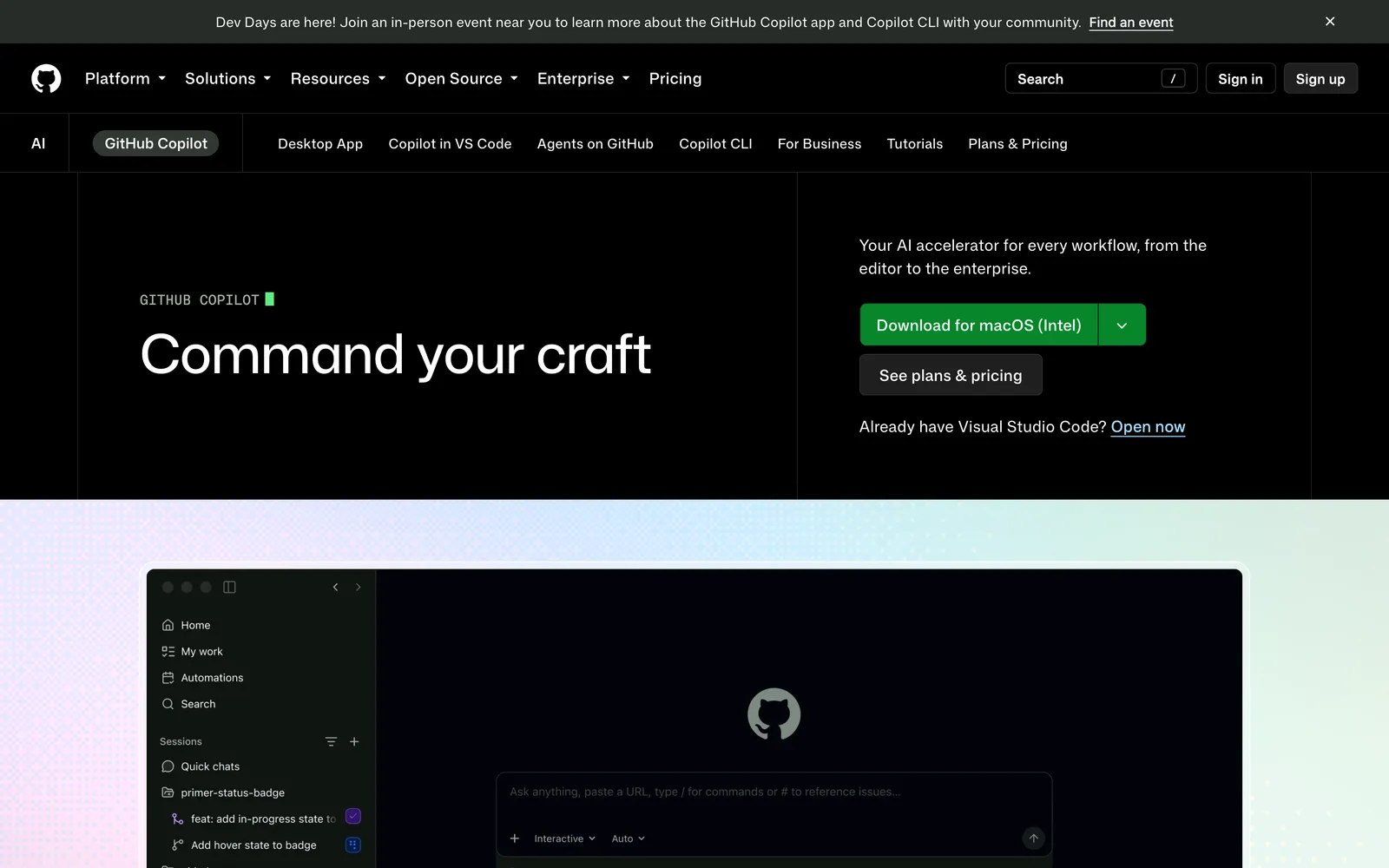
The no-new-vendor option, and the one a CodeReviewBot team may already be paying for. Copilot Free is $0 and does not include code review. Pro is $10 per user per month and is the first tier that does, with $15 of monthly GitHub AI credits. Pro+ is $39 with $70 in credits, and Max is $100 with $200. Code review spends those credits, and agentic review workflows also consume GitHub Actions minutes. One old limit has changed: a Copilot review now carries an approval assessment, and when Copilot approvals are enabled at repository, organisation or enterprise level it can submit an approving review. Sources: Copilot plans and Copilot code review, read 20 September 2026.
9. DeepSource
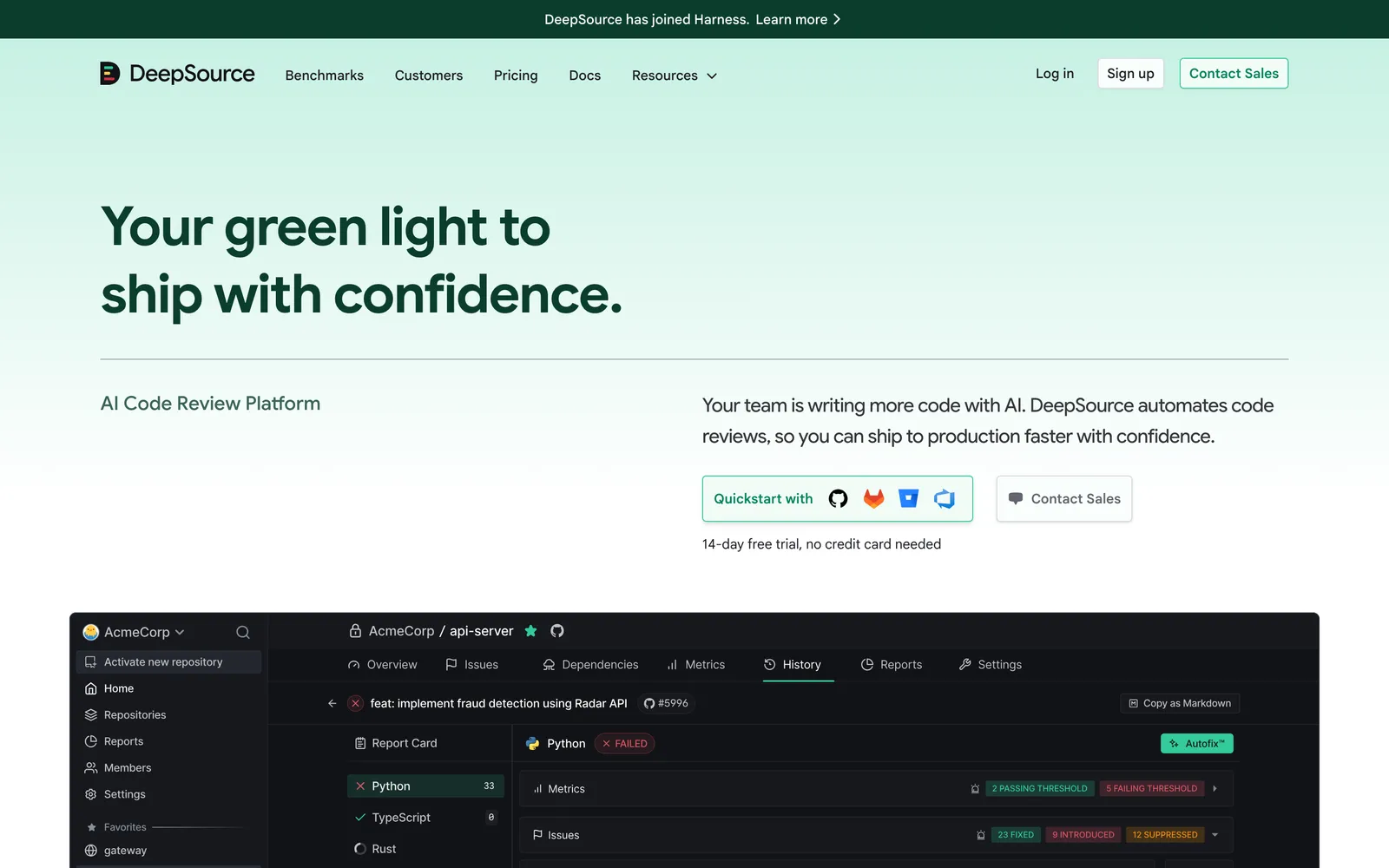
The analyzers-first answer, and the one that replaces a missing language list with named deterministic rules. Team is $24 per user per month billed yearly, with unlimited repositories, unlimited pull request reviews and explicit monorepo support. AI Review and Autofix are billed separately at $8 per 10,000 processed lines on standard or $15 on advanced, after a $100 annual credit per user. The Open Source plan is free for public repositories with 1,000 reviewed pull requests a month. Enterprise adds self-hosted and air-gapped deployment and bring-your-own model keys. The banner now says DeepSource has joined Harness. Source: DeepSource pricing, read 20 September 2026.
10. Snyk Code
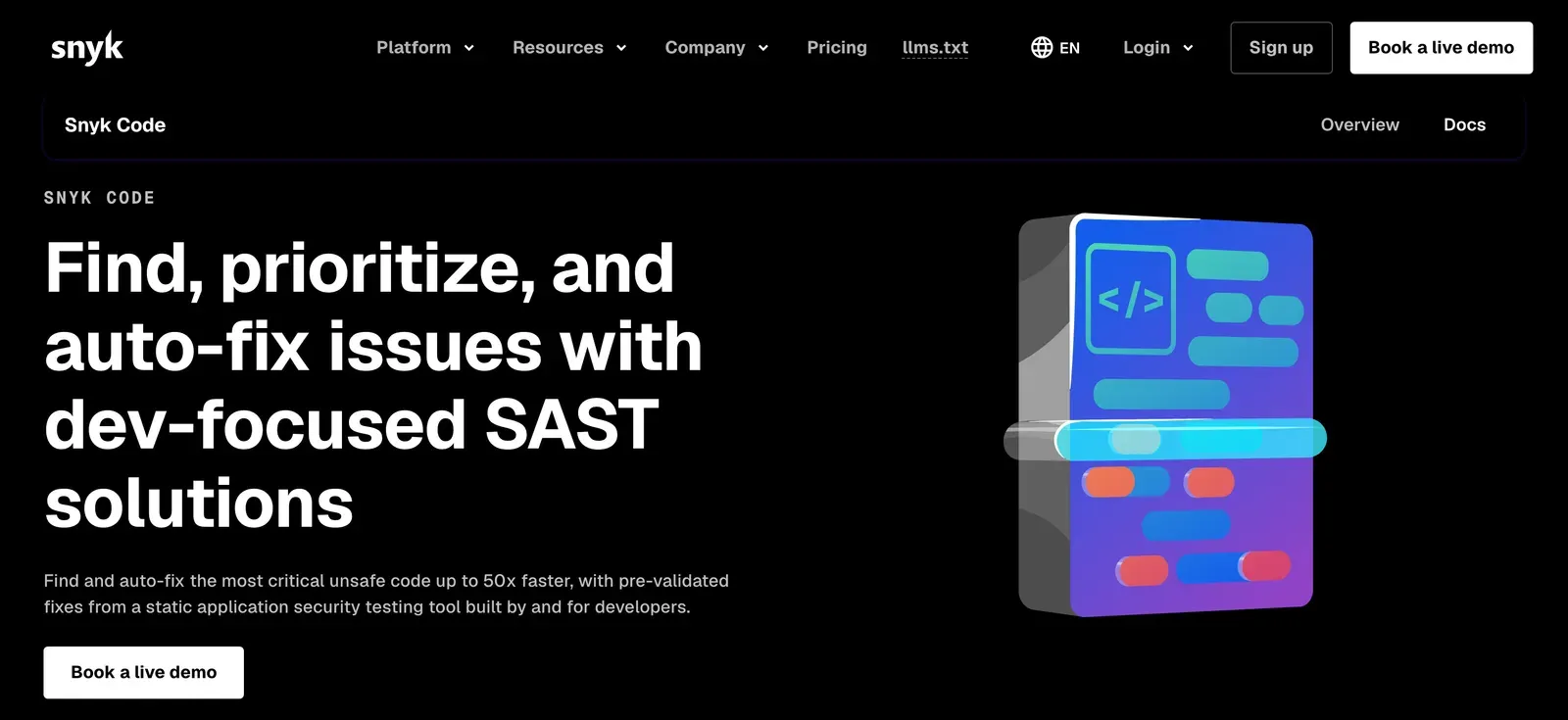
If security detection is why you installed CodeReviewBot, this is the product that specifies what it finds. Snyk Code is static application security testing with data-flow analysis and fix suggestions, inside Snyk's wider dependency, container and infrastructure platform. Free is $0 a month and includes 100 Snyk Code tests a month. Team starts at $25 a month for teams of up to 10 developers, with 1,000 Code tests a month. Enterprise is a credit-based subscription priced through sales. Source: Snyk plans and pricing, read 22 September 2026. More in our Snyk AI code review guide.
11. SonarQube
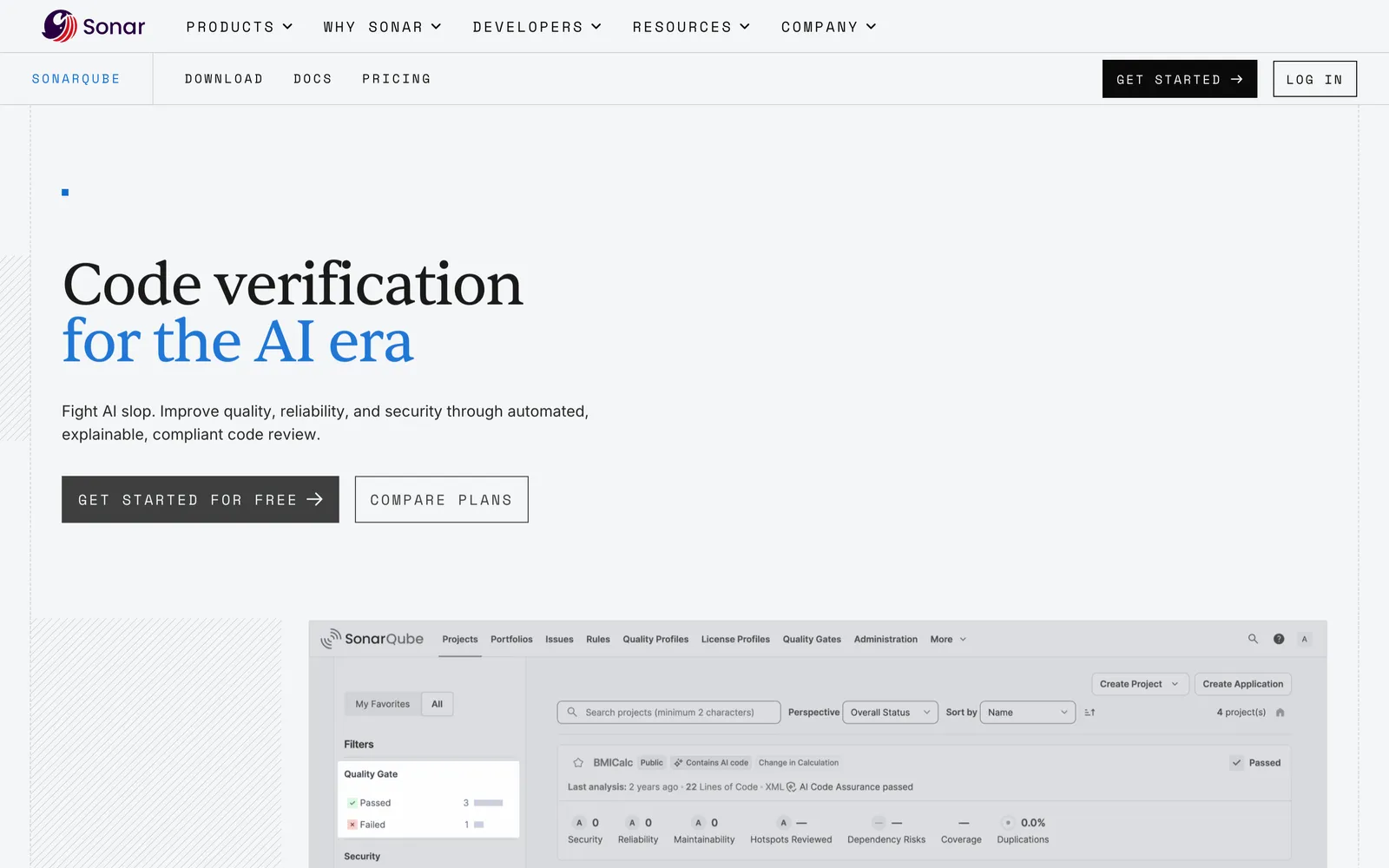
The self-managed, open-source end of the page, and the direct answer to an unpublished language list: Sonar documents its rules and languages in public, and its plans page lists 30+ languages on the Team plan. SonarQube Cloud Team starts at $34 a month, discounted from $68, for up to 100,000 private lines of code, with other increments available. The free tier covers private projects up to 50,000 lines with no card and no expiry, and Community Build is open source. SonarQube Server is self-managed and priced per instance per year by lines of code. Sonar now bundles an AI reviewer, Gitar, at $20 per user per month billed annually. Source: Sonar plans and pricing, read 22 September 2026.
How to test CodeReviewBot on a real pull request
Vendor claims are cheap. A short trial on a disposable repository is not. Plant one bug that a diff reader should catch, open a pull request that contains only that change, and see what comes back.
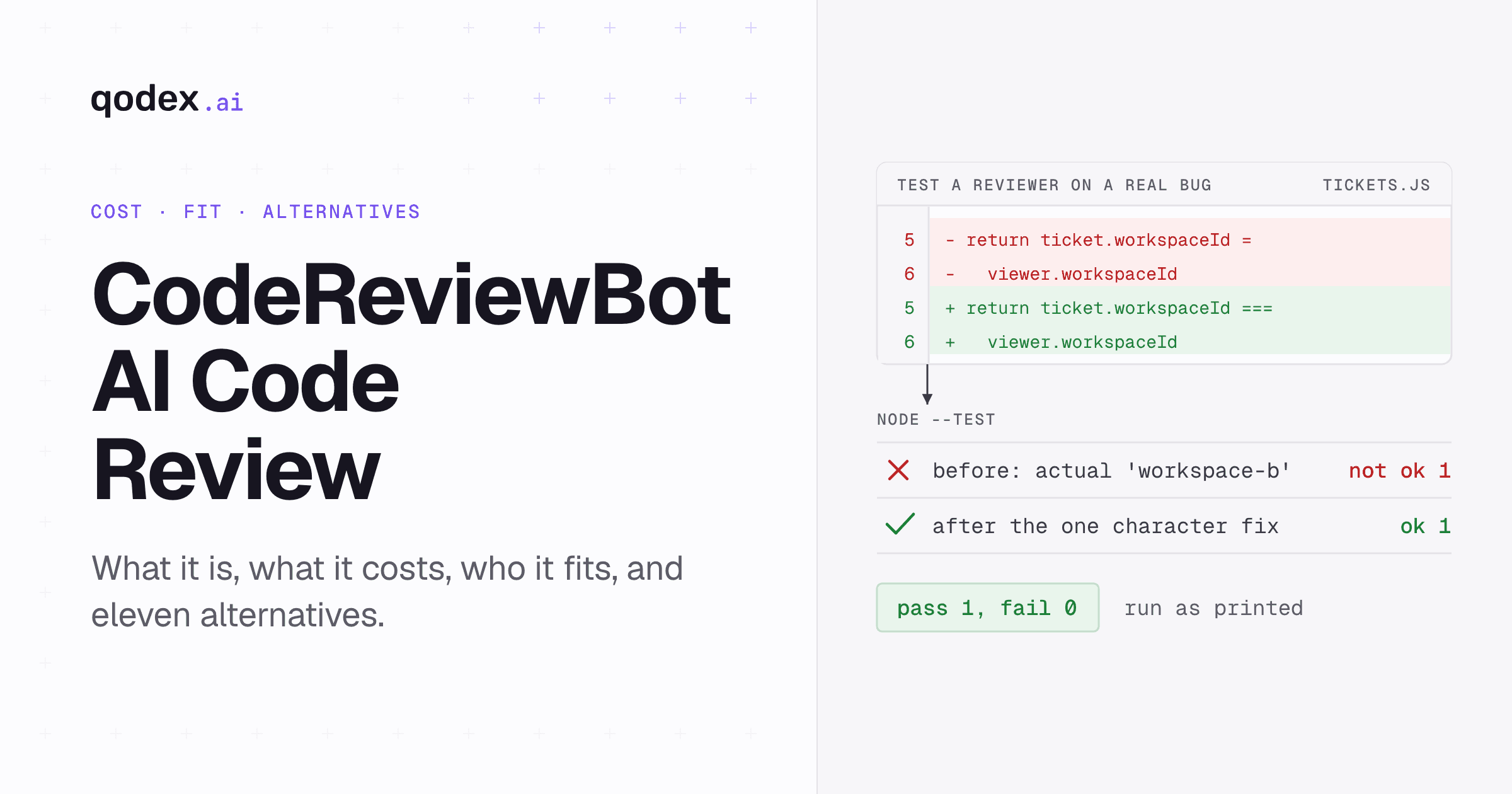
The bug below is an assignment where a comparison was meant. It reads as an authorisation check and behaves as an overwrite: it returns a truthy workspace id for everybody, and it quietly rewrites the ticket's own workspace on the way past. Two files, no dependencies, Node's built-in test runner.
// ticket-access.mjs
// Support tickets belong to a workspace. The viewer object is whatever the
// server already resolved from a verified session, never a header or a query
// string a caller can set.
export function canReadTicket(ticket, viewer) {
  return ticket.workspaceId = viewer.workspaceId; // deliberate bug: should be ===
}
// ticket-access.test.mjs
import test from 'node:test';
import assert from 'node:assert/strict';
import { canReadTicket } from './ticket-access.mjs';
test('a viewer from another workspace is refused', () => {
const ticket = { id: 'tkt-1', workspaceId: 'workspace-a' };
const viewer = { id: 'user-9', workspaceId: 'workspace-b' };
assert.equal(canReadTicket(ticket, viewer), false);
assert.equal(ticket.workspaceId, 'workspace-a');
});Put both files in an empty folder and run node --test --test-reporter=tap. On Node 26.9.0 the test fails, and the failure names both halves of the bug. Stack frames trimmed:
TAP version 13
# Subtest: a viewer from another workspace is refused
not ok 1 - a viewer from another workspace is refused
  ---
  duration_ms: 0.724333
  type: 'test'
  failureType: 'testCodeFailure'
  error: |-
    Expected values to be strictly equal:
    + actual - expected

    + 'workspace-b'
    - false

  code: 'ERR_ASSERTION'
  name: 'AssertionError'
  expected: false
  actual: 'workspace-b'
  operator: 'strictEqual'
  ...
1..1
# tests 1
# pass 0
# fail 1
Change the one character, so the line reads return ticket.workspaceId === viewer.workspaceId;, and the same command passes:
TAP version 13
# Subtest: a viewer from another workspace is refused
ok 1 - a viewer from another workspace is refused
  ---
  duration_ms: 0.711208
  type: 'test'
  ...
1..1
# tests 1
# pass 1
# fail 0
Now commit the broken version to a branch, open the pull request and score what the bot says. Four columns: did it name the assignment, did it also name the mutation of the ticket, how long did the comment take to arrive, and was the suggested fix correct. Run the same pull request past a second tool before you decide. Our guide on how to do code reviews using AI covers the rest of the scorecard.
Verdict
CodeReviewBot is a cheap GitHub pull request commenter with one distinctive feature: review output in 16 human languages. Its public surface stops short in four places. One host, no billing unit, no programming-language list, and no audit evidence behind "SOC2 compliance support". If that suits a solo project, the Hobby plan costs nothing to try. If any of the four gaps is a blocker, the table above lists the eleven alternatives with the constraint each one solves, and each price section gives the day it was read.
Frequently Asked Questions
What is CodeReviewBot?
It is a GitHub App that reviews pull requests automatically. You sign in with GitHub, authorise the app for your repositories, and the next pull request gets a review comment. The vendor says it finds bugs plus security and performance problems and suggests improvements. Source: codereviewbot.ai, read 20 September 2026.
How does CodeReviewBot work on GitHub pull requests?
Three steps, per the vendor's own setup section: sign in with GitHub, authorise the CodeReviewBot app, then create a pull request to trigger a review. Feedback arrives in the pull request thread. By default the bot describes a change in prose; a repository option in the dashboard turns code snippets on.
Is CodeReviewBot free?
There is a free plan. Public open-source repositories are reviewed at no cost, and private personal repositories get up to 10 reviews a month with standard review logic and email support. The card does not say whether that allowance belongs to a user, a repository or an organisation. Source: codereviewbot.ai pricing, read 20 September 2026.
How much does CodeReviewBot Team cost?
Starting at $25 a month for unlimited private-repository reviews, custom style guides and rules, context-aware models and priority email support. The site states no billing unit, so ask sales whether $25 buys a user, a repository or an organisation before you set it beside a per-seat price.
Which programming languages does CodeReviewBot support?
No supported programming-language list is published. A Java example appears on the homepage, which is an example rather than coverage. The 16 languages the vendor does list are the human languages the review is written in, from American English and German through to Arabic, Hebrew and Hindi.
Does CodeReviewBot support GitLab or Bitbucket?
GitHub is the only source host named on the public site, and the public sitemap carries no documentation page that says otherwise. For GitLab specifically, our GitLab AI code review guide covers the options; CodeRabbit, Bito and SonarQube all name GitLab on their own pages.
Does CodeReviewBot use private code to train models?
The vendor's wording is: "We never use private code to train models." The next sentence says reactions to bot review messages and review-thread messages may be used to improve models. Read those as two separate statements. The privacy notice publishes no source-code retention period. Source: codereviewbot.ai FAQ and privacy notice, read 20 September 2026.
What is the best CodeReviewBot alternative?
It depends on which gap you are closing. CodeRabbit is the closest like-for-like product with a published per-developer price. Greptile has the better free tier at 50 reviews a month. Bito publishes the cheapest seat and a self-host price. SonarQube is the self-managed, open-source end of the list.