Free AI Code Review in 2026: Every Free Tier Compared, and One Year Free With Your Codex Account
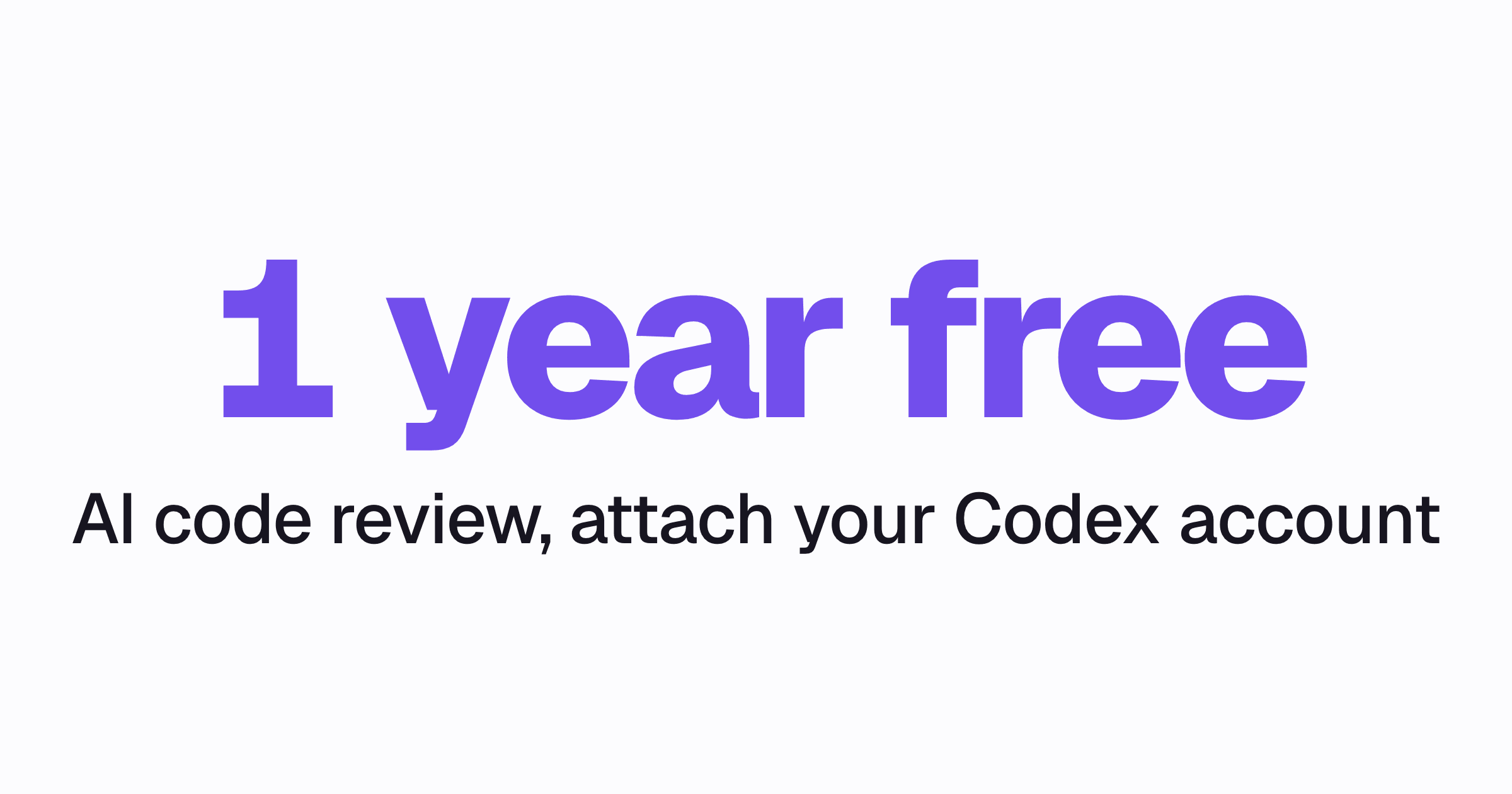
Free AI code review means one of five things: a permanent plan with a monthly cap, open source only, a credit pool, a 14-day trial, or an editor tool that never touches a pull request. This page sorts 15 tools by which one they are. The quickest free options are 20 reviewed pull requests per developer a month with no card, or one year free when you attach your Codex account.
Every vendor limit below was read on 3 September 2026 and is the vendor's own published claim, not a measured allowance. This page is part of our AI testing guide. Qodo in the tables below is qodo.ai, not Qodex.
1. What "free" means in AI code review
A permanent free plan with a monthly cap. You install it, it reviews pull requests, and it stops at a number each month. Qodex Free is 20 reviewed pull requests per developer a month, for up to 2 developers, with no card. CodeReviewBot's Hobby plan is up to 10 reviews a month on private personal repositories. Nothing expires. You wait for the reset.
Free for open source only. The tool refuses private repositories on the free tier. CodeRabbit, Qodo, Diffray, Revix, Sourcery and Codacy all work this way, and Greptile runs a separate application-based program for qualified projects. If your repository is public, this is the most generous bucket in the market.
A pool of credits. Greptile's Starter plan is $0 with 50 credits a month, where a standard review costs one credit and a TREX review costs three, for one active developer. A credit pool is a cap with arithmetic in front of it.
A trial. Fourteen days is the standard: CodeRabbit, Qodo, Codacy and Qodex Pro all use it. CodeReviewBot gives 30 days or 40 reviews. Revix gives two weeks across public and private repositories. A trial is not a free plan, and it is what most "has a free tier" claims turn out to mean.
An editor or paste-in tool that never sees the pull request. CodeRabbit's IDE extension, Codacy's Developer plan, and paste-your-snippet sites like zzzcode and Workik. Useful before you push. Nothing they say can block a merge.
| Your situation | Pick | Why |
|---|---|---|
| Private repository, no card | Qodex Free | 20 reviewed pull requests per developer a month, up to 2 developers, unlimited repositories. |
| Open source project | CodeRabbit, Qodo or Diffray | Public repos reviewed free, no card, no clock. |
| You have a Codex account (any ChatGPT plan, the $20 Plus plan included) | One year of Qodex free | Attach the account; Codex review itself comes with Plus and Pro. |
| A reviewer inside VS Code, not on the pull request | CodeRabbit's IDE extension | Free reviews in the editor, before anything is pushed. |
| You want the review to run tests against the preview | Qodex | It can run your API, UI and security scenarios against the preview. |
2. Free AI code review tools compared: 15 tools and Codex
Every cell is what the vendor's own page said on 3 September 2026. "Not stated" means the page is silent, not that the answer is no.
| Tool | Free plan | What you get free | Private repos | Card or trial | Read |
|---|---|---|---|---|---|
| Qodex | Free, $0, free forever | 20 reviewed pull requests per developer a month for up to 2 developers, 2 automatic reviews per pull request, unlimited repositories | Unlimited repositories; the page does not split public from private | No card. Pro has a 14-day trial, no card | 2026-10-05 |
| CodeReviewBot | Free / Hobby, $0 | 100% free for public open-source repos; up to 10 reviews a month on private personal repos | Yes, personal repos | No card named on the free plan. Team has 30 days or 40 reviews | 2026-09-03 |
| Greptile | Starter, $0 | 50 credits a month, 1 credit per standard review, 3 per TREX review, 1 active developer, unlimited repos | Not stated | Not stated. Paid plans have a 14-day trial | 2026-09-03 |
| Graphite | Hobby, $0 | Personal-account repos, "Limited AI Reviews", with no number published | Personal-account repos only | Not stated. Team has a free trial | 2026-09-03 |
| CodeRabbit | Free for public repositories | Install on a public repo and get "free reviews forever for public repositories", plus a free IDE extension | No | No card. All paid plans have a 14-day trial | 2026-09-03 |
| Qodo | Qodo for Open Source | Free access for qualified open-source projects, by application. The FAQ says there is no permanent free tier | No | No card for the trial. 14 days | 2026-09-03 |
| Diffray | Open Source, forever free | Unlimited reviews on public repos with an OSI-approved license. No limits on pull requests, files or lines | No, a paid plan is required | No card | 2026-09-03 |
| Revix | Free for open source | A connected public repo is reviewed free, every day, with no card and no expiry | Only inside the trial | Two weeks free across public and private repos | 2026-09-03 |
| Codacy | Developer, free forever | An IDE plugin that scans as you type, not pull request review. Open-source projects are free on Team | Public projects only | No card. 14-day trial | 2026-09-03 |
| Sourcery | Open Source, free | Pro features on public repos, plus limited security scans on 3 repos, run every two weeks | No | Paid plans have a free trial | 2026-09-03 |
| CodeAnt AI | None stated on the pricing page | Its plan tables render in the browser and did not load as text. The only free term the page states is the trial | Not stated | 14-day trial, no credit card required | 2026-09-03 |
| GitHub Copilot | Copilot Free, $0 | 2,000 completions a month. "Pull request reviews in GitHub" is marked not included on Free | Not applicable | No credit card required | 2026-09-03 |
| Bito | None on the pricing page | AI code reviews start at $12 a seat a month billed annually | Not applicable | 14-day trial on Professional, no card | 2026-09-03 |
| Snyk Code | Free, $0 | Security scanning on 5 projects, not general review; 100 Snyk Code tests a month | Not stated | Not stated | 2026-09-22 |
| Cursor Bugbot | Hobby, free | Limited Agent requests and Composer. Bugbot sits on usage-based billing on the paid plans | Not applicable | No credit card required | 2026-09-03 |
| OpenAI Codex | Included in every ChatGPT plan | Local review with /review in the CLI, the IDE extension and the app. Automatic code review is listed as a cloud integration under Plus | Not stated | A ChatGPT plan. The Free and Go entries list no Codex features of their own | 2026-09-03 |
Korbit is not a row. Boost Security announced its acquisition of Korbit in a post dated 6 May 2026. Korbit’s signup and documentation hosts did not resolve and its get-started page returned 404 when we checked on 22 September 2026. If Korbit reviews stopped appearing on your pull requests, read our Korbit alternatives guide.
Three things to hold on to while reading that table. The limits are the vendors' published numbers on the day they were read, and several of these pages change monthly. "Open source only" means the tool refuses private repositories on the free tier, not that it charges less for them. And a trial is not a free plan: it ends, and the reviews stop with it.
3. Free for private repositories: the short list
This is the bucket most people actually want, and it has two names in it.
Qodex Free. $0, no card, free forever: up to 2 developers, each with 20 reviewed pull requests a month, 2 automatic reviews per pull request, unlimited repositories, and the GitHub App with a pull request status check. When a developer reaches 20, that developer's reviews pause and resume on the 1st of the month, UTC. Be clear about what Free does not include: deep review on every pull request, the Qodex code graph, the merge gate and custom checks are all Pro features. Free is the review, not the gate.
CodeReviewBot Hobby. $0, public open-source repositories free with no number attached, and up to 10 reviews a month on private personal repositories. It is a GitHub bot.
Two more free plans get counted in this bucket and should not be. Greptile Starter is $0 for one active developer, unlimited repositories and 50 credits a month, where a standard review spends one credit and a TREX review spends three. Graphite Hobby is $0 for repositories on a personal account, with "Limited AI Reviews" and no published number, and unlimited AI reviews start at the $40 Team plan. Neither pricing page says whether the free plan allows private repositories. If the distinction matters to you, install on one private repository and watch whether a review lands before you plan around it.
4. Free for open source only
If your repository is public, you can have a good reviewer for nothing, permanently.
CodeRabbit is the best known: sign up with GitHub or GitLab, install it on a public repository, and you get free reviews forever on public repositories, with no extra setup. Private repositories get a 14-day trial and then a paid plan from $24 per developer per month billed annually. Qodo runs an application-based Qodo for Open Source program and states plainly that there is no permanent free tier otherwise. Diffray is free on any public GitHub repository with an OSI-approved license, with no limits on pull requests, files or lines, and no application to fill in. Revix reviews a connected public repository every day with no card and no expiry. Sourcery gives open-source repositories its Pro feature set plus security scans on three repositories. Codacy is free for teams working exclusively on public projects.
Check how each one decides your repository counts. Diffray asks for a public repo and an OSI license and nothing else. Greptile and Qodo want an application and judge whether the project is non-commercial. Codacy words it as working exclusively on public projects, so one private repository in the org can be enough to end the free plan.
5. Free tools that are not pull request review
Several well-known free tiers do something adjacent to review, and it is worth knowing which is which before you install one and wait.
GitHub Copilot Free gives 2,000 completions a month and the plan comparison marks pull request reviews in GitHub as not included; review starts at Copilot Pro. Snyk Code's free plan is security scanning on 5 projects, not a general reviewer. Its plans page, read 22 September 2026, gives the free plan 100 Snyk Code tests a month. Cursor's Hobby plan is free but Bugbot is not on it; Bugbot runs on usage-based billing on the paid plans. Bito no longer shows a free plan at all: AI code reviews start at $12 a seat a month billed annually, with a 14-day trial on Professional. Codacy's free Developer plan is an IDE plugin that scans as you type.
Then the editor and paste-in group. CodeRabbit's IDE extension gives free reviews inside VS Code, which is genuinely useful before you push. zzzcode and Workik review a snippet you paste into a web page. All of them are fine tools for their own job. None of them sees the pull request, so nothing they find can block a merge, and the output is not posted to the pull request.
6. Codex code review: what a ChatGPT plan gives you
If you pay for ChatGPT, you already have a code reviewer, and most people searching for "ChatGPT code review" mean this one. Codex is the code review feature of ChatGPT's plans, and OpenAI documents two ways to run it.
Locally, type /review in the Codex CLI, the IDE extension or the app. Codex starts a dedicated reviewer that reads the diff you select and reports prioritized findings without changing your working tree. The scopes are a base branch, uncommitted changes, a specific commit, or custom review instructions.
On GitHub, set up Codex cloud for the repository, turn on Code review in Codex settings, then comment on the pull request. Codex reacts, then posts a standard GitHub review. Turn on automatic reviews and it posts on every new pull request without being asked. It reads AGENTS.md files in the repository and follows a Code Review Rules section, so team conventions carry into the review. On GitHub, Codex flags only P0 and P1 issues, which keeps the comment count down.
# In the CLI, the IDE extension or the app
/review

# On a GitHub pull request, once Code review is on for the repo
@codex review
@codex review for issues in the database migration
What it costs: the pricing page lists Codex as included in the ChatGPT Free, Go, Plus, Pro, Business, Edu and Enterprise plans, and names automatic code review as a cloud integration under Plus. Pro says "Everything in Plus and:", so it carries that too. The Free entry describes Codex for quick coding tasks and Go for lightweight ones; neither lists automatic code review. Pro buys 5x or 20x the Codex usage of Plus. There is no published reviews-per-month number, because usage depends on the model, the size of the task, and whether the work runs locally or in the cloud.
What it reviews is the pull request diff, posted back as review comments. OpenAI's own pages describe diff review and comments. They do not describe running your tests or exercising the running application. OpenAI's GitHub setup page separately warns that code review rules guide Codex and do not replace tests, branch protections or required approvals. That is the seam the next section sits in.
7. One year of Qodex free with your Codex account
If you have a Codex account, attach it at the campaign link below and Qodex is free for one year. Every ChatGPT plan includes Codex, according to OpenAI's pricing page read on 3 September 2026, so a Codex account means any ChatGPT account, the $20-a-month Plus plan included.
Open the Codex offer link and sign in with your ChatGPT account.
Install the GitHub App on the repositories you pick. It takes minutes. Nothing goes into your application and no runner goes into your CI.
Open or push a pull request and read what comes back.
Six passes run before a single comment posts. More than a dozen deterministic linters and scanners first, per language, semgrep, gitleaks and osv-scanner among them. Every changed file read in full, with no size gate and no truncation. A code-graph pass for what else the change reaches: callers, callees, routes. Two models, an agentic primary and a second frontier model from a different lab, merged by fingerprint, with each finding tagged with who found it. Live probes against the preview deployment, read-only and SSRF-guarded, so a finding is checked before it is trusted. Then a Check Run that posts with the review and blocks the merge if you told it to, per repository, in .qodex.yaml.
The execution half is the part Codex does not describe doing. The same agent that reviews the pull request can run your API, UI and security scenarios against the preview and attach the evidence: the failing request, the response, or a screenshot. Replays are generated code with no model call, so the suite grows without the bill growing. On the pull request you drive it with three commands: @qodex-ai review, @qodex-ai fix and @qodex-ai ignore.
The standard plans are on the pricing page. Free is the 20 reviewed pull requests per developer a month in section 3. Pro is $30 per developer per month, with 50 reviewed pull requests per seat, pooled across the team. A seat there is a developer whose pull request Qodex reviewed that month, counted at month end, not a login, and developers with fewer than 3 reviewed pull requests a month are free. Two limits worth knowing before you start: GitHub is the only host the product pages name, and the live probes need a preview deployment to probe. See how Qodex reviews pull requests and the PR review pricing.
8. What a free review looks like on the pull request
A Check Run posts alongside the review, named for Qodex, and on Pro it can block the merge on critical findings, warn on the rest, or observe only, depending on what .qodex.yaml says. On Free it posts as a status check without the gate.
Each finding is tagged with what found it: an analyzer by name, the agentic primary, or the second model. Where the plan includes live probes, findings are probed against the preview deployment before they are trusted. Where a test scenario ran, the evidence is attached: the failing request, the response, or a screenshot.
Reviews are incremental. A push scores only the commits added since the last one, which is why 2 automatic reviews per pull request on Free goes further than it sounds.
9. Do you need a Codex API key?
You do not need an API key for Codex code review. Codex comes with a ChatGPT account, and OpenAI's pricing page says the API-key route has no cloud features, so a key would not give you GitHub code review.
The same pricing page lists Codex as included in the ChatGPT Free, Go, Plus, Pro, Business, Edu and Enterprise plans, and describes the Free plan as exploring Codex on quick coding tasks. An API key is a different route entirely: you pay per token at API prices, which the page recommends for automation in shared environments like CI.
So the API key gives you less of what this page is about, not more. The pricing page words the API-key route as Codex in the CLI, SDK or IDE extension, with "No cloud-based features (GitHub code review, Slack, etc.)". Local review still works. Cloud GitHub review does not.
What you want is a ChatGPT account, and, if you already have one, the year of Qodex free in section 7.
See also
Frequently Asked Questions
Are there free AI code review tools?
Yes, in five different shapes. Qodex Free reviews 20 pull requests per developer a month, for up to 2 developers, with no card. CodeRabbit, Diffray, Revix, Sourcery, Codacy and Qodo are free on public repositories. Greptile Starter gives 50 credits a month to one developer. Codex is included in ChatGPT plans. Everything else calling itself free is a trial or an editor tool.
Which free AI code review tools work on private repositories?
Two, clearly. Qodex Free covers unlimited repositories without splitting public from private. CodeReviewBot's Hobby plan does up to 10 reviews a month on private personal repositories. Greptile Starter and Graphite Hobby are often listed here too, but neither pricing page says whether the free plan allows private repositories. Read 3 September 2026.
Is Codex code review free?
Not on its own, but it is included in a plan you may already pay for. OpenAI lists Codex as part of the ChatGPT Free, Go, Plus, Pro, Business, Edu and Enterprise plans, and lists automatic code review under the Plus plan, which Pro inherits. There is no published reviews-per-month number.
Do I need a Codex API key?
No. Codex comes with a ChatGPT account, and OpenAI's pricing page says the API-key route has no cloud features, so a key would not give you GitHub code review. An API key is a separate pay-per-token route, meant for automation in shared environments like CI.
Does the Qodex free plan expire?
No. Free needs no trial and no card. Each developer's 20 reviewed pull requests are a monthly allowance rather than a countdown, and the limit resets on the 1st of every month, UTC. Pro is the plan with a clock on it: a 14-day trial with no card, for up to 100 reviewed pull requests, and after it the project is on Free.
What happens after 20 pull requests in a month?
That developer's reviews pause and resume on the 1st. No card is requested. A pull request is counted once, at its first review, and the pushes after that are covered by the 2 automatic reviews included per pull request, so 20 goes further than 20 pushes would suggest.
Is a free AI review as thorough as a paid one?
Usually not, and the vendors are open about where they cut. On Qodex Free, deep review on every pull request, the code graph, the merge gate and custom checks are Pro features. Graphite words its free tier as limited AI reviews. Greptile meters by credit. The free review finds things; the paid one is allowed to stop a merge.
Can I run two free reviewers on the same pull request?
On a public repository, where several reviewers are free, we have not verified whether CodeRabbit and Diffray can run on the same repository, so check both vendors' terms first. Codex is not a free third here: OpenAI lists automatic code review under the Plus plan. The cost is noise anyway, two bots restating the same finding in two voices. Pick one general reviewer, then add a second only for something the first does not do, such as security scanning or executed tests.
The short version
Five kinds of free, and only one table is needed to tell them apart. If your repository is public, take CodeRabbit, Diffray or Sourcery and pay nothing, permanently. If it is private, the quickest free path is 20 reviewed pull requests per developer a month with no card, or one year of Qodex free if you attach a Codex account.