Financial Software Testing: A Practical Guide
Financial software testing checks whether banking, payments, trading, lending, insurance, and wealth systems calculate money correctly and protect sensitive data. It also checks that they survive load and failure, satisfy applicable controls, reconcile across ledgers and partners, and preserve evidence of every material change. It combines functional, integration, reconciliation, security, performance, resilience, regression, and compliance testing, with test data and audit trails managed as carefully as production code.
Qodex writes those API tests from your spec, runs them on every pull request, and returns each finding with the failing request and response. See Qodex API testing.
The table turns the risks that make money software different into the test you run and the evidence you keep.
| Risk | Why finance is different | Example failure | Test to run | Evidence to retain |
|---|---|---|---|---|
| Money accuracy | Rounding is an outcome, not a display detail | Interest accrues a cent low everywhere | Boundary, rate and reversal tests | Inputs, rule version, expected, actual, currency, time |
| Duplicate processing | Retries are normal, double debits are not | A retry posts the payment twice | Idempotency under retry and duplicate message | Request key, transaction ID, posting count, ledger delta |
| Reconciliation | Books must agree with outside parties | Subledger matches, the bank statement does not | Totals compared across books, including late arrival | Totals, unmatched items, ageing, resolution, rerun |
| Unauthorized access | A role is spending power | A junior role releases a payment batch | Role, tenant and privileged-action tests | Request, response, role, environment, finding, fix |
| Sensitive data | Account and identity data carries legal duty | Production balances copied into a test database | Masking and exposure tests | Data set origin, masking rule, retention, deletion |
| Regulatory control | Controls have owners and audit dates | A control has no test and nobody noticed | Control to test to result traceability | Control, owner, test, build, result, approval |
| Peak load | Load arrives on known dates | Payroll queues past the settlement cutoff | Load tests at market open, payroll, month end | Profile, concurrency, latency, errors, saturation |
| Dependency failure | Rails and data feeds fail independently | A KYC provider times out, orders drop | Timeout, retry and degraded-mode tests | Scenario, dependency, behavior, customer impact |
| Recovery | In-scope firms must stay within stated impact tolerances for important business services | Failover works, the ledger comes back wrong | Failover, restore and disruption scenarios | Recovery time, data loss, reconciliation after |
| Audit trail | The record is the product, not a log | An adjustment has no actor or reason | Audit-event assertions inside functional tests | Actor, action, time, role, build, before and after |
What is financial software testing?
Financial software testing is the practice of proving that a system which moves, holds, or reports money behaves correctly, and of keeping the proof. The subject matter is the same in a bank, a payments processor, a lender, an insurer, and a wealth platform: balances, postings, rates, fees, entitlements, and the record of who changed what.
Generic QA asks whether the feature works. Finance adds three questions. Does the number match the rule the business and the regulator expect? Do the books still agree once the other side reports back? Can you show, months later, that the check ran against a named build and a named person approved the release?
That last question separates the discipline. A test suite here is not only a safety net for developers. It is a source of evidence, so the artifacts it produces need the same care as the assertions it makes.
Why financial software testing is different
Accuracy is the feature
In most products a rounding difference is cosmetic. In finance it is the outcome. Interest, fees, tax, foreign exchange, and amortization each carry their own rule about precision, direction, and the order operations happen in, and each rule has a version that changed on a date. Hold money in integer minor units, or in an approved decimal type with the scale fixed per currency, and make rounding a tested decision rather than whatever the language does by default.
Reconciliation never ends
A payment is not done when your API returns a success. It is done when your transaction log, subledger, general ledger, the processor's report, the bank statement, and the custodian's position all describe the same movement. Each arrives at a different time and some arrive twice. Tests that only look inside your own database will pass while the books disagree. The evidence worth keeping from a run is the totals compared, the unmatched items, how old each one is, how it was resolved, and the rerun that closed it.
Compliance turns rules into owners
Applicable law, regulation, and contract decide which controls exist for your entity, jurisdiction, product, and data. Testing cannot decide that, and no test proves compliance. What testing can do is give each control a check that runs, a result that is stored, and an owner accountable when the check is missing.
The audit trail is part of the product
An adjustment without an actor, a reason, and a time is a defect even when the balance is right. Treat audit events as assertable output: the test that moves money should also assert the event recording it, including role, correlation ID, and before and after values. Keep the requirement, the case, the build, the result, the approval, the defect, and the retest together, because that chain is what an assessment consumes.
Security and resilience carry money, not just uptime
Access control here is spending power, so a broken role boundary is a loss, not an inconvenience. Resilience is judged the same way. The question is not how many requests per second the service survives, but whether an important business service stays inside its impact tolerance when a dependency fails on the worst possible day.
Financial software test types and examples
The types below are ordinary. What changes is what you point them at.
Calculation and functional testing. Posting order, interest accrual, fee tiers, tax, foreign exchange, valuation, limits, cutoffs, and reversals. Drive each rule from its boundaries: the day a rate changes, the last minute before a cutoff, a zero balance, and the reversal that has to unwind cleanly.
Integration testing. Core banking, card processors, market data, KYC providers, credit bureaus, payment rails, custodians, and reporting feeds. The interesting cases are the ugly ones: a timeout with the request already accepted upstream, a duplicate webhook, a settlement file that arrives twice, a partner that returns a success status with an error inside the body. Use the API integration testing guide to design timeout, retry, contract, and third-party failure cases.
Reconciliation testing. Check completeness, uniqueness, balance, ordering, lineage, and correction across every book that holds a copy of the movement. Seed a break, then assert the run detects it, ages it, and clears it once the correction posts. A reconciliation nobody has tested against a real break is an assumption.
Security testing. Identity, role separation, tenant isolation, session expiry, injection, sensitive-data exposure, rate limits, and business-logic abuse such as approving your own payment. Version the requirements you test against instead of citing a moving checklist. OWASP ASVS says it "provides a basis for testing web application technical security controls". The latest stable version is 5.0.0, released 30 May 2025 and read 15 September 2026. Reference a requirement as v5.0.0-1.2.5 so the test plan still means something later. For the threat landscape behind these security tests, read the fintech cybersecurity challenges guide. For a worked security process, use the API penetration testing guide and keep automated checks separate from a human-signed engagement.
Performance and resilience testing. Model the calendar, not an average hour: market open, payroll day, month end, settlement windows, and statement runs. Then break something. Lose a dependency, fail over, restore from backup, and run degraded, measuring recovery time, data loss, and what a customer experienced.
Regression and change control. Every material change reruns the risk-weighted set: calculation, posting, reconciliation, authorization, and reporting. Selection by impact keeps the pull request fast, and a broader scheduled run keeps the selection honest. The regression-suite guide explains how to group and rerun payment, login, and other risk-based checks after a change.
Compliance and audit-evidence testing. For each applicable control, record the owner, the test that covers it, the build, the result, any defect, the fix, and the retest. Applicability depends on entity, jurisdiction, product, data, and contract, so the list is scoped with legal and then maintained, never guessed by the test team.
User acceptance and exploratory testing. Finance operations, treasury, and support know the exceptions: the manual adjustment, the returned direct debit, the account in dispute. Give them a session against real workflows, because a generic happy path will never find these.
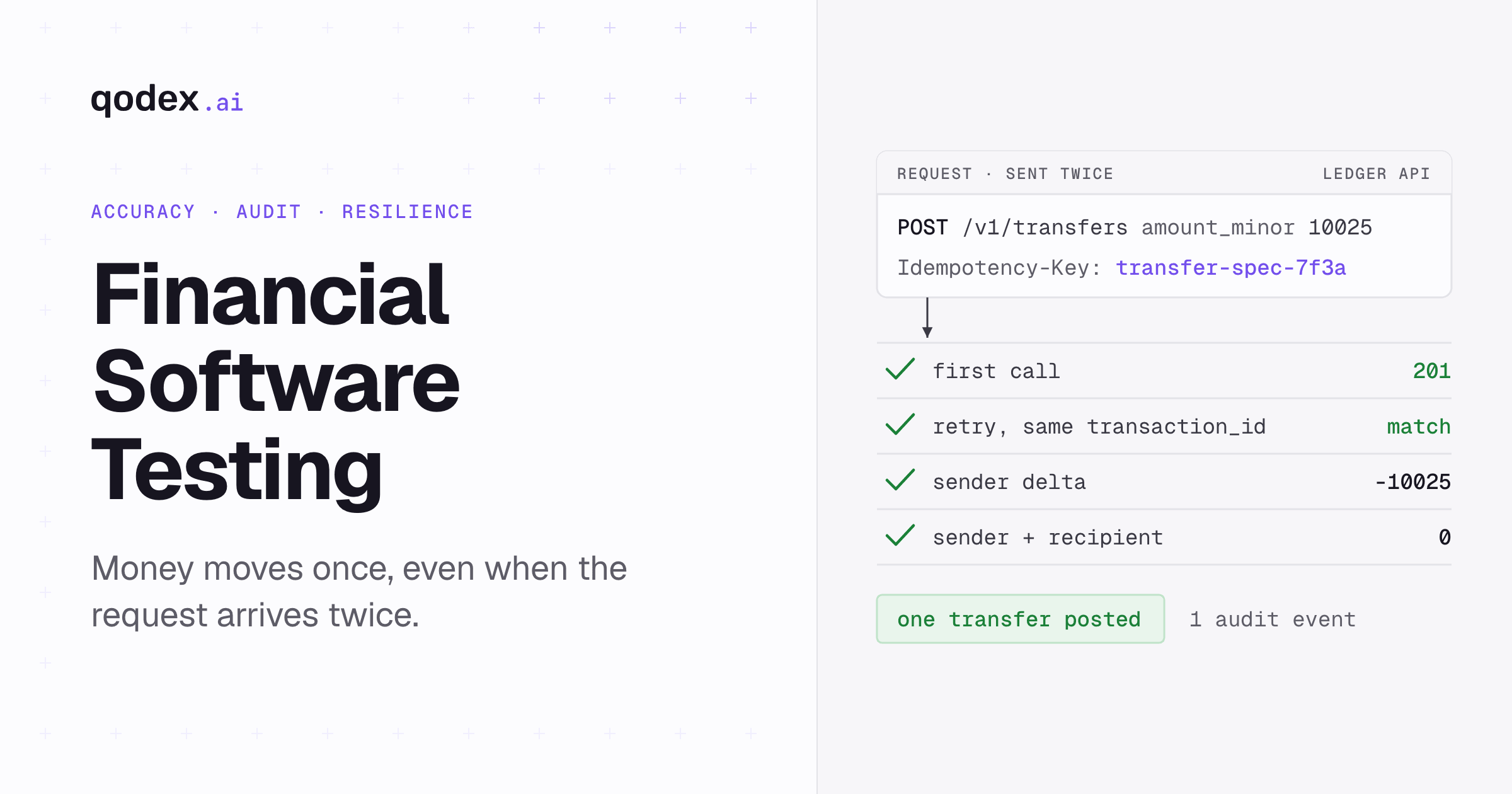
One test can cover three of those concerns: idempotency, ledger accuracy, and the audit and reconciliation evidence. The contract below is fictional, so adapt paths, fields, and headers to your own API.
// transfer-idempotency.spec.ts
// Fictional ledger API. Adapt paths, fields and headers to your own contract.
import { test, expect, request as apiRequest } from '@playwright/test';
import type { APIRequestContext } from '@playwright/test';
import { randomUUID } from 'node:crypto';

const BASE_URL = process.env.BASE_URL ?? 'http://localhost:4000';
const TOKEN = process.env.TEST_API_TOKEN ?? '';
const SENDER = 'acc_sender_001';
const RECIPIENT = 'acc_recipient_002';
const AMOUNT_MINOR = 10025; // 100.25 USD, held as integer minor units
// One key per run, so a rerun posts its own transfer instead of replaying the last one.
const IDEMPOTENCY_KEY = 'transfer-spec-' + randomUUID();

let api: APIRequestContext;

test.beforeAll(async () => {
  api = await apiRequest.newContext({
    baseURL: BASE_URL,
    extraHTTPHeaders: {
      Authorization: `Bearer ${TOKEN}`,
      'Content-Type': 'application/json',
    },
  });
});

test.afterAll(async () => {
  await api.dispose();
});

async function balanceMinor(accountId: string): Promise<number> {
  const response = await api.get(`/v1/accounts/${accountId}`);
  expect(response.status()).toBe(200);
  const body = await response.json();
  expect(body.currency).toBe('USD');
  return body.balance_minor;
}

test('a retried transfer posts once and stays reconciled', async () => {
  const senderBefore = await balanceMinor(SENDER);
  const recipientBefore = await balanceMinor(RECIPIENT);

  const payload = {
    from_account: SENDER,
    to_account: RECIPIENT,
    amount_minor: AMOUNT_MINOR,
    currency: 'USD',
  };
  const headers = { 'Idempotency-Key': IDEMPOTENCY_KEY };

  const first = await api.post('/v1/transfers', { data: payload, headers });
  expect(first.status()).toBe(201);
  const created = await first.json();

  // The identical retry must return the same transaction, not a second posting.
  const retry = await api.post('/v1/transfers', { data: payload, headers });
  expect([200, 201]).toContain(retry.status());
  const retried = await retry.json();
  expect(retried.transaction_id).toBe(created.transaction_id);

  const senderAfter = await balanceMinor(SENDER);
  const recipientAfter = await balanceMinor(RECIPIENT);
  const senderDelta = senderAfter - senderBefore;
  const recipientDelta = recipientAfter - recipientBefore;
  expect(senderDelta).toBe(-AMOUNT_MINOR);
  expect(recipientDelta).toBe(AMOUNT_MINOR);
  expect(senderDelta + recipientDelta).toBe(0);

  const audit = await api.get(
    `/v1/audit-events?transaction_id=${created.transaction_id}`,
  );
  expect(audit.status()).toBe(200);
  const events = (await audit.json()).events;
  const createdEvents = events.filter((e: any) => e.type === 'transfer.created');
  expect(createdEvents).toHaveLength(1);
  const event = createdEvents[0];
  // Set TEST_ACTOR_ID to pin this to your test user. Otherwise assert the event names an actor.
  const expectedActor = process.env.TEST_ACTOR_ID;
  if (expectedActor) {
    expect(event.actor_id).toBe(expectedActor);
  } else {
    expect(typeof event.actor_id).toBe('string');
    expect(event.actor_id.length).toBeGreaterThan(0);
  }
  expect(event.actor_role).toBe('payments.operator');
  expect(event.correlation_id).toBe(created.correlation_id);
  expect(event.amount_minor).toBe(AMOUNT_MINOR);
  expect(event.currency).toBe('USD');
  expect(Number.isNaN(Date.parse(event.occurred_at))).toBe(false);

  const recon = await api.get(
    `/v1/reconciliation/runs/latest?transaction_id=${created.transaction_id}`,
  );
  expect(recon.status()).toBe(200);
  const result = await recon.json();
  expect(result.balanced).toBe(true);
  expect(result.unmatched_external_items).toHaveLength(0);
});
Playwright's APIRequestContext sends HTTP requests directly, runs setup and teardown in beforeAll and afterAll hooks, checks server-side postconditions, and can reuse or isolate authentication state, which is why a ledger check needs no browser. Source: Playwright API testing documentation, read 15 September 2026.
Banking, payments, and wealth management examples
Banking application testing is the same discipline applied to core banking, cards, and payment rails, so the cases below are worth reading whichever product you own.
Core banking. Posting order decides whether a customer is overdrawn: the same transactions in a different sequence produce a different fee. Test the cutoff explicitly, including a transaction stamped a minute either side of it, a holiday that moves the value date, and a batch that starts before midnight and finishes after. Statement totals, accrued interest, and the balance the app shows should all derive from the ledger, and a test should prove they agree. Testing in the banking domain also means legacy interfaces: fixed-width files, overnight batches, and a mainframe that answers in its own time.
Payments. Idempotency is the first control, as in the test above. Then settlement and its edges: a file that arrives late, a partial settlement, a reversal, a chargeback weeks after the authorization, and a refund larger than the capture. Assert each one leaves the ledger, the processor report, and the customer's view in agreement. For the implementation-level checkout workflow, use our payment gateway API testing guide to cover sandbox cards, idempotency, signed webhooks, refunds, 3DS, and reconciliation.
Web banking. Web banking application testing adds the customer-facing surface to everything above. Test the product's specified session-expiry and re-authentication rules around payments. Where beneficiary approval exists, verify an unapproved beneficiary cannot be used. Check that limits and step-up checks are enforced on the server rather than in the page, and that the statement view agrees with the ledger behind it.
Choosing banking application testing services. If the work goes to a supplier, judge the offer the way you would judge your own suite. Ask which applicable controls their tests cover, what evidence each run retains, and who owns the map from control to test, build, result, and approval. A supplier that cannot produce that map is selling test execution, not audit readiness.
Wealth management. The money moves more slowly and the errors compound. Test fees across tiers, breakpoints, and mid-period changes. Test valuation on a day with a stale price, a suspended instrument, and a currency other than the portfolio's base. Test partial fills, cancellations, and orders that straddle a market close. Test corporate actions, because a split or a dividend applied twice silently corrupts every position report that follows. Test suitability rules as code, with a client profile exactly on a boundary. Then reconcile positions and cash against the custodian.
Regulations and standards to map into tests
Two different things get mixed together here, and mixing them produces claims that do not survive an audit. Laws and regulations bind the entities they name. Standards are catalogues you adopt, sometimes because a contract makes you. No test proves compliance with either. Tests produce evidence for an assessment somebody else signs.
Laws and regulations. The Sarbanes-Oxley Act, Public Law 107-204, section 404, requires management to assess the effectiveness of internal control over financial reporting in the annual report. It prescribes no test suite. For in-scope systems it implies a map from financial-reporting controls to approvals, access, transaction completeness, and retained evidence. The Act's control language is about records that permit financial statements to be prepared, and about receipts and expenditures made only with the authorization of management and directors. That is a testable statement about postings and approval paths. Read 15 September 2026 on govinfo.gov. In the UK, the FCA's operational resilience rules required in-scope firms to have performed mapping and testing by 31 March 2025, and to stay "within their impact tolerances" for each important business service. That turns resilience testing into scenario work with a defined pass mark. Read 15 September 2026 on fca.org.uk. In the EU, the Digital Operational Resilience Act, Regulation (EU) 2022/2554, and the General Data Protection Regulation, Regulation (EU) 2016/679, apply to the financial entities and the personal-data processing they name. Their canonical texts are on EUR-Lex, and neither downloaded during this check, so treat them here as names to scope with your legal team rather than as article-level obligations.
Standards and guidance. PCI DSS is a payment-card industry standard, not a law, and the official document library lists v4.0.1 as current, read 15 September 2026. Where you hold a cardholder-data environment, trace requirements to security, change, vulnerability, segmentation, and penetration-test evidence, and do not claim it governs products that never touch cards. NIST SP 800-53 Rev. 5 is a control catalogue, not a financial regulation, with minor release 5.2.0 dated 27 August 2025, read 15 September 2026. Its audit and accountability family is a ready-made source of event, timestamp, review, retention, and protection checks. OWASP ASVS 5.0.0 gives you versioned security requirements to test against.
Scope first, then test. Which of these applies depends on your entity, jurisdiction, product, data, and contracts, and that decision belongs to legal and compliance, not to QA.
How to build an audit-ready test process
Audit readiness is a property of your records, not a phase before the auditor arrives. Four habits produce it.
Trace requirement to control to test to result. Every applicable control needs an owner, at least one test, a cadence, and a release gate. The gap you are looking for is a control with no test, and the only way to see it is a list that is maintained, not rebuilt each year.
Manage test data like production data. Use masked, synthetic, or contract-approved data, with the origin of each set recorded, a retention period, and a deletion step that someone runs. Do not copy unmasked production data into a shared test environment. Use masked, synthetic, or contract-approved data.
Pin the evidence to a build. A result that cannot name the commit, the environment, the data set, and the test revision proves nothing later. Store run output somewhere time-synchronized, searchable, access-controlled, and tamper-resistant, and keep it as long as policy says, not as long as your CI provider does.
Separate the people. Whoever writes a change should not be the only person approving its release. Link defect, fix, retest, and sign-off so the chain reads in one direction, and require finance, security, and compliance sign-off where the risk earns it.
Done well, an audit request becomes a query, not a project.
Financial software testing checklist
Work through this once per product, then keep it as the release gate.
Scope it. Write down the product, jurisdiction, legal entity, data types, payment rails, and contractual obligations that apply. Everything below depends on it, and it changes when you enter a market.
Map controls to owners. Each applicable control gets an owner, a test, an evidence artifact, a cadence, and a release gate. Review the map when the product or the rules change.
Fix the money model. Store amounts in integer minor units or an approved decimal type, and define rounding per currency and rule. Assert it, because a library upgrade can change it quietly.
Test the hard arithmetic. Boundaries, dates, time zones, holidays, cutoffs, fees, tax, interest, foreign exchange, and reversals, including the day a rate changes.
Prove idempotency. Retry, timeout, duplicate message, and partial failure must each leave one posting and one audit event.
Reconcile across every book. Transaction log, subledger, general ledger, processor, bank, custodian, and customer reports. Seed a break and prove the run finds it.
Test access as spending power. Roles, tenant isolation, privileged actions, session expiry, rate limits, and hostile inputs, including the user approving their own payment.
Control test data. Masked, synthetic, or approved only, with retention and deletion enforced.
Load-test the calendar. Payroll, market open, month end, settlement windows, and statement runs, with every critical downstream dependency loaded too.
Rehearse failure. Failover, restore, degraded mode, and severe but plausible disruption, measured against impact tolerances and followed by a reconciliation.
Link the chain. Requirement, test, data set, environment, build, result, defect, fix, retest, approval. No gaps.
Protect the evidence. Tamper-resistant, time-synchronized, searchable, access-controlled, retained.
Regress on every material change. Risk-weighted selection on the pull request, a broader scheduled suite behind it, and a comparison that shows when the selection missed something.
Require the right signatures. Finance operations, security, compliance, and product sign off where the risk demands it, and the sign-off is stored with the release.
For the wider operating model behind these checks, covering ERP and CRM changes, release trains, environments, and ownership, see our enterprise software testing guide.
Frequently Asked Questions
What does financial software testing cover?
It covers systems that move, hold, or report money: banking, payments, lending, insurance, trading, and wealth platforms. It covers calculation accuracy, reconciliation, security, resilience, and the evidence each run leaves behind.
How is software testing for banking different from ordinary application testing?
Three things. A wrong number is a loss, not a cosmetic bug. Your books must agree with processors, banks, and custodians reporting on their own schedule. And the record of who tested what has to survive for the applicable retention period.
Which types of testing are used in financial services?
Calculation and functional, integration, reconciliation, security, performance, resilience, regression, and compliance evidence testing, plus user acceptance with finance operations. The types are ordinary; the scenarios are not.
How do you test financial calculations and rounding?
Fix the money model first: integer minor units or an approved decimal type, with rounding defined per currency and rule. Then test boundaries, rate-change dates, cutoffs, and reversals, asserting the exact amount rather than a tolerance.
What is reconciliation testing?
Comparing the same movement across every book that holds a copy of it, checking completeness, uniqueness, balance, ordering, and lineage. Good tests seed a break, then assert the run detects and clears it.
How do you test wealth management software?
As test design, not a legal exercise: fee tiers and breakpoints, valuation with stale prices, partial fills, corporate actions applied exactly once, suitability rules on their boundaries, and reconciliation against the custodian.
Which regulations apply to financial software testing?
It depends on your entity, jurisdiction, product, and data, and that call belongs to legal and compliance, not to QA. Examples, each only where it names you: SOX section 404 for internal control over financial reporting, the FCA's operational resilience rules for in-scope UK firms, DORA and GDPR for the EU financial entities and personal-data processing they cover, PCI DSS v4.0.1 where you hold a cardholder-data environment, and OWASP ASVS 5.0.0 as a standard you adopt.
What should a financial-software audit trail contain?
Actor, action, role, time, correlation ID, build, before and after values, and the result. Assert those fields inside the test that causes the event, so a missing record fails the build, not the audit.
Can financial software testing be fully automated?
No. Calculation, integration, reconciliation, regression, and most security checks automate well. Exploratory work, exception handling, user acceptance, and a human-signed penetration test still need people, and no run produces a compliance conclusion.
What belongs in a financial software testing checklist?
Applicable controls with owners, a fixed money and rounding model, date arithmetic, idempotency, reconciliation across books, access and tenant tests, controlled test data, calendar-based load tests, failure rehearsals, a linked evidence chain, and risk-weighted regression.