Enterprise Software Testing: A Practical Guide
Enterprise software testing checks whether large, business-critical systems work across applications, integrations, data, roles, environments, and release trains. It differs from ordinary product testing because a failure can cross departments, vendors, legal entities, and regulated controls. The job is not only finding defects. It is producing repeatable evidence that critical workflows are safe to release, and that they recover when a dependency fails.
Qodex runs API, UI, and security tests on every pull request and deploy, and keeps the failing request, response, and screenshot as evidence for each finding. See Qodex API testing.
What is enterprise software testing?
Enterprise software testing verifies systems that several departments depend on at once. Those are the ERP that posts journal entries, the CRM that holds the pipeline, the HR system that pays people, and the integrations that move records between them. The unit under test is rarely one application. It is a business process that passes through several systems, each owned by a different team, some bought rather than built.
That changes what a test is for. In a single product, a test answers whether this feature behaves as specified. In an enterprise, the question is whether this change can go out on the planned date without stopping invoicing, and whether you can show why you believed that. The second answer is the one missing when an audit or an incident review asks how a release was approved.
One boundary, stated once. Testing produces evidence about controls. It does not certify compliance with any law or standard. A passing test can show that an approval limit is enforced and that the enforcement was recorded; whether that satisfies an obligation is a decision for your legal, privacy, security, and compliance owners. For money systems, the regulation-by-regulation view is in our financial software testing guide, and API controls have their own evidence path in the API compliance testing guide.
What changes at enterprise scale
Scale here is not user count. A consumer app with a very large audience can be simpler to test than a mid-sized manufacturer running a handful of connected systems on different release calendars. These are the differences that change the work.
| What changes | Ordinary product testing | Enterprise testing |
|---|---|---|
| Unit under test | One application | A process across several systems |
| Code you control | Most of it | Configuration on top of vendor code |
| Release timing | Your pipeline | Your trains plus vendor releases |
| Data | Fixtures you invent | Real structures, restricted contents |
| Access rules | A few roles | A role matrix with segregation of duties |
| Failure cost | Feature broken | Invoicing, payroll, or shipping stopped |
| What is kept | A green build | Evidence tied to a requirement |
Configuration is the code. In a packaged ERP or CRM, a great deal of what breaks is not in a repository at all. It is a pricing rule, an approval hierarchy, a custom field, or a workflow someone changed in an admin screen. Test scope has to include configuration changes, and environments have to carry the same configuration, or a pass in staging means nothing.
The vendor ships too. Packaged systems have a change stream you do not control. Salesforce currently presents Spring '26, Summer '26, and Winter '27 material on one release page (Salesforce releases, read 19 September 2026). A regression plan for that system therefore has to cover vendor releases alongside your own changes. Treat each vendor release as a change with its own impact assessment and sign-off.
Integrations fail differently. Between systems you get queues, retries, batch windows, and file drops. The interesting failures are not the ones where a call returns a 500. They are a duplicate message that creates two invoices, or a retry that fires after the downstream system already succeeded. They are also a field truncated at the boundary, and a batch that runs while a nightly job holds a lock. A happy-path end-to-end test sees none of them. The patterns are in our system integration testing guide.
Data is restricted and large. You need production-shaped data to find the bugs that matter, and in a regulated or privacy-bound system copying production is off the table. The answer is a seeded synthetic set for repeatable tests plus a masked subset for volume and migration work, with masking rules owned by the data team rather than QA.
Access is part of the behavior. A quote a sales rep can create, a manager can approve, and an auditor can read but not change needs a test per role, and a test for each role that must be refused. Segregation of duties makes negative authorization cases first-class tests.
Environments are shared and drift. One integration environment serves several programs. Someone changes a flag for their own test, a certificate expires, a vendor sandbox refreshes on its own schedule, and last week's pass means nothing. Check environment state before a suite runs, rather than diagnosing it after.
Several release trains, one business. The CRM team ships fortnightly, the ERP team quarterly, the integration layer weekly. A change that is safe inside one train can break a process crossing all three. That is the coordination problem this page is built around.
Recovery is in scope. Say the payment gateway is down for a stretch of the working day. What happens to the orders taken in that window? Answer that with a test, not a paragraph in a runbook.
Enterprise test types, with examples
Every list of test types reads the same until you attach it to a real process. Here each type gets one example from quote-to-cash, procure-to-pay, hire-to-retire, or customer onboarding. Pick the types your risk demands rather than running all twelve everywhere.
Functional. One rule, checked against the requirement. For example, if your policy says a discount above a set percentage needs a regional manager's approval, the test is that the quote stays in draft until that approval arrives. The threshold is whatever your policy says.
API and contract. The message between two systems, checked from both sides. The order the CRM sends carries a currency code, a tax ID, and a line-level unit price, and the ERP consumer still accepts that payload after either team deploys.
Integration. The path, not the endpoints. A purchase order sent twice with the same correlation ID creates one invoice, and a retry after a downstream timeout does not create a second payment.
End-to-end. The whole business process, through the interfaces people use. A new hire is created in the HR system, appears in the identity provider, gets the right role in the ERP, and lands on the payroll run for the correct period. Keep these few, because they are slow and they break for environment reasons. Scoping rules: our end-to-end testing guide.
Regression. The same tests run again because something changed, including a vendor release. Selection is by impact, not by running everything. See building an effective regression test suite.
Data and migration. Counts, totals, and keys before and after a load. After a customer master migration the row count matches, open balances match to the cent, no duplicate tax IDs exist, and every child record still points at a parent.
Performance. The workload the business creates, at the moment it creates it. For example, month-end invoicing posts its document volume while the usual crowd of users is in the system, and the job has to finish inside its window. Take both numbers from your own calendar, not from a round figure.
Security. Access rules and input handling, tested as behavior. A buyer cannot approve their own purchase order, a support agent cannot read bank details through the API even when the UI hides the field, and an expired token is rejected everywhere.
Resilience and recovery. What happens when a dependency is gone. The tax service times out during checkout, the order is held rather than lost, and held orders complete without manual re-entry when the service returns.
Compatibility and localization. The combinations your users are on and the formats their country uses. A German invoice prints the right decimal separator, the right VAT layout, and a date nobody reads as the wrong month.
Accessibility. The screens staff use all day, checked against a named standard with a tool pass and a keyboard-only walk of the main task.
User acceptance. The business owner runs their own process in a controlled environment and signs that it matches how the work is done. This catches a requirement everyone wrote down wrongly.
Two get skipped and then show up in production: negative authorization cases, and duplicate or out-of-order messages. Both are cheap to write and neither appears in a happy-path script.
An operating model for enterprise testing
A strategy document nobody reads is not an operating model. What works is a short register of critical processes, an owner for each, a fixed set of layers per process, and a release gate that reads from evidence rather than from opinion. Build it in this order.
Register the critical processes. Name them in business language: quote-to-cash, procure-to-pay, hire-to-retire, customer onboarding. Keep it to the processes whose failure a director would hear about the same day. A register long enough to need scrolling has stopped being a register and become a feature list.
Score each one by failure impact. Money that stops, people who cannot be paid, goods that cannot ship, a control that would be breached. Impact sets test depth; nothing else does. Our test strategy guide covers how this feeds the wider plan.
Give every process one accountable owner. One person signs that it is safe to release. Shared accountability means none.
Fix the layers per process. High impact gets API, contract, end-to-end, and a recovery case. Lower impact may get API and one end-to-end path. Writing the required layers down is what makes a gap measurable.
Control data and environments as products. A named seed set per process, masking rules owned by the data team, and a pre-run check that fails fast when configuration or a certificate has drifted.
Link requirements to evidence. Each requirement points to its tests, each run to its result, each release to the runs it was approved on. That chain is what an audit asks for, and keeping it as you go is far cheaper than rebuilding it later.
Schedule suites against the trains. Fast API and contract checks on every pull request, impacted process suites on merge, the full stable suite nightly, and a cross-train run before any release touching more than one system.
Set entry and exit criteria once. Entry: environment check green, data seeded, change impact assessed. Exit: no open high-risk defect, a passing run per critical process on the release candidate, evidence stored.
Triage every failure as product, test, or environment. Counting environment failures separately stops a correct suite being written off as flaky.
Make exceptions explicit and expiring. Releasing with a known gap is a legitimate business decision. It needs the named approver, the reason, the compensating control, and a date the exception dies.
Review production escapes monthly. For each escape, ask which layer should have caught it. That answer is the only reliable input to what you build next.
The register itself is a table. Keep the cells short enough that people maintain it.
| Process | Systems | Layers | Environment | Owner | Evidence kept | Release gate |
|---|---|---|---|---|---|---|
| Quote-to-cash | CRM, ERP, tax | API, contract, E2E, recovery | Integrated, vendor sandbox | Revenue ops | Runs, payloads, approvals | All layers pass |
| Procure-to-pay | ERP, supplier portal | API, contract, E2E | Integrated | Finance systems | Runs, totals, sign-off | E2E plus contract pass |
| Hire-to-retire | HR, IdP, ERP, payroll | API, E2E, access | Integrated, masked data | HR systems | Runs, role matrix result | E2E plus access pass |
| Customer onboarding | CRM, billing, support | API, contract, E2E | Integrated | Customer ops | Runs, screenshots | E2E pass |
Ownership needs the same brevity. R does the work, A is the single accountable person, C is consulted, I is informed.
| Activity | Product owner | QA lead | Dev team | Platform | Compliance |
|---|---|---|---|---|---|
| Risk score per process | A | R | C | I | C |
| Test design and layers | C | A | R | I | I |
| Environment and data readiness | I | C | C | A | I |
| Release gate decision | A | R | C | C | I |
| Exception approval | A | C | I | I | R |
| Escape review | C | A | R | C | I |
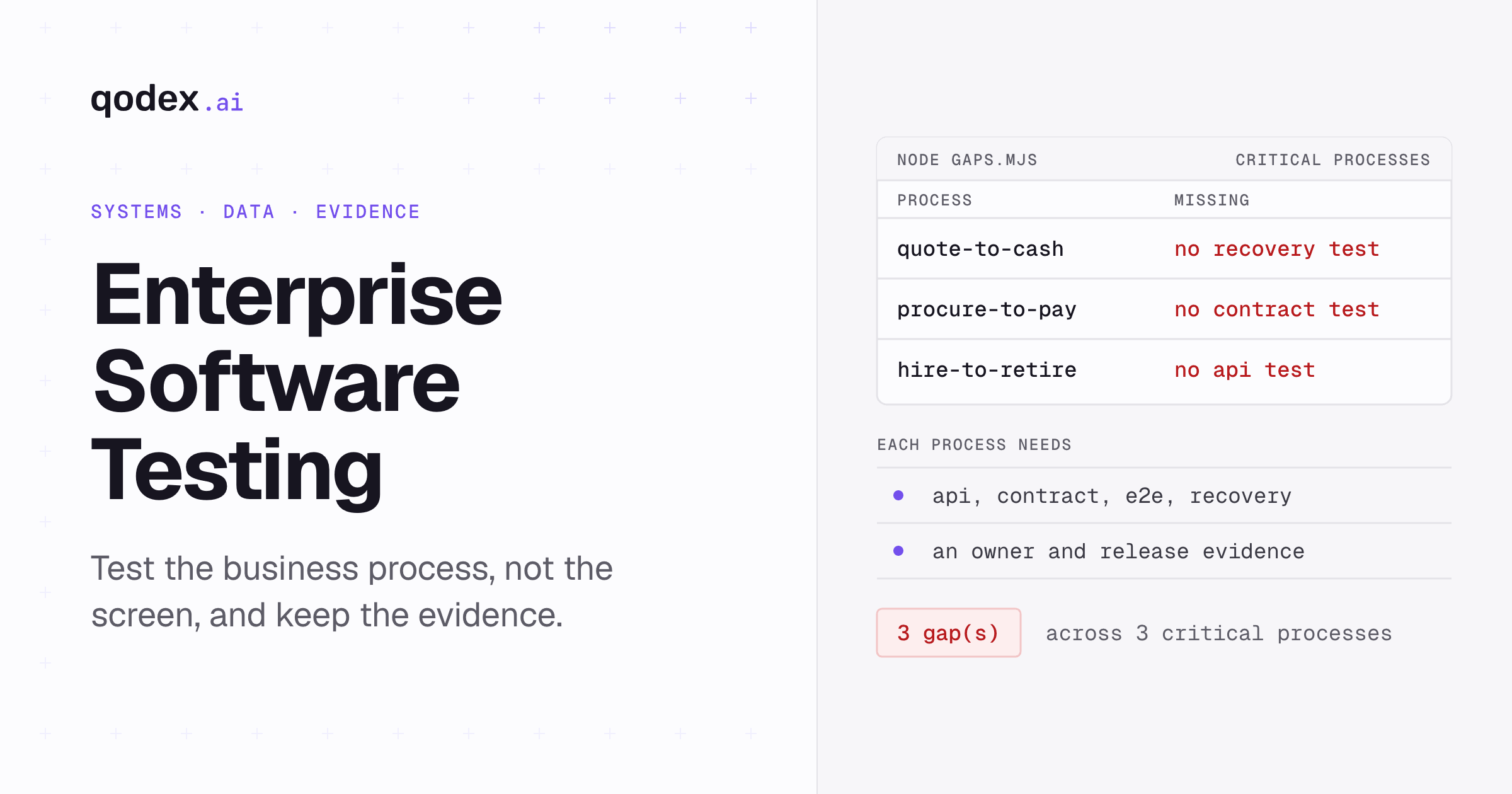
The measurable part of the model is the gap between the layers a process needs and the tests that exist. That check is a script, not a meeting. This one reads a register and the tags on your test files, and exits non-zero when a required layer is missing, so it can run in CI.
// Which critical processes are missing a required test layer?
// Register: one entry per business process, with the layers its risk demands.
const register = [
  { process: 'quote-to-cash', layers: ['api', 'contract', 'e2e', 'recovery'] },
  { process: 'procure-to-pay', layers: ['api', 'contract', 'e2e'] },
  { process: 'hire-to-retire', layers: ['api', 'e2e'] },
];

// Tags found in the suite, one per test file, read from your test runner.
const suite = [
  { file: 'tests/q2c/quote-create.api.spec.ts', tags: ['quote-to-cash', 'api'] },
  { file: 'tests/q2c/order-contract.spec.ts', tags: ['quote-to-cash', 'contract'] },
  { file: 'tests/q2c/quote-to-order.e2e.spec.ts', tags: ['quote-to-cash', 'e2e'] },
  { file: 'tests/p2p/invoice-post.api.spec.ts', tags: ['procure-to-pay', 'api'] },
  { file: 'tests/p2p/po-to-invoice.e2e.spec.ts', tags: ['procure-to-pay', 'e2e'] },
  { file: 'tests/h2r/joiner.e2e.spec.ts', tags: ['hire-to-retire', 'e2e'] },
];

const gaps = [];
for (const entry of register) {
  const covered = new Set(
    suite.filter((t) => t.tags.includes(entry.process)).flatMap((t) => t.tags)
  );
  for (const layer of entry.layers) {
    if (!covered.has(layer)) gaps.push(`${entry.process}: no ${layer} test`);
  }
}

for (const gap of gaps) console.log(gap);
console.log(`${gaps.length} gap(s) across ${register.length} critical processes`);
process.exit(gaps.length === 0 ? 0 : 1);
Saved as gaps.mjs and run with node gaps.mjs, on Node 26.9.0 in our run, it prints:
quote-to-cash: no recovery test
procure-to-pay: no contract test
hire-to-retire: no api test
3 gap(s) across 3 critical processes
Each line is a decision: write the test, or record an exception with an expiry. Wire the script to your real register and the tags your runner reports, and coverage stops being a debate about percentages.
Enterprise testing tool categories
Buy by category, not by brand. These are the slots an enterprise stack has to fill, and a single product can fill more than one of them well.
Test management and traceability. Requirements, cases, runs, approvals, and the links between them. This slot produces the audit chain.
Unit and component. Whatever your languages use, run by the same pipeline as everything else.
API and contract. Multi-step flows, auth profiles, and consumer-driven contracts between teams.
UI and mobile. Browser automation for journeys that only exist in a screen. Playwright v1.63.0, released 4 September 2026, added named locks so tests that mutate a shared account or a global setting can serialize against each other (Playwright v1.63.0 release notes, read 19 September 2026). Selenium's current release is 4.49.0, dated 9 September 2026 (Selenium 4.49.0, read 19 September 2026).
Performance. Apache JMeter 5.6.3 is the current download and needs Java 8 or later (Apache JMeter downloads, read 19 September 2026). For products by protocol, workload model, and deployment need, use the performance testing tools comparison.
Security. Access and authorization checks in the pipeline, plus scheduled scanning owned by the security team.
Test data management. Generation, masking, and seeding, with the rules owned outside QA.
Service virtualization. Stand-ins for vendor sandboxes that are slow, rate limited, or unavailable.
Environment orchestration. Provisioning, configuration comparison, and the pre-run drift check.
CI/CD and observability. What runs suites on the right trigger, and the traces you read when a run fails.
Evidence storage. Runs, payloads, screenshots, and approvals, retained as long as policy says.
Three buying questions. How is pricing metered, since seats, parallel sessions, and usage credits produce very different bills at enterprise volume? Where is test data stored and how is it redacted, which decides whether a tool is usable on regulated processes at all? What leaves with you if you cancel, because tests that exist only inside a vendor UI are not portable? If AI-assisted authoring is a buying requirement, compare the current AI QA tools separately from the operating model. Teams comparing browser and device clouds can use the Sauce Labs alternatives matrix after defining coverage needs, and before standardizing on captured UI flows, review why record and playback fails at scale. A shortlist by budget is in our free software testing tools roundup.
An enterprise software testing checklist
Work this per release, per critical process. Anything you cannot answer is a gap, and a gap you accept is an exception with an owner and a date.
Scope. Which critical processes does this change touch, directly or through an integration? Which vendor releases land in the same window? Is any configuration change in the same change record as the code?
Dependencies. Every system the process crosses is named with its owner and version. Every third-party service has a known timeout, retry, and rate limit. Any certificate expiring in the release window is listed.
Roles and access. The role matrix is current. Each role has a positive and a negative case. Segregation-of-duties rules have a test that fails when the rule is removed.
Data. A named seed set exists per process and can be recreated from scratch. Masking rules are signed off by the data owner. No test writes to a real customer, supplier, or employee record. Seeded records are cleaned up, or marked and kept out of reports.
Environment. Configuration is compared against production before the suite runs, with differences listed and accepted. Vendor sandbox refresh dates are known. The pre-run check fails the run rather than producing a misleading red.
Automation. Fast checks on every pull request, impacted process suites on merge, the full stable suite nightly. Quarantined tests carry an owner and an expiry, so quarantine is not where tests go to die.
Nonfunctional risk. Peak workloads are modelled on the real calendar, including month end and payroll. Recovery is tested for at least the top dependency. Localization and accessibility cover the screens and countries in scope.
Evidence. Each requirement links to its tests and each run to its result. Failing runs keep the request, the response, and a screenshot, not just a status. Retention matches policy. Four anchors tell you what that evidence has to be able to show. GDPR Article 32 asks for "a process for regularly testing, assessing and evaluating the effectiveness of technical and organisational measures" (EUR-Lex, read 19 September 2026). In FDA scope, 21 CFR 11.10(a) requires "Validation of systems to ensure accuracy, reliability, consistent intended performance, and the ability to discern invalid or altered records" (eCFR, read 19 September 2026). NIST SP 800-53 Rev. 5, Release 5.2.0 dated 27 August 2025, says its controls "are flexible and customizable and implemented as part of an organization-wide process to manage risk" (NIST, read 19 September 2026). That argues for risk-based depth over one universal checklist. For card payments, PCI DSS v4.0.1 became the only active version of PCI DSS 4 after v4.0 retired on 31 December 2024. That revision carries "no additional or deleted requirements" (PCI SSC, read 19 September 2026). A passing test satisfies none of them on its own.
Release. Entry and exit criteria are met and recorded. Open high-risk defects are zero or explicitly accepted. The accountable owner for each critical process has signed. Exceptions carry an approver, a compensating control, and an expiry.
Recovery. The rollback path has been executed, not just written. Data created during the release window has a defined fate if you roll back. Monitoring for the changed process is live before the change goes out.
After release. Every escape is reviewed against the layer that should have caught it. The register is updated when a process changes shape. Expired exceptions are closed or renewed on purpose.
Metrics that support a release decision
Test-case counts and automation percentages do not tell you whether to release. These nine do, each defined in a sentence so nobody argues about what it measures.
Critical-workflow coverage. The share of registered processes with a passing run at every layer their risk requires.
Untested changed requirements. Requirements changed in this release with no linked test run.
Defect escape rate. Defects found in production divided by defects found in total for the same period.
Flaky rate. The share of runs that changed result without a code or configuration change, counted per test.
Mean time to diagnose. Median time from a red run to a correct classification as product, test, or environment.
Suite duration. Wall-clock time for the suite that gates the merge, because a gate people skip is not a gate.
Environment-caused failures. Runs failed for drift, data, or an unavailable dependency, counted separately from product defects.
Open high-risk defects. Defects on registered processes, at the top impact band, still open at the gate.
Evidence completeness. The share of release-gating runs with the requirement link, result, artifacts, and approval all present.
Two are early warnings rather than gate inputs. A rising flaky rate and a rising environment-failure count both mean people are about to start ignoring red builds, which costs more than either number suggests.
What to do next
Enterprise testing is not a bigger test suite. It is a register of the processes that matter, fixed layers per process, one accountable owner each, controlled data and environments, and an evidence chain that survives being asked, months later, why you released this. Start with the register and the gap check on this page: both are short pieces of work and both tell you where you are. Then add the deepest layer you are missing, one process at a time.
Frequently Asked Questions
What does enterprise software testing mean?
It is the practice of verifying business-critical systems and the processes that run across them: functionality, integrations, data, roles, performance, resilience, security, and the evidence a release decision needs. The unit under test is a business process across several applications, not a single product.
How is enterprise testing different from regular software testing?
Three things change. A great deal of what breaks is configuration on top of vendor code rather than code you own. Releases have to be coordinated across several trains plus the vendor's release stream. And the output is not a green build; it is evidence tied to a requirement, kept as long as policy says.
How do you test ERP and CRM changes?
Treat configuration as a change with the same impact assessment as code, keep environments configuration-identical or accept the differences in writing, and select regression for every vendor release as well as your own. Salesforce presents Spring '26, Summer '26, and Winter '27 material on one release page (Salesforce releases, read 19 September 2026), so vendor changes belong in your test calendar.
Which enterprise test types are essential?
Start with the ones whose absence shows up in production: API and contract checks between systems, integration tests for duplicates, retries and out-of-order messages, one end-to-end path per registered process, and negative authorization cases. Add data reconciliation wherever records move, and a recovery case for the dependency you would miss most. Everything else is chosen by the impact score, not by the list.
How should teams test integrations and asynchronous workflows?
Test the path, not just the endpoints. Cover the duplicate message, the retry after a downstream success, the out-of-order arrival, the timeout, and the partial failure that leaves one system updated and the other not. Assert on the settled state after the queue drains, not on the immediate response.
How do you manage enterprise test data without copying production?
Use a seeded synthetic set per process for repeatable functional tests, and a masked subset for volume and migration work, with the masking rules owned by the data team. Seeded records carry a marker so they can be found, excluded from reports, and cleaned up.
What test evidence is needed for compliance and audits?
The chain from requirement to test to run to approval to release, with artifacts on failures. GDPR Article 32 asks for "a process for regularly testing, assessing and evaluating the effectiveness of technical and organisational measures" (EUR-Lex, read 19 September 2026). Tests evidence controls; they do not certify compliance. Your legal and compliance owners decide what the obligation requires.
How do multiple teams coordinate testing across release trains?
Give each critical process one accountable owner however many teams touch it, run a cross-train suite before any release that crosses systems, and make the gate read from evidence rather than from a status meeting. Exceptions are approved in the open, with a compensating control and an expiry.
Which enterprise software testing tools are needed?
Fill the categories, not a brand list: test management and traceability, unit, API and contract, UI and mobile, performance, security, test data management, service virtualization, environment orchestration, CI/CD and observability, and evidence storage. One product can cover several slots.
What should and should not be automated?
Automate what runs often and has a stable, checkable answer: API and contract checks, regression on registered processes, data reconciliation, and access rules. Keep exploratory testing, first-time user acceptance, and one-off migration rehearsals with people. Automating an unstable requirement only creates maintenance.
How do you measure enterprise testing effectiveness?
Critical-workflow coverage, untested changed requirements, defect escape rate, flaky rate, mean time to diagnose, suite duration, environment-caused failures, open high-risk defects, and evidence completeness. Avoid raw case counts and automation percentages, which move without any change in risk.